

Every law firm website faces the challenge of turning curious visitors into real clients. For small and mid-sized practices across Southern California, mastering the art of the call to action stands out as the secret to meaningful online engagement. Well-crafted CTAs are more than eye-catching buttons—they are digital invitations that move clients from hesitation to action, helping your firm communicate trust and drive measurable results.
Table of Contents
- Defining Calls to Action for Law Firm Sites
- Types of Calls to Action Attorneys Use
- Design and Placement Strategies That Convert
- Common Mistakes and Legal Compliance Issues
- Optimizing CTAs for Client Engagement
Key Takeaways
| Point | Details |
|---|---|
| Effective CTAs are essential for engagement | Clear, action-oriented CTAs can transform passive website visitors into active prospects by encouraging specific actions. |
| Understand client psychology | Successful CTAs address potential clients’ emotional needs, fostering a strong connection and motivating them to engage. |
| Strategic placement and design matter | Optimizing CTA design and positioning can significantly enhance client interaction and website conversion rates. |
| Compliance is critical | Law firms must navigate ethical and regulatory standards in their CTAs to avoid misleading clients and ensure professional integrity. |
Defining Calls to Action for Law Firm Sites
In the competitive landscape of legal services, understanding calls to action (CTAs) becomes critical for connecting with potential clients. A call to action represents a strategic prompt designed to encourage website visitors to take a specific, desired step – whether that means requesting a consultation, scheduling an initial meeting, or reaching out about legal representation.
Calls to action for law firms serve multiple strategic purposes, fundamentally designed to transform passive website visitors into active prospects. Legal service engagement strategies vary widely, but effective CTAs share several core characteristics:
- Communicate clear value proposition
- Create a sense of urgency
- Minimize perceived effort for the potential client
- Use direct, action-oriented language
- Align with specific legal service offerings
Understanding CTAs requires recognizing their psychological foundation. A compelling CTA taps into potential clients’ immediate needs, concerns, and desire for professional resolution. These strategic prompts function as digital invitations, bridging the gap between anonymous website browsing and meaningful legal engagement.
Law firm CTAs typically manifest in several standard formats:
- Contact request forms
- Free consultation buttons
- Live chat initiators
- Direct phone number displays
- Email newsletter sign-ups
By strategically positioning these elements, law firms can transform their websites from passive information repositories into dynamic client acquisition platforms.
Here’s how common CTA formats compare in terms of client engagement and business impact:
| CTA Format | Engagement Benefit | Typical Business Impact |
|---|---|---|
| Contact Form | Encourages direct inquiry | Generates new leads |
| Free Consultation Button | Reduces entry barriers | Increases initial contact |
| Live Chat Initiator | Offers immediate interaction | Builds trust quickly |
| Click-to-Call Button | Streamlines urgent outreach | Boosts conversion rates |
| Email Newsletter Sign-Up | Fosters ongoing relationship | Expands firm awareness |
Pro tip: Customize your CTAs to reflect the specific emotional state of potential clients seeking legal assistance, addressing their underlying concerns with empathy and professionalism.
Types of Calls to Action Attorneys Use
Attorneys deploy strategic calls to action (CTAs) across multiple digital platforms, each carefully designed to engage potential clients and guide them through the initial stages of legal representation. Case-specific legal engagement strategies vary widely, but fundamentally aim to simplify the client’s path to professional legal assistance.
The most common types of calls to action used by law firms include:
- Contact forms for initial consultations
- Free case evaluation buttons
- Live chat support options
- Downloadable legal resource requests
- Click-to-call telephone buttons
- Newsletter sign-up prompts
- Scheduling appointment links
Each CTA type serves a unique purpose in the client acquisition process. Consultation request CTAs typically focus on removing barriers to initial communication, offering low-risk engagement methods that help potential clients feel comfortable reaching out. These digital invitations are psychologically crafted to address common client hesitations and demonstrate the firm’s accessibility.
Moreover, attorneys recognize that different legal practice areas require nuanced approaches to client engagement. Legal service action prompts must align with the specific emotional and practical needs of potential clients. For instance, a personal injury law firm might emphasize immediate support and quick case evaluation, while a family law practice might prioritize empathetic, confidential consultation options.
By strategically implementing diverse calls to action, law firms can transform their digital presence from passive information repositories to dynamic client engagement platforms that guide potential clients seamlessly from initial curiosity to meaningful legal representation.
Pro tip: Design CTAs that reflect the specific emotional landscape of potential clients, addressing their underlying concerns with genuine empathy and professional clarity.
Design and Placement Strategies That Convert
Designing effective calls to action (CTAs) for law firm websites requires a strategic approach that goes beyond simple visual appeal. Conversion-optimized CTA placement demands understanding user psychology, website navigation patterns, and the specific emotional triggers that motivate potential legal clients to take action.
Key design elements that dramatically improve CTA performance include:
- High-contrast color schemes
- Clear, action-oriented language
- Prominent positioning above the fold
- Mobile-responsive design
- Minimalistic, uncluttered surrounding content
- Large, easily clickable buttons
- Compelling visual hierarchy
The visual presentation of CTAs plays a critical role in client conversion. Strategic color psychology can significantly influence user engagement, with research suggesting that colors like blue (representing trust) and green (signaling safety) can increase click-through rates for legal service buttons. Attorneys should choose colors that align with their firm’s branding while simultaneously creating a sense of professional reliability.

Law firm intake optimization reveals that CTA effectiveness extends beyond visual design. The placement of these digital invitations must strategically correspond with the user’s emotional journey. For example, placing a consultation request button immediately after describing complex legal challenges can capitalize on the potential client’s moment of vulnerability and desire for professional guidance.
Successful CTA strategies also require continuous testing and refinement. Law firms should implement A/B testing methodologies, experimenting with button sizes, color variations, and textual messaging to understand what resonates most effectively with their target client demographic.
Pro tip: Conduct monthly CTA performance reviews, analyzing click-through rates and adjusting design elements to continuously improve client engagement.
Common Mistakes and Legal Compliance Issues
Navigating the complex landscape of legal marketing requires attorneys to exercise extreme caution when crafting calls to action, as seemingly minor missteps can result in significant professional and ethical consequences. Legal marketing ethical standards demand meticulous attention to detail and unwavering commitment to professional conduct rules.
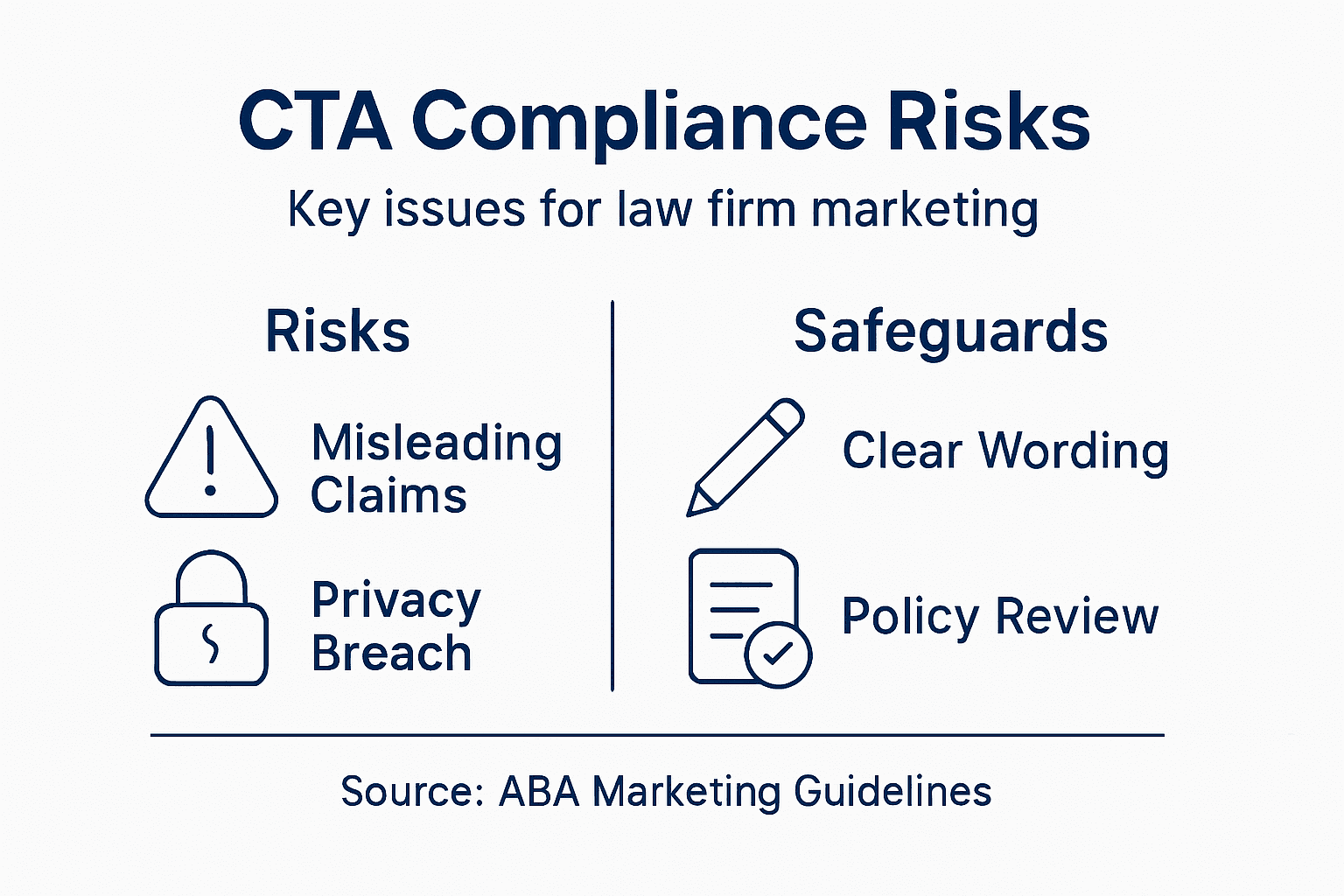
Common compliance pitfalls for law firm CTAs include:
- Making unverifiable performance claims
- Guaranteeing specific case outcomes
- Using misleading or sensationalist language
- Failing to include required legal disclaimers
- Potentially violating client confidentiality
- Implying specialization without proper certification
- Circumventing unauthorized practice of law restrictions
The regulatory landscape surrounding legal marketing is particularly intricate. Attorneys must carefully navigate a complex web of professional ethics, state bar regulations, and federal advertising guidelines. Anti-money laundering compliance adds another layer of complexity, requiring law firms to implement robust verification processes within their client engagement strategies.
Moreover, digital marketing platforms introduce unique challenges for legal professionals. CTAs must strike a delicate balance between compelling potential clients and maintaining absolute transparency. This means avoiding any language that could be interpreted as creating unrealistic expectations or promising guaranteed outcomes, which could potentially constitute false advertising.
Pro tip: Conduct quarterly compliance audits of your marketing materials, involving both legal and marketing teams to ensure full regulatory alignment.
For quick reference, here is a summary of legal compliance considerations for law firm CTAs:
| Compliance Issue | Risk Description | Recommended Safeguard |
|---|---|---|
| Unverifiable Claims | Can mislead clients | Use fact-based statements |
| Guaranteeing Outcomes | May breach advertising rules | Phrase benefits cautiously |
| Missing Legal Disclaimers | Could violate regulations | Include mandatory disclaimers |
| Implying Specialization | Might mislead without credentials | State certifications clearly |
Optimizing CTAs for Client Engagement
Creating compelling calls to action requires a nuanced understanding of potential clients’ psychological motivations and practical needs. Psychological triggers in legal marketing demonstrate that successful CTAs go far beyond simple design elements, tapping into deeper emotional and rational decision-making processes.
Key strategies for optimizing law firm CTAs include:
- Leveraging emotional resonance
- Creating clear value propositions
- Using persuasive, client-focused language
- Addressing potential client fears and uncertainties
- Highlighting unique firm capabilities
- Demonstrating empathy and understanding
- Offering immediate, low-risk engagement options
The psychological architecture of effective CTAs hinges on understanding client vulnerability. Legal matters are often deeply personal and stressful, requiring marketing approaches that communicate genuine understanding and professional competence. Client intake optimization reveals that CTAs perform best when they transform potential client anxiety into actionable hope.
Successful engagement strategies also demand technological integration. Modern law firms must design CTAs that seamlessly connect digital touchpoints with responsive human interaction, utilizing customer relationship management (CRM) tools to track and nurture potential client relationships. This means creating multi-channel engagement pathways that feel personalized and effortless.
Pro tip: Implement dynamic CTA variations that adapt based on user behavior, testing different emotional and rational messaging approaches to maximize client engagement.
Enhance Your Law Firm’s Client Engagement with Expert Digital Marketing
The article highlights the crucial challenge law firms face in converting website visitors into active clients through well-crafted calls to action. Common pain points include creating CTAs that speak to emotional vulnerabilities, ensuring ethical compliance, and placing action prompts strategically to maximize engagement. If you want to rise above competition and turn those passive browsers into meaningful consultations, tailored strategies that combine psychology with marketing expertise are essential.

At Case Quota, we specialize in helping Southern California law firms design SEO-optimized websites and performance-driven campaigns that leverage compelling calls to action perfectly aligned with your practice area. Our AI-powered pay-per-click ads and Google Local Services Ads put your firm front and center when potential clients need you most. Don’t wait to make every visitor a potential lead. Visit us at Case Quota to explore how our comprehensive legal marketing solutions can boost your client base today. Discover more about our approach to law firm SEO and web design and how professional marketing leadership drives measurable growth.
Frequently Asked Questions
What is a call to action (CTA) for a law firm?
A call to action (CTA) is a strategic prompt designed to encourage website visitors to take specific actions, such as requesting a consultation or reaching out for legal representation.
Why are CTAs important for law firms?
CTAs are essential for transforming passive website visitors into active prospects by clearly communicating the value proposition, creating a sense of urgency, and minimizing perceived effort for potential clients.
What are some common types of CTAs used by law firms?
Common types of CTAs include contact forms, free consultation buttons, live chat options, downloadable resources, and email newsletter sign-ups, each serving a unique purpose in client engagement.
How can law firms optimize their CTAs for better engagement?
Law firms can optimize their CTAs by utilizing emotional resonance, ensuring clear value propositions, leveraging persuasive language, addressing potential client fears, and implementing A/B testing to refine their approach.
Recommended
- Best Digital Marketing for Lawyers: 12 Proven Strategies to Win More Cases in 2024 – Case Quota
- Social Media Marketing for Law Firms That Wins Clients
- How to Improve Law Firm Website for More Clients Fast – Case Quota
- 8 Essential Law Firm Website Design Tips for 2025
- 7 skutecznych typów treści dla firm lokalnych – lokalne wizytówki pl