

Social media isn't just for sharing vacation photos anymore. For law firms, platforms like LinkedIn and Facebook have become powerful tools for building a solid reputation, connecting with the community, and, most importantly, attracting new clients.
Think of it less as advertising and more as a strategic way to build trust and showcase your expertise in a very crowded market. A smart, well-executed social media plan can put a human face on your practice and bring in a surprising number of quality leads.
Why Social Media Is Essential for Modern Law Firms
Let's be blunt: in an age where potential clients vet everyone online, avoiding social media isn't a choice—it's a massive missed opportunity. Your firm's presence on these platforms is a serious asset for boosting visibility, cementing your credibility, and opening a direct line of communication with your community. It takes your firm from being just another name in a legal directory to an accessible, trustworthy resource people can turn to.
This isn't just a trend; it's a proven way to get clients. The numbers don't lie. Recent data shows that approximately 85% of law firms are already using social media in their marketing, and for good reason. 71% of lawyers have successfully generated new leads through these channels.
Even more telling? Over 30% have signed clients who came directly from their social media presence. That’s a direct impact on your bottom line.
Building Trust and Authority Online
When people search for a lawyer, they aren't just looking for legal services. They're looking for an expert they can trust with incredibly sensitive problems. Social media is the perfect stage to demonstrate both your authority and your human side.
- Humanize Your Practice: Don't be afraid to share behind-the-scenes content, spotlight your team members, or post about your firm's community involvement. This builds an emotional connection that a billboard or a print ad simply can't match.
- Educate Your Audience: Your best content simplifies complex legal topics. Answering common questions and offering practical tips positions you as a helpful authority, not just someone trying to sell a service.
- Showcase Your Expertise: You can ethically share positive case results, client testimonials, and professional achievements. This is the tangible proof that reinforces your credibility and is a key part of managing your online reputation. You can learn more about this by reading our guide to attorney reputation management.
Cost-Effective Lead Generation
Compared to the sky-high costs of traditional marketing like TV or print ads, social media offers a much more targeted and budget-friendly way to reach the exact clients you want. You can dial in on specific demographics, industries, and geographic locations with incredible precision. This ensures your marketing budget is actually working for you, not just being thrown into the void.
For law firms that are essentially small businesses, weaving this into your broader online efforts is critical. Mastering your overall Small Business Social Media Strategy is the key to getting the best possible return on your investment.
When you focus on providing real value and building relationships, social media marketing for your law firm becomes a sustainable engine for growth. You'll cultivate a loyal following that not only turns to you for legal help but also refers others, creating a powerful network of advocates for your practice.
Choosing the Right Platforms for Your Practice
It's a classic mistake I see law firms make all the time: they jump onto every social media platform at once, hoping something sticks. This scattergun approach is a recipe for burnout. It wastes your time, dilutes your message, and ultimately leaves you with very little to show for your efforts.
The smarter play? Be selective. Focus your energy where your ideal clients are already hanging out.
Not all social platforms are created equal, especially when it comes to the legal world. Each one has a distinct audience, a unique content style, and a different professional culture. The real strategy lies in matching a platform’s strengths with your firm's specific practice areas and the clients you want to attract.
This infographic lays out some pretty compelling reasons why a social media strategy is no longer optional for law firms.
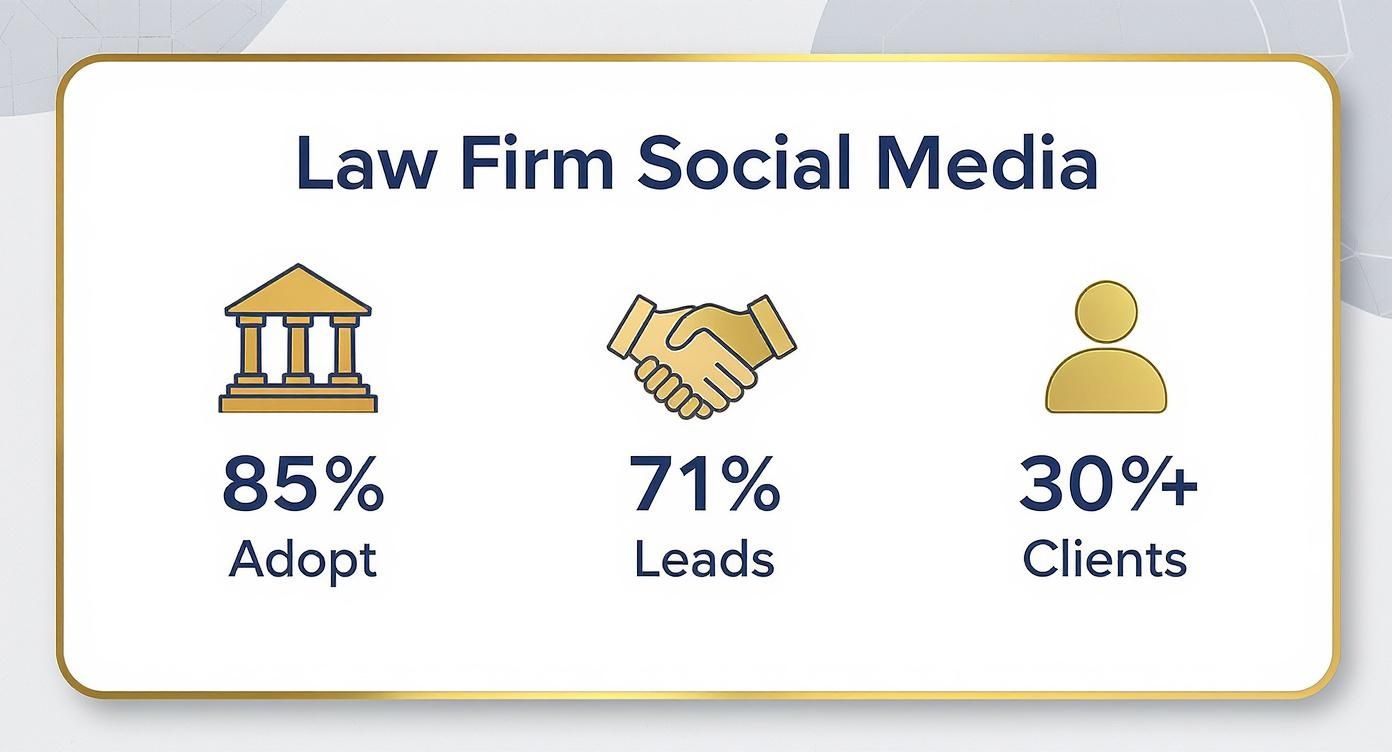
The numbers don't lie. A well-executed social media presence isn't just about getting your name out there; it's a proven way to generate real leads and sign new cases.
To help you decide where to plant your flag, let's look at the major players and how they fit into a legal marketing strategy.
Strategic Platform Selection for Law Firms
| Platform | Primary Audience | Ideal for Practice Areas | Key Content Types |
|---|---|---|---|
| Business professionals, executives, corporate counsel, B2B-focused individuals | Corporate Law, Business Litigation, Intellectual Property, Employment Law (B2B) | In-depth articles, case studies, analysis of legal news, firm announcements, professional networking | |
| General public, local community members (broad age range) | Personal Injury, Family Law, Estate Planning, Criminal Defense, Real Estate Law | Educational posts, client testimonials, community involvement, local event promotion, targeted ads | |
| Younger demographic (under 45), visually-driven users | Boutique firms, practices with a strong brand personality (e.g., modern family law, tech law) | Behind-the-scenes content, short video Reels, infographics, team highlights, "ask me anything" sessions | |
| YouTube | All demographics, users seeking in-depth information and "how-to" content | All practice areas, especially complex ones like bankruptcy, immigration, or patent law | Explainer videos, FAQ series, webinar recordings, client success stories, detailed legal process guides |
This table is a starting point. The best choice always comes back to a deep understanding of who your specific client is and where they go for information.
LinkedIn: The Professional Powerhouse
If your firm serves other businesses—think corporate law, IP, or B2B litigation—LinkedIn is non-negotiable. This is the definitive platform for professional networking, with nearly one billion members who are educated, career-focused, and actively looking for industry expertise.
On LinkedIn, you’re not just posting; you’re building authority. You can connect directly with in-house counsel, CEOs, and other professionals who can become fantastic referral sources. The content here needs to be substantive. Forget the flashy graphics and focus on insightful articles, sharp commentary on legal news, and posts about your firm's wins.
For example, a business litigation firm could publish a detailed analysis of a recent court ruling that impacts local companies. That’s how you position your firm as a thought leader and become the go-to resource for high-value corporate clients.
Facebook: Connecting With Your Community
While LinkedIn dominates the corporate sphere, Facebook is the undisputed king of community engagement. With over 3 billion active users, it's where you'll find potential clients for practices like family law, personal injury, and estate planning.
Facebook lets you connect with people in your town on a much more personal level. You can join local groups, share content that's genuinely helpful for their everyday lives, and run incredibly targeted ads based on location, age, and interests. It's a powerful tool for reaching people who need your services, right in your own backyard.
A personal injury lawyer, for instance, could share a short video on the "5 Things to Do After a Car Accident." This provides instant value and builds trust with people when they're most vulnerable, making your firm the first one they think to call.
Key Takeaway: The goal isn't just to be on social media; it's to be effective on social media. That means choosing platforms where you can genuinely connect with the audience that actually matters to your firm's bottom line.
Instagram and YouTube: Humanizing Your Firm
Visual platforms like Instagram and YouTube offer a golden opportunity to humanize your law firm and build a different kind of trust. They might not be the primary lead source for every practice, but they are fantastic for showcasing your brand's personality.
-
Instagram: Use it to share behind-the-scenes photos of your team, celebrate firm milestones, or post short, engaging "Reels" that break down complex legal topics. An estate planning attorney could create a simple, visually appealing graphic explaining the difference between a will and a trust.
-
YouTube: This is your home for longer, more educational content. Create a video series answering common client questions, host webinars, or walk people through a specific legal process. For firms that want to stand out, investing in professional social media video editing can make a world of difference.
These platforms show the people behind the law degree. By sharing your firm’s culture and values, you become more relatable and approachable—a massive advantage in an industry often seen as cold and intimidating.
Crafting a Content Strategy That Commands Authority
A powerful social media presence for a law firm isn't about posting random holiday greetings or office pictures. It's about a deliberate, calculated content strategy. The entire goal is to position your firm as a trusted, authoritative resource.
You want to provide so much value that when someone in your community has a legal question, your firm is the first one that comes to mind. It's a mental shift from advertising to educating. Your content needs to answer the questions potential clients are already asking, simplify dense legal topics, and showcase your expertise in a way that’s both professional and genuinely helpful.

This isn’t just theory; it's a proven method for driving real business. The data backs it up: 84% of law firms are already generating leads through organic social media, which pulls in nearly twice the leads of traditional marketing. And these aren't just vanity metrics. Those leads from organic social media hit a 4% conversion rate, making a tangible impact on the firm's bottom line.
The Four Pillars of Winning Legal Content
To build a content plan that actually works, I always advise firms to focus on four key pillars. This framework ensures you have a balanced mix of content that educates your audience, humanizes your firm, keeps people informed, and builds unwavering trust.
- Educational Content (Simplifying the Complex): This is your bread and butter. Your job is to break down intricate legal topics into easy-to-digest posts, short videos, or clean infographics. Think "Top 3 Things to Do After a Car Accident" or "What 'Probate' Actually Means."
- Behind-the-Scenes Content (Humanizing Your Firm): People hire people, not faceless entities. Show the team behind the law degrees. Highlight an associate's recent achievement, celebrate a firm anniversary, or share photos from a community event you sponsored. It makes you relatable.
- Timely Legal Commentary (Showcasing Authority): When a new law passes or a major ruling hits the news, offer your professional take. This positions your firm as a go-to authority that’s on top of current events relevant to your practice areas.
- Client Success Stories & Testimonials (Building Social Proof): With explicit client permission, share anonymized case results or powerful testimonials. There is nothing more convincing to a potential client than seeing how you've helped others in similar situations.
Your content strategy should aim to answer a potential client's most pressing questions before they even think to ask them. When you consistently provide clarity in a field known for complexity, you build unshakable trust.
Put It on a Calendar
An idea is just an idea until it's on a schedule. A content calendar is what turns your strategy into a manageable, consistent workflow. And it doesn't need to be some fancy, expensive software—a simple spreadsheet is often all you need to get started.
Organize your calendar with a few key columns:
- Date: When the content goes live.
- Platform(s): Where you'll post it (LinkedIn, Facebook, etc.).
- Content Pillar: Which of the four pillars it aligns with.
- Topic/Headline: A clear title for the post.
- Format: The type of media (e.g., text post, video, infographic, link to blog).
- Status: Its current stage (e.g., Idea, In Progress, Scheduled, Published).
This simple structure helps you see your content mix at a glance, preventing your feed from getting stale or repetitive. It also allows you to batch-create content, which is a game-changer for a busy firm's schedule.
Turn One Blog Post into a Week of Content
One of the smartest tactics for a law firm's social media is content repurposing. A single, well-researched blog post can fuel a dozen different social media updates. This isn't about being lazy; it's about maximizing the ROI on the time you invested in creating that original piece.
Let’s say you wrote a 1,000-word blog post on "Common Mistakes in Estate Planning." Here’s how you can slice it and dice it for social media:
- LinkedIn Article: Post a slightly shorter, professional summary of the blog post directly on the platform to capture the business audience.
- Facebook Posts: Create three separate posts, each one diving into a specific "mistake" from the article, always linking back to the full piece on your website.
- Instagram Carousel: Design a slick 5-slide carousel that lists all the mistakes with brief, punchy explanations. Visuals work wonders here.
- YouTube Short/Reel: Have an attorney film a quick 60-second video explaining the single most critical mistake people make. Quick, direct, and valuable.
- Quote Graphics: Pull 2-3 powerful quotes from the article and turn them into shareable images for all your platforms.
By planning to repurpose from the get-go, you create a steady stream of high-quality content without feeling the pressure to constantly reinvent the wheel. If you want a deeper dive, our complete guide on content marketing for law firms is a great resource.
Nail Down Your Brand Voice
Your firm's brand voice is its personality. Are you compassionate and reassuring? Or are you aggressive and a fighter? Whatever your firm's identity is, it has to be rock-solid and consistent across every single post, comment, and message.
To define it, get your team together and answer these questions:
- What three words best describe our firm? (e.g., "Knowledgeable," "Community-Focused," "Tenacious")
- What is our role for our audience? (e.g., Are we a Teacher, an Advocate, or an Advisor?)
- What is the overall tone? (e.g., Formal and buttoned-up, or conversational and approachable?)
Write these answers down. This simple document becomes your guide for anyone who touches the firm's social media. It ensures that whether an associate or a marketing partner is posting, the firm always sounds like one cohesive, professional entity. It’s this consistency that truly cements an authoritative and trustworthy online presence.
Staying on the Right Side of the Bar: Ethics and Compliance
For lawyers, jumping into social media isn't just about crafting the perfect post. It's about doing it all within a very strict ethical framework. The American Bar Association (ABA) and every state bar have rules for attorney advertising, and yes, those rules apply to every single tweet, comment, and direct message you send.
Ignoring these guidelines is a high-stakes gamble. One misstep can lead to serious consequences, including disciplinary action that could put your license on the line. The only way to win is to build your entire social media plan with a compliance-first mindset.
This means you have to view every piece of content through an ethical lens. Before you hit "publish," you need to ask yourself if you're accidentally creating an attorney-client relationship or making a statement that sounds like a misleading promise.
That Awkward Moment: The Unintentional Attorney-Client Relationship
One of the biggest tripwires on social media is accidentally forming an attorney-client relationship. It happens more easily than you’d think. A potential client sends you a DM with the details of their case, you offer a thoughtful response, and suddenly you’ve crossed a line.
To protect yourself and your firm, you have to set crystal-clear boundaries.
- Stick to Information, Not Advice: Your content should be a source of general legal information, not specific advice for someone's unique situation. Frame everything as educational. Instead of saying, "In your case, you should file a motion to dismiss," try explaining, "A motion to dismiss is a common tool used in these types of cases to…"
- Plaster Disclaimers Everywhere: Your profile bios on all platforms need to state clearly that interacting with your page does not create an attorney-client relationship. It’s also smart to drop a quick disclaimer on posts discussing legal strategy, just to remind people the content is for educational purposes only.
A simple, clear disclaimer can be your first line of defense. Think along the lines of: "Viewing this content or contacting us does not form an attorney-client relationship. Please do not send confidential information until we have formally engaged."
Guarding Confidentiality and Advertising with Integrity
Client confidentiality is the bedrock of our profession, and that doesn't change just because you're online. It feels great to share a big win, but doing so can quickly become an ethical nightmare if you aren't extremely careful.
The same goes for the words you use to promote your firm. Language that's standard practice in other industries can get you in hot water.
Your Quick Compliance Checklist:
- Get It in Writing: Never, ever discuss a case—even if you think it's anonymized—without explicit, written permission from the client. That consent needs to specifically mention that you can use it on social media.
- Ditch the Guarantees: You can't promise results. Phrases like "we guarantee a win" or "get the maximum settlement" are off-limits. Talk about your experience, your process, and your dedication instead.
- Keep It Factual and Verifiable: Any claims you make about your experience, awards, or success rates must be 100% accurate and something you can prove. Steer clear of subjective superlatives like "the best" or "the top" unless you have objective data to back them up.
Getting these rules right is absolutely critical. For lawyers in California, it's especially important to know how state-specific regulations come into play, which we cover in our guide on navigating Rule 7.2 for ethical attorney advertising.
At the end of the day, a compliant social media marketing for law firm strategy isn't about holding back. It's about building a trustworthy, sustainable presence that protects both your clients and your career. When you bake these ethical principles into your daily workflow, you can market your firm with integrity and confidence.
Put Your Growth on the Fast Track with Paid Social Media
A solid organic social media strategy is your firm's foundation—it builds trust and authority over time. But if you want to really hit the gas, paid social advertising is the way to do it.
Think of it this way: organic is like having a billboard on a busy highway, hoping the right people drive by. Paid ads are like having a personal courier deliver your message directly to the front door of your ideal client, exactly when they need you. It cuts through the noise.
Paid advertising on platforms like Facebook and LinkedIn gives you a surgical level of precision that you just can't get with traditional marketing. You can go way beyond basic demographics and target people based on their specific location, industry, job title, company size, and even their interests. It turns marketing from a guessing game into a calculated strategy.

With over 4.9 billion people on social media globally, this isn't a small opportunity. Law firms are seeing real results by running targeted ad campaigns on these platforms. Of course, this also means you have to be vigilant about evolving data privacy rules like GDPR and CCPA, which dictate how consumer data can be used for advertising.
Hyper-Targeting Your Ideal Clients
The real magic of a paid social media marketing for law firm campaign is in the targeting. This is where you get strategic and make every dollar in your budget count.
Let’s walk through a few real-world examples:
- You're a Corporate Law Firm: Imagine running a LinkedIn campaign targeting C-suite executives, in-house counsel, and startup founders. You can narrow it down to those within a 50-mile radius of your office who work in tech or finance. That's a powerful audience.
- You're a Personal Injury Attorney: With Facebook ads, you could target people in specific zip codes who've shown interest in motorcycles. You can even ethically use platform data to reach those who have recently been in locations like hospitals or auto repair shops.
- You run an Estate Planning Practice: Why not target Facebook users aged 45-65? You can layer on filters for high-income earners, parents, and those who have shown interest in financial planning or retirement topics.
This kind of detail ensures your message lands in front of a receptive audience, dramatically increasing your chances of getting a high-quality lead.
Your ad budget doesn't need to be huge to be effective. A smaller, highly targeted budget will always outperform a large, unfocused one. Start small, test your audiences, and scale what works.
Designing Ads That Convert While Staying Compliant
A great social media ad isn't just about a slick graphic. It has to connect with a potential client's immediate problem while playing strictly by your bar association's advertising rules.
Here are the key ingredients for a high-performing, compliant ad:
- A Compelling Hook: That first line is everything. Instead of a generic "Need a Lawyer?", try something specific like, "Navigating a Business Dispute? Understand Your Options." It speaks directly to their pain point.
- Value-Oriented Creative: Ditch the cheesy stock photos. Use clean, professional images or short videos that build trust. A quick video of an attorney explaining a common legal question can be incredibly effective.
- A Clear Call-to-Action (CTA): Don't make them guess what to do next. Be direct. Use phrases like "Download Our Free Estate Planning Guide," "Schedule a Confidential Consultation," or "Learn More on Our Website."
- The Essential Disclaimer: This is non-negotiable. Every ad must have the necessary disclaimers, like "This is attorney advertising" or "No representation is made that the quality of the legal services to be performed is greater than the quality of legal services performed by other lawyers."
To get even more out of your campaigns, modern tools for leveraging AI for ad launching can help optimize your budget and targeting for even better results. And if you’re looking for more ways to get your firm's name out there, we've got a whole guide on creative law firm advertising ideas.
Got Questions About Social Media for Your Firm? We've Got Answers.
Even with a solid strategy in place, I get it. The day-to-day reality of managing social media brings up a lot of questions. It's completely normal to wonder about the time suck, the ethical minefields, and whether any of this actually brings in good cases.
Let's cut through the noise and tackle the most common questions I hear from lawyers. My goal is to turn social media from a chore you're dreading into a powerful, manageable part of your firm's growth engine.
How Much Time Does This Really Take for a Small Firm?
For a solo practitioner or a small firm, the key isn't being online 24/7. It's all about consistency.
A realistic target is 3-5 hours a week. And no, that doesn't mean you're chained to your desk scrolling through feeds. It’s about being smart and efficient.
Break it down. Aim for about 30-45 minutes each day for the real-time stuff—replying to comments, connecting with colleagues, and keeping an eye on mentions. This is the simple, active engagement that shows you're present.
The biggest time-saving hack? Batch your content. Block out a single 2-hour window once a week. Use that time to write and schedule all your posts with a tool like Buffer or Sprout Social. This one move frees you up to focus on billable hours while your online presence runs like clockwork.
This approach makes your social media marketing for a law firm sustainable, not a burden.
What Are the Biggest Ethical Traps to Avoid?
This is the big one. Navigating the ethics rules is non-negotiable. While we've talked about compliance, a few critical mistakes pop up again and again. Sidestepping them is essential to protect your license and your reputation.
Here are the career-killers I see most often:
- Giving Legal Advice in the DMs: It’s so easy to do. Someone messages you with a "quick question," and your instinct is to help. But responding with personalized guidance can accidentally create an attorney-client relationship. Keep all communications, public and private, general and informational. A clear disclaimer in your bio is your best friend.
- Promising a Specific Result: Any language that even hints at guaranteeing an outcome is a massive red flag for the bar. Phrases like "we'll get you the maximum settlement" are out. Instead, talk about your experience, your process, and your dedication to clients.
- Breaching Client Confidentiality: This should be obvious, but it happens. Sharing details about a case, even if you change the names, is a serious breach without explicit, written consent from the client. Don't do it.
- Making Misleading Claims: Statements in your bio, posts, or ads must be verifiable. Calling yourself "the best personal injury lawyer in Chicago" is a problem unless you have a specific, objective award or ranking to back that claim up.
Can Social Media Genuinely Land High-Value Cases?
Yes, absolutely. But it's rarely a straight line. You probably won't land a seven-figure corporate client from a single Facebook post. Think of social media as the tool that builds the credibility and authority that secures those clients.
Make no mistake: high-value clients and, just as importantly, high-value referral sources are on platforms like LinkedIn. They are vetting you before they ever think about picking up the phone. They're looking for signs of deep expertise, consistent professional engagement, and genuine thought leadership.
When you consistently share insightful commentary on legal news, publish articles on complex topics, and showcase your professional wins, you're building that authority. Over time, this consistent, strategic effort positions you as a leader. That's what leads to better inquiries and powerful referrals from other professionals who see you as the go-to expert in your field.
How Can I Actually Measure the ROI on This?
To prove social media is worth the effort, you have to look past the vanity metrics. Follower count is nice, but it doesn't pay the bills. You need to track the numbers that tie directly to your business goals.
Here are the KPIs that show a real return on your investment:
- Website Clicks: Use UTM parameters in your links. This lets you see in your analytics exactly how many people are coming to your website from LinkedIn, Facebook, or any other platform.
- Form Submissions: How many of those website visitors filled out your contact or consultation form? This is a direct measure of lead generation.
- Tracked Phone Calls: Use a unique, trackable phone number in your social media profiles. Now you'll know precisely how many calls came directly from your social efforts.
- Engagement Rate: Don't dismiss this one. A high engagement rate (likes, comments, shares relative to your audience size) is a critical leading indicator. It proves your content is hitting the mark with the right people—the essential first step to generating a qualified lead.
At Case Quota, we build and run compliant, high-impact social media strategies that drive real, measurable growth for law firms. Let us handle the complexity so you can focus on practicing law. Book a consultation with Case Quota today.