

More than 80 percent of american law firm websites fail to convert visitors into actual clients, missing out on valuable business every day. With legal consumers turning to online searches for answers, outdated or poorly optimized websites can cost your firm both trust and revenue. If you want to stand out and win more cases, learning how to assess, improve, and track your website’s performance is key to building a reliable growth engine.
Table of Contents
- Step 1: Assess Current Website Performance
- Step 2: Upgrade Design and User Experience
- Step 3: Optimize Content For Legal SEO
- Step 4: Implement AI-Driven Lead Generation Tools
- Step 5: Verify Performance And Track Conversions
Quick Summary
| Key Insight | Explanation |
|---|---|
| 1. Assess Website Performance First | Use analytics tools to evaluate key metrics like traffic, bounce rate, and conversions to identify areas for improvement. |
| 2. Enhance Design for User Experience | Upgrade your website’s design to improve navigation and readability, ensuring it looks professional on all devices. |
| 3. Optimize Content for Search Engines | Create high-quality, keyword-rich content to enhance your online visibility and establish your firm as an authority. |
| 4. Incorporate AI for Lead Generation | Utilize chatbots and AI-driven systems for constant engagement with visitors, automating lead capture and follow-ups. |
| 5. Track Conversions for Continuous Improvement | Implement conversion tracking to analyze user behavior and refine your marketing strategy based on actionable insights. |
Step 1: Assess Current Website Performance
Assessing your law firm’s website performance is the critical first step in understanding how to attract more potential clients online. This comprehensive evaluation will help you identify strengths, weaknesses, and opportunities for significant digital marketing improvements.
Start by using robust analytics tools like Google Analytics to examine key performance metrics. Track important indicators such as website traffic volume, average time spent on pages, bounce rate, and conversion rates specific to legal service pages. Pay special attention to which practice area pages attract the most visitors and where potential clients might be dropping off before contacting your firm. You’ll want to analyze user behavior patterns that reveal how visitors interact with your site.
To make this assessment more actionable, consider performing a detailed technical website audit. Check for critical elements like mobile responsiveness, page loading speed, and overall user experience. ADA compliance checklist for websites can also help ensure your site meets accessibility standards, which not only improves user experience but can prevent potential legal complications. Remember that a smooth, professional website experience directly impacts how potential clients perceive your law firm’s professionalism and competence.
The insights from this performance assessment will serve as your strategic roadmap for targeted website improvements that can significantly boost client acquisition.
Step 2: Upgrade Design and User Experience
Upgrading your law firm’s website design and user experience is a strategic move to transform casual visitors into potential clients. This crucial step will help you create a professional digital environment that effectively communicates your firm’s expertise and builds immediate trust.
As recommended by JD Supra, implement a clear visual hierarchy that guides visitors to key information seamlessly. This means strategically positioning critical elements like practice area descriptions, attorney profiles, and contact information where visitors can easily find them. Ensure your design uses consistent typography, color schemes, and navigation elements that reflect your firm’s professional brand. Your website should present a clean, modern interface that makes complex legal information accessible and understandable.
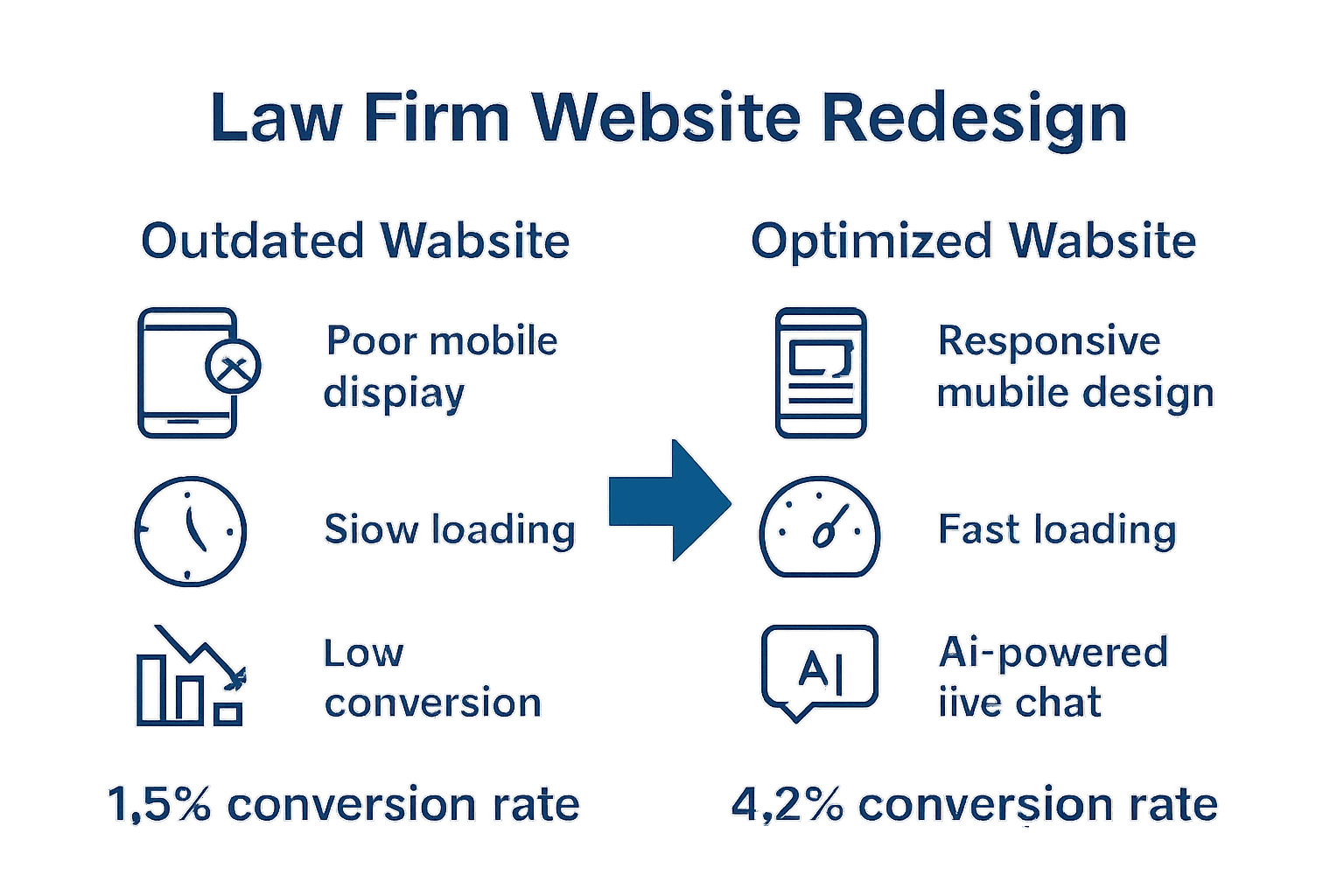
Focus on creating a responsive design that adapts perfectly across desktop, tablet, and mobile devices. Potential clients often research legal services on multiple devices, so a seamless user experience is non negotiable. Optimize page loading speeds, use high quality professional images that represent your team authentically, and create intuitive navigation paths that allow visitors to find information quickly. Include clear call to action buttons that make scheduling consultations or contacting your firm straightforward and convenient.
These design improvements will transform your website from a simple online brochure into a powerful client acquisition tool that represents your law firm’s professionalism and commitment to exceptional client service.

Step 3: Optimize Content for Legal SEO
Optimizing your law firm’s website content for search engines is a strategic approach to attract more potential clients and increase your online visibility. This crucial step will help you create targeted, searchable content that positions your firm as an authoritative resource in your legal practice areas.
As recommended by JD Supra, focus on creating high quality, informative content that resonates with your target audience. Start by developing comprehensive practice area pages that address specific legal questions and concerns potential clients might have. Use relevant keywords naturally throughout your content, ensuring that each page targets specific legal services and geographic locations. Complete Guide to SEO Legal Marketing can provide additional insights into developing a robust content strategy.
Prioritize creating in depth legal guides, blog posts, and FAQs that demonstrate your expertise while incorporating strategic keyword research. Implement local SEO techniques by including location specific keywords, adding your firm’s Google Business Profile, and ensuring consistent contact information across all online platforms. Write content that answers real client questions, using a conversational tone that makes complex legal information accessible and engaging. Remember that search engines reward content that provides genuine value to readers, so focus on creating informative, helpful resources that truly address potential clients’ legal concerns.
By systematically optimizing your content, you’ll transform your website into a powerful client acquisition tool that attracts and converts potential legal clients through strategic online visibility.
Step 4: Implement AI-Driven Lead Generation Tools
Implementing AI-driven lead generation tools represents a transformative strategy for law firms looking to accelerate client acquisition and streamline their marketing efforts. This step will help you leverage cutting edge technology to identify, attract, and convert potential legal clients more effectively than traditional marketing approaches.
Start by integrating intelligent chatbots on your website that can engage visitors 24/7, answering preliminary legal questions and capturing contact information for potential clients. These AI tools can qualify leads by asking structured questions about their legal needs, directing them to appropriate practice areas, and scheduling initial consultations automatically. A Modern Guide to Attorney Lead Generation can provide additional insights into implementing these advanced technologies effectively.
Consider using AI powered customer relationship management systems that can track client interactions, predict potential legal service needs, and automate follow up communications. These tools can analyze website visitor behavior, track engagement metrics, and provide personalized recommendations that increase the likelihood of converting website visitors into actual clients. Implement predictive analytics that help you understand which marketing channels are most effective, allowing you to optimize your digital marketing budget and focus on strategies that generate the highest quality leads.
By strategically integrating AI-driven lead generation tools, you’ll create a sophisticated client acquisition system that works continuously to grow your law firm’s client base with minimal manual intervention.
Step 5: Verify Performance and Track Conversions
Verifying your law firm website’s performance and tracking conversions is the critical final step in ensuring your digital marketing strategy delivers tangible results. This comprehensive evaluation will help you understand exactly how your website transforms website visitors into potential clients and identify areas for continuous improvement.
Set up robust conversion tracking using Google Analytics and Google Tag Manager to monitor key performance indicators specific to law firms. Configure goals that track meaningful actions like contact form submissions, phone call clicks, consultation requests, and document downloads. Create custom dashboards that provide real time insights into visitor behavior, highlighting which practice area pages generate the most engagement and which marketing channels drive the highest quality leads.
Dive deep into your website analytics by examining metrics beyond basic traffic numbers. Analyze conversion rates for different practice areas, track the average time potential clients spend on your site, and review the user journey from initial website visit to consultation scheduling. Pay special attention to mobile versus desktop performance, as an increasing number of potential clients search for legal services on smartphones. A Modern Guide to Attorney Lead Generation can provide additional strategies for interpreting these critical marketing metrics.
By systematically verifying your website performance and tracking conversions, you’ll create a data driven approach that continuously refines your online marketing strategy and maximizes your law firm’s client acquisition potential.
Unlock Your Law Firm’s Full Potential with Proven Digital Marketing Solutions
If you are struggling to convert website visitors into paying clients or frustrated by low online visibility despite your efforts, you are not alone. Many law firms face challenges like outdated website design, poor SEO optimization, and ineffective lead capture methods that hold back growth. This article highlights crucial steps such as SEO content optimization, user-friendly design, AI-powered lead generation, and performance tracking to overcome these obstacles and attract more potential clients fast.
At Case Quota, we specialize in helping Southern California law firms like yours address these exact pain points with tailored marketing strategies designed for legal professionals. Our expertise in SEO-optimized web design, advanced AI lead generation, and comprehensive digital campaigns helps your firm stand out against larger competitors with bigger budgets. We combine over 15 years of digital marketing experience with insights specific to the legal industry to boost your online presence and convert more visitors into clients.

Take control of your law firm’s growth today by partnering with a dedicated agency that understands your unique challenges. Visit our website to explore how customized SEO, AI tools, and fractional CMO services can transform your client acquisition efforts. Don’t wait for potential clients to find another firm. Act now and start growing your practice with Case Quota.
Frequently Asked Questions
How can I assess my law firm’s current website performance?
Start by using analytics tools to track key metrics like website traffic, bounce rate, and conversion rates. Analyze which practice area pages attract the most visitors and identify where potential clients drop off before contacting your firm.
What design improvements can enhance user experience on my law firm’s website?
Upgrade your website design to create a clean, modern interface that is mobile responsive and easy to navigate. Position critical elements like attorney profiles and contact information prominently to make them easily accessible for potential clients.
How do I optimize my law firm’s website content for search engines?
Focus on creating high-quality, informative content that includes relevant keywords related to your legal services. Develop comprehensive practice area pages and blog posts that answer potential clients’ questions and improve your search engine ranking.
What are the benefits of using AI-driven lead generation tools for my law firm?
AI-driven lead generation tools can engage website visitors 24/7, qualify leads, and schedule consultations automatically. By integrating these tools, you can streamline your marketing efforts and potentially increase client acquisition rates significantly.
How can I track conversions effectively on my law firm’s website?
Set up conversion tracking to monitor actions like contact form submissions and consultation requests. Use analytics dashboards to gain insights into visitor behavior and optimize your marketing strategy based on this data.
What steps can I take to verify the performance of my law firm’s website?
Regularly evaluate key performance metrics through conversion tracking and website analytics to understand how visitors interact with your site. Focus on analyzing conversion rates and user journeys to identify areas for improvement.