

Standing out from national law firms can feel daunting when every client is checking Google, legal directories, and social media before making a decision. For small and mid-sized Southern California practices, reputation management is no longer optional—it shapes trust, drives referrals, and keeps you competitive. This guide highlights practical steps to help your firm proactively control its digital image, turning online perception into a powerful tool for attracting and retaining the right clients.
Table of Contents
- Defining Reputation Management for Law Firms
- Core Elements of Effective Reputation Strategy
- Online Reviews and Public Perception Impact
- Key Legal Risks and Ethical Issues
- Avoiding Common Reputation Pitfalls
Key Takeaways
| Point | Details |
|---|---|
| Reputation Management is Essential | For law firms, managing reputation is a fundamental business strategy in today’s digital landscape, affecting client trust and hiring decisions. |
| Proactive Monitoring is Key | Continuous online presence audits allow for early issue detection and minimize reputational damage. |
| Responsive Engagement Builds Trust | Timely and thoughtful responses to both positive and negative feedback establish professionalism and enhance public trust. |
| Ethical Standards are Critical | Maintaining client confidentiality and ensuring transparent communication are paramount for protecting reputation and avoiding legal risks. |
Defining Reputation Management for Law Firms
Reputation management for law firms represents a strategic approach to actively shaping and protecting the firm’s professional image across digital and traditional platforms. At its core, it involves meticulously monitoring, influencing, and maintaining how the firm is perceived by clients, peers, legal professionals, and potential future clients.
Understanding reputation management requires recognizing its multifaceted nature. Strategic online perception management encompasses several critical components:
- Continuous online presence monitoring
- Proactive feedback response strategies
- Search engine optimization to highlight positive content
- Public relations campaign development
- Managing reviews across multiple digital platforms
The digital landscape has transformed how law firms build and maintain their professional reputation. Potential clients now extensively research attorneys online, checking Google reviews, legal directories, and social media profiles before making hiring decisions. This shift means reputation management is no longer optional but a fundamental business strategy for legal practices.
Successful reputation management goes beyond simply responding to negative reviews. It involves crafting a comprehensive narrative that demonstrates the firm’s expertise, reliability, and commitment to client success. By strategically managing digital touchpoints, law firms can build trust, credibility, and competitive differentiation.
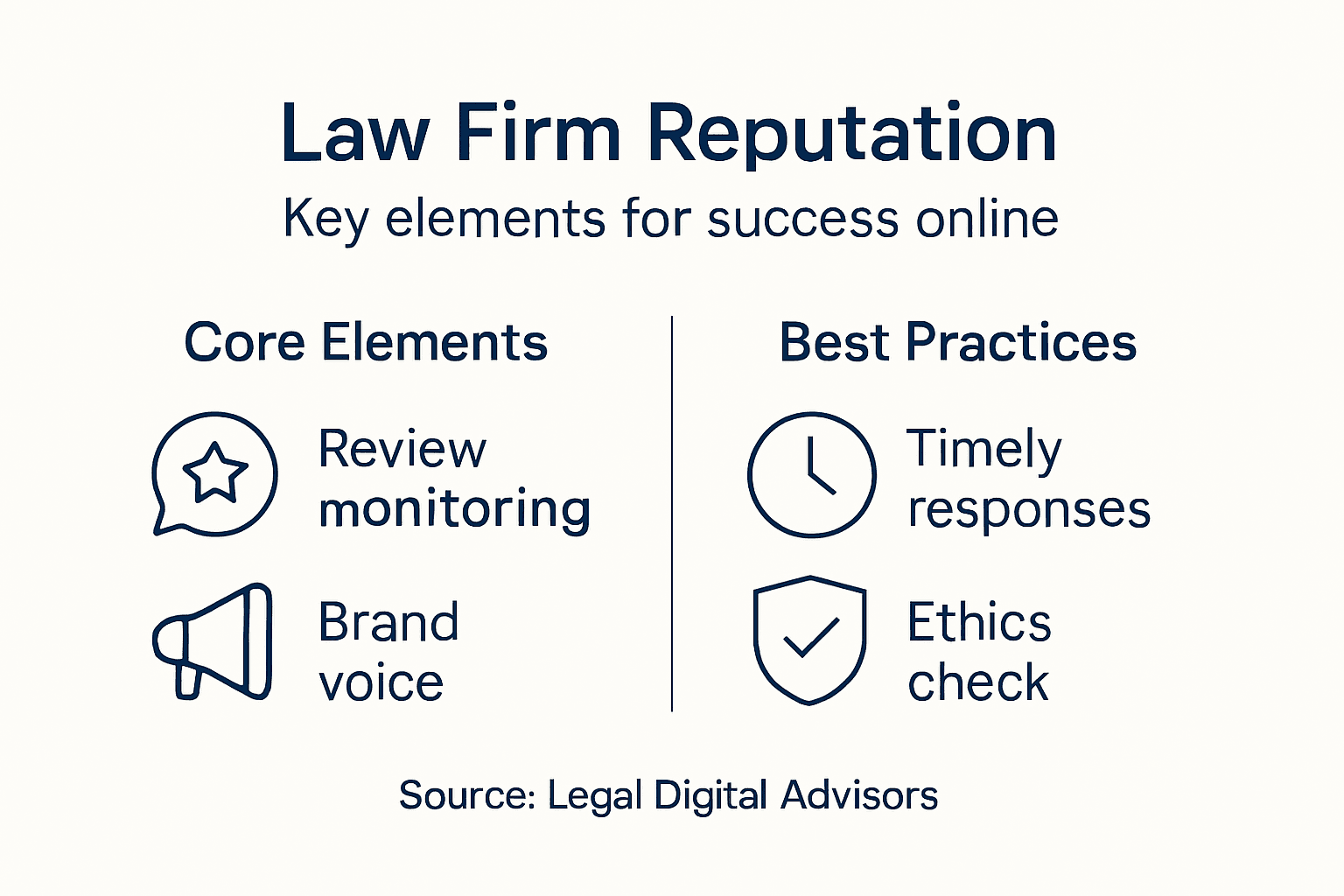
The following table summarizes how reputation management activities align with core business outcomes for law firms:
| Strategic Activity | Primary Goal | Desired Business Outcome |
|---|---|---|
| Proactive online monitoring | Early issue detection | Minimized reputational damage |
| Search engine content optimization | Boost positive visibility | Attract more potential clients |
| Professional feedback response | Enhance public trust | Increased client retention |
| Consistent messaging | Brand cohesion | Stronger competitive identity |
Pro tip: Implement a systematic approach to monitoring online mentions and proactively addressing feedback to maintain a positive professional reputation.
Core Elements of Effective Reputation Strategy
Developing a comprehensive reputation strategy for law firms requires a systematic and proactive approach to managing digital and professional perception. Core strategic elements must be carefully integrated to create a robust reputation management framework that protects and enhances the firm’s professional image.
The most critical components of an effective reputation strategy include:
- Comprehensive online presence audit
- Consistent brand messaging across platforms
- Active client feedback monitoring
- Strategic search engine optimization
- Thought leadership content development
- Rapid response protocols for potential reputation challenges
Successful reputation management goes beyond simple review monitoring. Law firms must develop a holistic digital strategy that encompasses multiple channels and touchpoints. This involves creating a consistent professional narrative that highlights the firm’s expertise, values, and unique strengths across all digital platforms.
Building a reputation strategy also requires ongoing commitment and adaptability. Law firms need to continuously track their online mentions, respond professionally to feedback, and proactively manage their digital footprint. By implementing a dynamic and responsive approach, attorneys can transform reputation management from a defensive tactic into a powerful competitive advantage.
Pro tip: Develop a systematic monitoring dashboard that tracks online mentions, reviews, and sentiment across multiple digital platforms to enable rapid and strategic reputation management.
Online Reviews and Public Perception Impact
Online reviews have become a critical determinant of public perception for law firms, fundamentally transforming how potential clients evaluate legal services. Client decision-making processes now heavily rely on digital testimonials and online reputation signals that provide insights into a firm’s professional capabilities and client satisfaction levels.
The most significant impacts of online reviews include:
- Establishing initial trust with potential clients
- Providing social proof of legal expertise
- Influencing search engine visibility
- Creating transparent performance metrics
- Demonstrating professional responsiveness
- Building credibility beyond traditional marketing
Law firms must recognize that modern clients conduct extensive digital research before selecting legal representation. Potential clients typically review multiple platforms including Google, legal directories, and specialized review sites to assess a firm’s reputation, track record, and client communication standards.

Addressing online reviews requires a strategic and nuanced approach. Constructive responses to both positive and negative feedback demonstrate professionalism, transparency, and genuine commitment to client satisfaction. By actively managing their online reputation, law firms can transform digital interactions from potential reputation risks into powerful trust-building opportunities.
Pro tip: Implement a structured review response protocol that addresses each client review within 48 hours, showing authentic engagement and professional accountability.
Key Legal Risks and Ethical Issues
Reputation management in law firms involves navigating complex ethical terrain where professional integrity intersects with digital communication. Reputational risks extend far beyond simple marketing challenges and require sophisticated ethical considerations.
Key legal and ethical risks in reputation management include:
- Maintaining client confidentiality
- Avoiding misleading professional representations
- Preventing potential conflicts of interest
- Protecting sensitive case information
- Ensuring transparent communication
- Respecting professional conduct guidelines
Law firms must carefully balance proactive reputation management with strict ethical standards. Professional communication demands nuanced strategy that protects both the firm’s reputation and client interests. This involves creating clear protocols for online interactions, reviewing all public communications, and maintaining strict boundaries between marketing efforts and professional obligations.
The consequences of ethical missteps can be devastating. A single inappropriate online response, breach of confidentiality, or misleading statement can trigger professional disciplinary actions, potential legal sanctions, and irreparable damage to the firm’s reputation. Successful reputation management requires a comprehensive approach that prioritizes legal and ethical considerations above short-term marketing gains.
Pro tip: Develop a comprehensive review protocol for all public communications that includes legal counsel validation to prevent potential ethical breaches.
Avoiding Common Reputation Pitfalls
Navigating reputation management requires law firms to strategically avoid potential digital communication traps that could undermine their professional standing. Attorney reputation strategies must anticipate and proactively address common mistakes that can rapidly erode client trust and professional credibility.
The most critical reputation pitfalls for law firms include:
- Inconsistent messaging across digital platforms
- Delayed or inappropriate response to client feedback
- Oversharing sensitive case details
- Neglecting negative online reviews
- Publishing unprofessional or controversial social media content
- Failing to monitor digital brand mentions
Digital communication demands precision and restraint. Law firms must recognize that every online interaction represents a potential reputational risk. This requires developing comprehensive guidelines that establish clear boundaries for professional communication, ensuring that all digital content reflects the firm’s core values and ethical standards.
Understanding the nuanced landscape of online reputation requires continuous learning and adaptation. Successful law firms view reputation management not as a static process, but as a dynamic strategy that requires constant vigilance, strategic thinking, and proactive engagement. By anticipating potential communication challenges and implementing robust protocols, attorneys can transform potential reputation risks into opportunities for demonstrating professional excellence.
Here is a comparison of common reputation pitfalls versus best practice solutions for law firms:
| Common Pitfall | Potential Negative Impact | Best Practice Solution |
|---|---|---|
| Inconsistent messaging | Brand confusion | Unified brand guidelines |
| Neglecting online reviews | Erosion of client trust | Timely, thoughtful responses |
| Oversharing case information | Legal and ethical breach risk | Strict confidentiality protocols |
| Slow response to feedback | Missed service recovery chance | 48-hour response goal |
Pro tip: Create a comprehensive digital communication playbook that outlines specific guidelines, response protocols, and approved messaging strategies for all team members.
Take Control of Your Law Firm’s Reputation Today
Reputation management challenges demand more than reactive solutions. This article highlights how law firms must proactively monitor their online presence, respond thoughtfully to client feedback, and maintain consistent brand messaging to build trust and credibility. At Case Quota, we understand the critical need for a comprehensive digital strategy that protects your professional image while growing your client base in Southern California.

Ready to transform your firm’s reputation into a powerful competitive advantage? Our tailored services include SEO-optimized web design, targeted pay-per-click advertising powered by AI, and strategic social media marketing designed specifically for legal practices. Don’t let inconsistent messaging or slow review responses hold your firm back. Visit Case Quota now to discover how our expert team can help you implement a proven reputation management framework that aligns with your firm’s goals. Take the first step in safeguarding your reputation and expanding your client reach by exploring more about our digital marketing expertise today.
Frequently Asked Questions
What is reputation management for law firms?
Reputation management for law firms is a strategic approach to shaping and protecting a firm’s professional image across various platforms. It involves monitoring, influencing, and maintaining the firm’s perception by clients and peers.
Why is online review management important for law firms?
Online review management is crucial as potential clients heavily rely on digital testimonials to assess a law firm’s expertise and client satisfaction. Managing these reviews helps build trust and credibility, ultimately attracting more clients.
What are some key components of an effective reputation management strategy?
Key components include continuous online presence monitoring, consistent brand messaging, active client feedback monitoring, strategic SEO, and rapid response protocols for managing reputation challenges.
How can law firms avoid common reputation pitfalls?
Law firms can avoid reputation pitfalls by establishing unified brand guidelines, responding promptly to feedback, maintaining client confidentiality, and ensuring consistent messaging across all digital platforms.