

Attorney reputation management isn’t some vague marketing term; it's the real, hands-on work of shaping what potential clients find when they search for you online. It's about taking control of the narrative on search engines, review sites, and social media to build trust and attract the cases you actually want.
Why Your Digital Reputation Is Your Firm's Top Asset
Long before a potential client picks up the phone, they’ve already made up their mind about you. They’ve Googled your name, scrolled through your Avvo profile, and dissected reviews from people you’ve helped in the past. That first digital handshake is everything—it determines whether they call you or click over to your competitor.
Think of your online reputation as your firm’s most dedicated salesperson. It works 24/7, either building you up or tearing you down.
- A steady flow of five-star Google reviews directly translates to more qualified leads. It just does.
- A sharp, updated LinkedIn profile showcasing your wins and insights positions you as a go-to expert in your field.
- On the flip side, one nasty review left to fester can scare off dozens of potential clients and hit your revenue in a real, tangible way.
The power of online reviews, in particular, can't be overstated. With over 90% of potential clients checking them out before hiring a lawyer, this feedback is the new word-of-mouth referral. In fact, a staggering 78% of people trust online reviews as much as they trust a recommendation from a friend. A solid digital footprint isn't just nice to have; it's essential for credibility.
The Pillars of a Strong Legal Reputation
Building a rock-solid reputation isn't a single action but a combination of consistent efforts across several key areas. Each pillar supports the others, creating a comprehensive strategy that protects and grows your firm's brand.
| Pillar | What It Involves | Primary Goal |
|---|---|---|
| Monitoring & Listening | Using tools to track mentions of your firm, attorneys, and keywords across the web, including review sites and social media. | To gain real-time awareness of the conversation surrounding your brand and identify issues before they escalate. |
| Review Generation | Proactively and systematically requesting feedback from satisfied clients on key platforms like Google, Avvo, and others. | To build a large volume of positive social proof that accurately reflects the quality of your work. |
| Feedback Management | Responding professionally and strategically to all reviews—both positive and negative—in a timely manner. | To show engagement, resolve client concerns, and demonstrate that your firm values feedback. |
| Content & SEO | Creating and promoting high-value content (articles, case studies, videos) that highlights your expertise and ranks on search engines. | To control the search results for your name and firm, pushing positive, authoritative content to the top. |
Mastering these four pillars ensures that when potential clients search for you, they find a consistent, compelling, and trustworthy narrative that encourages them to take the next step.
From Reviews to Revenue
The line connecting a strong online presence to your firm's growth is straight and clear. It’s a simple, powerful sequence that the most successful firms have already mastered.
A pristine online reputation isn't just about looking good; it's a fundamental business asset. It functions as a trust signal that pre-qualifies clients, reduces friction in the intake process, and ultimately allows you to command higher fees for your expertise.
This flow chart breaks down exactly how a great digital reputation fuels your firm's growth engine.
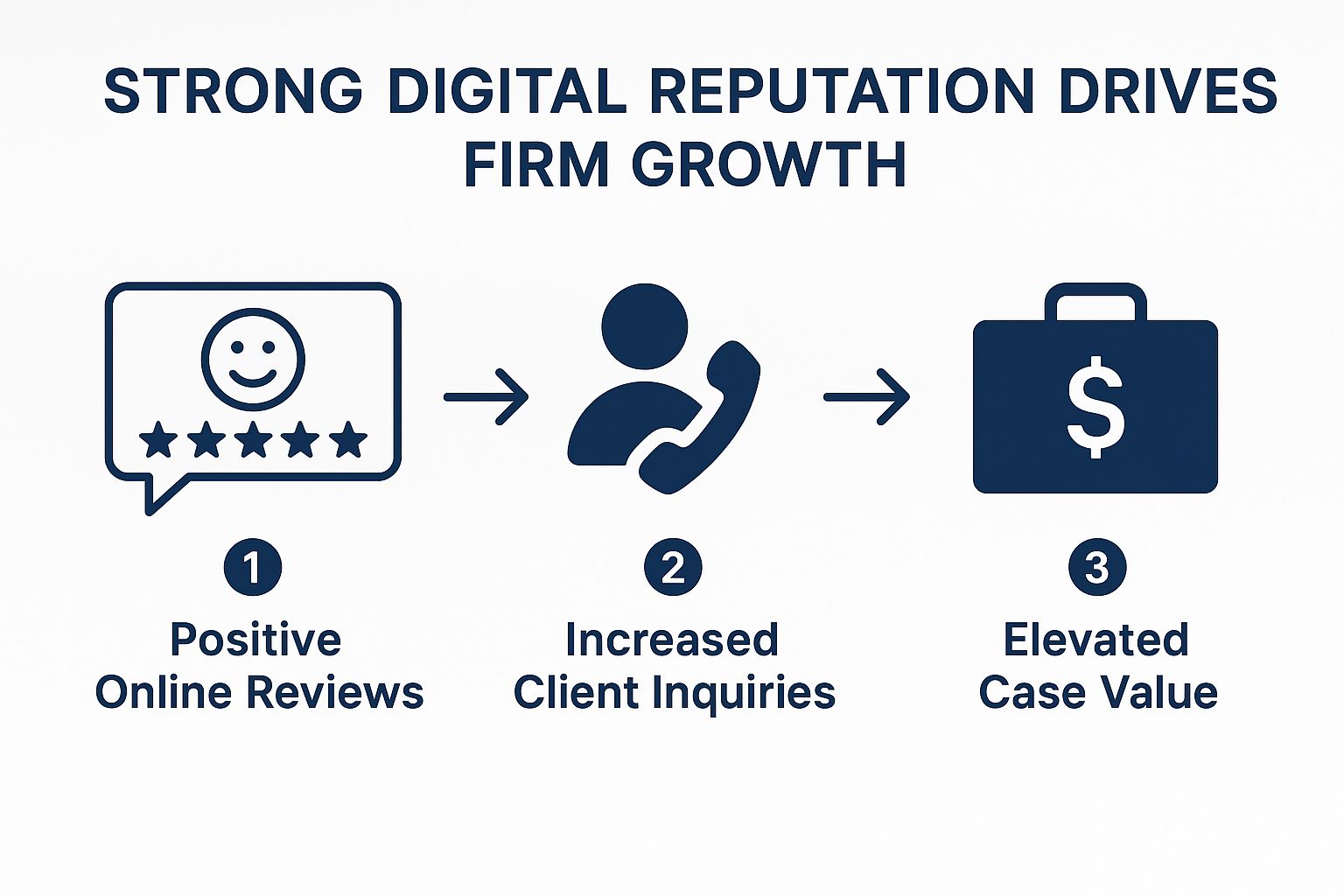
As you can see, it all starts with positive reviews. They act as the catalyst, sparking more client inquiries which, in turn, lead to higher-value cases. In today's market, ignoring this part of your business is no longer an option—it’s a core driver of your client acquisition strategy and has a direct impact on your bottom line. You can find more on this topic in our guide on the most important key performance indicators for law firms.
Setting Up Your Reputation Monitoring System
You can't manage what you don't measure. This old business adage is especially true when it comes to your law firm's reputation. Without a system in place to listen to the online chatter about your firm and its lawyers, you're essentially flying blind. You'll only find out about problems long after the damage is done.
The goal here isn't to obsessively check every single mention. It's about building an efficient, sustainable process that brings the important conversations directly to you. This simple shift moves you from a reactive, crisis-management mode into a proactive one where you can spot both issues and opportunities as they arise.
Start with Free and Powerful Tools
You don't need to shell out big bucks for a complicated software suite right away. The most effective first step is to set up a baseline monitoring network using tools that are already available—and completely free. This approach costs nothing, is surprisingly powerful, and will catch the vast majority of what's being said about you online.
Your first line of defense is Google Alerts. It's a simple service that emails you whenever new web pages, news articles, or blog posts mention your specific keywords.
Here’s a quick look at the straightforward interface where you'll create and manage your alerts.

As you can see, you just type in your firm's name and Google gives you a preview of recent results. This helps you fine-tune your settings for relevance and how often you get notified.
To cast a comprehensive net, you need to think like a potential client or even a journalist. Don't just track your firm's official name. Set up alerts for a variety of terms:
- Your Firm's Name:
"[Your Law Firm Name]" - Key Attorneys' Names:
"[Attorney Name] lawyer"or"[Attorney Jane Doe]" - Common Variations: Be sure to include common misspellings or abbreviations people might use.
- Firm Name + "Review":
"[Your Law Firm Name] review"or"[Attorney Name] feedback"
Pro Tip: Always use quotation marks around your search terms. This tells Google to look for that exact phrase. It’s a simple trick that dramatically cuts down on irrelevant noise, making sure the alerts you get are targeted and actually useful.
This initial setup gives you a solid foundation and gets you in the game without any investment.
Knowing When to Upgrade Your System
While free tools are the perfect starting point, there will come a time when a growing firm simply needs more. If you find yourself spending more time sifting through alerts than acting on them, or if your firm has a significant public profile, it’s probably time to invest in a specialized reputation management platform.
These paid services offer some serious advantages over the basic free alerts:
- Social Media Monitoring: They dig into platforms like Twitter, Facebook, and public forums—places Google Alerts often misses entirely.
- Sentiment Analysis: This is a big one. The software can use AI to gauge whether a mention is positive, negative, or neutral, which helps you prioritize what needs your attention first.
- Consolidated Dashboards: Instead of getting dozens of separate emails, you get a single, clean dashboard that pulls in reviews and mentions from across the web, including critical legal directories like Avvo and Yelp.
The decision to upgrade really comes down to volume. If you're getting more than a handful of relevant mentions each week or are navigating a sensitive PR issue, a dedicated tool can save you an incredible amount of time and provide much deeper insights. It's a worthwhile investment in your firm's long-term health.
How to Handle Online Client Reviews for Your Firm
Think of online reviews as today's word-of-mouth referral. They carry enormous weight, and for many prospective clients, they’re a deciding factor. Properly managing this feedback is a huge part of attorney reputation management. It's a two-sided coin: you need to actively encourage your happy clients to share their stories while also skillfully navigating the inevitable negative comment.
The goal here isn't just damage control. It's about building a systematic process that feels organic to your clients and highlights your firm's professionalism at every single touchpoint.

Simply crossing your fingers and hoping for good reviews to roll in is not a strategy. You have to ask—proactively, but always ethically.
Timing is everything. You want to make the ask when the client’s positive feelings are at their absolute peak. The perfect moment is right after a successful case resolution or a major positive milestone.
And please, don't make it complicated. A simple, personalized email goes a long way. The key is to make it dead simple for them to follow through. Include a direct link to the exact review profile you want them to use, whether that's your Google Business Profile, Avvo, or another legal directory.
Responding to Negative Reviews Like a Pro
Look, it’s going to happen. Sooner or later, every single law firm gets a negative review. It’s just part of being in business. The review itself isn't what defines you; your response is. Flying into a panic or getting defensive online will only pour fuel on the fire.
Your public response needs to be three things: prompt, professional, and brief. Your only goals are to acknowledge their feedback, show you take it seriously, and get the conversation offline. Never, ever debate the details of a case or—even worse—disclose confidential information in a public forum.
Here's a simple, effective framework for your reply:
- Acknowledge and Apologize: Kick it off by thanking them for the feedback. Express regret that their experience wasn't what they expected. This isn't admitting guilt; it's basic empathy.
- Reiterate Your Commitment: Briefly mention your firm's dedication to client service. This shows other potential clients reading the exchange what your values are.
- Take It Offline: This is the most important part. Give them a direct name, email, or phone number to discuss the issue privately. This proves you’re serious about making it right.
A well-handled response to a negative review can honestly be more powerful than a dozen five-star ratings. It shows you’re accountable, professional, and genuinely care about fixing problems—all qualities a potential client is desperately looking for in a lawyer.
Real-World Response Examples
Let's break down two ways to handle the same fictional (but common) complaint: "My lawyer never returned my calls and I felt completely in the dark."
Poor Response (This makes it so much worse):
"That's not true. Our records show we called you multiple times and you never answered. You were also behind on your payments which complicated things. We did our best given the circumstances."
This is a train wreck. It’s argumentative, it violates client confidentiality by mentioning payments, and it blames the client. This response guarantees you'll alienate the reviewer and scare away any prospect who sees it.
Effective Response (This de-escalates and shows class):
"Thank you for sharing your experience. We are very sorry to hear that you felt this way, as clear and consistent communication is something we strive for with every client. We would appreciate the opportunity to discuss this with you directly to better understand what happened. Please call our office manager, Sarah, at your convenience."
See the difference? This reply is pure professionalism. It's empathetic, avoids getting into a public he-said-she-said, and immediately moves the conversation to a private, productive channel. This is the gold standard for attorney reputation management.
Proactively Building a Positive Online Presence
Reacting to reviews is a necessary part of the game, but the best attorney reputation management strategy is a powerful offense. It’s about building a digital fortress of positive, firm-controlled content that you own. This way, when a potential client searches for you or your firm, they find a wealth of credible information that you’ve created, pushing any stray negative comments way down the search results page.
This isn’t about just crossing your fingers and hoping for the best; it’s about actively shaping your online story. This proactive stance is becoming critical across every industry. In fact, 84% of executives now view brand and reputation risk as their number one external threat—even more so than cybersecurity. A strong reputation isn't just for show, either; it can add up to 25% to a company's valuation, proving the clear financial upside. You can see more data on this at Nadernejad Media.
Use Content to Establish Your Authority
Content marketing is your most powerful tool for building this digital fortress. When you consistently publish insightful articles, detailed case studies, and helpful guides on your firm’s website, you accomplish two critical goals at once. First, you showcase your expertise and build immediate trust with potential clients. Second, you create assets that Google loves to rank, allowing you to dominate the first page of search results for your name and key practice areas.
Just think about the questions your ideal clients are asking Google right now. Create content that gives them the answers.
- Insightful Blog Posts: Write about recent changes in the law or offer practical advice that speaks directly to a client's problem.
- Detailed Case Studies: Anonymize the client details and walk readers through a complex case. Show them your strategic approach and highlight the successful outcome.
- In-Depth Practice Area Pages: Don't just list your services. Create deep, authoritative pages for each one that positions your firm as the go-to expert.
This kind of content works for you long after you hit "publish." It becomes a magnet for new clients and constantly reinforces your position as a thought leader in your field.
Polish Your Professional Profiles
Your own website is just the beginning. Your profiles on professional networks and legal directories are crucial outposts in your digital presence. After finding you on Google, these are often the very next places potential clients or referring attorneys will look. An incomplete or outdated profile sends a sloppy, unprofessional message.
Your LinkedIn profile and legal directory listings are not just online resumes; they are active marketing assets. A polished, comprehensive profile acts as powerful social proof, validating the expertise you claim to have on your website and in your content.
Make sure every single profile is complete and consistent with your firm's branding. This means using a high-quality, professional headshot, writing a detailed biography, and listing your notable achievements or publications. These small details add up to create a powerful, cohesive online brand that inspires confidence.

When you take control of these platforms, you leave less room for ambiguity or negative content to fill the void. Learn more about how we help firms grow with our customized legal marketing solutions. Proactive attorney reputation management is all about owning your digital footprint, piece by piece.
Deciding to Hire a Reputation Management Agency
Juggling active casework with a demanding digital strategy is a tough balancing act. While many law firms try to handle their online presence in-house, there are clear signals that it’s time to call in the experts for your attorney reputation management. Spotting these red flags early can save you from a full-blown crisis down the road.
Let's be realistic. If your team is out of time or just doesn't have the specific skills to handle advanced digital threats, outsourcing is simply a smart business decision. An agency brings more than just an extra pair of hands; they come equipped with specialized skills in crisis communication, advanced SEO, and content suppression—things a busy law practice can't just learn overnight.
This isn't a niche trend, either. As of 2025, a staggering 83% of law firms are hiring outside marketing agencies for promotion and getting new clients. This shift highlights just how complex and competitive legal marketing has become, making expert guidance more critical than ever. You can dig into more law firm marketing trends on amraandelma.com.
Key Triggers for Seeking Professional Help
Knowing when to make the call is everything. Are you suddenly dealing with a flood of negative reviews you can't get ahead of? That’s a major indicator. Another is facing a public relations issue that feels like it could spiral out of control and tank your firm’s credibility.
It might be time to bring in an agency if you're seeing any of these signs:
- Stubborn Negative Search Results: You've tried everything, but negative articles or bad reviews are still camped out on the first page of Google for your firm's name.
- No In-House Bandwidth: Your staff is already stretched thin. Reputation management tasks keep getting pushed to the bottom of the to-do list.
- Complex Digital Attacks: You’re dealing with sophisticated problems like fake reviews, slanderous blog posts, or coordinated attacks that require a real technical response.
Outsourcing reputation management isn't admitting defeat; it's a strategic move. It frees up your attorneys to focus on what they do best—practicing law—while specialists protect and enhance your firm's hard-earned reputation on the digital front lines.
Questions to Ask a Potential Agency
Choosing the right partner is vital. Not every marketing agency gets the nuances of legal ethics and professional responsibility. Before you sign anything, you need to vet them carefully to make sure they're the right fit for your firm.
Get ready to ask some specific, pointed questions:
- How, exactly, do you handle negative review removal while staying within the platform’s rules?
- Can you show me case studies from other law firms you've worked with?
- What's your process for managing client confidentiality when creating testimonials or content?
- Do you have experience navigating our state bar's advertising rules?
Their answers will tell you everything you need to know about their experience in the legal field. You want a partner who can show a clear understanding of the professional constraints attorneys work under, like a certified Google Partner agency. Making a smart, informed choice now will pay dividends in protecting your firm’s most valuable asset.
Got Questions About Managing Your Firm’s Reputation? We’ve Got Answers.
When we talk to attorneys about reputation management, the same handful of questions pop up again and again. It’s no surprise—the rules around advertising, client confidentiality, and what you can say online often feel like a minefield.
Let's cut through the noise. Here are some clear, direct answers to the most common concerns we hear from law firms trying to navigate their online presence. Getting this right is all about striking that delicate balance between smart marketing and your strict ethical duties.
Can I Offer an Incentive for a Positive Review?
This is a big one, and the answer is almost always a hard no.
Most state bar associations have pretty clear rules against giving anything of value in exchange for a recommendation or testimonial. The reasoning is simple: it can be seen as misleading advertising because the review doesn't reflect a client's genuine, unprompted opinion.
Instead of trying to buy reviews, focus on making it incredibly easy for truly happy clients to leave one. The best play is to build a simple, ethical process for requesting feedback right after you've successfully closed a case.
What if a Negative Review Is Completely False?
It's infuriating. You see a one-star review from someone you've never even represented, or a post filled with factual errors. The gut reaction is to jump in and publicly dismantle every false claim, but that almost always backfires.
Here’s how to handle it like a pro:
- Report It, Don’t Debate It: Platforms like Google, Avvo, and Yelp all have processes for flagging reviews that violate their terms of service. A fake review is a clear violation. Use their system and provide as much detail as you can to support your claim.
- Post a Careful Public Response: While you're waiting for the platform to act, post a single, brief, professional reply. Something like, "We take all client feedback seriously, but we have no record of this individual as a client of our firm," is perfect. It shows you’re paying attention without dragging you into a messy public fight.
The goal isn't to win an online argument. It’s to show the thousands of potential clients reading the exchange that you are a calm, measured professional.
How Much Time Should This Realistically Take?
I get it—you’re a busy attorney. This can't become a second job. The good news is, it doesn’t have to.
The initial setup, like getting tools like Google Alerts in place, might take an hour or so. After that, it’s all about a consistent, efficient routine.
A sustainable rhythm could look like this:
- Daily Check-In (5 minutes): A quick scan of your alerts and primary review sites. Is there anything new that needs an immediate, thoughtful response?
- Weekly Pulse (15-20 minutes): Block out a little time to review all platforms, send out a few feedback requests for recently closed cases, and think about any proactive content you want to share.
Effective attorney reputation management is a marathon, not a sprint. It’s about consistency, not constant obsession. By building a smart system, you can protect your firm’s most valuable asset without sacrificing those crucial billable hours.
Ready to build a powerful online reputation that brings in the high-value cases you want? The experts at Case Quota specialize in marketing solutions that deliver real results while respecting legal ethics. Learn how we can protect and grow your firm's brand today.