
So, you're weighing Local Service Ads against Google Ads. The decision really boils down to one question: what's your immediate goal?
If you're after a direct pipeline of qualified, ready-to-hire leads, Local Service Ads (LSAs) are your play. They're built on a foundation of trust and operate on a straightforward pay-per-lead model. On the other hand, if you want total control over your messaging, targeting, and brand presence, Google Ads offers an unmatched level of command with its classic pay-per-click system.
It's not about which one is "better" in a vacuum. It’s about which one is the right tool for your firm, right now.
Your Local Advertising Playbook
For any local service business, especially law firms, getting this choice right directly impacts your case flow and market visibility. Let's cut through the noise and figure out which platform aligns with your goals.
LSAs are designed for one thing: converting high-intent searchers into immediate clients. To even get in the game, you have to pass a rigorous screening process, earning you that coveted "Google Guaranteed" or "Google Screened" badge. This little checkmark does heavy lifting, building instant credibility with someone who needs to hire a professional now.
Google Ads, however, is the powerhouse of versatility. It’s a sophisticated engine that lets you get incredibly granular. You can target potential clients based on the exact keywords they search, their demographics, and even their online behavior. This makes it perfect for firms with longer client intake cycles or those looking to build a dominant brand that goes beyond just immediate service calls.
For example, a comprehensive law firm marketing strategy might use Google Ads to educate and nurture leads for complex, high-value cases, while running LSAs to capture more straightforward inquiries. Before you spend a dime on either, make sure your foundation is solid by optimizing your Google Business Profile—it's the bedrock of local visibility.
The shift in consumer trust is already clear. New data reveals that 29% of users now click on Local Service Ads first, which is more than double the 11% who stick with traditional Google Ads. LSAs have quickly become the new king of the paid search results.
To really drive home the differences, let's lay it out side-by-side.
LSA vs Google Ads Core Differences
Here's a quick cheat sheet summarizing the core distinctions between these two platforms. It's a great starting point before we dive deeper into the nuts and bolts of each.
| Feature | Local Service Ads | Google Ads |
|---|---|---|
| Pricing Model | Pay-per-lead (PPL) | Pay-per-click (PPC) |
| Primary Goal | Generate direct leads & calls | Brand awareness, traffic, leads |
| Ad Placement | Very top of search results | Above/below organic results |
| Control Level | Limited & automated | High & granular |
| Best For | Immediate service needs | Complex sales funnels |
This table gives you the 30,000-foot view. Now, let's get into the details of what makes each platform tick and where your firm will see the best return on investment.
Breaking Down the Two Platforms
Before you can pick a winner in the local service ads vs google ads showdown, you have to get under the hood of each platform. While they’re both part of the Google family, they were built for completely different jobs and serve very different client intentions.
Think of it this way: one is a precision tool for getting calls right now, and the other is a full-blown workshop for building a comprehensive marketing strategy.
Local Service Ads are engineered around one thing: trust. Their entire model is built on the "Google Guaranteed" or "Google Screened" badge. This isn't just a decorative icon; it’s a powerful signal to potential clients that Google has already vetted your firm for licenses, insurance, and background checks.
This simple badge cuts right through the biggest hesitation a potential client has: finding a trustworthy local professional. By putting badged providers at the very top of the search results, Google gives users a direct, frictionless path to someone who is ready to take their call.
Understanding Local Service Ads
LSAs don't play the long game of brand awareness or website traffic. They are a pure, unapologetic lead-generation machine.
- Focus on Trust: The Google Guaranteed badge comes with a real promise—it can reimburse clients up to $2,000 if they're unhappy with the quality of your work. That’s a massive incentive for them to pick you over a competitor.
- Automated Simplicity: Forget about deep keyword research or ad copywriting. Google handles the ad’s look and targeting based on the services you list and your location. It’s designed to be simple.
- Direct Connection: These ads are built for immediate action. A user sees your rating, the badge, and your phone number, prompting a call or message straight from the search results.
Local Service Ads act less like traditional ads and more like a pre-vetted, high-visibility business directory. Their sole purpose is to connect a client with a verified problem-solver, fast.
Deconstructing the Google Ads Engine
Now, let's shift gears to Google Ads. This is an entirely different beast. If LSAs are a scalpel for capturing high-intent local leads, Google Ads is a versatile marketing suite designed to reach clients at every single stage of their journey. It all runs on a massive, real-time auction where advertisers bid on keywords to get their ads in front of the right searchers.
This is the engine that powers the classic text ads you see on search results, but its power goes way beyond that. You can run slick Display ads across millions of websites, compelling video ads on YouTube, and even Shopping ads for e-commerce.
For a law firm, this versatility is everything. You can build a campaign with multiple touchpoints, attracting clients for specific case types and building a commanding online presence. Our comprehensive guide on Google Ads for lawyers dives deep into how you can use this massive toolkit to your advantage.
Of course, all that power comes with a trade-off: complexity. You have pinpoint control over your audience, targeting them by demographics, interests, online behavior, and even whether they’ve visited your site before. But running a successful campaign requires constant management, optimization, and a solid grasp of bidding strategies.
Comparing Ad Placement and Search Visibility
Where your ads show up is every bit as important as what they say. When we line up Local Service Ads against Google Ads, placement is one of the clearest dividing lines—and it has a massive impact on who sees you and how much they trust you.
Local Service Ads own the most valuable real estate on the entire search results page. I’m talking about the absolute top, sitting above everything else—even the traditional paid ads and the local map pack. This isn't a fluke; it's by design. When a potential client has an urgent legal problem, your firm is the very first thing they see.
This prime position gives you an incredible advantage. Google wants to provide a quick, trustworthy solution for people in a moment of need. For someone frantically searching for a lawyer, that immediate, top-of-page visibility can be the deciding factor.
Here’s exactly what that looks like in the wild. Notice how LSAs instantly grab your attention with trust signals.
As you can see, the LSA block dominates the most prominent spot. It’s impossible to miss, featuring photos, ratings, and that critical "Google Screened" badge that builds instant credibility before a user ever clicks.
The Expansive Reach of Google Ads
Google Ads, on the other hand, offer a different kind of visibility. It’s less about owning that single top spot and more about achieving incredible breadth. While Google Ads can appear high on the page (always below the LSA block), their real power comes from the sheer scale of the network.
They’re not just confined to the top of Google Search. The reach is immense.
- Search Network: Your ads appear above and below the organic search results on Google.
- Display Network: You can follow potential clients across millions of websites, news pages, and blogs, keeping your firm top-of-mind.
- YouTube: Video ads can intercept users while they're watching content related to legal issues or local news.
- Google Maps: Promoted pins make your office stand out when someone is looking for directions or a law firm nearby.
This is a multi-channel presence that Local Service Ads simply don’t offer. It allows your firm to build brand awareness and stay visible to potential clients throughout their entire online journey, not just in the single moment they’re actively searching.
The core trade-off is clear: Local Service Ads give you unparalleled, immediate visibility for specific, high-intent local searches. Google Ads provides a broader, more sustained presence across the entire web.
Your Google Business Profile Is the Foundation for Both
Ultimately, the performance of either ad platform gets a major boost from a solid online foundation. A strong local presence is crucial, which means optimizing your Google Business Profile is non-negotiable.
For LSAs, your GBP data—especially reviews—feeds directly into your ad and influences your ranking. For Google Ads, a well-managed profile powers your local ad extensions and improves your visibility on Maps.
Attorneys trying to get an edge in crowded markets should dig into the actionable steps here: https://casequota.com/10-proven-google-business-profile-for-attorneys-tweaks-to-dominate-southern-california-local-search-2025-lead-gen-checklist/. That guide details how to turn your profile into a powerful lead-gen tool that supports both ad platforms.
Analyzing Cost Models and Budget Management
To get the most out of your marketing spend, you have to understand the financial engine behind Local Service Ads and Google Ads. The two platforms couldn't be more different in how they charge you, and that difference has massive implications for your budget, your cash flow, and how you measure success.
One platform makes you pay for a qualified conversation. The other makes you pay for the chance to start one. This is a critical distinction that changes everything.
The Predictable Pay-Per-Lead Model of LSAs
Local Service Ads operate on a clean and simple pay-per-lead (PPL) model. This means your credit card only gets charged when a potential client takes a real step and calls or messages you directly through the ad. You’re not paying for views or clicks; you're paying for a genuine connection.
This model gives service-based businesses a predictable and often much more comfortable way to advertise. You tell Google how many leads you want each week by setting a budget, and it works to deliver them without going over. The cost for each lead changes depending on your industry and location, but it’s generally a fixed price, which takes all the auction-style guesswork out of the equation.
The real game-changer here is your ability to dispute bad leads. If a call comes from a salesperson, a wrong number, or is for a service you don’t even offer, you can contest the charge. This feature is a powerful safeguard, ensuring your budget is only spent on real opportunities—something you just don't get with traditional Google Ads. For high-stakes professions, this level of control is central to effective lead generation for lawyers.
With Local Service Ads, you’re buying a tangible outcome—a direct conversation with a potential client. This model aligns your ad spend directly with business opportunities, making it easier to track ROI from day one.
The Dynamic Pay-Per-Click Auction of Google Ads
Google Ads, on the other hand, runs on the classic pay-per-click (PPC) model. Here, you get charged every single time someone clicks your ad. It doesn't matter if they call you, fill out a form, or hit the "back" button a second later. This approach brings far more variability and demands a much deeper level of active management.
Your actual cost-per-click (CPC) is decided in a split-second auction, influenced by a few key factors:
- Your Bid: What you’re willing to shell out for a single click.
- Quality Score: Google’s internal grade on how relevant your ad, keywords, and landing page are.
- Competition: How many other firms are throwing their hats in the ring for the same keywords.
This system offers incredible control, but it comes with the risk of burning money on unqualified traffic. A great Quality Score can lower your costs, but fierce competition can send them through the roof. Managing a Google Ads budget isn't just about setting a daily spending limit; it's a constant process of tweaking keywords, ad copy, and landing pages to make sure every dollar you spend has a purpose.
Comparing Financial Scenarios
Let's ground this in a couple of real-world examples to see how these cost models work for different businesses.
Scenario A: The Emergency HVAC Contractor
An HVAC company that focuses on emergency repairs needs the phone to ring right now. They go with Local Service Ads because the pay-per-lead model is built for capturing urgent, high-intent customers. They set a weekly budget to get 15 qualified calls, confident they won't waste money on clicks from people just browsing for a new system.
Scenario B: The Custom Home Builder
A high-end custom home builder has a much longer sales cycle. They use Google Ads to target specific, research-heavy keywords like "luxury home architect Los Angeles." They're happy to pay per click to guide prospects to their website, where an impressive portfolio can nurture leads through a detailed project form. The PPC model works perfectly for their long-term, relationship-building approach.
Ultimately, your choice depends on your business goals, risk tolerance, and cash flow. LSAs deliver predictable costs tied directly to leads, while Google Ads offers the powerful tools needed for granular control and scaling massive campaigns.
Evaluating Ad Control and Targeting Granularity
The conversation around Local Service Ads versus Google Ads really boils down to one thing: simplicity versus control. One platform is built to find relevant local customers for you with minimal fuss, while the other gives you a massive dashboard with endless levers to pull. Getting this choice right from the start is absolutely critical for a successful campaign.
Local Service Ads are designed to be almost completely hands-off. Your input is limited to three core things: the exact services you offer, the geographic areas you want to cover, and how much you're willing to spend each week. From there, Google’s algorithm does the heavy lifting, matching your business with people searching for what you do in your chosen zip codes.
The entire approach is intentionally simple. You don't have to worry about keyword research, writing compelling ad copy, or segmenting audiences. For a busy contractor or a law firm partner, this is a huge win—it puts lead generation on autopilot.
This decision tree nails the core choice between the two.
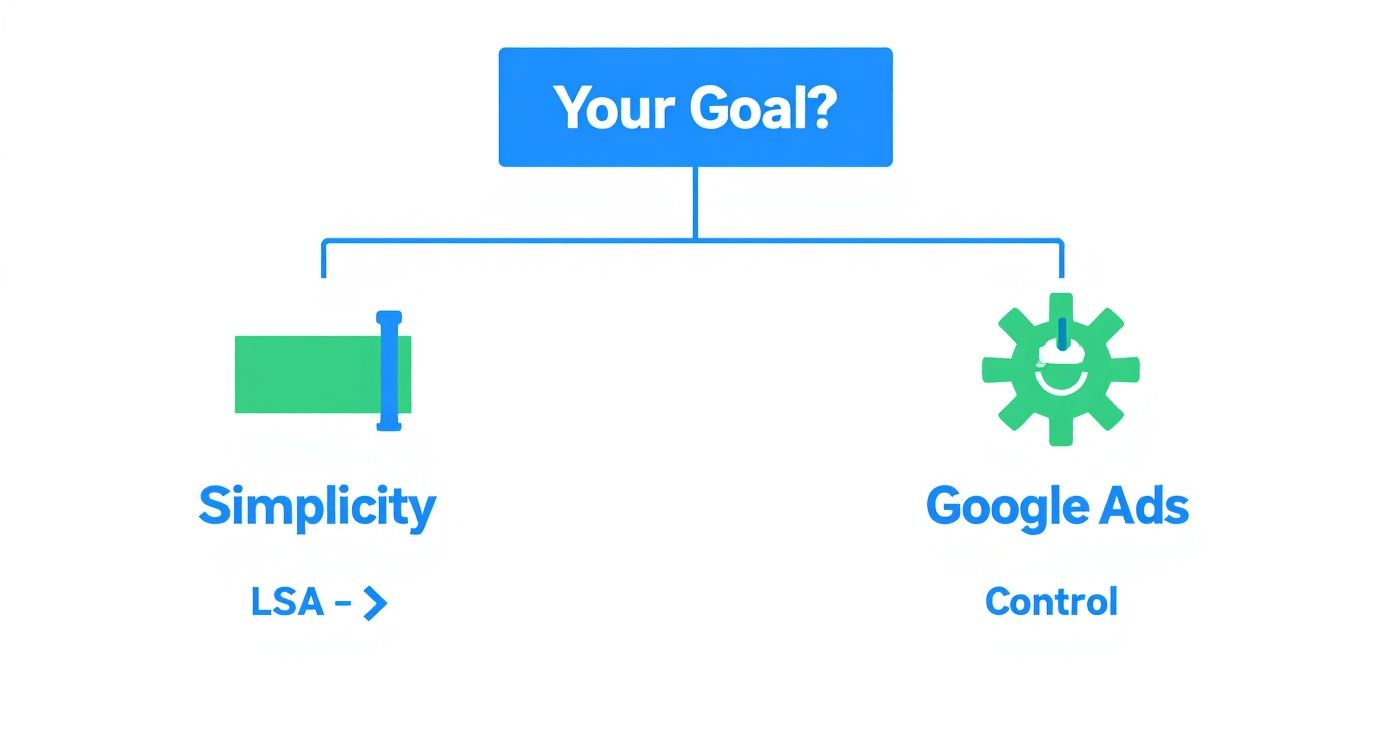
As the infographic shows, if your main goal is getting leads without the headache, Local Service Ads are your best bet. But if you need to be in the driver's seat, you’re pointing straight toward Google Ads.
The Deep Customization of Google Ads
Google Ads is the polar opposite. It offers an almost staggering degree of control over every single piece of your campaign. This is the platform for advertisers who want to meticulously define, chase, and refine their ideal customer segments with a precision LSAs just can't touch.
This granularity is what allows for truly strategic campaigns. For example, you can target users not just by their location, but by their demographics, what they're interested in, and even their past visits to your website using remarketing lists. This capability is why Google Ads dominates the market. Think about it: Google handles over 80% of all desktop searches, and its Display Network reaches over 90% of internet users. That's a colossal audience you can slice and dice with incredible detail. You can explore more about Google's advertising reach to really grasp the scale.
With Google Ads, you aren't just targeting a service area; you're targeting specific people with specific behaviors. This shift from broad-stroke geography to nuanced audience definition is the platform's greatest strength.
Key Targeting Levers in Google Ads
The level of control in Google Ads goes way beyond basic demographics. Here are some of the make-or-break targeting options that set it apart from the automated simplicity of LSAs:
- Keyword Match Types: You get to choose between broad, phrase, or exact match keywords. This gives you direct control over how closely a search has to be to your keywords, letting you filter out tire-kickers and focus your budget on people ready to buy.
- Ad Scheduling: Only want calls during business hours? No problem. You can schedule your ads to run only when you're there to answer the phone. This is a game-changer for service businesses looking to stop wasting money on after-hours clicks that go nowhere.
- Device Targeting: You can bid differently depending on whether someone is on a desktop, tablet, or mobile phone. A personal injury law firm, for instance, would be smart to bid higher on mobile devices to catch people searching for help right after an accident.
- Audience Layering: This is where it gets powerful. You can combine different signals—like targeting users who are actively "in-market" for legal services and who also fall within a certain income bracket. This creates a hyper-specific, high-value audience.
This granular control is precisely why Google Ads is still the king of digital advertising. While LSAs provide an incredibly efficient way to get qualified leads in the door, Google Ads gives you the toolkit to build a sophisticated, multi-layered marketing engine that you can fine-tune to hit very specific business goals.
So, Which One is Right for Your Business?
Figuring out where to put your marketing dollars—Local Service Ads or Google Ads—comes down to understanding your business model, your goals, and who you're trying to reach. There’s no magic bullet here. The real question isn't "which is better?" but "which is the right tool for the job right now?"
The decision really boils down to whether you need a constant flow of immediate leads or you're playing the long game of brand building and market dominance.
For businesses built on urgency, the choice is a no-brainer. Think plumbers dealing with a burst pipe, locksmiths answering a late-night lockout, or an electrician responding to a power outage. In these moments, customers need help, and they need it fast. Trust is everything.
This is where Local Service Ads absolutely shine. The pay-per-lead model, backed by the "Google Guaranteed" badge, cuts right to the chase. It connects you directly with customers ready to hire, filtering out the tire-kickers and saving you a ton of money on wasted clicks.
When Google Ads is the Smarter Play
On the flip side, businesses with a longer sales cycle or those offering high-ticket, specialized services will find Google Ads to be a much better fit. Imagine a custom home builder whose projects are planned months in advance, or a corporate law firm handling a complex merger. These clients aren't making a snap decision from a single ad.
They're doing their homework, and Google Ads is built for that journey. It gives you the control to:
- Target Hyper-Specific Keywords: Go after the exact long-tail phrases your ideal, high-value clients are typing into Google.
- Build Your Brand: Use Display and Video ads to get your name out there and position your firm as the go-to expert.
- Nurture Potential Clients: Stay top-of-mind with remarketing campaigns that follow up with people who've visited your site but haven't yet reached out.
This kind of detailed control is non-negotiable when a client relationship is built over weeks or months, not just one phone call.
Why Not Both? The Power of a Hybrid Strategy
The most sophisticated marketers aren't choosing one over the other; they're using both to create a dominant, two-pronged attack that captures clients at every stage of their search.
Think of it this way: LSAs are your front line, scooping up all the low-hanging fruit. These are the urgent, high-intent leads ready to hire someone today. They keep the lights on and your team busy with a steady stream of revenue.
At the same time, your Google Ads campaigns are working in the background to build a robust, long-term pipeline. These campaigns educate potential clients, showcase your unique expertise, and retarget prospects who are still weighing their options.
This dual approach means you're not just winning today's business—you're securing tomorrow's. Top agencies have mastered this integrated model, and partnering with the right one is crucial. For attorneys, understanding how specialized agencies build these campaigns is key; you can see how different marketing firms for attorneys structure these strategies to maximize every dollar. The end goal is to achieve a commanding presence in your market, ensuring you're there for clients now and later.
Decision Framework: Which Platform to Choose
Still on the fence? This quick-reference table should help you decide which platform aligns best with your immediate goals.
| Your Primary Goal | Choose Local Service Ads | Choose Google Ads | Consider Using Both |
|---|---|---|---|
| Get immediate, high-intent leads | ✓ If you need the phone to ring now with qualified, ready-to-hire customers. | ✓ Use LSAs for immediate demand and Google Ads for long-term pipeline building. | |
| Build brand awareness | ✓ If you need to establish your name and expertise in a competitive market. | ✓ Use Google Ads for branding and LSAs for direct lead generation. | |
| Target a niche, high-value service | ✓ If you need granular control over keywords, ad copy, and audience targeting. | ✓ Target niche terms with Google Ads while capturing broader service calls with LSAs. | |
| You're in an emergency-based industry | ✓ If your customers need you urgently (e.g., plumbing, locksmith, HVAC repair). | ✓ Capture urgent leads with LSAs and use Google Ads for non-emergency services like installations. | |
| Control ad spend and pay for results | ✓ If you prefer a pay-per-lead model over a pay-per-click model. | ✓ Balance a predictable lead cost (LSAs) with the scalability of a PPC budget (Google Ads). | |
| Dominate the entire search results page | ✓ This is the ultimate goal. Appearing in both LSA and traditional ad spots creates maximum visibility and authority. |
Ultimately, the choice isn't just about platforms; it's about aligning your marketing strategy with your business reality. Whether you go with one or both, the key is to be intentional and measure what matters.
Frequently Asked Questions
When you're trying to figure out the best way to spend your marketing dollars, a lot of questions come up. Let's tackle some of the most common ones we hear from law firms comparing Local Service Ads and Google Ads.
Can I Run Local Service Ads and Google Ads at the Same Time?
You absolutely can. In fact, running them together is often the smartest play you can make. It's a two-pronged attack that lets you completely dominate the search results page.
Think of it this way: LSAs are your frontline, capturing high-intent clients who are ready to pick up the phone right now. At the same time, your Google Ads campaigns are working in the background, building your firm's brand recognition, retargeting people who visited your site but weren't ready to commit, and going after highly specific, complex legal keywords. This dual strategy ensures you’re covering all your bases—from immediate leads to long-term growth.
What Is the Google Guaranteed Badge and How Do I Get It?
The Google Guaranteed badge is the ultimate seal of approval from Google. For law firms, you'll often see it called "Google Screened," but the principle is the same: it shows potential clients that you've passed Google's tough vetting process.
To earn it, you have to go through comprehensive background checks and provide proof of your license and insurance. It's not optional; you must have this badge to even be eligible for Local Service Ads. Its real power lies in the instant trust it builds. When a client sees that badge next to your name, it tells them Google has already done the due diligence, making them far more likely to contact you.
The core value of the Google Guaranteed or Screened badge is its ability to instantly overcome a potential client's primary hesitation: "Can I trust this firm?" It's a powerful shortcut to establishing credibility in a crowded market.
Which Platform Has a Better Return on Investment?
This is the million-dollar question, and the honest answer is: it depends. There’s no single winner here because ROI is tied directly to your practice area, how good your leads are, and how well your campaigns are managed.
LSAs often have a more straightforward and easily tracked ROI because you pay per valid lead, not per click. This makes your cost-per-acquisition crystal clear.
Google Ads, on the other hand, can deliver a massive ROI for firms that handle high-value cases or have a long client lifetime value. The catch is that it requires constant, expert management to get there. A finely tuned Google Ads campaign can be a goldmine, but the path to profitability isn't as direct as the LSA model.
What Types of Businesses Are Not Eligible for Local Service Ads?
Google is pretty strict about who gets into the LSA program. Eligibility is limited to specific service-based industries where professionals typically meet clients in person. This means businesses that don't have that direct, face-to-face component are out of luck.
For instance, e-commerce brands, retail stores, and even some very niche legal specialties that don't fit into Google's pre-approved categories won't qualify. For those businesses, the broad reach and incredible versatility of Google Ads remain the go-to solution for connecting with their audience online.
Ready to stop guessing and start getting real results from your legal marketing? The team at Case Quota has over 15 years of experience building winning ad strategies for law firms. We can help you decide between Local Service Ads and Google Ads—or create a powerful hybrid strategy to dominate your local market. Schedule your consultation at https://casequota.com today.