

Competing with larger firms in Southern California can feel like a constant challenge, especially when it comes to online visibility. Small and mid-size firms often face a crowded digital field where every search result counts. By focusing on a thorough website audit, strategic content development, and robust local optimization, your firm can uncover opportunities to boost visibility and attract the right clients. Discover how a grounded approach to technical SEO health and targeted legal content can set your practice apart.
Table of Contents
- Step 1: Analyze Current Website SEO Performance
- Step 2: Optimize Legal Content For Search Intent
- Step 3: Strengthen Local SEO With Google Business Profile
- Step 4: Build Quality Backlinks From Legal Sources
- Step 5: Monitor Results And Refine Your Strategy
Quick Summary
| Key Takeaway | Explanation |
|---|---|
| 1. Conduct Regular SEO Audits | Perform comprehensive SEO audits quarterly to fix errors and enhance website health. |
| 2. Prioritize Search Intent | Optimize content by understanding user intentions to effectively attract potential clients. |
| 3. Optimize Google Business Profile | Ensure your Google Business Profile is complete and accurate to improve local search visibility. |
| 4. Build Quality Backlinks | Focus on acquiring backlinks from authoritative legal sources to strengthen online authority. |
| 5. Monitor Performance Continuously | Regularly track website metrics to refine strategies and maintain search ranking improvements. |
Step 1: Analyze Current Website SEO Performance
Analyzing your law firm’s current SEO performance is the critical first step toward improving your Google rankings. This comprehensive assessment will help you understand exactly where your website stands and identify strategic opportunities for enhancement.
To begin, you’ll want to conduct a thorough technical SEO audit using tools like Google Search Console. Comprehensive SEO audits involve several key diagnostic steps:
- Check website indexing status
- Identify crawl errors and broken links
- Verify mobile responsiveness
- Assess page loading speed
- Review keyword optimization
- Analyze current backlink profile
Specifically for law firms, pay close attention to how your practice area pages are performing. Technical SEO health directly impacts your ability to attract potential clients through organic search results. You’ll want to examine metrics like:
- Total number of indexed pages
- Current search engine rankings for key legal service keywords
- Click-through rates from search results
- Website loading performance across desktop and mobile platforms
The most successful law firm websites understand that SEO is an ongoing process of refinement and strategic optimization.
Automated SEO analysis tools can quickly highlight areas needing improvement. These tools can scan your website and provide instant insights into word count, page titles, meta descriptions, and potential technical issues that might be hindering your search rankings.

Pro tip: Run a comprehensive SEO audit quarterly to stay ahead of potential technical issues and algorithm changes that could impact your law firm’s online visibility.
Step 2: Optimize Legal Content for Search Intent
Optimizing your law firm’s content for search intent is crucial for improving your Google rankings and attracting potential clients. This process involves creating targeted, authoritative content that directly addresses what potential clients are searching for online.
Legal content optimization requires a strategic approach that goes beyond simple keyword insertion. You’ll need to understand the specific search intentions behind legal queries and craft content that provides comprehensive, valuable answers. Here are key strategies to align your content with user search intent:
- Identify common legal questions in your practice areas
- Analyze search query patterns for specific legal services
- Create in-depth, authoritative content that answers these queries
- Use clear, accessible language that speaks directly to potential clients
- Incorporate relevant legal terminology naturally
For each practice area, develop content that addresses different search intents:
- Informational intent: Explanatory articles about legal processes
- Navigational intent: Clear service descriptions and practice area pages
- Transactional intent: Content that guides potential clients toward consultation
Successful legal content meets potential clients exactly where they are in their legal journey.
Semantic search optimization becomes critical in legal content marketing. This means creating content that understands and matches the deeper meaning behind search queries, not just matching exact keywords.
Large language model insights suggest developing content that demonstrates expertise, authoritativeness, and comprehensiveness in your specific legal niche.
Pro tip: Regularly update your content to reflect current legal trends and emerging client questions to maintain relevance and search ranking momentum.
Step 3: Strengthen Local SEO with Google Business Profile
Improving your law firm’s local search visibility starts with a robust Google Business Profile. This critical digital asset acts as your firm’s online storefront, helping potential clients find you quickly and easily in local search results.
Local SEO strategies require meticulous attention to detail when setting up and maintaining your Google Business Profile. The process involves several key steps to maximize your local search potential:
- Claim and verify your business listing
- Ensure all business information is 100% accurate
- Add high-quality, professional photos of your law office
- Select the most precise practice area categories
- Encourage and respond to client reviews
- Keep your business hours and contact information current
Your Google Business Profile optimization should focus on these critical elements:
- Complete every possible field in your profile
- Use professional, high-resolution images
- Write a compelling business description
- Include service-specific keywords naturally
- Regularly update your profile with new information
Your Google Business Profile is more than a listing – it’s your digital first impression for potential clients.
Local search optimization goes beyond simply filling out a profile. Government digital resources emphasize the importance of maintaining consistent business information across all online platforms.
Pro tip: Schedule a monthly review of your Google Business Profile to ensure all information remains current and accurately represents your law firm’s services and expertise.
Step 4: Build Quality Backlinks from Legal Sources
Building high-quality backlinks is a critical strategy for improving your law firm’s search rankings and establishing online authority. This process requires a strategic approach focused on acquiring links from reputable and relevant legal sources.
Backlink strategies demand careful selection of authoritative legal websites and industry-specific platforms. Your goal is to develop a network of credible links that demonstrate your firm’s expertise and reliability:
- Target legal directories with strong reputations
- Seek guest posting opportunities on legal blogs
- Connect with professional legal associations
- Participate in legal industry forums and discussions
- Create shareable, high-quality content that attracts natural links
- Collaborate with other legal professionals for cross-linking
Your backlink acquisition strategy should prioritize these key approaches:
- Identify high-authority legal websites
- Develop relationships with legal industry publications
- Create exceptional, link-worthy content
- Monitor and analyze your backlink profile
- Remove or disavow toxic or irrelevant links
Not all backlinks are created equal – quality always trumps quantity in legal SEO.
Link building techniques require ongoing maintenance and strategic thinking. High-quality backlink principles emphasize the importance of relevance and authority in your link acquisition strategy.
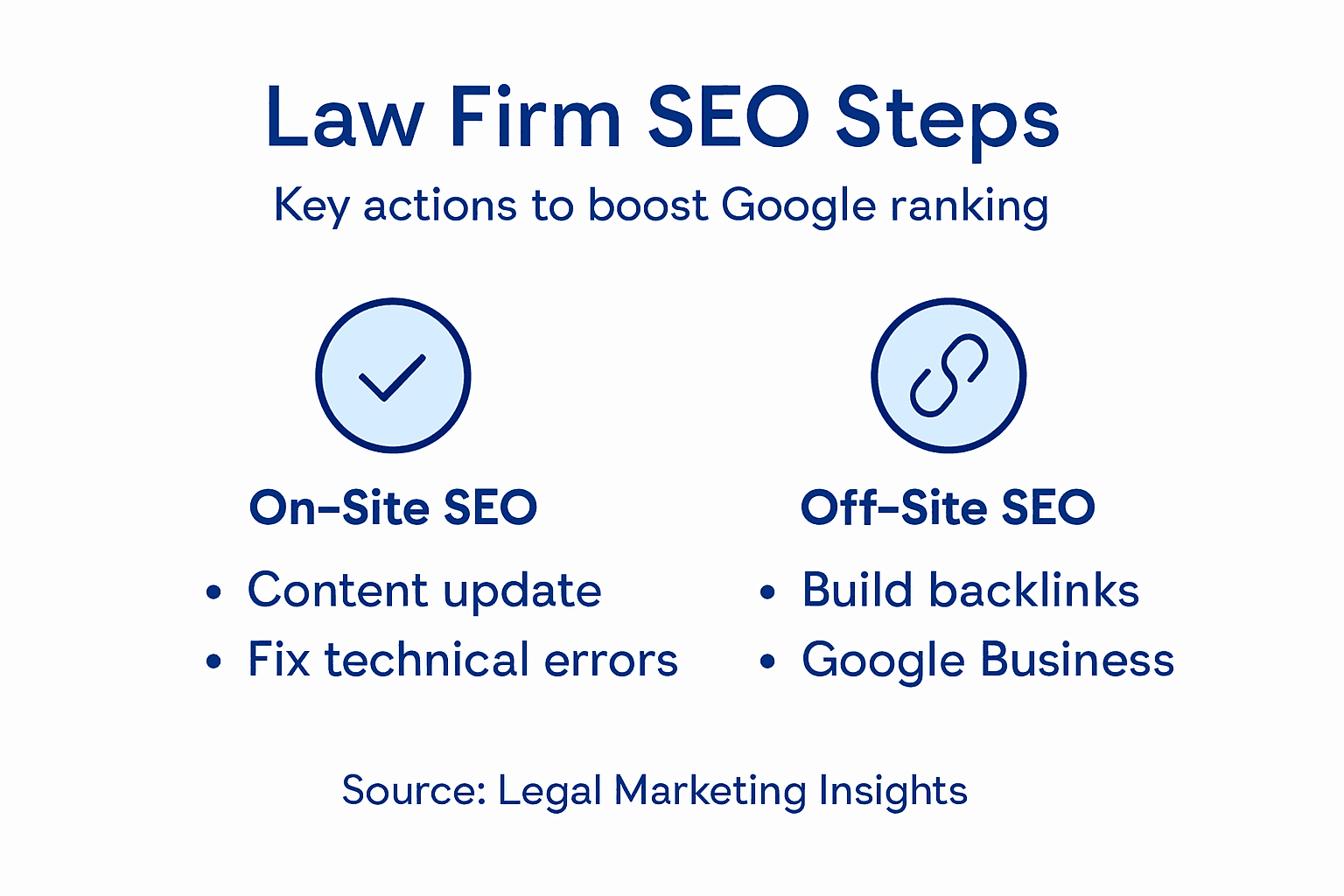
Pro tip: Use professional SEO tools to regularly audit your backlink profile and ensure you’re maintaining a clean, high-quality network of legal industry connections.
Step 5: Monitor Results and Refine Your Strategy
Successfully improving your law firm’s Google rankings requires ongoing monitoring and strategic refinement. This final step transforms raw data into actionable insights that continuously elevate your digital marketing performance.
Strategic SEO monitoring involves using sophisticated analytics tools to track your law firm’s online visibility and performance. Key metrics you’ll want to examine include:
- Organic search traffic volume
- Keyword ranking progression
- Website conversion rates
- User engagement metrics
- Click-through rates from search results
- Bounce rates on practice area pages
Your monitoring approach should include these systematic steps:
- Set up comprehensive tracking in Google Analytics
- Create custom dashboards for quick performance insights
- Compare monthly and quarterly performance trends
- Identify top-performing and underperforming content
- Benchmark against competitor digital marketing metrics
Data-driven refinement is the hallmark of successful law firm digital marketing strategies.
Performance analysis techniques require consistent evaluation and strategic adjustments. Search engine optimization refinement demands a proactive approach to interpreting website performance data.
Pro tip: Schedule quarterly comprehensive SEO audits to ensure your strategy remains aligned with the latest search engine algorithms and your firm’s evolving business goals.
Use this reference to select the best SEO analytics tool for your firm:
| Tool Name | Strength | Ideal Use Case |
|---|---|---|
| Google Analytics | Traffic and behavior data | Track overall website usage |
| Google Search Console | SEO diagnostics | Identify ranking issues |
| SEMrush | Competitive analysis | Benchmark vs. other law firms |
| Ahrefs | Backlink analysis | Monitor inbound links |
Here’s a comparison of law firm SEO strategies and their business impact:
| SEO Strategy | Main Goal | Example Impact on Law Firm |
|---|---|---|
| Technical SEO Audits | Fix site issues | Improved site health and ranking |
| Content Optimization | Match user search intent | Increased client inquiries |
| Local SEO with Business Profile | Boost local visibility | More local client leads |
| High-Quality Backlink Building | Increase site authority | Outrank competitors for keywords |
| Ongoing Performance Monitoring | Refine digital tactics | Sustained ranking improvements |
Elevate Your Law Firm’s Google Ranking with Expert Legal Marketing
Improving your law firm’s Google ranking is more than just fixing technical issues or adding keywords. This article highlights key challenges like optimizing content for true search intent, maintaining a robust Google Business Profile, and building authoritative backlinks. If you want to address these pain points and see real growth in client inquiries, you need a partner who understands the legal market’s unique demands. Case Quota specializes in tailored digital marketing solutions built specifically for law firms competing in Southern California’s crowded marketplace.

Discover how our expert team harnesses proven SEO strategies, AI-powered pay-per-click advertising, and local search optimization to transform your online presence. Don’t let your firm get lost among bigger competitors. Visit Case Quota now to explore how our custom marketing campaigns and fractional CMO services give you a competitive edge. Take action today to secure more leads and grow your client base with confidence.
Frequently Asked Questions
How can I analyze my law firm’s current SEO performance?
To analyze your law firm’s current SEO performance, conduct a comprehensive technical SEO audit. Use tools to check your website’s indexing status, identify crawl errors, verify mobile responsiveness, and analyze keyword optimization.
What type of content should I create to improve my law firm’s Google rankings?
Create targeted, authoritative content that directly addresses the common legal questions potential clients have. Focus on providing comprehensive answers and use clear, accessible language that resonates with your audience.
How do I optimize my Google Business Profile for local SEO?
To optimize your Google Business Profile, ensure all your business information is accurate and complete. Regularly update your profile with high-quality images, a compelling business description, and encourage client reviews to boost local visibility.
What strategies can help me build quality backlinks for my law firm?
You can build quality backlinks by targeting reputable legal directories, guest posting on legal blogs, and participating in industry discussions. Aim to create exceptional content that naturally attracts links from other websites.
How often should I monitor my law firm’s SEO performance?
Monitor your law firm’s SEO performance at least quarterly to remain aligned with the latest trends and algorithm changes. Set up a dashboard to track key metrics like organic search traffic and keyword rankings for continuous improvement.
What are the key metrics to track when refining my law firm’s SEO strategy?
Key metrics to track include organic search traffic volume, keyword ranking progression, and website conversion rates. Focus on identifying top-performing content and comparing trends monthly for actionable insights.
Recommended
- Complete Guide to Law Firm Marketing SEO: Strategies That Drive Results – Case Quota
- How to Improve Google Local Ranking for Law Firms
- Complete Guide to SEO Legal Marketing: Proven Strategies for Law Firms – Case Quota
- Winning Online Website Optimization for Law Firms
- 7 astuces référencement local pour PME à Le Mans – IT-Pascaud