

Think of your law firm’s website not as a digital business card, but as your most powerful, around-the-clock client-acquisition engine. This isn’t just about looking good online; it’s a core business strategy. It’s about meeting a potential client at their moment of need and instantly proving your Law firms is the answer.
Why Your Website Is Your Firm’s Hardest Working Employee

Let’s get one thing straight: your website is no longer a simple online brochure. It has become your firm’s #1 rainmaker, its most visible brand ambassador, and the first handshake you have with a potential client.
Before anyone calls your office or books a consultation, they’re typing their legal anxieties into a search bar. Your website absolutely must be there to greet them.
The modern client journey almost always starts with a Google search. Someone looking for a “criminal defense lawyer near me” or “how to file for divorce” isn’t just hunting for a phone number. They are stressed, and they’re looking for reassurance, authority, and a clear path forward.
Establishing Credibility in a Heartbeat
A well-tuned website does more than just show up in search results—it establishes instant credibility. When your site loads quickly, is a breeze to navigate, and provides clear answers, you are silently communicating professionalism and competence.
This digital first impression is everything. Consider this: approximately 96% of people looking for legal services search for them online. That single stat shows why just being online isn’t enough. You have to be seen as the definitive authority in your practice area. High search rankings build a foundation of trust before you’ve even spoken a single word.
To give you a clearer picture, this guide breaks down the essential components that turn a static website into a lead-generating machine.
Core Pillars of Law Firm Website Optimization
| Pillar | Primary Goal | Impact on Your Firm |
|---|---|---|
| Technical SEO | Make it easy for Google to find, crawl, and index your site. | Higher search rankings and increased organic traffic from qualified leads. |
| UX & Accessibility | Create a seamless, intuitive, and accessible experience for all visitors. | Lower bounce rates, higher engagement, and more consultation requests. |
| Content Strategy | Provide valuable, expert-driven answers to your ideal clients’ questions. | Establishes your firm as an authority and builds trust before the first call. |
| Performance Tuning | Ensure your site is lightning-fast and secure on all devices. | Improved user experience, better Google rankings, and protected firm reputation. |
| Local Visibility | Dominate local search results and the Google Map Pack. | A steady stream of local cases from clients in your service area. |
Each pillar works together to build a powerful online presence that doesn’t just attract visitors, but actively converts them into clients.
The Shift from Tech Chore to Growth Strategy
Seeing website optimization as a simple IT task is a massive missed opportunity. It’s a fundamental part of your firm’s growth and business development. When done right, it directly impacts your bottom line by:
- Attracting the Right Leads: It filters for potential clients who are actively looking for the exact legal services you offer.
- Showcasing Your Expertise: Strong content on your practice area pages positions you as the go-to expert in your field.
- Building a Lasting Asset: Unlike a paid ad that disappears when you stop paying, an optimized website is an asset that grows in value, generating leads for years.
Your website is your firm’s hardest-working employee. It never sleeps, never takes a vacation, and is constantly making a case for your firm to hundreds or thousands of potential clients.
Ultimately, a sharp optimization strategy transforms your digital presence from a passive placeholder into an active, lead-generating machine. It’s one of the most critical aspects of how to market a law firm today, ensuring you connect with clients at the precise moment they need you most.
Building a Foundation That Google Trusts
Before a potential client ever reads a single word on your site, Google has already made up its mind about you. That first impression isn’t based on your case wins or your amazing content; it’s based on the technical health of your website—the digital foundation everything else is built on.
Think of it like this: a brilliant legal argument presented in a chaotic, disorganized courtroom is destined to fail. Your website’s content needs a clean, efficient, and trustworthy environment to have any impact. Get this part wrong, and even the most persuasive copy will never reach the people who need to see it.
The Non-Negotiables of Technical Health
First things first: your website must be secure. In 2024, an HTTPS connection isn’t a feature; it’s table stakes. An unsecured (HTTP) site gets flagged by browsers with a “Not Secure” warning, which is an immediate deal-breaker for client trust. Would you hand over sensitive case details on a site you perceive as unsafe? Of course not.
Just as important is speed. Modern clients expect instant gratification. According to Google, the probability of someone bouncing from your site jumps by 32% as page load time goes from just one to three seconds. A slow site doesn’t just frustrate potential clients; it tells search engines that you offer a poor user experience, tanking your rankings.
“A slow or unsecure website is like having a receptionist who never answers the phone. No matter how great your attorneys are, potential clients will simply move on to the next firm on the list.”
Ignoring these core issues is the fastest way to become invisible online. To really understand the damage, it’s worth reading how a slow, unsecure website and being invisible on Google are directly linked. It’s one of the biggest (and most common) mistakes firms make.
Speaking Google’s Language with Schema Markup
Beyond the basics, you have to explicitly tell search engines what your law firm is all about. This is where schema markup comes in. It’s a bit of code you add to your website that helps search engines understand the context of your content, not just the words.
For law firms, this is a game-changer. You can use specific schema types to define:
- LegalService: Clearly label your practice areas, like “Family Law” or “Criminal Defense.”
- Attorney: Spotlight individual lawyers, showcasing their specialties and credentials.
- LocalBusiness: Pinpoint your firm’s name, address, and phone number—absolutely critical for local search.
When you implement this markup correctly, Google can reward you with rich results. Think star ratings from reviews or a “call” button appearing right in the search results. It makes your listing stand out and gives potential clients a reason to click on you instead of your competitor.
Optimizing for the Mobile-First World
Finally, your website has to work flawlessly on a phone. No exceptions. Over half of all web traffic now comes from mobile devices, and clients are constantly researching lawyers on the go. Google knows this, which is why it uses the mobile version of your site for indexing and ranking. This is called mobile-first indexing.
This means your site needs a responsive design that automatically adapts to any screen. Text must be readable without pinching and zooming, buttons need to be easy to tap, and the navigation has to be simple. A clunky mobile experience isn’t just an annoyance anymore—it’s a direct ranking penalty that will cost you cases.
Crafting Content That Turns Visitors Into Clients

A technically perfect website is just the foundation. The real work—the part that gets the phone to ring—happens when your content connects with a potential client’s very real legal anxieties and shows them you’re the only solution.
Great content does more than just rank on Google. It builds immediate trust, proves your authority, and convinces someone who is stressed and searching for answers to finally make a move.
We’re not talking about generic blog posts. The goal here is to build a strategic library of assets that work together to turn website traffic into actual consultations. This means a laser focus on authoritative practice area pages, genuinely helpful legal guides, and compelling case studies that put your expertise on full display. The entire game of website optimization for law firms is won or lost based on the quality of what you publish.
Uncovering What Your Clients Actually Ask
Your content strategy has to start with getting inside the head of your ideal client. They aren’t searching for broad legal theories; they’re looking for answers to urgent, specific, and often scary problems. This is where effective keyword research becomes less about SEO and more about empathy.
Instead of just chasing a huge term like “personal injury lawyer,” your research needs to dig deeper to find the long-tail keywords that signal real intent. These are the detailed questions people type into Google when they are genuinely in need of a lawyer.
- “What to do after a slip and fall at a grocery store”
- “How is child custody determined in California”
- “Average settlement for a rear-end collision back injury”
These aren’t just keywords; they’re cries for help. Answering them directly with clear, authoritative content is how you start building a relationship before you’ve even spoken. This is the core of smart law firm content marketing—it attracts the right people with the right problems.
From Information to Persuasion
Once you know what questions people are asking, you can build content that not only answers them but also gently guides them toward a consultation. Every single piece of content should have a clear job to do.
Don’t just tell visitors what you do. Show them how you solve problems like theirs by creating content that addresses their immediate fears and questions head-on. This is the fastest way to build credibility.
For example, a blog post titled “5 Things to Know Before Filing for Divorce in Los Angeles” should offer real value and actionable advice. Within that post, you can naturally link to your much more comprehensive “Divorce Law Practice Area” page, which then features attorney bios and a clear, no-pressure call-to-action to schedule a confidential meeting.
This creates a seamless path from someone just gathering information to them becoming a qualified lead. It’s a powerful funnel. And the numbers back it up: while the average conversion rate for law firm websites sits around a modest 2.07%, traffic from these SEO efforts converts at a much higher rate of 7.4%. This shows just how critical it is to attract visitors who are actively looking for solutions.
Building Authoritative Content Pillars
To truly own your market, you need to organize your content around core “pillar” pages for each practice area. Think of these as your definitive, in-depth resources that cover a topic from every angle. All of your related blog posts, FAQs, and case studies should link back to these main pillar pages.
This structure works wonders for two reasons:
- For Users: It creates an organized hub of information, making it incredibly easy for them to find everything they need about their specific legal issue without having to jump all over your site.
- For Google: It sends a massive signal to search engines that your firm has deep expertise on the topic. This boosts the authority and ranking potential of your entire website, not just one page.
By building this kind of robust content engine, you transform your site from a static brochure into a dynamic, client-attracting asset that works for your firm 24/7.
Designing a Client-First User Experience

A technically sound website gets you in the game, but a thoughtful user experience (UX) is what actually wins clients. When someone is facing a legal crisis, the last thing they have patience for is a confusing, cluttered, or frustrating website. Your site’s design has to instill confidence, not add to their stress.
A poor user experience will send them straight to a competitor, often in seconds. This is why focusing on a client-first design is a massive part of any real strategy for website optimization for law firms. It’s all about making it effortless for a person in a tough spot to find exactly what they need, fast.
Making Navigation Intuitive and Reassuring
Your website’s navigation is the roadmap for potential clients. If they can’t immediately find your attorney bios, practice areas, or contact information, you’ve already failed the first test. Keep your main menu dead simple and use clear, direct language.
Think about the user’s mindset. Someone looking for a family law attorney needs to find that specific page without digging through multiple confusing menus. Every single click should feel logical and bring them closer to an answer.
Your website should feel like a calm, organized office, not a chaotic file room. An intuitive design communicates that your firm is professional, competent, and ready to bring order to a client’s complex situation.
Good design is about more than just looks; it’s about empathy. For a deeper dive into creating a site that truly connects with visitors, exploring expert resources on website design for law firms can give you invaluable insights into blending function with professional appeal.
Placing Strategic Calls-to-Action
Once a visitor feels confident you know what you’re doing, you have to give them a clear next step. That’s the job of your Calls-to-Action (CTAs). These aren’t just buttons; they are invitations to start a conversation.
The best CTAs are direct and show the benefit. Instead of a vague “Submit,” use action-driven phrases that manage expectations.
- “Schedule a Free, Confidential Consultation”
- “Download Our Guide to Car Accident Claims”
- “Call Us Now for Immediate Assistance”
Place these CTAs where they can’t be missed. The top-right corner of your header is prime real estate. You also need one at the end of every practice area page and inside relevant blog posts. Make the path to contacting you impossible to miss.
Embracing Accessibility and ADA Compliance
Finally, your website must be accessible to everyone, including individuals with disabilities. This isn’t just an ethical high ground; it’s a legal one. Making your website ADA compliant is a smart move that expands your potential client base and actually improves your SEO.
Accessibility involves practical choices like adding alt text to images for screen readers, ensuring high color contrast for readability, and making sure your site can be fully navigated with just a keyboard. These adjustments don’t just serve a wider audience—search engines recognize them as signs of a high-quality website. An accessible site is, by its very nature, a better-optimized site for everyone.
Winning the Local Battle for Nearby Clients
Let’s be honest, for most law firms, the game isn’t won by attracting clients from across the country. It’s won right in your own backyard. The highest-value cases often come from people in your community, searching on their phones for immediate legal help.
This is why mastering local search is one of the most powerful forms of website optimization for law firms. It’s about connecting with potential clients at the exact moment they need you.
The entire battle is fought and won in Google’s “map pack”—that prime real estate at the top of local search results. Getting your firm featured in one of those top three spots isn’t luck; it’s the result of a deliberate, focused strategy.
Mastering Your Google Business Profile
Think of your Google Business Profile (GBP) as more than just an online directory listing. It’s a dynamic mini-website that Google hands directly to searchers, and it’s your single most important local marketing tool. An incomplete profile is a massive self-inflicted wound, especially when you consider that customers are 70% more likely to visit businesses that have a complete one.
To get this right, you have to go way beyond just plugging in your name and address.
- Get Granular with Categories: Don’t just list your firm as “Lawyer.” That’s far too broad. Your primary category should be specific, like “Personal Injury Attorney” or “Family Law Attorney.” Then, add secondary categories for every other distinct practice area you cover.
- Show, Don’t Just Tell: Upload high-quality photos. I’m talking professional shots of your office (both inside and out) and your team of attorneys. This isn’t vanity; it builds immediate trust and gives a potential client a feel for your firm’s character before they even pick up the phone.
- Lean Into Reviews: Positive reviews are pure gold for local rankings. Make it a habit to ask satisfied clients to leave a review. Just as importantly, respond to every single one—good or bad. This engagement signals to both Google and prospective clients that you’re attentive and genuinely care about feedback. Mastering this is so crucial, it’s worth diving deep into online reputation management for lawyers.
A fully optimized Google Business Profile is the single most powerful lever you can pull to increase your local visibility. Treat it with the same care and attention you give your actual website’s homepage.
Ultimately, attracting local traffic is about guiding a user from discovery to action. The journey has to be seamless.
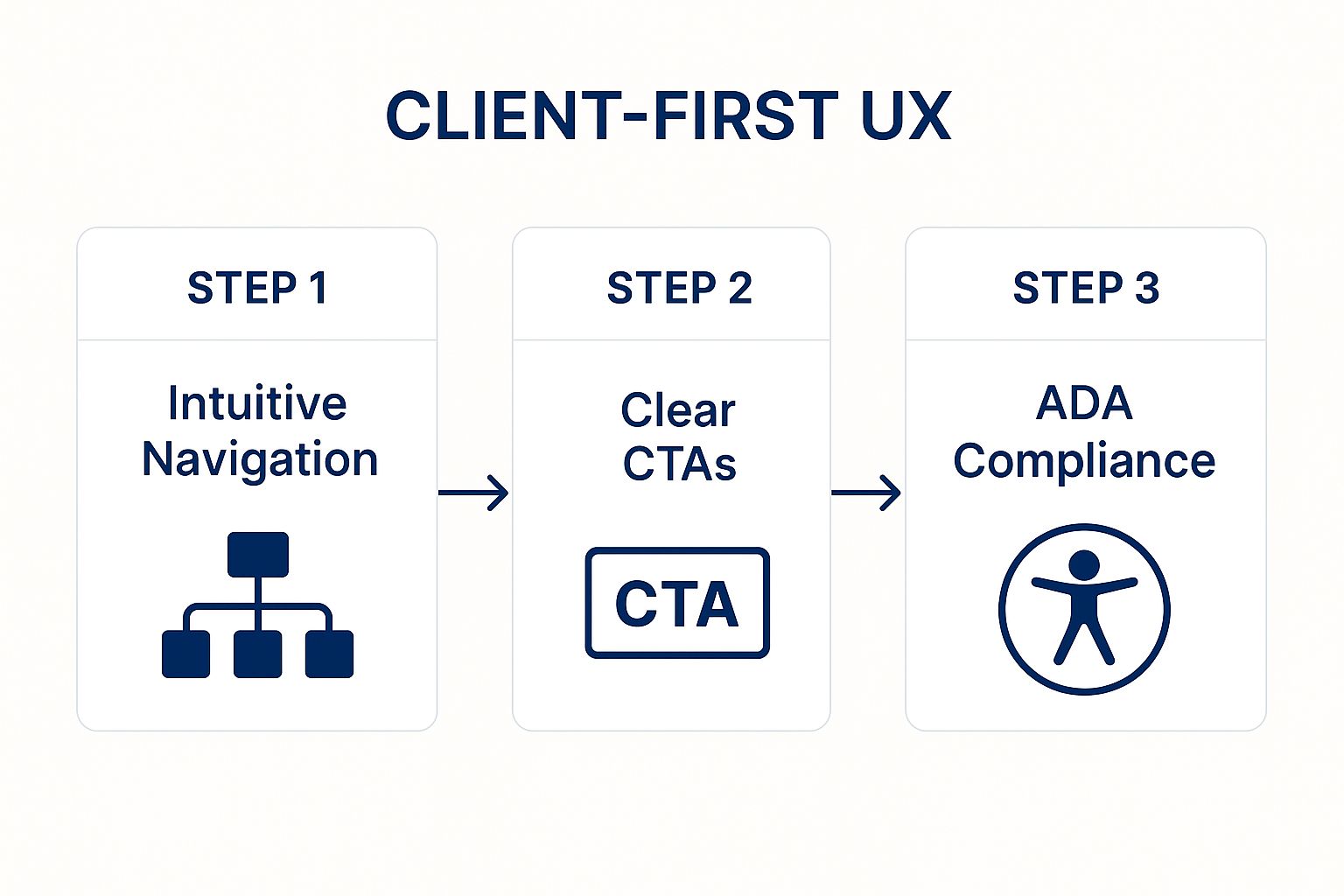
This flow shows how a great user experience is a logical progression. Nailing each of these steps is what turns a local searcher into a new client.
The Critical Role of NAP Consistency
Your GBP is the centerpiece, but Google doesn’t take it at face value. It acts like a detective, cross-referencing your firm’s information all across the web to verify that you are who you say you are.
This is where your Name, Address, and Phone Number (NAP) come in. This information must be identical everywhere it’s listed online.
That means checking major legal directories like Avvo and FindLaw, your social media profiles, and local business directories. A tiny inconsistency—like using “St.” on one site and “Street” on another—can create confusion for Google’s algorithm, diluting your local authority and dragging down your rankings.
Absolute consistency is the key to building the trust signals Google needs to confidently recommend your firm to people searching nearby.
To help you get this right, here is a simple checklist to follow.
Local SEO Checklist for Law Firms
This table breaks down the essential tasks for boosting your local search presence, organized by what will give you the biggest impact first.
| Action Item | Priority Level | Expected Outcome |
|---|---|---|
| Fully Optimize Google Business Profile | High | Increased visibility in Google Maps & the “map pack” |
| Audit and Correct NAP Consistency | High | Stronger local authority and trust signals with Google |
| Generate a Steady Stream of Reviews | High | Improved ranking, social proof, and higher click-through rates |
| Create Localized Landing Pages | Medium | Rank for “[practice area] + [city]” specific search queries |
| Acquire Local Backlinks | Medium | Boosts domain authority and local relevance |
| Add Local Business Schema Markup | Low | Helps search engines understand your location and services |
By working through these items, you’re not just checking boxes; you’re building a powerful, sustainable foundation for attracting local clients who need your help right now.
Measuring What Matters for Sustainable Growth
Getting your website right isn’t a “set it and forget it” task. It’s a constant loop of making smart changes, checking the results, and tweaking your approach. If you want to see your efforts turn into actual clients and revenue, you have to look past vanity metrics like raw traffic numbers.
You need to focus on the key performance indicators (KPIs) that really signal growth for a law firm. Tracking the right data is the only way to prove your marketing is working and decide where to put your money next. Without it, you’re just flying blind.
Identifying Your Firm’s True North Metrics
For a law firm, website activity is not all created equal. A thousand random visitors who click away are far less valuable than five people who are genuinely looking for legal help. Your entire measurement strategy has to be laser-focused on tracking the actions that represent a potential new case.
These are the metrics that actually move the needle:
- Conversion Rate: The percentage of visitors who actually do something, like filling out your contact form or calling the office.
- Contact Form Submissions: A hard count of how many potential clients have reached out directly through your site.
- Click-to-Call Completions: A crucial mobile metric showing how many users tapped your phone number to call you right from the search results or your site.
- Lead Quality: This is a big one. Are the inquiries you’re getting for the practice areas you actually want? And are they from clients you can even represent?
The most crucial part of website optimization for law firms is tying every action back to a measurable business outcome. Your goal isn’t just to get more traffic; it’s to sign more of the right cases.
This focus on tangible results is more critical than ever. We saw a massive shift where 84% of law firms planned to ramp up their digital marketing budgets, because they saw the direct line to growth. When you consider that the cost-per-click for some legal keywords can hit an eye-watering $1000, a smart organic SEO strategy isn’t just a nice-to-have—it’s your best defense against insane ad costs. You can learn more about legal marketing statistics to see just how fierce the competition has gotten.
Essential Tools for Tracking Success
The good news is you don’t need a bunch of expensive software to get started. Two incredibly powerful—and free—tools from Google give you everything you need to guide your strategy.
1. Google Analytics (GA4)
This is your command center for understanding what people do once they land on your site. With GA4, you can see how visitors found you, which pages they spend time on, and most importantly, track the real-world goals we just talked about. It answers the question, “What are people doing on my website?”
2. Google Search Console (GSC)
Think of Google Search Console as your direct line to Google itself. It shows you exactly which search terms are bringing people to your site, how you’re ranking for key phrases, and flags any technical problems that might be tanking your visibility. It answers the question, “How are people finding my website?”
Using these two tools together gives you a complete picture. You can directly connect an SEO effort (like finally ranking for “divorce lawyer in downtown Dallas”) to a real business result (like a sudden increase in contact form submissions). This data-first approach is the secret to building sustainable, long-term growth.
Answering Your Top Questions About Law Firm Website Optimization
Even with a solid plan, I know a lot of attorneys and marketing directors still have questions about how all this works in the real world. Let’s dig into some of the most common ones I hear.
How Long Until I Actually See SEO Results?
This is always the first question, and for good reason. While a few quick technical tweaks might give you a small, immediate bump, the truth is that ranking for valuable legal keywords is a long-term play.
Being realistic, you should expect to see significant, needle-moving progress in 6 to 12 months.
Think about what it takes to get referrals in your community. You don’t become the go-to “criminal defense attorney” overnight. It takes time to build a reputation. SEO works the same way. You’re building digital authority through consistent content, technical excellence, and local signals. You’ll likely see early signs of life—like climbing the ranks for less-contested, long-tail keywords—within the first 3 to 4 months, but the big wins take patience.
SEO is like building a reputation. It doesn’t happen with one big splash. It’s the result of consistent, high-quality work over time that eventually makes you the obvious choice.
What’s More Important: The Content or the Design?
Ah, the classic chicken-or-the-egg debate. But in web optimization, it’s not a competition. They are completely codependent, and one is useless without the other.
- Great Content, Bad Design: Imagine you wrote the most definitive guide to personal injury claims in your state. If that article is on a website that’s slow, looks untrustworthy, or is impossible to read on a phone, no one will stick around to read it. They’ll leave frustrated before ever realizing you’re an expert.
- Great Design, Bad Content: On the flip side, a stunningly beautiful, lightning-fast website with thin, generic content is just an empty brochure. It will never earn the trust of Google or a potential client. It looks the part but offers zero value.
A winning website seamlessly marries deep, expert content with a clean, professional design that makes it incredibly easy for a visitor to take the next step and contact you.
Can I Do This Myself, or Do I Need an Agency?
Many firms can absolutely handle the basics in-house. Things like claiming and updating your Google Business Profile, writing your first few blog posts, and setting up a system to ask clients for reviews are fantastic starting points.
But let’s be blunt: the online legal space is a shark tank. You aren’t just competing against the firm down the street; you’re up against practices with full-time marketing staff and six-figure budgets.
To consistently rank for the terms that bring in high-value cases, you’re going to need specialized expertise. A good agency lives and breathes technical SEO, legal content strategy, and link building for lawyers. They’ve already made the mistakes, run the tests, and know what it takes to win in this brutally competitive arena.
At Case Quota, we turn your firm’s website into its most reliable engine for client acquisition. We know the legal market inside and out and focus exclusively on strategies that drive real, measurable growth.
Ready to see what a dedicated partner can do for your firm? Learn more about our approach at https://casequota.com.