

Over 80 percent of American legal marketers now rely on Artificial Intelligence to drive growth. Small and mid-sized law firms in Southern California must rethink their strategies to stay competitive against larger rivals. Smart use of AI can help firms attract the right clients, streamline their marketing tasks, and build a stronger local reputation. This guide explains which AI tools truly impact client acquisition and how modern technology changes the way law firms connect with their communities.
Table of Contents
- Defining AI In Modern Legal Marketing
- Types Of AI Tools For Law Firm Campaigns
- How AI Personalizes And Automates Outreach
- Enhancing Local Visibility With AI Technology
- Risks, Ethics, And Compliance In Legal AI Marketing
- Comparing AI Approaches To Traditional Methods
Key Takeaways
| Point | Details |
|---|---|
| AI Revolutionizes Legal Marketing | AI technologies enhance client acquisition and deliver personalized services by analyzing data and predicting client behaviors. |
| Diverse AI Tools for Efficiency | Utilizing tools like predictive analytics and content generation can significantly optimize marketing campaigns and improve performance. |
| Personalization Enhances Client Engagement | AI-driven outreach strategies create highly tailored communications that resonate with specific client needs and preferences. |
| Ethical Considerations are Crucial | Law firms must implement ethical guidelines to ensure client privacy and avoid misrepresentation while using AI in marketing. |
Defining AI in Modern Legal Marketing
Artificial Intelligence represents a transformative technology reshaping legal marketing strategies, enabling law firms to enhance client acquisition, streamline operational workflows, and deliver more personalized legal services. At its core, AI in legal marketing leverages machine learning algorithms and advanced data processing to generate sophisticated insights, predict client behaviors, and optimize marketing approaches.
The legal industry is experiencing a profound technological shift, with generative AI expanding the reach of legal services and marketing capabilities. These intelligent systems can analyze vast datasets, identify potential client demographics, and generate targeted marketing content with unprecedented precision. By processing historical performance data, AI tools help law firms understand which marketing messages resonate most effectively with specific client segments, allowing for hyper-personalized communication strategies.
Key applications of AI in legal marketing include predictive client profiling, automated content generation, intelligent lead scoring, and data-driven campaign optimization. Marketing professionals can now leverage AI to:
- Predict potential client conversion probabilities
- Generate personalized email and social media content
- Analyze competitor marketing strategies
- Automate client communication workflows
- Develop dynamic audience segmentation models
Pro tip: Start small by integrating one AI-powered marketing tool into your current strategy and measure its performance against traditional methods to understand its specific impact for your law firm.
Types of AI Tools for Law Firm Campaigns
Law firms can leverage a diverse array of AI marketing tools designed to transform digital outreach and client engagement strategies. Marketing automation platforms utilize sophisticated AI algorithms to streamline communication, personalize client interactions, and optimize campaign performance across multiple digital channels.
Specific AI tools tailored for legal marketing include intelligent solutions that address unique industry challenges. These technologies range from advanced chatbots capable of initial client screening to predictive analytics platforms that help firms understand potential client behaviors. For instance, AI-powered CRM systems can now analyze historical case data, predict potential client conversion rates, and recommend targeted marketing approaches with remarkable precision.
Key categories of AI marketing tools for law firms encompass:
The following table summarizes key AI tool categories and their main business impact for law firms:
| AI Tool Category | Primary Function | Business Impact |
|---|---|---|
| Conversational Chatbots | Initial client engagement | Speeds up lead response times |
| Predictive Analytics | Forecasting client conversion | Improves marketing ROI |
| Content Generation | Crafting tailored materials | Enhances client personalization |
| SEO Optimization | Boosting online visibility | Attracts more local clients |
- Conversational AI Chatbots: Handling initial client inquiries and screening potential leads
- Predictive Analytics Platforms: Analyzing client behavior and predicting case acquisition probabilities
- Content Generation Tools: Creating personalized marketing materials and case-specific communications
- SEO Optimization Software: Improving online visibility and search engine rankings
- Client Segmentation Systems: Developing targeted marketing strategies based on demographic and behavioral data
Pro tip: Start by selecting one AI tool that addresses your most significant marketing challenge and conduct a focused pilot program to measure its specific impact on your firm’s client acquisition efforts.
How AI Personalizes and Automates Outreach
Artificial Intelligence has revolutionized client outreach by transforming traditional marketing approaches into highly targeted, dynamic communication strategies. Law firms can now leverage advanced lead nurturing techniques that adapt in real-time to potential client behaviors, interests, and engagement patterns, creating a more personalized and responsive marketing ecosystem.

The automation capabilities of AI enable law firms to develop sophisticated communication workflows that feel individualized and contextually relevant. Intelligent systems can analyze historical interaction data, track client touchpoints, and generate automated yet nuanced communication sequences that feel authentically personalized. This approach allows marketing teams to maintain consistent engagement without the manual effort traditionally required for relationship building.
Key personalization and automation strategies include:
- Dynamic Content Generation: Creating tailored email and messaging content
- Behavioral Tracking: Monitoring potential client interactions across digital platforms
- Predictive Response Modeling: Anticipating client needs before they articulate them
- Segmentation Intelligence: Categorizing leads based on complex behavioral and demographic signals
- Automated Follow-up Sequences: Designing intelligent communication cascades that adapt to client responses
Pro tip: Implement a phased AI integration strategy by first applying automation to your most time-consuming marketing communication processes, carefully measuring engagement metrics to validate and refine your approach.
Enhancing Local Visibility With AI Technology
AI technology has transformed local marketing strategies for law firms, enabling unprecedented precision in targeting potential clients within specific geographic regions. Local marketing strategies now leverage sophisticated SEO techniques that dynamically adapt to regional search patterns, helping law firms become more discoverable in competitive local markets.
Intelligent geotargeting technologies allow law firms to create hyperlocal marketing campaigns that speak directly to community-specific legal needs. AI algorithms analyze complex data points including local search trends, demographic information, and geographic search behaviors to generate highly targeted content and advertising strategies. These systems can pinpoint exactly where potential clients are searching, what legal services they need, and how to effectively communicate with them.
Key AI-powered local visibility strategies include:
- Hyperlocal Keyword Optimization: Tailoring content to specific neighborhood and city-level search terms
- Intelligent Geofencing: Creating targeted ad campaigns within precise geographic boundaries
- Dynamic Local Content Generation: Producing region-specific legal advice and marketing materials
- Localized Search Intent Analysis: Understanding neighborhood-level legal service requirements
- Automated Local Listing Management: Optimizing and maintaining online business profiles across multiple platforms
Pro tip: Conduct a comprehensive local digital audit using AI tools to identify your firm’s current local search performance, then develop a targeted strategy to address specific geographic visibility gaps.
Risks, Ethics, and Compliance in Legal AI Marketing
Legal marketing professionals must navigate a complex landscape of ethical considerations when implementing AI technologies. Emerging governance frameworks are critical for responsible AI deployment that maintains professional integrity and protects client confidentiality while leveraging technological innovations.
The integration of AI into legal marketing requires a nuanced approach that balances technological capabilities with stringent ethical guidelines. Potential risks include data privacy violations, algorithmic bias, unauthorized client information processing, and unintentional misrepresentation of legal services. Law firms must implement robust oversight mechanisms that ensure AI tools operate within established professional conduct standards, maintaining transparency and avoiding manipulative marketing practices.
Key ethical considerations for AI marketing in legal practices include:
- Data Privacy Protection: Ensuring client information remains confidential and secure
- Algorithmic Bias Mitigation: Preventing discriminatory targeting or messaging
- Transparent Marketing Practices: Clearly disclosing AI-generated content and interactions
- Informed Consent: Obtaining explicit permission for data usage and AI-driven communications
- Professional Conduct Compliance: Adhering to state bar advertising regulations
Pro tip: Develop a comprehensive AI ethics policy that outlines specific guidelines for technological implementation, including regular audits and accountability mechanisms for your marketing technologies.
Comparing AI Approaches to Traditional Methods
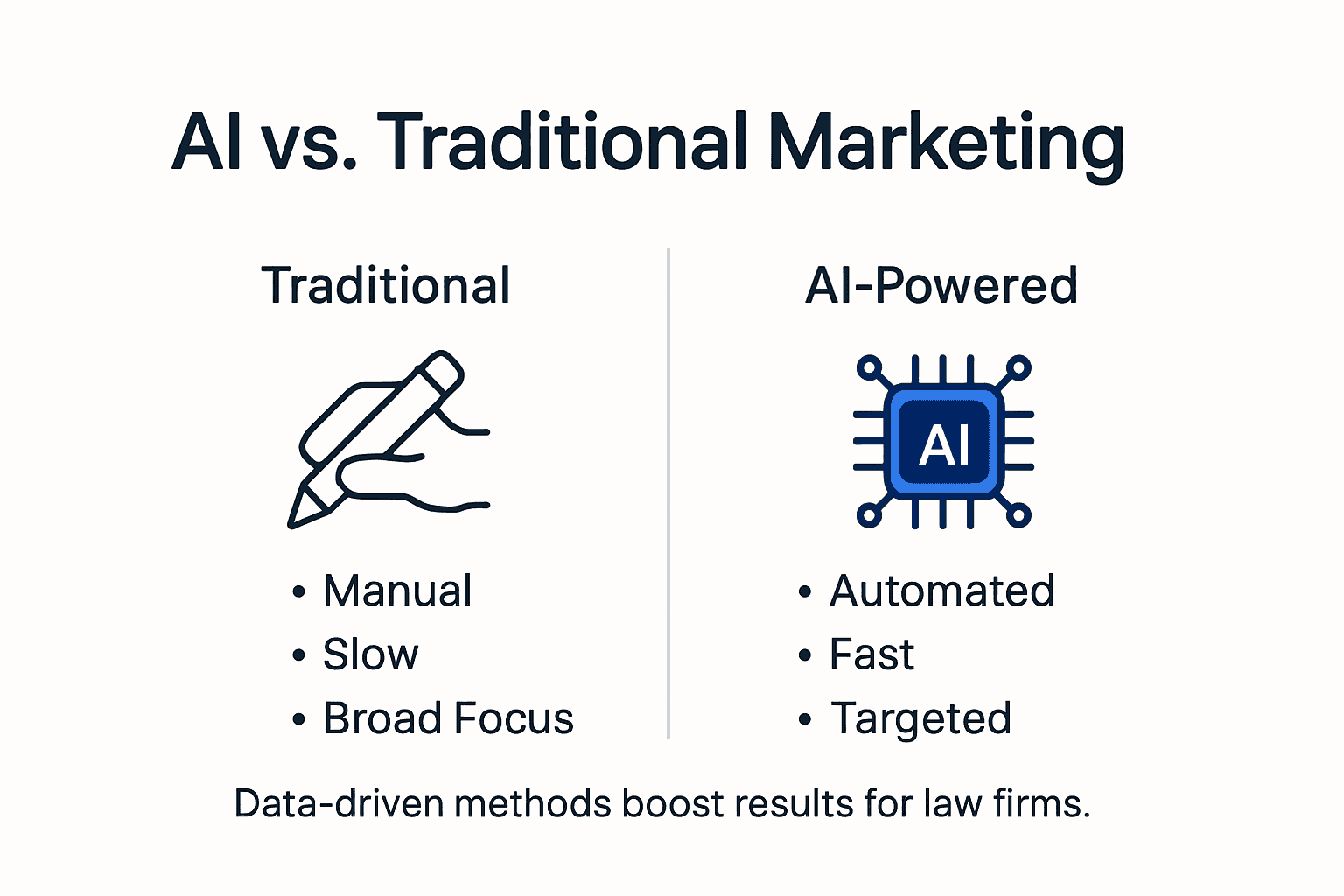
Emerging marketing technologies dramatically transform traditional strategies by introducing data-driven precision and dynamic adaptability into legal marketing workflows. Where traditional methods relied on broad, intuitive approaches, AI-powered systems now enable hyper-targeted, real-time communication strategies that respond instantaneously to potential client behaviors and preferences.
The fundamental distinction between AI and traditional marketing lies in their core operational mechanisms. Traditional marketing strategies depend on human intuition, manual segmentation, and generalized targeting, whereas AI marketing leverages complex algorithms, machine learning, and continuous data analysis to create personalized, predictive engagement models. This shift allows law firms to move from reactive, one-size-fits-all communication to proactive, individualized client interaction strategies.
Key comparative elements between AI and traditional marketing approaches include:
Here’s a comparative overview of key marketing approaches for law firms:
| Aspect | AI-Powered Marketing | Traditional Marketing |
|---|---|---|
| Targeting Precision | Highly specific, data-driven | Broad, intuition-based |
| Adaptability | Real-time campaign updates | Periodic, manual adjustments |
| Content Personalization | Hyper-personalized messaging | Generic communication |
| Resource Efficiency | Automates repetitive tasks | Requires manual effort |
- Data Processing: AI analyzes massive datasets instantaneously
- Personalization: AI generates hyper-targeted content
- Response Time: AI enables real-time campaign adjustments
- Cost Efficiency: AI reduces manual labor and optimization expenses
- Predictive Capabilities: AI forecasts client behavior with statistical precision
Pro tip: Implement a hybrid approach by gradually integrating AI tools alongside existing marketing strategies, allowing your team to benchmark performance and systematically optimize technological adoption.
Unlock the Power of AI to Grow Your Law Firm Client Base
The article highlights the challenge law firms face in navigating complex AI technologies to create personalized, efficient, and ethical marketing strategies. Many firms struggle with implementing AI tools that boost local visibility, automate client outreach, and enhance lead conversion while staying compliant with legal advertising ethics. If you want to overcome these pain points and harness AI-powered marketing tailored specifically for law practices in Southern California, you are in the right place.
At Case Quota, we specialize in delivering customized digital marketing solutions that integrate AI-driven strategies like SEO-optimized web design, pay-per-click advertising with smart targeting, and Google Local Services Ads. Our 15 years of digital expertise combined with six years focused on California legal marketing empower small to mid-size law firms to compete effectively against larger firms with bigger budgets. Experience firsthand how AI-enhanced marketing can transform client acquisition and campaign ROI.
Discover a proven partner who understands the unique demands of legal marketing.

Ready to elevate your marketing with AI-powered strategies designed exclusively for law firms? Visit Case Quota to explore how our comprehensive solutions can help you personalize outreach, improve local visibility, and automate workflows ethically and effectively. Don’t wait — start gaining your competitive edge today by connecting with our expert team to build your tailored marketing plan.
Frequently Asked Questions
What are the main benefits of using AI in legal marketing?
AI in legal marketing enhances client acquisition, streamlines workflows, and personalizes services by analyzing data and predicting behaviors, leading to more effective marketing strategies.
How can AI tools improve client engagement for law firms?
AI tools improve client engagement by enabling predictive client profiling, automated content generation, and intelligent lead scoring, resulting in tailored marketing communications and increased responsiveness.
What types of AI tools are commonly used in legal marketing campaigns?
Common AI tools for legal marketing include conversational chatbots for client inquiries, predictive analytics for forecasting conversions, content generation tools for personalized materials, and SEO optimization software for online visibility.
What ethical considerations should law firms keep in mind when utilizing AI in marketing?
Law firms should ensure data privacy protection, mitigate algorithmic bias, maintain transparency in marketing practices, obtain informed consent for data usage, and comply with professional conduct standards.
Recommended
- Marketing Trends for Law Firms 2025: Winning Strategies
- Digital Marketing Agency for Attorneys: Complete Guide to Growing Your Law Practice Online – Case Quota
- Why Law Firms Need Digital Marketing for Growth | Case Quota
- Legal Marketing for Small Firms A Complete Guide
- Rôle de l’IA en SEO : Impact, Outils et Bonnes Pratiques – ByTheWise