

Let’s be real for a moment—hoping for another word-of-mouth referral to walk through the door isn’t a growth strategy. Not anymore. We live in a world where the first stop for someone needing a lawyer is a search bar. For a small firms to compete, let alone thrive, you need a modern marketing plan. This guide is built to give you exactly that, with practical advice that works for smaller practices.
Why Your Old Marketing Playbook is Collecting Dust

The old-school methods just don’t have the same pull. Networking events and local print ads have lost their power. Sure, referrals are still gold when they come in, but you can’t build a predictable, scalable business on them. Your potential clients aren’t thumbing through the Yellow Pages anymore. They’re typing into Google, scrolling through online reviews, and checking out your social media profiles.
This seismic shift means one thing: visibility is everything. If your firm doesn’t show up in local search results or lacks a professional online footprint, you’re essentially invisible to the overwhelming majority of people actively looking for legal help. Marketing for small law firms has moved from a “nice-to-have” to an absolute necessity for survival.
The New Competitive Landscape
The legal field is more crowded than it’s ever been, and a wait-and-see approach is a recipe for stagnation. The numbers don’t lie. Research predicts that by 2025, 58% of law firms and solo practitioners will be actively using marketing strategies to bring in cases. What’s more, a whopping 83% of them are outsourcing that work to specialized agencies, which tells you just how much value they place on an expertly managed digital presence.
This new reality demands a completely different mindset. Instead of waiting for clients to find you, you have to go meet them where they already are—online. That means deploying a smart mix of digital tactics designed to build trust and establish your authority before they even think about picking up the phone.
The goal isn’t just to be found. It’s to be chosen. A strong digital presence communicates your credibility and expertise long before a potential client ever speaks to you.
What This Guide Will Cover
Think of this guide as your roadmap to sustainable growth in this new era. We’ll start with the fundamentals and build up to the advanced tactics that can help you punch above your weight and take on larger competitors.
You’re going to learn how to:
- Build a powerful online presence that attracts the right kind of clients.
- Pick the most effective digital channels for your specific practice area.
- Map out a realistic budget and actually measure your return on investment.
- Navigate the tricky ethical rules of legal marketing and stay compliant.
Mastering these core components will give you the power to craft a plan that truly works for your firm. If you want a head start, you can explore our detailed overview of effective law firm marketing strategies.
Building Your Law Firm’s Marketing Foundation
Every successful legal case starts with meticulous preparation. The same holds true for marketing. Before you spend a single dollar on ads or SEO, you have to lay a solid groundwork. Jumping straight into tactics without a clear strategy is like walking into a trial without reviewing the evidence—it’s a surefire way to burn through cash with nothing to show for it.
This foundational stage is all about making deliberate choices that will guide every marketing decision you make down the line. It’s what keeps your efforts focused, efficient, and aimed squarely at the clients you actually want to work with. Honestly, skipping this is one of the biggest and most common mistakes I see small firms make.
Define Your Ideal Client with Precision
The first step is to get way more specific than broad practice areas like “family law” or “business litigation.” Who is your ideal client? Answering this question in granular detail is critical for effective legal marketing for small firms. Think of it like creating a detailed profile of a key witness—the more you know, the stronger your case.
Don’t just stop at their legal problem. You need to understand their entire world.
- Demographics: How old are they? Where do they live? What do they do for a living, and what’s their income level? A 30-year-old tech founder who needs a contract reviewed has completely different worries than a 65-year-old retiree working on their estate plan.
- Psychographics: What are their fears, their goals, their motivations? Getting inside their head helps you craft messages that connect on a human level, not just a legal one.
- Online Habits: Where do they hang out online? Are they scrolling through local Facebook groups, networking on LinkedIn, or reading niche industry blogs? This tells you exactly where you need to be to get their attention.
When you know this stuff, you can create content and ads that speak directly to their pain points, making your firm feel like the only logical choice.
Craft Your Unique Value Proposition
Once you know who you’re talking to, you have to give them a compelling reason to pick you. This is your Unique Value Proposition (UVP). In a sea of other attorneys, your UVP is the clear, punchy answer to a potential client’s biggest question: “Why should I hire your small firms over that big, fancy one down the street?”
Your UVP isn’t a simple list of your services. It’s the promise you make to your clients—the unique benefit or experience they will only get by working with you. It’s what makes you different.
For a small firms, your biggest advantages are often in areas where large firms just can’t compete. Maybe you offer direct partner access on every single case. Perhaps it’s a more empathetic, client-first approach, or you have deep, specialized expertise in a tiny corner of the law. Whatever it is, define it, own it, and wrap all of your messaging around it.
This infographic breaks down these core pillars in a really simple, visual way.
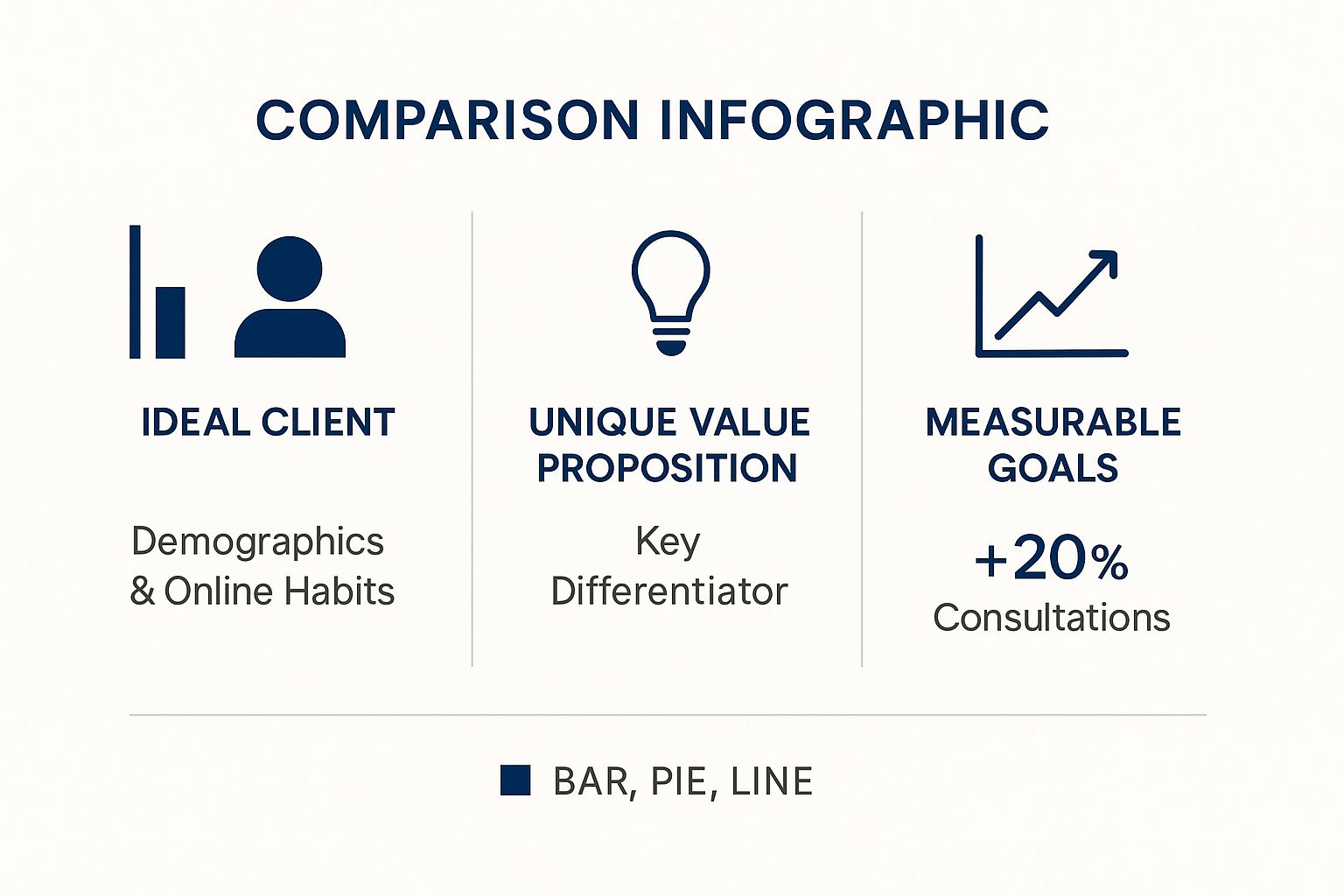
You can see how these three elements—the who, the why, and the what—all lock together to create a solid, actionable strategy for growing your firm.
Set Clear and Measurable Goals
Finally, your foundation needs a blueprint. That comes from setting specific, measurable goals. Vague ambitions like “get more clients” are useless because they’re impossible to track and lead to scattered, ineffective marketing. You need tangible targets that define exactly what success looks like for your firm.
Start thinking in terms of concrete, numbers-based outcomes.
- Increase qualified consultation bookings by 20% in the next quarter.
- Grow organic website traffic from local searches by 15% within six months.
- Generate 10 new, qualified leads per month from our Google Business Profile.
Goals like these give you a clear yardstick to measure your performance. They turn marketing from a mysterious, frustrating expense into a predictable engine for growth. To start pulling these pieces together, you can use a helpful law firm marketing plan template. This kind of structure makes sure that every dollar you spend and every action you take is a deliberate step toward a defined business objective.
Choosing the Right Digital Marketing Channels

Alright, with a solid marketing foundation in place, the next big question is where to actually spend your time and money. The world of digital marketing is huge, and it’s incredibly easy to get pulled in a dozen different directions. Trying to be everywhere at once is a classic mistake that burns out small firms and wastes precious cash.
The key isn’t mastering every single platform out there. It’s about making smart, strategic choices. You need to figure out the handful of high-impact channels where your ideal clients are already looking for help and go all-in on those. Think of it like fishing—you don’t cast a net across the entire ocean; you find the spot where the fish are biting.
To help you decide, let’s compare some of the most effective channels for smaller practices.
Digital Marketing Channel Comparison for Small Law Firms
This table breaks down the main options based on what they’ll cost you in time and money, and what kind of impact you can expect.
| Channel | Primary Goal | Typical Cost | Time Investment | Key Benefit for Small Firms |
|---|---|---|---|---|
| Local SEO | Get found in local searches | $-$$ | Medium-High | Highest ROI for attracting local clients with immediate legal needs. |
| Content Marketing | Build trust and authority | $$ | High | Attracts clients by answering their questions; long-term SEO asset. |
| PPC Advertising | Generate leads quickly | $$-$$$ | Medium | Immediate visibility and lead flow, but expensive to maintain. |
| Social Media | Build community & referrals | $-$$ | Medium | Great for staying top-of-mind and connecting with referral sources. |
| Email Marketing | Nurture leads & referrals | $ | Low-Medium | Keeps you connected with past clients and professional contacts. |
Ultimately, a mix of these is ideal, but starting with one or two is the most realistic path to success. Now, let’s dig into the non-negotiables.
Dominate Your Backyard with Local SEO
For most small law firms, your clients live and work right in your community. That makes Local Search Engine Optimization (SEO) the single most powerful tool you have. When someone in your town searches for “family lawyer near me,” you absolutely need to be the first name they see.
Local SEO is all about making your firm hyper-visible in location-based Google searches. It’s not about competing with massive national firms; it’s about becoming the undisputed legal authority in your specific service area. The absolute cornerstone of this strategy is your Google Business Profile (GBP).
Think of your Google Business Profile as your digital storefront. It’s often the very first interaction a potential client has with your firm, and it’s completely free to set up and optimize.
A well-managed GBP can start generating calls and website visits almost immediately. To make yours a client-magnet, you have to focus on these essentials:
- Complete and Accurate Information: Make sure your firm’s name, address, phone number, and hours are perfect and match exactly everywhere else online.
- High-Quality Photos: Get professional photos of your office and your team. It builds instant trust and makes you look more established.
- Gather Client Reviews: Actively ask satisfied clients to leave you a review. Positive feedback is one of the biggest factors in local search rankings.
- Use Google Posts: Share updates, blog articles, or firm news using the Posts feature. It shows Google (and potential clients) that you’re active and engaged.
Establish Authority with Content Marketing
Content marketing is your chance to answer your clients’ most urgent questions before they even pick up the phone. By creating genuinely helpful blog posts, articles, and FAQs, you position your firm as a knowledgeable and trustworthy guide. This isn’t about giving away free legal advice; it’s about demonstrating your expertise.
Someone facing a stressful legal problem is searching for answers and reassurance. If your website provides clear, easy-to-understand information about their situation, you build instant credibility. For example, a personal injury firm could publish a detailed guide titled, “What to Do Immediately After a Car Accident in California.”
This strategy does more than just build trust. It’s also rocket fuel for your SEO, targeting the exact phrases and questions people are typing into Google. Considering that 65% of firms say their website is their highest ROI marketing channel, investing in great content is a proven path to growth. You can learn more about getting the fundamentals right in our guide on website optimization for law firms.
Connect Strategically on Social Media
Let’s be clear: social media for lawyers isn’t about going viral. It’s about building real relationships and staying top-of-mind. But not all platforms are created equal. Instead of trying to manage five different profiles, pick one or two that actually make sense for your practice.
- LinkedIn for Professional Networking: This is the place to connect with other professionals who can become amazing referral sources—think accountants, financial advisors, or attorneys in other practice areas. Sharing insightful articles and joining industry discussions cements your reputation as an expert.
- Facebook for Community Connection: For practice areas like family law, estate planning, or personal injury, Facebook is perfect for connecting with people in your local community. You can share helpful tips, highlight your community involvement, and use its powerful ad tools to reach potential clients right in your zip code.
Don’t just take my word for it. Recent data shows that 71% of lawyers report generating new client leads through social media. It’s become a critical tool for client acquisition. The difference between a successful social media strategy and a massive waste of time is choosing the right channel and showing up there consistently.
How to Plan Your Marketing Budget
Figuring out your marketing budget can feel like a high-stakes negotiation where you’re arguing with yourself. For small law firms, it’s often the first line item to get axed when cash flow gets tight, but that’s a huge mistake. Effective legal marketing for small firms isn’t just another expense; it’s the engine that powers predictable growth and gets you off the referral treadmill.
Think of your marketing budget less like a cost center and more like an investment portfolio. Just as you’d advise a client, you need to spread your funds across different assets (your marketing channels) based on their potential to deliver a return. Simply throwing money at different tactics without a clear plan is like gambling—it’s risky, and you’re unlikely to come out ahead.
Start with a Realistic Framework
There’s no magic number here that works for every single firm. However, there are some solid benchmarks that can give you a starting point. While a brand-new firm might need to be more aggressive with its spending to get noticed, most established small firms find their sweet spot within a certain range.
Small to medium-sized firms typically allocate between 2% and 20% of their annual revenue to marketing. A firm fighting for clients in a competitive city like Los Angeles or New York will probably need to be on the higher end of that scale. On the other hand, a firm in a smaller town with a rock-solid referral network might be just fine closer to the lower end.
The most important thing is to start where you are. Don’t get trapped into thinking you need to match the spending of a bigger competitor down the street. A smaller, intelligently managed budget focused on high-return activities will always beat a large, unfocused one.
Prioritize Spending Based on Your Growth Stage
Your budget allocation needs to evolve right along with your firm. A practice that just opened its doors has completely different needs than a firm that’s been around for five years and is looking to scale.
Here’s a simple way to think about prioritizing your dollars:
- Launch Stage (Year 1): Your focus should be laser-sharp on the absolute essentials. The main goal is local visibility, period. Almost your entire budget should be funneled into two things: a professional, client-focused website and a fully optimized Google Business Profile. These two assets deliver the best bang for your buck when you’re just starting out.
- Growth Stage (Years 2-4): Once you have a solid foundation, you can start expanding your reach. Now it’s time to allocate funds to content marketing—like consistent blogging—to build long-term SEO authority. This is also the perfect time to dip your toes into pay-per-click (PPC) ads with a small, highly targeted campaign to bring in immediate leads while your organic efforts gain momentum.
- Scale Stage (Year 5+): At this point, you can really start to diversify. Keep investing in what’s already working (SEO and content are your workhorses), but now you can explore channels with a longer payback period or broader reach. This could mean sponsoring local community events, producing professional videos, or even looking into traditional ads like billboards. Just be sure you analyze the potential returns first. To get a better sense of that commitment, see our guide on what you need to know before signing a billboard advertising contract.
Tracking Your Spend and Measuring ROI
A budget is completely useless if you don’t track it. You don’t need fancy software; a simple spreadsheet is enough to monitor your monthly marketing spend against your plan. This simple habit keeps you from overspending and shows you exactly where every dollar is going.
The next, crucial step is measuring your Return on Investment (ROI). For every dollar you put into marketing, how many are you getting back in new client revenue? The easiest way to start is by tracking where your leads come from. Just ask every single potential client, “How did you hear about us?” That one question gives you priceless data on which channels are actually ringing your phone.
Unfortunately, most firms never get around to this. Shockingly, only about 14% of solo law firms even have a formal marketing budget. To make matters worse, 77% report spending too much time on administrative work instead of practicing law, which eats into the time they could be using to market themselves effectively. By simply creating a budget and a basic tracking system, you put your firm leagues ahead of the competition.
Using Technology and AI to Compete
For a small firms, technology isn’t a luxury—it’s the ultimate equalizer. It’s what lets you automate the grunt work, amplify your marketing, and give clients an experience that rivals firms ten times your size. The right tools help you punch way above your weight class without needing a massive budget or an in-house IT department.
Think of it this way: a big firm might have a full-time receptionist, a marketing team, and a dedicated intake specialist. A solo attorney can get damn close to the same result with a virtual receptionist to catch every call, some email automation to nurture leads, and a simple Client Relationship Management (CRM) system to keep track of it all. That’s the magic of using tech smartly.
Automate and Amplify Your Marketing Efforts
A lot of the most powerful tools out there are built to be affordable and easy to use, helping you get back your most valuable asset: time. Instead of trying to manually follow up with every single lead or remember who needs what, you can build systems that work for you 24/7.
This isn’t about replacing the human touch that makes your firm unique. It’s about automating the administrative headaches so you can focus on high-value work—practicing law and actually talking to your clients.
Here are a few great places to start:
- Client Relationship Management (CRM): A legal CRM like Clio Grow or Lawmatics is your central command. It organizes all your contacts, leads, and client conversations in one place, so potential clients stop falling through the cracks. It also shows you exactly where your best leads are coming from.
- Email Automation: Tools like Mailchimp let you set up simple email sequences that automatically follow up with new contacts. For example, a new lead who fills out your contact form could get a welcome email instantly, followed by a helpful article a few days later. It keeps your firm top-of-mind without you lifting a finger.
- Virtual Receptionists: Services like Ruby or Smith.ai ensure you never miss a potential client’s call again. Their trained receptionists can answer calls, screen leads, and even book consultations for you, giving your firm a polished, professional image for a fraction of what a full-time employee would cost.
The goal is to build a tech stack that acts as a force multiplier for your efforts. Each tool should free up your time and enhance your ability to connect with and serve clients effectively.
The Rise of AI in Legal Marketing
Artificial intelligence stopped being a futuristic buzzword a while ago—it’s a practical tool that small firms can and should be using right now. AI can help you brainstorm blog topics in minutes, draft social media posts, and even analyze your marketing data to spot new opportunities. These tools are becoming essential for efficient legal marketing for small firms.
The adoption of AI-powered tools is exploding because they solve real problems. The legal marketing technology ecosystem is growing fast, jumping from 200 providers in 2024 to an expected 309 in 2025. This growth is driven by tools that make client acquisition and firm operations smoother.
In fact, 40% of solo law firms plan to integrate AI within the next six months—a rate that’s even outpacing larger firms. You can dig into this trend and find more insights in the 2025 legal marketing technology ecosystem report. It’s clear that small, agile firms don’t just see technology as a tool anymore; they see it as a core competitive advantage.
Staying Compliant with Marketing Ethics Rules

Legal marketing operates under a completely different playbook than other industries. While a local bakery can shout from the rooftops that they have the “best cupcakes in town,” a law firm making a similar boast could land in some seriously hot water.
Navigating your state bar’s rules on advertising isn’t just a suggestion—it’s non-negotiable. Think of these ethics rules as the guardrails on a highway. They aren’t there to slow you down. They’re there to keep you safely on the road as you build your practice. Breaking them, even by accident, can lead to sanctions that tarnish your reputation and undo all your hard work.
Navigating Common Ethical Pitfalls
While the fine print varies from state to state, a few common pitfalls trip up even the most well-intentioned attorneys. The core idea is simple: be truthful, be clear, and never make a promise you can’t guarantee.
Here are a few of the most frequent compliance hurdles to watch for:
- Improper Claims of Specialization: You can’t just call yourself an “expert” or a “specialist” unless you’ve been officially certified by your state bar. Instead, frame it differently. Say your practice focuses on or is limited to a specific area of law.
- Misleading or Unverifiable Statements: Your marketing has to be grounded in fact. Saying you’re “the best litigator” or “the top family law firm” is impossible to prove and, therefore, prohibited. Stick to objective statements about your actual experience.
- Mishandling Client Testimonials: Testimonials are marketing gold, but they come with strings attached. They must be genuine and not misleading. You’ll also likely need a disclaimer like, “past performance does not guarantee future outcomes.”
The fundamental principle is to avoid creating an unjustified expectation in a potential client’s mind. Your marketing should educate and inform, not promise a specific result.
From Prohibited Promises to Factual Statements
The line between confident marketing and an ethics violation can feel incredibly thin. It almost always comes down to promises versus facts—a subtle but critical distinction that keeps your firm safe.
Look at these simple “do this, not that” examples:
- Don’t Say: “We guarantee we will win your case.”
- Do Say: “We have a strong track record of success in cases like yours.”
- Don’t Say: “Hire us for the highest possible settlement.”
- Do Say: “Our team is dedicated to pursuing the maximum compensation you are entitled to.”
These rules aren’t meant to stop you from marketing effectively. They exist to protect the public and uphold the integrity of our profession. For a closer look at the details, this guide to ethical attorney advertising is a fantastic resource that breaks down the nuances.
By marketing with confidence and integrity, you build real trust—and attract the right clients for the right reasons.
Frequently Asked Questions About Legal Marketing
Jumping into legal marketing brings up a lot of questions. It’s completely normal. Small firms are always trying to find that perfect balance between winning cases and winning new clients. Let’s tackle some of the most common questions we hear from attorneys just like you.
How Much Should a Small Law Firm Spend on Marketing?
There’s no one-size-fits-all answer, but a solid rule of thumb for an established small firms is to invest 2-10% of your gross annual revenue back into marketing. If you’re just hanging your shingle or operate in a crazy-competitive practice area, you’ll want to aim for the higher end of that range to carve out your space.
The most important thing? Start with a budget you can actually track. Put your initial dollars into high-impact activities—like getting your local search presence dialed in—and then scale up as you see the phone start ringing and revenue climbing.
What Is the Most Effective Tactic for a New Firm?
For a brand-new firm, your first and most critical move is to perfect your Google Business Profile (GBP). Seriously. It’s a free, powerhouse tool that puts you on the map—literally—when potential clients are searching for a lawyer in your neighborhood.
A fully fleshed-out profile with the right details, a handful of great reviews from your first clients, and a few posts here and there can start bringing in calls and clicks almost immediately. It’s the best return you’ll get on your time right out of the gate and builds the foundation for everything else.
Investing time in your Google Business Profile is like setting up shop on the busiest street in town—it puts you exactly where clients are looking, right when they need you most.
Should I Do My Own Marketing or Hire an Agency?
This really boils down to a classic trade-off: your time versus your money. Can you handle your own marketing? Absolutely, especially if you have the time to learn the ropes of things like SEO and content.
But let’s be honest—your time is gold, and every hour you spend wrestling with a marketing campaign is an hour you’re not spending on billable work. Bringing in a specialized legal marketing agency gives you instant expertise and can put your growth on the fast track, though it’s obviously a bigger financial investment. Many firms strike a great balance with a hybrid approach: they handle things like social media posts in-house and leave the heavy lifting like paid ads and technical SEO to the pros.
At Case Quota, we specialize in turning marketing investments into measurable growth for law firms across Southern California. If you’re ready to move beyond questions and start seeing results, let’s build a strategy that works for you. Learn more about our approach.