

More than 60 percent of American law firms believe their marketing strategies will need a transformation by next year. For marketing directors at small and mid-sized firms in Southern California, keeping up with these fast-paced changes means rethinking how you use technology, content, and analytics. This guide uncovers the actionable trends redefining competitive advantage so your firm can stand out in the evolving American legal market.
Table of Contents
- Defining Legal Marketing Trends for 2025
- AI-Driven Advertising and Automation
- SEO Strategies Shaping Law Firm Growth
- Video and Social Media Engagement Tactics
- Compliance and Ethical Considerations in Digital Marketing
- Maximizing ROI for Small Law Firms
Key Takeaways
| Point | Details |
|---|---|
| Emphasize Technology Integration | Leverage AI and advanced analytics to create personalized marketing strategies that resonate with specific client segments. |
| Focus on Ethical Compliance | Maintain transparency and integrity in digital marketing, ensuring adherence to regulatory standards and client confidentiality. |
| Adopt Deep Personalization Techniques | Create targeted content that addresses the unique needs of clients to enhance engagement and improve conversion rates. |
| Invest in Continuous Training | Ensure marketing teams are well-versed in ethical use of AI and emerging digital marketing strategies to optimize performance and uphold professional standards. |
Defining Legal Marketing Trends for 2025
The legal marketing landscape is experiencing a profound transformation, driven by technological innovation and shifting client expectations. Law firms are no longer competing solely on legal expertise but on their ability to demonstrate value through strategic marketing approaches. Marketing insights from industry leaders reveal a critical shift toward more personalized, technologically integrated marketing strategies.
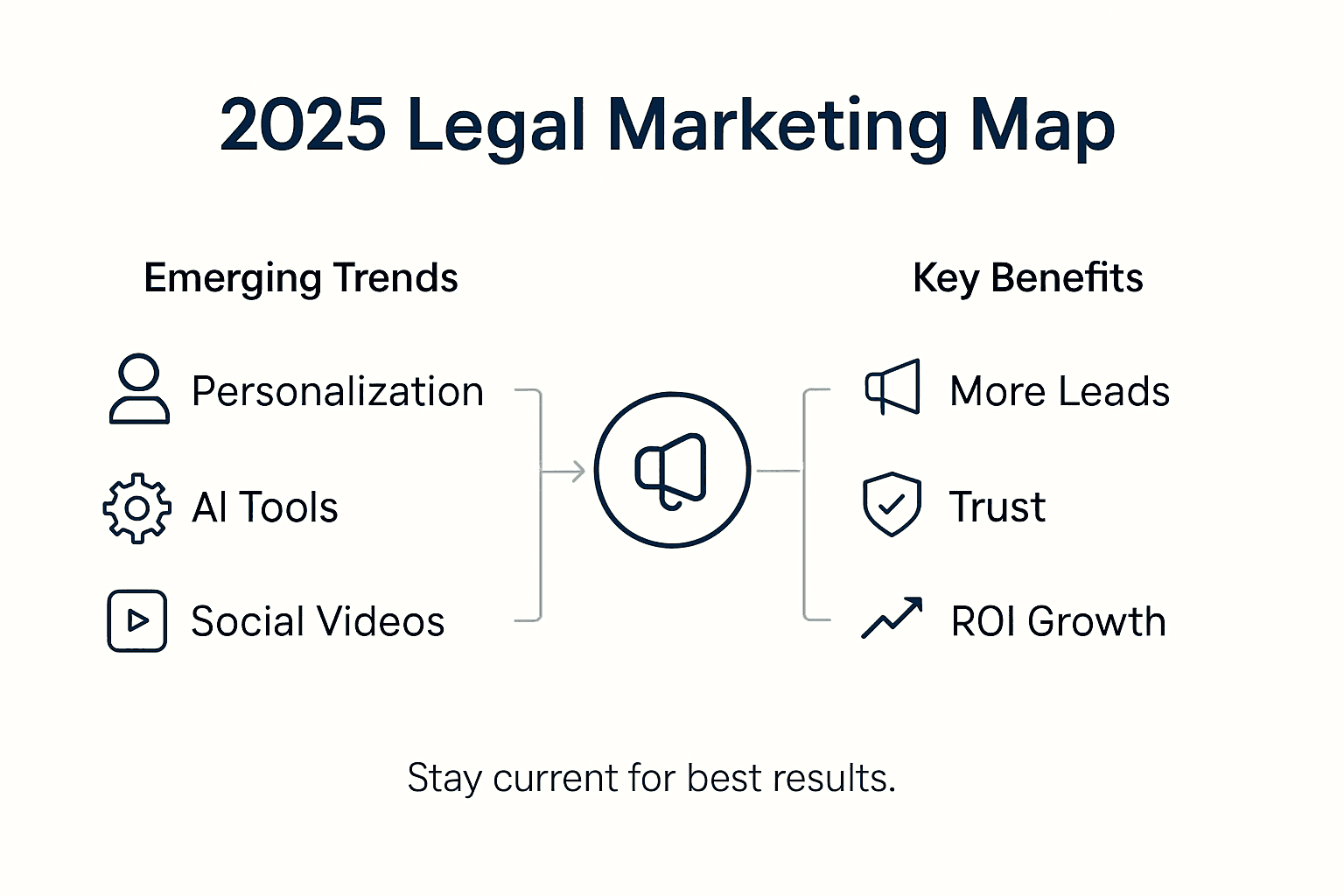
Key emerging trends for legal marketing in 2025 include deep personalization, AI-powered engagement tools, and hyper-targeted digital communication strategies. Law firms are moving away from generic content production toward creating precise, value-driven marketing assets that speak directly to specific client segments. Zero-click marketing and intentional social media community building are becoming central strategies, allowing firms to establish thought leadership without relying on traditional advertising approaches.
Technological integration will be paramount, with AI playing a transformative role in marketing execution. Advanced analytics, predictive client behavior modeling, and automated content personalization will enable law firms to craft more intelligent, responsive marketing campaigns. Firms that can leverage these technologies to create genuine, meaningful connections will distinguish themselves in an increasingly competitive legal marketplace.
Pro Tip – Strategic Marketing Approach: Develop a comprehensive digital marketing strategy that balances technological innovation with authentic human connection, focusing on creating targeted, high-value content that demonstrates your firm’s unique expertise and understanding of client needs.
Here’s a summary comparing the major legal marketing trends shaping 2025:
| Trend | Core Focus | Technology Impact | Key Business Benefit |
|---|---|---|---|
| Deep Personalization | Customized client targeting | AI-powered segmentation | Higher engagement rates |
| Zero-Click Marketing | Social visibility | Advanced analytics | Passive lead generation |
| Hyper-Targeted Content | Niche audience messaging | Automated content delivery | Improved conversion potential |
| AI Integration | Predictive engagement | Machine learning | Efficient marketing execution |
AI-Driven Advertising and Automation
Artificial Intelligence is rapidly transforming legal marketing, offering unprecedented opportunities for targeted advertising and strategic client engagement. Law firms are discovering that AI-powered tools can revolutionize how they approach digital marketing, enabling more precise targeting and personalized communication strategies. Successful AI transformation requires building organizational readiness through comprehensive training and strategic implementation.

The core advantage of AI-driven advertising lies in its ability to analyze complex data patterns and generate hyper-targeted marketing campaigns. Advanced machine learning algorithms can now predict client behaviors, optimize ad spending, and create personalized messaging that resonates with specific legal service needs. Predictive analytics enable law firms to identify potential clients with remarkable accuracy, reducing wasted marketing expenditure and increasing conversion rates.
Ethical considerations remain paramount in AI adoption for legal marketing. Firms must balance technological innovation with strict data privacy standards and professional conduct guidelines. This means implementing robust governance frameworks that ensure AI tools are used responsibly, maintaining client confidentiality while delivering sophisticated marketing insights. The most successful law firms will be those that integrate AI as a collaborative tool, enhancing human expertise rather than attempting to replace professional judgment.
Pro Tip – Responsible AI Integration: Develop a comprehensive AI training program for your marketing team, focusing on ethical use, data privacy, and understanding AI capabilities as augmentation tools rather than complete replacements for human strategic thinking.
SEO Strategies Shaping Law Firm Growth
The search engine optimization landscape for law firms is undergoing a radical transformation, driven by artificial intelligence and evolving user behaviors. SEO strategies in 2025 now focus on becoming trusted sources cited by AI assistants, moving beyond traditional keyword rankings to establish comprehensive, authoritative digital presences. Law firms must reimagine their online content strategy to align with these sophisticated search ecosystem requirements.
Modern SEO demands a multi-dimensional approach that prioritizes entity-based content and sophisticated technical optimization. Advanced law firms are implementing structured data markup, creating modular content blocks, and developing comprehensive schemas that enable AI systems to quickly understand and contextualize their expertise. This means developing content that not only answers specific legal questions but also provides deep, interconnected insights that demonstrate genuine subject matter authority.
Technical optimization remains critical for law firm digital visibility. Mobile responsiveness, page load speed, secure connections, and intricate schema implementations are now fundamental rather than optional strategies. Firms must invest in robust analytics platforms that can track not just traditional SEO metrics, but also emerging indicators like citation rates, AI assistant referencing, and comprehensive user engagement signals that reflect true content quality and relevance.
Pro Tip – Strategic SEO Positioning: Develop a content strategy that focuses on creating comprehensive, well-structured legal resources that serve both human readers and AI search algorithms, emphasizing depth, accuracy, and clear, authoritative information presentation.
Video and Social Media Engagement Tactics
The digital marketing landscape for law firms is experiencing a dramatic transformation, driven by rapidly evolving social media platforms and sophisticated user engagement strategies. Emerging marketing trends highlight the critical importance of short-form video and adaptive social media approaches, demanding law firms develop more nuanced and authentic digital communication techniques.
Successful social media engagement for law firms now requires a platform-specific content strategy that goes beyond traditional marketing approaches. Each social media channel demands unique content formats and interaction styles, particularly on platforms like YouTube, Instagram Reels, and TikTok. Advanced law firms are creating targeted video content that demonstrates expertise, builds trust, and provides genuine value to potential clients through concise, informative storytelling that addresses specific legal concerns and questions.
Technical optimization and strategic content creation are equally crucial in modern social media marketing. Law firms must invest in high-quality video production, understand platform-specific algorithms, and develop content that encourages meaningful audience interaction. This means creating videos that are not just informative but also engaging, using interactive features, responding to comments, and developing a consistent brand voice that resonates with potential clients across different digital platforms.
Pro Tip – Engagement Optimization: Develop a social media content calendar that balances educational legal insights with authentic, human-centered storytelling, focusing on creating short-form videos that provide real value and demonstrate your firm’s unique expertise and approachability.
Compliance and Ethical Considerations in Digital Marketing
Law firms navigating digital marketing in 2025 must prioritize ethical practices that balance innovative strategies with stringent regulatory requirements. The Federal Trade Commission’s Consumer Review Rule enforcement highlights the critical importance of transparency and honesty in online marketing, emphasizing the potential legal and financial risks of non-compliant marketing approaches.
Ethical digital marketing for law firms extends beyond mere regulatory compliance, encompassing a comprehensive commitment to professional integrity. This involves carefully crafting marketing messages that are accurate, verifiable, and respectful of client confidentiality. Law firms must develop robust internal review processes that scrutinize digital content for potential misleading statements, unauthorized client testimonials, or claims that could be construed as guaranteeing specific legal outcomes.
Technological advancements have complicated the ethical marketing landscape, introducing new challenges in data privacy, targeted advertising, and digital communication. Law firms must implement sophisticated compliance frameworks that address emerging digital marketing channels, including social media, programmatic advertising, and AI-driven marketing tools. This requires ongoing training for marketing teams, regular audits of digital assets, and a proactive approach to understanding evolving regulatory expectations in the digital marketing ecosystem.
Pro Tip – Ethical Marketing Safeguard: Develop a comprehensive digital marketing compliance checklist that includes regular legal review of all marketing materials, mandatory ethics training for marketing staff, and a systematic approach to monitoring and updating marketing practices in response to changing regulatory standards.
The following table highlights critical ethical and compliance challenges in digital legal marketing:
| Challenge | Main Risk | Recommended Safeguard |
|---|---|---|
| Data Privacy | Unauthorized disclosure | Robust data governance policies |
| Misleading Messaging | Regulatory investigation | Rigorous content review process |
| AI Tool Misuse | Breach of professional standards | Mandatory ethics training |
| Unverified Testimonials | Credibility loss | Strict testimonial verification |
Maximizing ROI for Small Law Firms
Small law firms face unique challenges in marketing effectiveness, requiring strategic approaches that maximize limited resources and deliver measurable results. Small business marketing trends emphasize investing in targeted digital strategies and AI-powered technologies that can dramatically improve marketing efficiency and client acquisition rates.
Successful ROI strategies for small law firms center on data-driven decision making and strategic technology adoption. By leveraging AI tools for automation, firms can streamline repetitive marketing tasks, freeing up resources to focus on high-value relationship-building activities. This approach allows smaller practices to compete effectively with larger firms by creating more personalized, targeted marketing campaigns that resonate with specific client segments and demonstrate unique expertise.
Digital marketing optimization requires a multifaceted approach that goes beyond traditional advertising. Small law firms must develop comprehensive digital ecosystems that integrate sophisticated tracking mechanisms, performance analytics, and adaptive marketing strategies. This includes developing targeted content marketing, implementing precise social media engagement tactics, and using advanced analytics to continuously refine marketing approaches based on real-time performance data.
Pro Tip – Strategic Resource Allocation: Create a marketing budget that dedicates at least 20% to experimental digital strategies, allowing for agile testing and optimization of marketing channels while maintaining a conservative baseline approach to resource investment.
Elevate Your Law Firm’s Marketing Strategy for 2025 Success
The legal marketing trends for 2025 highlight challenges like harnessing AI-powered tools, mastering deep personalization, and creating hyper-targeted content to stand out in a competitive market. If your small to mid-size law firm struggles with optimizing SEO, managing AI-driven advertising, or engaging potential clients through modern social media tactics you are not alone. Achieving meaningful client connections while respecting ethical boundaries can feel overwhelming without the right expert guidance.
Case Quota specializes in delivering tailored digital marketing solutions designed specifically for law firms in Southern California. With over 15 years of digital marketing experience and six years focused exclusively on California legal marketing, we understand how to make AI integration, SEO strategies, and video marketing work cohesively to maximize your firm’s ROI. Whether you need AI-powered pay-per-click advertising or a fractional CMO to lead your growth efforts, our customized campaigns help you compete confidently against larger firms by showcasing your unique expertise.
Unlock your firm’s full potential by partnering with professionals who translate the latest marketing trends into real results. Explore how we combine technological innovation with authentic human connection to grow your client base at Case Quota.
Discover more about our comprehensive suite of services at https://casequota.com and learn how effective SEO and social media strategies can elevate your practice in our dynamic digital landscape.
Ready to transform your marketing approach with proven strategies designed for legal professionals?

Take action now and visit Case Quota to schedule a consultation. Let us help you implement winning marketing tactics for 2025 that are tailored to your firm’s goals and challenges.
Frequently Asked Questions
What are the key marketing trends for law firms in 2025?
The key marketing trends for law firms in 2025 include deep personalization, AI-powered engagement tools, zero-click marketing strategies, and hyper-targeted digital content that focuses on specific client segments.
How can law firms leverage AI in their marketing strategies?
Law firms can leverage AI by using it for targeted advertising, predictive analytics, and automated content personalization which helps create more tailored campaigns that resonate with specific client needs.
What role does SEO play in legal marketing for 2025?
SEO in 2025 focuses on becoming a trusted source for information, utilizing entity-based content, and technical optimization strategies to enhance digital visibility and authority in legal matters.
Why is compliance important in digital marketing for law firms?
Compliance is crucial for law firms to ensure ethical marketing practices, adhere to regulatory standards, and maintain client confidentiality while navigating the complexities of digital communication.
Recommended
- Complete Guide to Digital Marketing for Legal Firms: Strategies That Drive Results – Case Quota
- 7 Strategies: The Best Marketing for Law Firms in 2025
- Digital Marketing Agency for Attorneys: Complete Guide to Growing Your Law Practice Online – Case Quota
- Social Media for Law Firms a Strategic Guide
- 7 Essential Types of Marketing Strategies for Business Growth – Jarrod Harman