

A winning law firm marketing strategy isn't just a list of things to do; it's a structured plan built to attract, engage, and ultimately sign the clients you actually want. It's the difference between random acts of marketing and a predictable system for firm growth.
Building Your Foundational Marketing Plan
Before you spend a dime on an ad or write a single blog post, the most successful firms start with a brutally honest assessment of where they stand. A solid marketing plan is a roadmap, not a wish list. Every action you take should be connected to a measurable business outcome.
This foundational work is what prevents you from wasting money and turns your marketing budget into a growth engine instead of just another line-item expense.
The whole process really boils down to three stages: auditing what you're doing now, setting goals that actually mean something, and then building a plan that ties it all together.
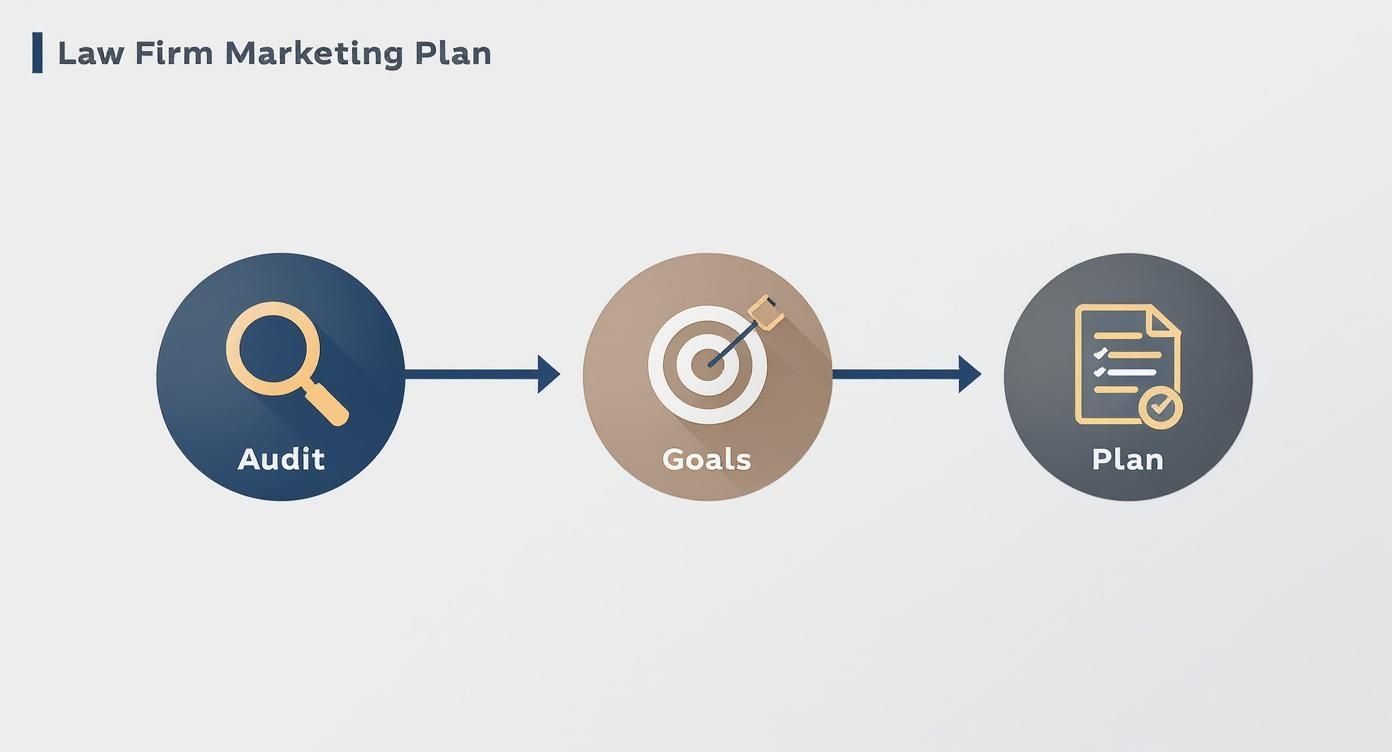
This visual shows the flow perfectly. A deep audit informs your goals, and those goals dictate exactly what goes into your plan.
Performing an Honest Marketing Audit
First things first: you have to get an unfiltered look at what’s working—and what’s not. This means digging into the data, even if it feels a little intimidating. You can't map out a route to your destination if you don't know where you're starting from.
For most firms, your website is the hub of all your marketing. Recent data confirms it, with a staggering 65% of firms reporting that their website delivers a higher return than any other channel. That makes a deep dive into your site's performance absolutely non-negotiable.
Your audit needs to answer some tough questions:
- Website Performance: How many people are actually visiting our site? Where are they coming from? Which pages are they sticking around to read, and which ones make them leave immediately?
- Lead Generation: How many real inquiries are coming through the website, social media, or referrals? More importantly, are they the right kind of inquiries?
- Online Visibility: When someone searches for our most important practice area keywords on Google, where do we show up? Is our Google Business Profile fully built out and optimized?
- Reputation: What are clients really saying about us in online reviews? How does our online brand stack up against our top three competitors?
To give you a clearer picture, here’s a quick-glance table to guide your audit and help you spot immediate opportunities.
Core Components of a Law Firm Marketing Audit
| Audit Area | What to Analyze | Key Performance Indicator (KPI) |
|---|---|---|
| Website Traffic | User numbers, traffic sources (organic, paid, etc.), top pages. | Monthly Unique Visitors, Bounce Rate |
| Search Engine Rankings | Keyword positions for primary practice areas and locations. | Average Keyword Position, Search Impressions |
| Lead Generation | Form submissions, phone calls, live chat inquiries. | Cost Per Lead (CPL), Conversion Rate |
| Competitor Analysis | Competitors' online presence, content, and ad strategies. | Share of Voice, Backlink Profile |
| Online Reputation | Google, Avvo, and Yelp reviews; social media mentions. | Average Star Rating, Review Velocity |
This table isn't exhaustive, but it's the perfect starting point to diagnose the health of your current marketing and pinpoint where the low-hanging fruit is.
Setting SMART Marketing Goals
Once your audit shows you the baseline, you can set goals that will actually move the needle. Vague targets like "get more leads" are useless because they're impossible to measure. They lead to unfocused, scattered efforts that go nowhere.
Instead, we use the SMART framework to create goals that are Specific, Measurable, Achievable, Relevant, and Time-bound.
A goal without a measurement is just a dream. Shifting from 'increase brand awareness' to 'achieve a top 3 ranking for "Chicago personal injury lawyer" within 9 months' turns a vague hope into an actionable target.
Here’s what this looks like in the real world:
-
Instead of: "We need to improve our SEO."
-
SMART Goal: "Increase organic website traffic from Google by 30% over the next six months by publishing two keyword-optimized blog posts per month."
-
Instead of: "We want more family law cases."
-
SMART Goal: "Generate 15 qualified leads for divorce consultations per month through our website's contact form by the end of Q3."
These specific targets give your marketing a clear purpose. They become the benchmarks you'll use to measure success and make smart decisions about where your time and money go.
For a more structured approach, you might find it helpful to use a comprehensive law firm marketing plan template to document your findings and goals. Honestly, this initial planning phase is the most critical part of building a strategy that delivers consistent, long-term results.
Pinpointing Your Ideal Client and Unique Edge
Trying to market your law firm to "everyone" is a surefire way to connect with absolutely no one. The most effective marketing strategies I've seen are always hyper-focused. It all starts not with what you do, but with who you do it for. The most successful firms I've worked with operate with a crystal-clear picture of their ideal client.
Imagine knowing the exact question a potential client is frantically typing into Google at 2 AM. Picture understanding their deepest fears about the legal process and what would make them feel truly heard and supported. This isn't just a "nice-to-have" insight; it's the bedrock of messaging that actually works.

When you get this right, you stop broadcasting generic services and start having a real conversation with the people you are best equipped to help.
Developing Your Ideal Client Persona
A client persona is simply a detailed, semi-fictional profile of your perfect client. This goes way beyond basic demographics like age and income. It's about getting into their head—understanding their motivations, their biggest challenges, and their emotional state. Think of it as creating a character sketch for the person who needs you the most.
To build an effective persona, you need to get specific. Start by looking at your best past clients. You know the ones—they valued your work, paid on time, and were a pleasure to represent.
Drill down into these elements for your persona:
- Demographics: What’s their age, job, family status, and location? (e.g., "Divorcing Dad," a 45-year-old IT manager with two kids in a specific suburb).
- Pain Points: What's the real problem keeping them up at night? It’s rarely just "I need a lawyer." It’s "I'm terrified of losing custody of my kids" or "This business dispute could tank everything I've built."
- Goals and Aspirations: What does a "win" look like for them? Is it a fast, quiet resolution, or is it fighting for every last asset?
- Watering Holes: Where do they hang out online and get their information? Are they listening to specific podcasts, reading certain industry blogs, or active in local Facebook groups?
This detailed profile lets you create content and ads that speak directly to their situation. A blog post titled "5 Things Every IT Manager Should Know Before a High-Asset Divorce" is going to attract far more qualified leads than a generic post about "divorce law."
Uncovering Your Firm's Unique Edge
Once you know exactly who you're talking to, you have to give them a compelling reason to choose you over the firm down the street. This is your Unique Selling Proposition (USP). It’s the distinct value that only your firm provides.
Your USP is almost never about being the "best" or the "most aggressive." Those are vague claims every lawyer makes. A powerful USP is specific and laser-focused on the client.
A strong USP answers the client’s silent question: "Out of all the lawyers who do what you do, why should I trust you with my problem?" It’s the intersection of what you do best and what your ideal client values most.
To find yours, do a quick and dirty competitive analysis. Pick three to five direct competitors and scan their online presence. Ask yourself:
- What’s their core message? Are they selling speed, experience, compassion, or price?
- Who are they trying to attract? Does their website's language and imagery scream "corporate," "family-focused," or "individual"?
- What are they not saying? Where are the gaps in their messaging that you can fill?
Maybe you notice every competitor uses stuffy, intimidating legal jargon. Your USP could be your firm's approachable, plain-English communication style. Or maybe no one else offers a transparent flat-fee structure for a particular service. That clarity can be your winning edge.
This process of defining your client and your unique value is absolutely fundamental. It shapes every single part of your law firm marketing strategy, from the blog posts you write to the ad copy you run. For a deeper look into attracting the right people, our guide on how to get clients for your law firm offers more actionable steps.
When you know who you serve and why you're different, you stop competing on price and start attracting clients who are the perfect fit for your firm.
Choosing Your Highest-Impact Digital Channels

Now that you know exactly who you're trying to reach, the next question is where to find them. It’s easy to get sucked into the idea of being everywhere at once—on every social platform, running every type of ad. But that’s a surefire way to burn through your budget and end up with mediocre results across the board.
The goal isn't universal coverage; it's a strategic presence. The most successful firms I’ve worked with don’t just throw money at every new shiny object. They figure out where their ideal clients are already looking for answers and then invest heavily in dominating those channels. It's about fishing where the fish are, not trying to boil the ocean.
For most law firms, this comes down to mastering a few core pillars of digital marketing.
Dominating Search with Local SEO
If your firm serves a specific geographic area—think family law, criminal defense, or personal injury—Local Search Engine Optimization (SEO) is hands down the most powerful long-term asset you can build.
When someone in your town searches for "divorce lawyer near me," you absolutely must show up in those top few spots on the map and in the organic results. That’s where the best clients are found.
This isn't about some secret, complex technical wizardry. It’s about sending clear signals to Google that you are the most relevant, authoritative, and trusted answer for a local legal search. That means focusing on the fundamentals:
- Optimizing Your Google Business Profile: This is your digital front door. It needs to be complete, accurate, and packed with high-quality photos, a clear list of services, and regular updates.
- Building Local Citations: Get your firm's name, address, and phone number (NAP) listed consistently across reputable directories like Yelp, Avvo, and your local chamber of commerce. Consistency is key here.
- Gathering Client Reviews: Nothing builds trust faster than a steady stream of positive Google reviews. They are one of the strongest signals of your firm's relevance and reputation.
A well-executed SEO plan builds a sustainable pipeline of high-intent leads that only grows stronger over time. If you want to dive deeper, this guide on SEO for lawyers is a great resource.
Building Authority with Content Marketing
While SEO gets you found, content marketing is what convinces a potential client that you're the right choice. By creating genuinely helpful content, you answer their most pressing questions, calm their anxieties, and build rock-solid trust before they even think about picking up the phone.
A personal injury firm, for instance, could publish a definitive guide on what to do in the first 24 hours after a car accident in their city. An estate planning attorney might create a simple, downloadable checklist for new parents.
Your content's job isn't to sell your services directly. Its job is to be so helpful that the potential client wouldn't dream of hiring anyone else.
This strategy positions you as a helpful expert, not just another service provider pushing for a consultation. It builds an unshakeable foundation of authority that pays dividends for years to come.
Generating Leads with Social Media
Don't dismiss social media as just a place for family photos and life updates. It has become a serious client acquisition machine for law firms that know how to use it.
In fact, recent industry research shows that 71% of law firms are now generating new business directly from platforms like LinkedIn and Facebook. The key is to stop trying to be on every platform and instead focus on the one that makes sense for your practice.
- LinkedIn: An absolute must for B2B practices like corporate, IP, or M&A law. It’s the perfect place to network with referral sources and establish yourself as a thought leader in your industry.
- Facebook: Incredibly effective for B2C firms focused on local communities, like family law or estate planning. You can use it to build trust and run hyper-targeted ad campaigns to reach your ideal clients.
Remember, a strong social media presence is about more than just posting links to your blog. For a detailed playbook, our guide to social media marketing for a law firm walks you through the steps. Your goal is to spark conversations and build a community, which is what ultimately drives consultations.
Putting Your Campaigns Into Motion
A strategy doc gathering dust on a server does you no good. The real work—the part that actually gets the phone to ring—begins when you put that plan into action. This is where your research and goals become tangible campaigns designed to guide your ideal clients from a passing thought to a scheduled consultation.
This isn't about throwing a few ads out there and hoping for the best. It's about creating a connected, logical journey for potential clients. Someone might find a helpful blog post of yours through a Google search, see a retargeting ad on their LinkedIn feed a few days later, and then decide to sign up for your webinar. Each touchpoint builds on the last, establishing trust and gently moving them forward.
How to Structure Your First Campaigns
Let's make this real. Imagine you're a personal injury firm in Austin, Texas. Your research shows a specific highway interchange has a high number of accidents. A generic "Injured? Call Us!" ad is lazy and ineffective. A smarter approach is to build a focused campaign around that specific, local insight.
That campaign could look something like this:
- Create a "Pillar" Piece of Content: Write an in-depth blog post like, "A Driver's Guide to Navigating the I-35 and US 290 Interchange Safely." This provides real value and immediately positions your firm as a local authority, not just another advertiser.
- Focus on Local SEO: Optimize that article for local search terms people are actually typing into Google, like "Austin car accident lawyer" and "I-35 accident attorney." This ensures you show up the moment they're actively looking for help.
- Amplify with Social Media: Chop up the article into short, easily digestible video clips or graphics. Share them on Facebook, targeting local drivers with safety tips and a clear link back to your full guide.
See how that works? It’s a cohesive system. The blog pulls in organic search traffic, the social content expands your reach, and both position you as a helpful expert.
Setting Up a High-Intent Google Ads Campaign
Content marketing is a fantastic long-term play, but sometimes you need inquiries now. That's where a tightly-structured Google Ads campaign is invaluable. It's the most direct path to getting your firm in front of people who are actively searching for a lawyer.
Take a corporate law firm that specializes in startup compliance. They shouldn't just bid on a broad term like "business lawyer." That's a great way to waste money. Instead, they should target highly specific, high-intent keywords that signal someone is ready to take action.
Think phrases like:
- "Delaware C-corp registration for startups"
- "Founder stock vesting agreement"
- "Seed round legal documents"
This is the kind of precision you're aiming for. The Google Ads dashboard is your command center for creating ad groups, writing compelling copy, and setting budgets for these exact keyword targets.
By focusing on these niche, action-oriented phrases, the firm ensures its ad budget is spent on prospects who are much, much closer to making a hiring decision.
A rookie mistake is chasing volume over quality. Getting 100 clicks from a generic term like "lawyer" is worthless compared to 5 clicks from "child custody lawyer for fathers" if that's your exact niche. In paid search, precision is everything.
Once you have content and ads running, the next step is making sure your valuable insights reach the right audience beyond just a Google search. To do this, you need a robust content distribution strategy to proactively push your articles and videos across multiple channels where your potential clients spend their time.
Creating a Cohesive Multi-Channel Experience
The real magic happens when all your channels work together in harmony. A potential client rarely finds you once and immediately picks up the phone. They're on a journey, and your marketing should be the seamless guide that leads them from one step to the next.
Here’s an integrated flow for a family law firm:
- Awareness (Blog): A person finds the firm's helpful article, "How to Prepare for a Divorce Mediation in California," through a simple Google search.
- Consideration (Retargeting): A few days later, they see a subtle, professional ad on Facebook from the same firm, this time offering a free "Divorce Preparation Checklist." They download it, giving the firm their email address in return.
- Decision (Email): They receive a short, non-pushy email sequence. The first email delivers the checklist. A week later, another email invites them to a no-obligation webinar on "Navigating Your Finances During a Divorce."
- Conversion (Consultation): After attending the webinar and seeing the firm's expertise firsthand, they feel confident and comfortable enough to finally schedule that initial consultation.
This journey feels natural and helpful, not like a sales pitch. Each step provides genuine value and builds trust, making the decision to contact the firm the next logical step. The success of this entire model hinges on a deep understanding of lead generation for attorneys, which is all about turning passive interest into active engagement.
Measuring What Matters to Drive Growth
You can have the most brilliant marketing strategy on paper, but if you can’t prove it’s working, it’s just a collection of expensive hopes. It’s time to move beyond guesswork and start making data-driven decisions that actually impact your firm’s bottom line.
This means letting go of vanity metrics like social media likes or website impressions. They feel good, but they don't pay the bills.
Instead, the focus has to shift to the numbers that truly matter—the key performance indicators (KPIs) that draw a straight line from your marketing spend to signed clients. When you measure what matters, your marketing budget stops being an expense and becomes one of your firm's most powerful investments.
Identifying Your Most Important KPIs
To get started, you need to zero in on a handful of core metrics. Chasing too many numbers at once is a classic recipe for analysis paralysis. For most law firms, the entire client acquisition journey can be boiled down to just three critical KPIs.
These are the non-negotiables:
-
Cost Per Qualified Lead (CPQL): This is your total marketing spend on a specific channel divided by the number of truly qualified leads it generated. It answers the crucial question, "How much did it cost to get a potential client on the phone who actually has a case we can take?"
-
Client Acquisition Cost (CAC): Taking it a step further, CAC measures the total cost to acquire a new, paying client, including all marketing and sales-related expenses. This is your firm's ultimate ROI metric.
-
Website Conversion Rate: This is simply the percentage of your website visitors who take a desired action, like filling out a contact form or calling your office. A low conversion rate is almost always the first sign that something’s broken.
Focusing on these three gives you a clean, powerful view of your marketing performance without getting lost in the weeds. A striking 83% of law firms now rely on external marketing agencies to manage their campaigns, which makes having clear, objective data to hold your partners accountable more important than ever.
Using the Right Tools for Tracking
Guessing which campaigns are working is how you burn through a marketing budget with nothing to show for it. To get accurate data, you need to implement a few fundamental tracking tools. These aren’t optional; they are the bedrock of any serious marketing effort.
Google Analytics is your command center. It shows you where your traffic is coming from, which pages people are visiting, and how they behave once they arrive. Setting up conversion goals here is mission-critical—it allows you to see exactly which traffic sources (like Google organic search or a specific ad campaign) are generating the most contact forms.
Call Tracking software is the other essential piece of the puzzle. It assigns unique, trackable phone numbers to each of your marketing channels. This is the only way to know for sure whether that new client came from your Google Business Profile, a billboard, or a specific pay-per-click ad. Without it, you’re flying blind.
Data tells a story. If your website gets 5,000 visitors a month but only generates five leads, the data is telling you there’s a major disconnect between what visitors expect and what your site delivers. That’s not a failure; it’s a clear, actionable insight.
Turning Data Into Smarter Decisions
The whole point of tracking this data is to use it to make smarter, more profitable decisions. Analytics should fuel action. Once you start seeing the numbers, you can begin optimizing your strategy with real confidence.
For instance, if your data shows that a specific Google Ads campaign targeting "estate planning for small business owners" has a low CPQL and is bringing in high-value clients, the decision is simple: double down on that campaign. You can increase the budget knowing you're pouring gasoline on a fire that’s already burning bright.
Conversely, if a series of blog posts about family law isn't generating any organic traffic or leads after six months, the data gives you permission to change course. You can either refine the content to better match what people are searching for or reallocate those resources to a channel that is performing. Optimizing your site based on this kind of user data is critical, and you can learn more by exploring our detailed guide on website optimization for law firms.
This is how you stop gambling with your marketing and start systematically improving your firm's ROI over time.
Common Law Firm Marketing Questions

Even with the best-laid plans, questions always pop up when you start putting a real marketing strategy into action. It's completely normal. The world of digital promotion can feel like a maze, but most of the common hurdles have pretty straightforward answers.
Let's tackle the questions I hear most often from managing partners and solo attorneys who are finally getting serious about growing their practice. Getting these right will help you invest your time and money where it actually counts.
How Much Should a Law Firm Spend on Marketing?
There's no magic number that fits everyone, but a solid rule of thumb for a law firm marketing strategy is to earmark between 5% and 10% of your gross revenue. That gives you a healthy budget to fuel consistent, sustainable growth.
Now, if your firm is brand new or you're in a heavy growth phase, you might want to push that closer to 12-15%. This initial surge helps you build momentum and carve out market share when you need it most.
The most important thing is to stop thinking of marketing as an expense. It's a measurable investment. Start with a budget you can track, get obsessive about your client acquisition cost (CAC), and then double down on the channels that are actually delivering a positive return.
What Is the Most Effective Marketing Channel for Lawyers?
For the vast majority of law firms—especially those serving local clients in practice areas like personal injury, family law, or criminal defense—Local SEO is the most powerful long-term channel. Period. It's not just a tactic; you're building a valuable asset that will generate high-intent leads for years to come.
Of course, SEO takes time. For more immediate results, pay-per-click (PPC) advertising through platforms like Google Ads is the most direct path to getting your phone to ring. You can show up at the top of search results almost instantly, but you have to keep feeding the machine to stay there.
The best approach doesn't pit SEO against PPC. A truly effective law firm marketing strategy almost always combines both—using PPC for short-term wins and immediate lead flow while SEO builds your firm's long-term, organic authority.
This dual approach gives you leads today while you build a pipeline for tomorrow.
How Long Does It Take for Law Firm SEO to Work?
Patience is the name of the game with SEO. While you might see some small upticks in your rankings or website traffic in the first few weeks, you should realistically expect to see significant, needle-moving results in about 6 to 12 months.
Think of SEO as earning trust with Google. You do that by building authority, creating genuinely helpful content, and making sure your website offers a great user experience. The results are incredibly powerful and lasting, but they don't happen overnight.
If any agency or consultant promises you guaranteed #1 rankings in 30 days, run the other way. Real SEO success is a marathon, not a sprint.
Should My Law Firm Be on Social Media?
Yes, but you have to be smart about it. The biggest mistake I see firms make is trying to be everywhere at once. That just spreads your resources too thin and you end up with mediocre results across the board. The key is to go where your ideal clients already are.
Here’s how to think about it:
- For B2B Firms: If your practice serves businesses (think corporate law, IP, or commercial litigation), a strong presence on LinkedIn is non-negotiable. It’s the online home for professional networking, establishing yourself as a thought leader, and nurturing referral relationships.
- For B2C Firms: If you serve individuals (family law, estate planning, criminal defense), Facebook can be a goldmine. It's a phenomenal tool for building trust in your community, sharing helpful content, and running laser-targeted ad campaigns to reach specific people in your city.
The goal isn't just to be on social media; it's to choose the right platform and provide real value, not just a constant stream of sales pitches.
At Case Quota, we specialize in creating data-driven marketing strategies that deliver measurable results for law firms. If you're ready to move beyond guesswork and build a predictable client acquisition engine, let's talk. Visit us at https://casequota.com to schedule your consultation.