

For many Southern California law firm partners, a prospective client’s first impression starts online and can either spark trust or create doubt within seconds. In legal services, user experience design is not just a technical upgrade but a direct route to building confidence, simplifying complex information, and attracting clients who value clarity in stressful moments. This article breaks down how thoughtful website design transforms client relationships, highlights the most important UX elements, and explains why every interaction matters for firm growth.
Table of Contents
- User Experience Defined For Law Firms
- Core UX Elements In Legal Websites
- How UX Drives Client Engagement Online
- Legal Requirements And Accessibility Standards
- Risks Of Poor UX For Attorneys
Key Takeaways
| Point | Details |
|---|---|
| User Experience (UX) is Essential | A well-designed UX fosters seamless interactions, builds trust, and effectively communicates legal services to potential clients. |
| Accessibility is a Fundamental Requirement | Compliance with accessibility standards ensures equitable access for all users, enhancing the overall experience and inclusivity. |
| Poor UX Can Negatively Impact Business | Substandard user experiences can lead to decreased client trust, higher bounce rates, and lost consultation opportunities. |
| Regular Audits and Testing are Crucial | Conducting user experience audits and testing can identify and address friction points, improving client engagement and satisfaction. |
User Experience Defined for Law Firms
User experience (UX) represents the comprehensive interaction between potential clients and a law firm’s digital platforms. At its core, UX goes far beyond aesthetic design – it’s about creating seamless, intuitive pathways that guide visitors through complex legal information with clarity and confidence.
In the legal sector, user experience design focuses on eliminating barriers and creating meaningful digital interactions that build trust and demonstrate professional competence. Meaningful digital experiences involve understanding how potential clients navigate websites, seek information, and ultimately decide to engage legal services.
Key components of exceptional law firm UX include:
- Fast, mobile-responsive website design
- Clear, jargon-free navigation
- Intuitive service descriptions
- Easy contact and consultation scheduling
- Transparent pricing and service information
- Accessible content for diverse user needs
Professional UX design recognizes that legal websites serve multiple purposes: informing, reassuring, and converting potential clients. Unlike retail or entertainment sites, law firm websites must balance complex information delivery with emotional sensitivity. Visitors often arrive during high-stress moments, seeking both professional expertise and human understanding.
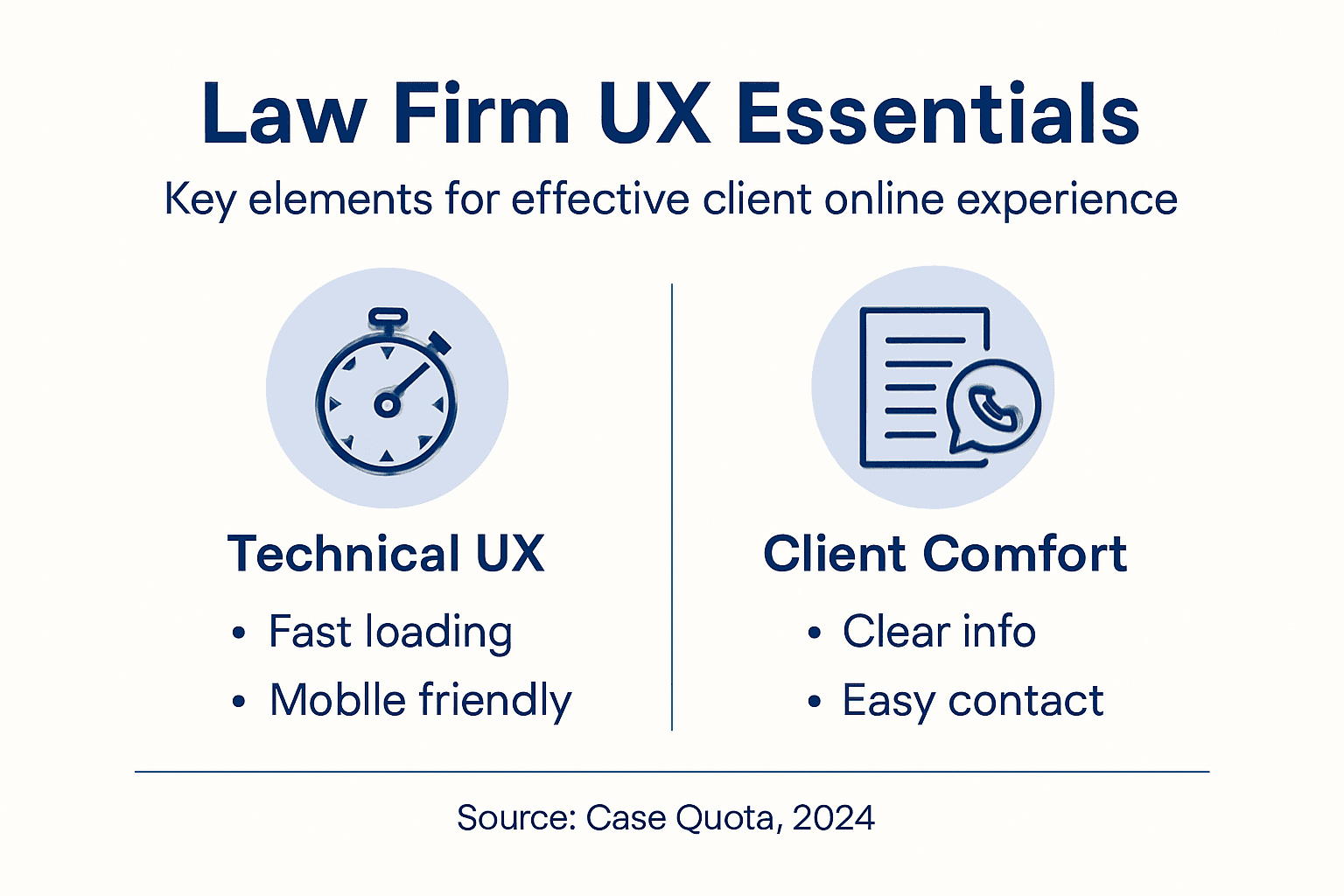
Here’s a summary of how user experience (UX) improvements specifically benefit law firms:
| UX Improvement Area | Direct Benefit to Law Firms | Impact on Potential Clients |
|---|---|---|
| Streamlined navigation | Reduces site drop-offs | Easier access to needed legal information |
| Transparent pricing | Increases consultation inquiries | Builds early trust and confidence |
| Mobile optimization | Expands client base | Enables access from any device |
| Accessibility compliance | Avoids discrimination complaints | Ensures equitable online access |
User experience in legal websites is not just about design – it’s about creating digital environments that make potential clients feel heard, supported, and confident in their choice of representation.
Pro tip: Conduct regular user testing to understand how potential clients actually interact with your website and identify friction points in their journey.
Core UX Elements in Legal Websites
Legal websites demand a specialized approach to user experience that balances professional credibility with user-friendly design. Core digital service requirements underscore the critical need for websites that are not just visually appealing, but strategically constructed to guide potential clients through complex legal information.
Successful law firm websites integrate several fundamental user experience elements that transform digital interactions from transactional to meaningful:
- Intuitive navigation structure
- Clean, professional visual design
- Mobile-responsive layouts
- Clear, concise service descriptions
- Accessible contact methods
- Fast page loading speeds
- Prominent call-to-action buttons
- Secure and trustworthy appearance
Technical performance plays a crucial role in legal website UX. Potential clients often research legal services during stressful life moments, which means your website must provide immediate clarity, reassurance, and effortless information access. Slow-loading pages, confusing menus, or complex navigation can instantly discourage potential clients from engaging with your firm.
Effective legal website UX transforms complex legal information into digestible, approachable content that builds trust and encourages client interaction.
Beyond technical elements, the psychological aspects of UX design are paramount for law firms. Your website should communicate professionalism, empathy, and competence through every design choice, from color palette to typography to content organization.
Pro tip: Conduct quarterly user experience audits to identify and eliminate potential friction points in your website’s client journey.
How UX Drives Client Engagement Online
Effective user experience strategies transform law firm websites from passive digital brochures into dynamic client engagement platforms. Understanding how UX drives online interactions is crucial for legal practices seeking to convert website visitors into actual clients.
Client engagement through UX revolves around several critical interaction points:
- Immediate visual credibility
- Frictionless information discovery
- Emotional connection and trust-building
- Clear pathways to consultation
- Personalized content experiences
- Responsive design across devices
- Simplified contact mechanisms
- Transparent service explanations
The psychology of online engagement goes far beyond simple website design. Potential clients evaluate law firms through digital interactions that communicate professionalism, expertise, and understanding. A well-crafted UX anticipates user needs, addressing potential concerns before they become barriers to engagement.
User experience is the silent ambassador of your law firm’s brand, speaking volumes before a single word is read.
Technical performance plays a pivotal role in maintaining user interest. Websites that load quickly, provide intuitive navigation, and offer clear calls-to-action dramatically increase the likelihood of converting casual browsers into committed clients. Every second of load time, every confusing menu item, represents a potential client walking away.
Pro tip: Map your website’s user journey from a potential client’s perspective, identifying and eliminating any points of potential friction or confusion.
Legal Requirements and Accessibility Standards
Americans with Disabilities Act guidelines establish critical digital accessibility standards that law firms must carefully implement to ensure equitable online experiences for all potential clients. Legal websites are not merely digital marketing tools, but essential communication platforms that must be inclusive and barrier-free.
Key accessibility compliance requirements include:
- Screen reader compatibility
- Keyboard navigation support
- Alternative text for images
- High color contrast options
- Closed captioning for multimedia
- Resizable text without layout breaking
- Clear, logical content structure
- Predictable page interactions
Web accessibility goes beyond legal compliance – it represents a fundamental commitment to serving diverse client populations. Potential clients with visual, auditory, motor, or cognitive disabilities must be able to seamlessly interact with your digital platform, understanding your services and initiating contact without unnecessary obstacles.
To better understand accessibility, here is a comparison of key accessibility features and the main audiences they serve:
| Accessibility Feature | Beneficiaries | Example of Use Case |
|---|---|---|
| Screen reader support | Visually impaired individuals | Navigating service pages |
| Keyboard navigation | Users with motor limitations | Filling in contact forms |
| Alternative image text | Blind or low-vision users | Understanding image content |
| High color contrast | Color-blind or low-vision users | Reading call-to-action buttons |
Accessibility is not a feature – it’s a fundamental right of digital communication.
Technical implementation requires comprehensive strategies that integrate design, content, and interactive elements. Law firms must view accessibility as an ongoing process, continually evaluating and improving digital experiences to meet evolving standards and technological capabilities.
Pro tip: Conduct annual accessibility audits using professional evaluation tools to identify and proactively address potential compliance gaps in your website design.
Risks of Poor UX for Attorneys
Legal technology survey data reveals the critical consequences of substandard website experiences for law firms. Poor user experience is not merely a design inconvenience – it represents a fundamental threat to client acquisition, reputation, and long-term business sustainability.
Key potential risks of inadequate UX include:
- Decreased client trust
- Higher bounce rates
- Reduced online credibility
- Lost consultation opportunities
- Negative brand perception
- Decreased search engine rankings
- Reduced conversion rates
- Potential compliance violations
Potential clients evaluate law firms through digital interactions, making website usability a direct reflection of professional competence. A confusing, slow, or inaccessible website signals potential inefficiency and lack of technological sophistication, causing potential clients to quickly seek alternatives.
Your website’s user experience speaks louder than any marketing message – it communicates your firm’s commitment to client service.
Technological barriers can dramatically impact client acquisition strategies. Law firms operating with outdated or poorly designed websites risk becoming invisible in an increasingly competitive digital marketplace, where potential clients have multiple options and limited patience for complicated online experiences.

Pro tip: Regularly conduct user testing and gather anonymous feedback to identify and proactively address potential friction points in your website’s design and functionality.
Elevate Your Law Firm’s User Experience to Win More Clients
The challenge for many law firms lies in transforming complex, high-stress legal information into a clear, trustworthy, and accessible online experience. This article highlights how poor user experience can drive potential clients away through confusing navigation, slow load times, and lack of transparent communication. If you want your website to be more than just a digital brochure and truly connect with visitors during their moment of need, a strategic, client-focused approach to UX is essential.
At Case Quota, we specialize in crafting SEO-optimized web design and comprehensive digital marketing tailored exclusively for Southern California law firms. Our solutions directly address the UX pain points discussed in the article including mobile responsiveness, accessible site architecture, and transparent service presentation. With over 15 years of digital marketing experience and six dedicated years in legal marketing, we leverage AI tools and targeted campaigns to ensure your website builds trust and converts visitors into clients.
Take the next step to transform your law firm’s digital presence. Discover how our tailored online strategies can improve your website’s user experience and attract more clients today.
Improve your law firm’s client engagement with expert insights and proven results.
Ready to make your website a competitive advantage in Southern California’s legal market Visit Case Quota now to schedule a consultation and start growing your client base with results-driven UX and marketing strategies.
Frequently Asked Questions
What is user experience (UX) and why is it important for law firm websites?
User experience (UX) encompasses how potential clients interact with a law firm’s digital platforms. It is crucial because it determines how effectively a website communicates complex legal information, builds trust, and converts visitors into clients.
How can improving UX benefit my law firm?
Improving UX can lead to a more streamlined navigation experience, increased consultation inquiries, and greater client satisfaction. A well-designed website ensures easy access to information, fostering trust and engagement with potential clients.
What are some key elements of effective UX design for legal websites?
Key elements include intuitive navigation, mobile responsiveness, clear service descriptions, fast loading speeds, prominent call-to-action buttons, and accessible contact methods. These features work together to create an inviting and informative digital experience for users.
How does accessibility impact the UX of a law firm’s website?
Accessibility ensures that all potential clients, including those with disabilities, can navigate and engage with a law firm’s website without barriers. Incorporating accessibility measures enhances user experience and fulfills legal obligations, ultimately widening the client base.