

When it comes to getting new clients for your estate planning practice, the game has fundamentally changed. SEO is no longer just a marketing buzzword; it's the single most effective way to connect with the people actively searching for your exact services right now.
Think about it. From a young couple in Orange County finally writing their will to a retiree in San Diego looking to set up a complex trust, their first move isn't flipping through the Yellow Pages. It’s a Google search. SEO is how you make sure your firm is the first one they find.
Why SEO Is Your Firm’s Most Powerful Client Magnet

Relying on referrals and the occasional networking event isn't a strategy for growth. It’s a passive waiting game. SEO flips the script, putting your firm directly in the path of motivated, high-intent clients at the precise moment they need help.
Let's be blunt: if your firm doesn't show up on the first page for searches like "living trust attorney Santa Monica" or "probate lawyer near me," you are completely invisible to the overwhelming majority of your market.
While you're waiting for the phone to ring, your competitors who have invested in a smart SEO strategy are capturing those leads and growing their practice.
The New Client Journey and Building Digital Trust
Today's clients are researchers. They don’t just pick a name from a list. Before they ever dream of calling an attorney, they’re online, reading articles, comparing firms, and trying to understand their options. This is your first, and most important, chance to build trust.
SEO lets you guide that entire journey.
By creating genuinely helpful content that answers their real-world questions, you position your firm not as a vendor, but as a trusted authority. In a practice area built entirely on discretion and confidence, that digital first impression is everything.
A well-executed SEO strategy isn't just about traffic. It's a business-building machine that:
- Builds Local Authority: Ranking for key estate planning terms cements your firm as a leader in your city or county.
- Generates Qualified Leads: You're not casting a wide net; you're attracting people with an immediate, specific legal need.
- Creates a Predictable Pipeline: Unlike the unpredictable nature of referrals, SEO delivers a consistent, measurable flow of new client inquiries.
- Educates Your Ideal Client: Your content answers their initial questions, calms their anxieties, and primes them for a productive consultation.
The modern client journey begins online. An estate planning attorney who neglects SEO is essentially telling potential clients that their practice isn't open for business in the digital world.
To really understand this shift, just look at how people find and choose a lawyer today compared to a decade ago.
The Modern Client Journey For Estate Planning
| Client Action | Traditional Method (Pre-Digital) | Modern Method (SEO-Driven) |
|---|---|---|
| Initial Need | Asks a friend or financial advisor for a referral. | Searches Google for "how to create a will in California." |
| Research Phase | Relies solely on the referred attorney's reputation. | Reads the firm's blog posts, checks online reviews on Avvo and Google. |
| Vetting Firms | Might call one or two referred options. | Compares 3-5 firms found in local search results. |
| Decision Making | Decision based on a single personal recommendation. | Decision based on expertise demonstrated online, reviews, and website quality. |
| First Contact | Calls the office to schedule an appointment. | Fills out an online contact form or uses a web chat feature after-hours. |
The entire process has moved online, and your firm needs to be there every step of the way.
The financial impact is undeniable. In the hyper-competitive legal field, SEO campaigns tailored specifically for estate planning attorneys are delivering a staggering 7.1% conversion rate and a 561% return on investment over three years. The data is clear: this works.
Ultimately, a powerful online presence isn't optional anymore. To see how all these pieces fit together, check out our complete guide on estate planning attorney marketing. It's the most reliable client magnet available to any modern law firm.
Finding The Keywords That Attract High-Value Clients
Let's get one thing straight: SEO for estate planning attorneys isn't about chasing vanity metrics. Ranking for "attorney" might feel good, but it does absolutely nothing for your bottom line. Success comes from getting inside the head of your ideal client and understanding the exact words they type into Google when they have an urgent, specific need.
You have to think less like a lawyer and more like a person facing a major life event.
When someone searches for "living trust attorney in Santa Monica," they aren't just browsing. That’s what we call a transactional keyword—it signals a clear problem and an active search for a solution. One lead from a search like that is worth a thousand clicks from someone vaguely Googling "what is a lawyer." Your entire marketing strategy pivots on finding these golden nuggets.
Mapping Keywords To The Client Journey
Clients don’t just wake up one day and decide to hire you. They go through a process, and your website needs to meet them at every single step. If you miss a stage, you miss a client.
Here’s what that journey usually looks like:
- Awareness Stage: The person knows they have a problem but isn't sure what to do about it. They're asking questions. Think: "what happens if you die without a will in California" or "how to avoid probate."
- Consideration Stage: Now they know they need a lawyer and start comparing their options. Their searches get more specific: "best estate planning lawyer Los Angeles" or "will and trust attorney reviews."
- Decision Stage: They're ready to pick up the phone. These are the money keywords, almost always with a location attached: "hire estate planning lawyer near me" or "probate attorney Irvine consultation."
Your job is to build content that answers the questions at each stage, guiding prospects from a vague worry to a scheduled consultation. Before you even think about keywords, you have to be crystal clear on how to identify your target audience. This is the foundation—get it right, and your keyword strategy will practically build itself.
Uncovering High-Intent Search Terms
So where do you find these game-changing keywords? You don't need to start with expensive, complicated tools. The best place to look is right in front of you: Google.
Start typing one of your core services into the search bar. The phrases Google suggests are real searches from real people in your area. It’s a direct line into your clients' minds.
Then, scroll down. The "People Also Ask" and "Related Searches" sections are pure gold for uncovering client pain points and long-tail keyword ideas. A "long-tail keyword" is just a longer, more specific phrase, like "special needs trust attorney for young families." The search volume is lower, sure, but the person searching is infinitely more likely to convert.
A single client gained from a highly specific, long-tail keyword is more valuable than a hundred website visits from a vague, general search term. Focus on intent, not just volume.
This isn’t a one-and-done task. It’s an ongoing part of your marketing rhythm. Getting your keywords right is a critical piece of a much larger puzzle, which we cover in-depth in our guide to attorney search engine marketing.
The endgame is a master list of keywords that becomes the blueprint for your website. It dictates your service pages, your blog posts, and your local landing pages, taking all the guesswork out of your content. This is crucial, especially now. Consider that 1 in 3 potential legal clients now begin their hunt for an attorney online—a huge leap from under 20% back in 2015. With that much competition, a precise, data-backed keyword strategy is no longer optional.
Dominating Local Search In Your Service Area

Let's be blunt: for an estate planning firm, chasing national rankings is a complete waste of time. Your clients aren't scattered across the country. They live and work right in your backyard, needing an attorney who intimately understands the nuances of California probate.
This is why mastering local search isn't just part of your strategy—it is the entire game.
When a potential client in Irvine searches for a "special needs trust attorney," your one and only goal is to show up in that coveted Google "map pack." That's the block of three local businesses at the very top. Landing there is the difference between getting the call and being completely invisible. It's the most valuable digital real estate for any local firm.
The engine that drives you into that prime spot is your Google Business Profile (GBP). This isn't just an online business card. It's a dynamic hub that proves your local relevance to Google and, more importantly, to prospective clients.
Going Way Beyond The GBP Basics
Simply claiming your GBP is table stakes. Your competitors did that years ago. To actually win, you need to treat your profile like a primary marketing channel, optimizing every last detail with strategic intent.
Think about it from the client's perspective. They’re dealing with deeply personal, often emotional decisions about their family and legacy. An incomplete or stale profile sends a message of carelessness. A robust, active, and detailed profile, on the other hand, shows you’re a professional who sweats the small stuff—exactly what they’re looking for.
Here’s where you need to focus your attention:
- Pinpoint Your Service Area: Don't just put "Orange County." Get granular. List the specific cities and neighborhoods you serve, like Newport Beach, Laguna Hills, and Mission Viejo. This precision helps Google match you to highly qualified local searches.
- List Every Single Service: "Estate Planning" is too broad. Detail everything you do, using the exact language clients search for. Think "Revocable Living Trusts," "Probate Administration," and "Advance Healthcare Directives."
- Use Google Posts Strategically: These are free mini-ads on your profile. Share updates on changes to California estate law, link to a new blog post, or highlight a free consultation. Consistent posts keep your profile fresh and engaging.
A meticulously optimized Google Business Profile is the single most powerful tool in the SEO for estate planning attorneys playbook. It’s what drives map pack visibility and generates high-intent local leads.
Google Business Profile Optimization Checklist
To truly stand out, every section of your GBP needs to be complete and compelling. Use this checklist to ensure you’re not leaving any opportunities on the table.
| Optimization Task | Why It Matters | Pro Tip |
|---|---|---|
| Complete All Profile Sections | An incomplete profile looks unprofessional and misses ranking opportunities. | Fill out 100% of the fields, including accessibility, amenities, and firm history. |
| Primary Category Selection | This is the most important signal you send to Google about what you do. | Choose "Estate Planning Attorney" as your primary. Use others like "Probate Lawyer" as secondary. |
| Add All Specific Services | Captures "long-tail" keyword searches from clients who know what they need. | Create a unique service entry for every practice area, from "Will Contests" to "Trust Administration." |
| Upload High-Quality Photos/Videos | Builds trust and helps potential clients feel comfortable with your firm. | Include professional headshots, office interior/exterior shots, and a short "about us" video. |
| Actively Solicit & Respond to Reviews | Reviews are a massive local ranking factor and a key trust signal for clients. | Respond to every review (positive and negative) within 24 hours. |
| Utilize Google Q&A Proactively | Answers common questions upfront, showcasing your expertise and saving time. | Seed the Q&A section yourself by asking and answering the top 5-10 questions you get from clients. |
| Publish Weekly Google Posts | Keeps your profile active, which Google rewards, and promotes your content. | Link your posts directly to relevant service pages or blog articles on your website. |
A fully fleshed-out profile not only helps Google understand your practice but also provides immense value to the user, making them far more likely to contact you.
Getting Clients Engaged On Your Profile
Your GBP is also an interactive platform. The Q&A feature, for example, is criminally underused by most law firms. Don't wait for someone to ask a question. Seed this section yourself by posting and answering common queries like, "What is the difference between a will and a trust in California?" or "How long does probate take in Los Angeles County?"
This preemptively tackles client concerns and immediately demonstrates your expertise. Likewise, your response to reviews is critical. A quick, professional response to a positive review shows you appreciate your clients, while a thoughtful, non-defensive reply to a negative one shows your commitment to service.
For a deeper dive, our guide has 10 proven Google Business Profile tweaks for attorneys that will help you dominate local search.
The Absolute Necessity of NAP Consistency
Beyond your GBP, Google cross-references your firm’s information across the web to verify you are who you say you are. The most crucial signal is your NAP (Name, Address, Phone Number).
This data must be 100% identical everywhere it appears.
Even tiny inconsistencies—like using "St." on one directory and "Street" on another, or having an old phone number on Avvo—sow confusion for search engines. This erodes the trust signals that are vital for local rankings. It's time to audit your listings on all the key legal directories:
- Avvo
- Justia
- FindLaw
- Martindale-Hubbell
- Your local and state bar association profiles
Fixing these discrepancies is a foundational step. When Google sees the exact same information everywhere, it validates your location and legitimacy, giving it the confidence to feature you in the map pack. This isn't just theory. We've seen focused estate planning SEO strategies deliver a 2,577% increase in organic traffic and a 642% ROI over three years. That’s the real-world impact of truly dominating your local service area.
Creating Content That Builds Unshakeable Trust

When it comes to estate planning, your website content is doing a lot more than just listing services. It's your very first chance to build the deep, profound trust someone needs before they hand over the most sensitive details of their life.
Google gets this. Their quality guidelines, known as E-E-A-T (Experience, Expertise, Authoritativeness, and Trustworthiness), are incredibly strict for topics that impact a person's finances or life stability. They call this "Your Money or Your Life" (YMYL), and legal services are right in the middle of it.
Bottom line: For your firm to rank, your content has to prove to both Google and your prospects that you are a legitimate, experienced, and trustworthy authority in estate planning.
Content That Answers Real Questions
That keyword research you did? It's not just a list of search terms. It's a direct line into the anxieties and urgent questions of your potential clients. A winning content strategy turns those keywords into genuinely helpful resources that calm those fears.
Forget generic pages. You need to focus on client-centric topics that prove you understand exactly what they're going through. This is the heart of effective SEO for estate planning attorneys.
- "The Difference Between a Will and a Trust in California": This is a classic. A detailed article here, using real-world examples to explain the pros and cons, is worth its weight in gold.
- "Navigating Probate in Los Angeles County": A piece like this immediately establishes your local expertise. You're showing you know the local courts, the timelines, and the common headaches.
- "How to Choose a Guardian for Your Children in Your Will": This topic hits the emotional core of estate planning. It builds a connection that goes far beyond legal paperwork.
By creating content that educates and empowers potential clients, you shift the relationship from a simple transaction to a trusted partnership before they even pick up the phone.
This kind of content becomes the backbone of your website, turning it from a digital brochure into an essential resource. It's a critical part of a much larger picture, and you can see how it all fits together in this deep dive on law firm content marketing. This isn't just about building trust; it's about attracting highly qualified leads who already see you as the expert. And as search evolves, it's also smart to understand how AI influences ranking factors to keep your content connecting with both users and Google.
Transforming Attorney Bios Into Trust Signals
Your attorney bio page is one of the most-visited pages on your site, yet it's almost always the most neglected. Most firms just post a static résumé—degrees, bar admissions, done. This is a massive missed opportunity.
Your bio needs to be a powerful story that screams E-E-A-T. It should tell people why you practice estate planning and why they should trust you with their legacy.
What a High-Impact Attorney Bio Needs:
- A Personal Connection: Briefly share what brought you to this field. Did a messy probate in your own family inspire you? This humanizes you and creates an instant bond.
- Proven Experience: Don't just say you have a J.D. Talk about the specific types of complex cases you've handled, like high-net-worth estate tax planning or multi-generational trust administration.
- Visible Authority: Add links to articles you've published, talks you've given at local financial planning seminars, or memberships in elite groups like the American College of Trust and Estate Counsel (ACTEC).
- Genuine Trustworthiness: Put client testimonials right on your bio page. Even better, a short video of you explaining your philosophy can be incredibly powerful.
Stop thinking of your bio as a list of credentials. It's your primary sales page for you.
Using Case Studies To Prove Your Expertise
Nothing shows you know your stuff better than real-world results. While client confidentiality is obviously non-negotiable, you can create powerful, anonymized case studies that highlight your problem-solving skills.
A case study doesn't have to be a novel. Just follow a simple, clear structure:
- The Challenge: Describe the client's initial situation. For example, "A blended family with complex assets worried about treating children from previous marriages fairly while minimizing estate taxes."
- The Strategy: Detail the specific legal tools you used. "We created a qualified terminable interest property (QTIP) trust combined with a strategic gifting plan."
- The Outcome: Explain the positive result. "The final plan gave the family security and clarity, protected their assets from unnecessary taxes, and ensured the clients' specific wishes were honored."
These quick stories are potent proof of your abilities. You're moving beyond just saying you're an expert to actually showing it—and that's the whole point of trust-building content.
Building Authority With Links And Reviews
Your on-site content and local SEO are the engine. But to really get that engine humming, you need to prove to Google that people in your community and industry see you as a credible authority. This comes down to two crucial off-page signals: high-quality backlinks and a steady stream of positive client reviews.
Think of a backlink as a vote of confidence from another website. When a reputable site links to yours, it's essentially vouching for your expertise. These "votes" are still one of the most powerful ranking factors in all of SEO.
This timeline shows how these off-page efforts work in tandem to build your firm's authority over the long haul.
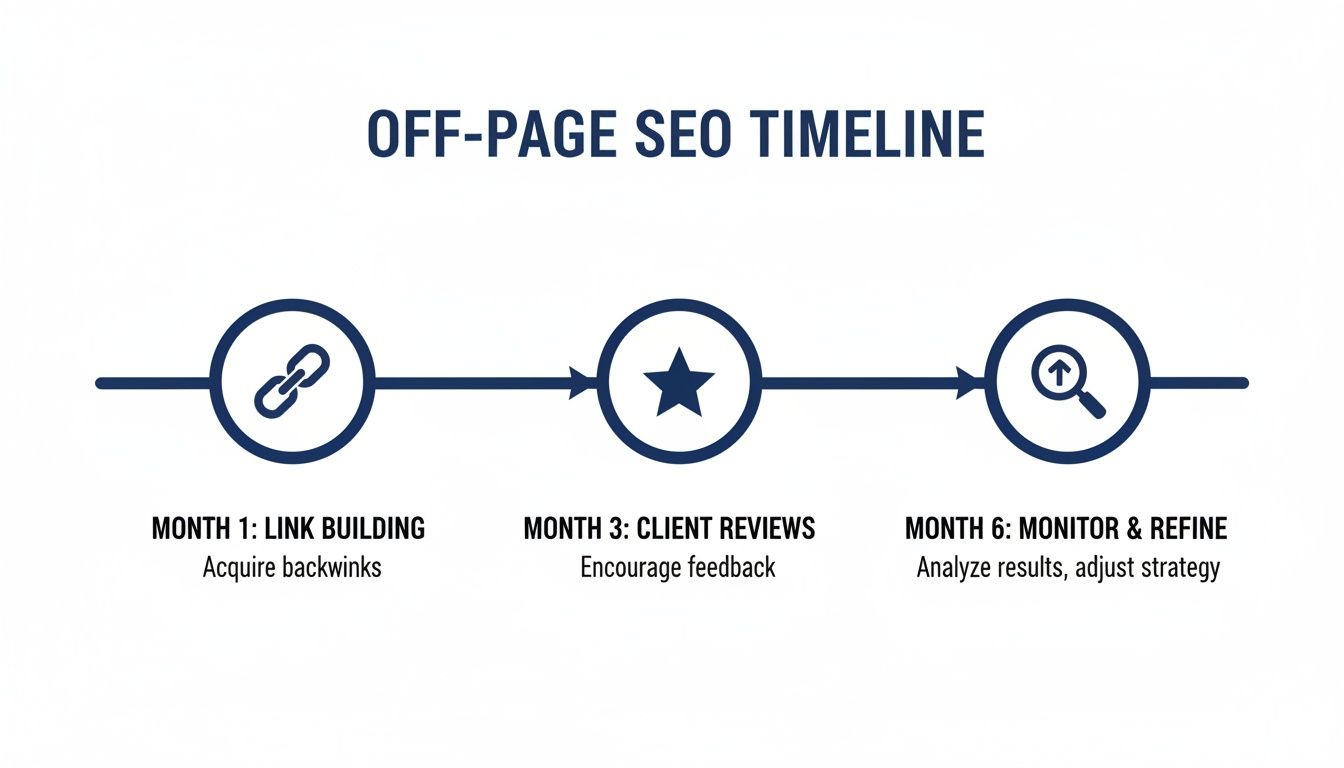
The key takeaway here is that building a strong backlink profile and a solid base of reviews isn't a one-and-done task. It's an ongoing process that pays compounding dividends, boosting your firm’s digital reputation month after month.
Earning High-Quality Backlinks (The Right Way)
Let's get one thing straight: the old, spammy tactics of buying links are dead. Trying that today is a surefire way to get your site penalized by Google. The goal now is to earn links by being a valuable resource. For an estate planning attorney, this means putting your legal expertise in front of the people and organizations who matter.
Your local community is the perfect place to start.
- Sponsor a local charity event: Getting your firm's name on the back of a 5K t-shirt is nice, but the real value is the link you get from the organization's website. It's a powerful local signal.
- Get featured in local publications: Pitch a story to a local business journal about a unique angle of your practice, like planning for digital assets or pet trusts.
- Speak at community events: Offer to give a free seminar on wills and trusts at a local library or senior center. They’ll almost always link to your website from their event page.
A single, relevant backlink from a trusted local organization is worth more than a hundred low-quality links from spammy directories. Always focus on quality, not quantity.
Another fantastic strategy is to contribute expert commentary to financial blogs or publications. Financial advisors are natural referral partners, and their websites are constantly looking for expert legal opinions on topics like estate tax planning or trust administration. Providing a quick quote for an article can earn you a highly relevant and authoritative backlink.
Turning Client Satisfaction Into A Ranking Signal
While backlinks build your authority with search engines, reviews build trust with potential clients. And in a field as personal as estate planning, that social proof is everything. In fact, more than 70% of clients say they read online reviews before ever picking up the phone to call a lawyer.
A consistent flow of positive reviews on your Google Business Profile is one of the most direct signals for ranking in the local map pack. But you can't just cross your fingers and hope clients leave them. You need a simple, professional, and consistent process for asking.
The secret is all in the timing. The perfect moment to ask for a review is right after a positive milestone—like when you've just signed the final documents and your client is visibly relieved and grateful.
A Simple System For Generating Reviews
Your review request process shouldn't feel pushy or awkward. A simple, automated email can do all the heavy lifting for you.
- Craft a personal email: Start by thanking the client for their trust and mention how much you enjoyed working with them on their plan.
- Make it ridiculously easy: Include a direct link to the "Leave a Review" section of your Google Business Profile. Don't make them hunt for it.
- Set the expectation: Gently let them know that their feedback is incredibly helpful for other families in the community trying to find the right legal help.
This system turns a single client interaction into a lasting digital asset. Managing your online reputation is a core part of any modern marketing strategy. To dig deeper, check out our complete guide on reputation management for attorneys.
By combining a proactive review strategy with ethical link building, you create a powerful off-page SEO foundation that drives both rankings and, more importantly, client trust.
Your First 90 Days: An Actionable SEO Roadmap
All the strategy in the world doesn't mean much without a plan to execute it. This is where the rubber meets the road. Instead of trying to do everything at once and getting overwhelmed, let's break this down into a focused, 90-day sprint.
This timeline is designed to build momentum, with each month's tasks laying the groundwork for the next.
Month 1: The Foundation
The first 30 days are all about pouring a rock-solid foundation. If you skip this, everything you build later—all the content, all the links—will be on shaky ground. This is the critical prep work that separates firms that get real results from those that just spin their wheels.
Here are your priorities:
- Technical SEO Audit: Get under the hood of your website. We need to find and fix all the little gremlins holding you back: slow page speeds, broken links, or a clunky mobile experience. These are silent ranking killers.
- Deep Keyword Research: This is where we finalize the master list of high-intent, location-specific keywords. This isn't just a one-off task; this list will be your North Star for your entire content strategy for the next year.
- Google Business Profile Optimization: Go through your GBP with a fine-tooth comb and fill out every single section. Add detailed service descriptions, upload professional photos of your office and team, and seed the Q&A with common questions you get from clients.
Month 2: Content and Authority Building
With the technical and local SEO foundation firmly in place, Month 2 is all about creating the assets that will attract and convert your ideal clients. This is where you start to really demonstrate your expertise and build that crucial digital trust.
Now, your focus shifts to production:
- Publish Core Service Pages: It's time to write and publish those in-depth pages for each of your key practice areas. Think Living Trusts, Probate Administration, or Special Needs Planning. Each one needs to be thoroughly optimized with the keywords we identified in Month 1.
- Launch Your Blog: Get your first two educational blog posts written and published. Start by answering the questions you hear every day, like "What's the real difference between a will and a trust in California?"
This two-pronged approach is the engine of a powerful content strategy. Your service pages are built to convert people who are ready to hire you now. Your blog posts are there to educate and build trust with people who are still in the research phase. You need both.
Month 3: Amplification and Measurement
In the final month of our initial sprint, we start amplifying your message and putting the right tracking in place. This is where we begin building authority outside of your own website and prove that all this work is actually paying off.
Finish strong with these three goals:
- Launch a Local Link Building Campaign: It's time to earn your first one or two high-quality local backlinks. This could be from sponsoring a local charity event, getting featured in a neighborhood publication, or joining a professional association.
- Implement a Review Generation System: Stop waiting for reviews to happen organically. Start actively—and professionally—requesting them from happy clients. A simple email template is all it takes to get the ball rolling.
- Define and Track KPIs: Get your analytics dialed in. You need to be tracking the right Key Performance Indicators (KPIs), like organic traffic growth, keyword ranking improvements, and the ultimate metric: the number of qualified leads coming from your website. This is the data that proves your ROI.
Common Questions About SEO For Attorneys
Most attorneys I talk to are curious about what an investment in SEO really looks like day-to-day. Let's get straight to the questions we hear most often from estate planning firms.
How Long Does SEO Actually Take To Show Results?
Let's set realistic expectations: SEO is a long-term play, not a quick fix. It’s about building a valuable asset for your firm, and that takes time.
You'll likely see some early momentum in the first 3-6 months—think climbing the ranks for more specific, long-tail searches. This is the foundational period. But for those high-value, client-generating keywords like "estate planning attorney Santa Monica," you're looking at a 6-12 month journey of consistent, strategic work. The good news? The results compound, creating a sustainable source of leads for years to come.
Should I Try SEO Myself or Hire an Agency?
This really comes down to a classic trade-off: your time versus your money.
- DIY SEO: Going it alone gives you total control and avoids the monthly retainer. But be prepared for a steep learning curve. You’re committing a significant amount of your own time to learn and execute everything from technical audits and content writing to the nuances of link building.
- Hiring an Agency: Working with a team of specialists fast-tracks your results and frees you up to practice law. A good agency brings proven processes, expensive tools, and years of experience to the table, but it's a significant budget item.
Honestly assess your available hours, comfort level with technical marketing, and your firm's budget before making the call.
Is SEO or Paid Advertising Better for My Firm?
This isn't an "either/or" question. The smartest firms don't choose one; they integrate both.
Think of it like this: SEO is your long-term wealth-building strategy. It builds organic authority and trust, eventually generating "free" traffic once you've earned those top rankings. It's the foundation.
Paid ads (PPC), on the other hand, are for immediate impact. They put your firm right at the top of Google from day one. The most powerful approach is to run them in parallel. Use PPC to get the phone ringing right away while your SEO strategy matures and starts delivering sustainable, long-term growth.
At Case Quota, we build comprehensive SEO strategies that do one thing: drive measurable growth for estate planning firms. Let's build a plan that brings you more clients.