
Personal injury marketing is how law firms connect with people who've been hurt and desperately need a lawyer. It’s a specialized mix of digital strategies like SEO and paid ads, keeping a close eye on the competition, and crafting a clear message that attracts high-value cases.
But here’s the thing: success is determined long before you spend a single dollar on an ad.
Build Your Foundation First to Attract High-Value Cases
The most successful firms I’ve seen all do the same thing: they build a solid strategic foundation before launching any campaigns. This isn't about just throwing ads out there and hoping for the best. It's about figuring out exactly who you want to reach and giving them a compelling reason to choose your firm over the sea of others.
If you skip this groundwork, you're just gambling with your marketing budget. It becomes an expensive guessing game.
Define Your Ideal Client and Market Position
The first step is to get way more specific than "car accident victims." A winning strategy requires creating detailed profiles of your ideal clients.
Think about it. Are you targeting commercial truck drivers injured on major highways? Or are you focused on rideshare passengers hurt in downtown traffic? Each of these groups has completely different problems, they search for different things online, and they'll respond to very different messages.
Drilling down this deep allows you to tailor every single piece of your marketing. Someone dealing with a complex medical malpractice case has a much longer, more emotional journey than a person with a straightforward slip-and-fall claim.
When you understand these nuances, you can:
- Craft Messaging That Resonates: You can speak directly to their specific fears, questions, and what they hope to achieve.
- Target Keywords That Convert: Focus on the high-intent phrases that signal a serious, immediate need for legal help.
- Choose the Right Channels: Put your budget where your ideal clients are actually looking for answers, not where you think they are.
This level of focus is absolutely critical. The personal injury market is huge and fiercely competitive, projected to hit $61.7 billion in revenue by 2025. You can't be everything to everyone. Carving out your specific niche is the only way to grab a profitable piece of the pie.
A strong foundation isn't about targeting everyone; it's about becoming the undeniable choice for a specific type of client with a specific type of problem. This clarity makes every subsequent marketing decision simpler and more effective.
This simple process shows how these foundational pieces fit together.
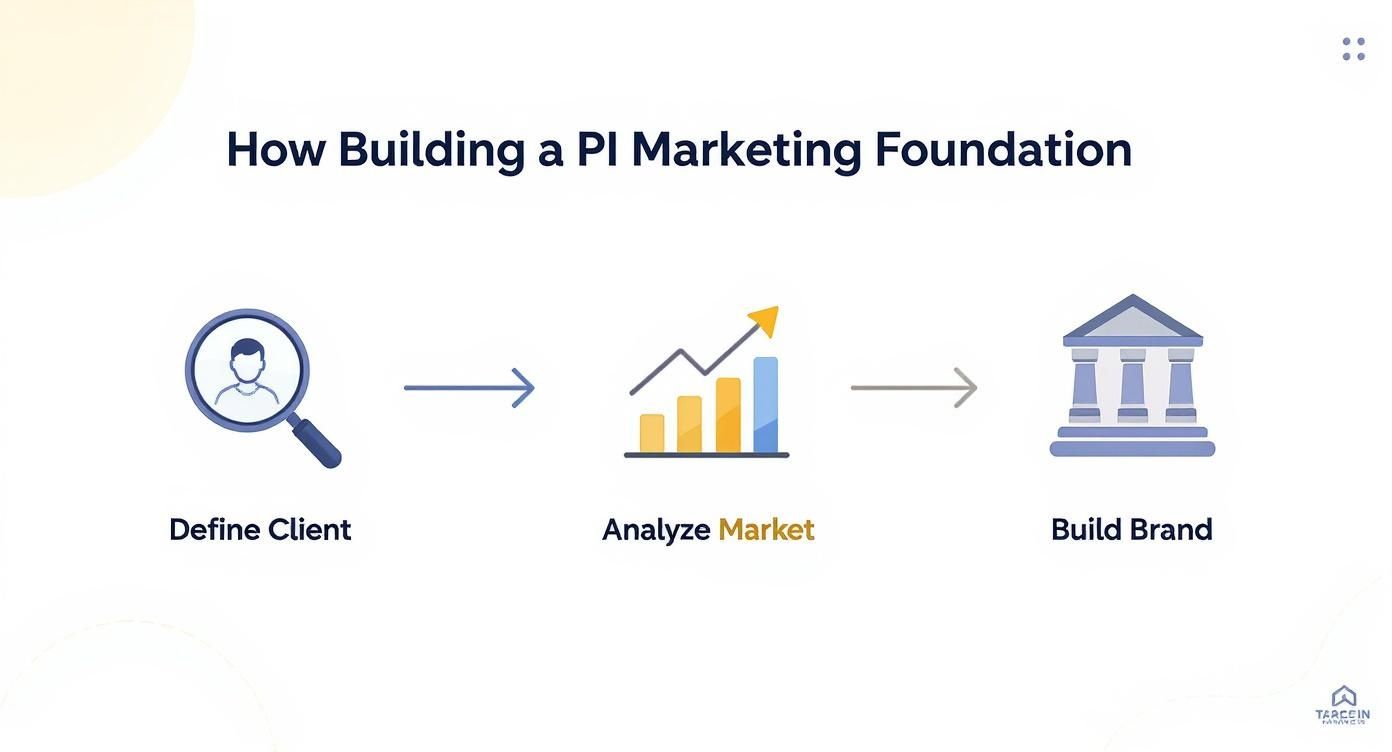
It’s a logical flow: know your client, understand the battlefield, and then build your brand to win.
Analyze Your Competitors to Find an Opening
Once you know who you’re after, it's time to size up the competition. Don't just glance at the firms ranking at the top of Google. Look for their weaknesses.
Is their website a nightmare to navigate on a phone? Is their messaging generic and boring? Are they completely ignoring the specific, high-value case types you want to own?
Every single weakness you find is a golden opportunity for your firm. This analysis helps you define your unique selling proposition (USP)—the one thing that makes your firm the obvious best choice. This is a core part of any successful law firm marketing strategy and it's how you go from being "just another PI firm" to becoming the go-to authority for your ideal clients.
Building a Website That Actually Wins Cases
Let's get one thing straight: your law firm's website is not an online brochure. It's your digital workhorse, a client-generating machine that should be bringing in cases 24/7. But it only works if it's built from the ground up to do one thing: win.
Think of it like this. Your site has two very different audiences to please. First, there's the potential client, panicked and frantically Googling for help on their phone after a wreck. Second, there's Google's algorithm, a cold, calculating machine that's constantly sizing you up, deciding if you're worthy of ranking for a money-making search like "truck accident lawyer near me."
To succeed, you have to nail it for both.

Go Deep on Your Practice Area Pages
Generic, surface-level content gets you nowhere. If you want to dominate the search rankings, you need to create incredibly deep, authoritative pages for every single case type you handle. These aren't just short summaries; they are the ultimate resources for someone in a desperate situation.
Take a "Car Accidents" page, for example. It can't just say, "We handle car accidents." It needs to be a pillar of information that leaves no stone unturned.
- Walk them through the process: Map out exactly what happens after an accident, from the first call to your office all the way through filing a claim and what to expect from litigation.
- Talk about their injuries: Cover the specifics—whiplash, TBIs, spinal cord damage—and connect those injuries back to the legal help you can provide.
- Get local: Reference specific state laws or city ordinances that apply to auto accidents in your area, like the statute of limitations or "at-fault" rules.
- Show, don't just tell: Use anonymized but detailed case results. Proving you've won cases just like theirs is how you build immediate trust.
Apply this same obsessive detail to every practice area, whether it's slip-and-falls, medical malpractice, or wrongful death. Each one of these pages proves your expertise, signaling to Google that you're the real deal.
Hunt Down High-Intent Keywords
Keyword research is the foundation of it all. You have to put yourself in the shoes of someone who's just been hurt and needs a lawyer now. Their searches are urgent, specific, and loaded with intent.
Your job is to zero in on these "high-intent" keywords. These are the phrases people type when they're ready to pick up the phone, not just browse for information.
| Keyword Type | Example | What It Really Means |
|---|---|---|
| Informational | "what to do after car accident" | Just doing research, not ready to hire. |
| High-Intent | "best car accident lawyer houston" | They're actively looking for an attorney. |
| Long-Tail | "lawyer for rear-end collision TBI" | This person has a specific, serious problem and needs help immediately. |
This is where you focus your energy. Weave these high-intent and long-tail keywords into your page titles, headings, and throughout your content. It’s like putting up a giant neon sign that tells Google exactly who you're trying to reach. If you want to go deeper on the technical side, our complete guide to website optimization for law firms is a great next step.
Why ADA Compliance Is a Non-Negotiable SEO Win
Here’s a secret weapon that most firms completely ignore: website accessibility. Making your site compliant with the Americans with Disabilities Act (ADA) isn't just the right thing to do; it's a massive, and often overlooked, technical SEO advantage.
An accessible website is, by its very nature, a clean, well-structured site. Google absolutely loves that kind of clarity and rewards it with better rankings because it makes for a better experience for everyone.
An ADA-compliant site means anyone, regardless of disability, can access your information. This includes simple but powerful updates:
- Adding Alt Text to Images: This descriptive text allows screen readers to describe images to visually impaired users.
- Ensuring Keyboard Navigation: The entire site has to work perfectly using just a keyboard, no mouse required.
- Providing Transcripts for Videos: Written transcripts let users with hearing impairments understand your video content.
These aren't just minor tweaks. They send powerful positive signals to search engines. By making your firm accessible to every potential client, you also give your marketing a serious, built-in SEO advantage.
Winning the Local Battle with Google Business Profile
For personal injury firms, the real marketing war isn't fought on some national stage—it's won street by street, right in your own backyard.
Your potential clients aren't just looking for any lawyer. They're frantically searching for a local expert who gets their community, someone they can trust. This is where mastering your Google Business Profile (GBP) becomes your single most powerful weapon.
A fully-tuned GBP is so much more than a digital business card. It’s an interactive storefront that can rocket your firm to the top of local search results, often appearing above the traditional organic website listings. When someone searches "motorcycle accident attorney near me," a well-managed profile makes you the first, most obvious choice.
Go Way Beyond the Basics
Just filling out your firm's name, address, and phone number? That's table stakes. To truly own the local map pack, you have to treat your GBP as a living, breathing marketing channel. This means you need to be constantly engaging with its features to show Google you’re active and relevant.
Your competitors are probably letting their profiles collect digital dust. That’s a massive opportunity for you.
Start by digging in and populating every single section you can find. I mean everything.
- Services: Don't just list "Personal Injury." Get specific. Break it down into your money-making case types like "Commercial Truck Accidents," "Brain Injury Claims," and "Wrongful Death Litigation." This is how you show up for those high-intent, long-tail searches.
- Q&A Section: Don't wait for people to ask questions—pre-load this section yourself. Think about the top 5-10 questions you get on initial calls and answer them right there. This instantly frames you as the authority before they've even picked up the phone.
- Google Posts: This is your mini-blog on Google. Use it to share recent (anonymized) case wins, talk about your community involvement, or link to a helpful new article on your site. Every post is a fresh signal to Google that you’re an active, engaged firm.
This dashboard is your command center for local search. Get familiar with it.

Actively working these features has a direct impact on how often you appear in that all-important "map pack."
The Power of Reviews and Local Citations
In the legal world, social proof is everything. Online reviews are the currency of trust today.
A steady stream of 5-star client reviews is one of the heaviest-hitting local ranking factors. It tells both Google and your potential clients that your firm is the real deal and gets results.
You need a simple, repeatable process for asking satisfied clients for a review when their case wraps up. A simple email with a direct link to your GBP review page works wonders. The goal is to make it completely frictionless for them.
A quick but critical pro-tip: Respond to every single review, good or bad. Thanking someone for a positive review shows you appreciate them. A professional, calm response to a negative one demonstrates your commitment to client service for all to see.
Beyond reviews, you need to build a rock-solid foundation of local citations. These are just mentions of your firm's Name, Address, and Phone number (NAP) on other credible sites, especially legal directories like Avvo, FindLaw, and Justia.
Consistency is king here. Your NAP info has to be identical everywhere. No exceptions. This creates a clean, authoritative footprint that Google trusts.
Create Hyper-Local Landing Pages
To tie your local strategy together, you need dedicated, location-specific pages on your website. If you serve multiple cities, a generic "Contact Us" page just won't cut it. A potential client in Long Beach needs to feel like you understand their community, not just the massive Los Angeles metro area.
These pages need to be laser-focused. Pack them with local flavor:
- Drop names of local landmarks, major cross-streets, or the courthouse in that city.
- Feature testimonials from clients who live in that specific town.
- Embed a Google Map showing your office's location relative to them.
- Discuss any local rules or ordinances that might be relevant to their PI case.
This strategy does two crucial things. First, it builds an immediate connection with the visitor, showing them you're a true local, not some out-of-town firm. Second, it feeds Google powerful local signals, dramatically boosting your odds of ranking for searches like "[City Name] car accident lawyer."
For an even deeper dive, check out these 10 proven Google Business Profile tweaks for attorneys to really put your GMB strategy into overdrive.
Running Paid Ad Campaigns That Actually Convert
Organic SEO is a fantastic long-game, but let's be honest—sometimes you need to get in front of a potential client right now. That’s where paid advertising comes in. It’s the express lane to visibility, putting your firm right where accident victims are desperately searching for help.
But this speed comes with a serious risk. Without a disciplined, well-executed strategy, it's terrifyingly easy to burn through thousands of dollars with almost nothing to show for it.
The secret to winning with paid ads isn't just about getting clicks. It's about getting the right clicks—the ones that turn into high-value signed cases. This requires a methodical approach to targeting, bidding, and creating ad copy that forces a potential client to take immediate action.
Choosing Your Channels Wisely
Not all paid platforms are built the same, especially in the cutthroat legal marketing space. Knowing the user intent and the cost on each channel is absolutely critical to spending your budget wisely. The two main battlegrounds are Google Ads and social media platforms like Facebook, and they serve very different roles in your marketing machine.
Google Ads is all about capturing high-intent searchers. When someone types "18-wheeler accident lawyer near me" into Google, they aren't just browsing. They have a serious problem and they need a solution now. Of course, that kind of immediate intent comes at a steep price.
On the flip side, social media ads target users based on their demographics and interests. The intent is much lower—you’re interrupting their scroll, not answering a direct plea for help. The trade-off? The cost to get in front of them is often significantly less.
Let’s talk numbers. When you look at the average cost per lead (CPL) for PI firms, the story becomes crystal clear.
Average Cost Per Lead (CPL) by Marketing Channel
The cost to acquire a single lead can vary dramatically depending on where you're spending your marketing dollars. Here’s a quick breakdown of what you can expect to pay on average for a personal injury lead across different channels in 2025.
| Marketing Channel | Average CPL |
|---|---|
| Google Search Ads | $442 |
| Facebook Ads | $286 |
| Organic SEO | $183 |
As you can see, paid channels get you leads quickly but at a premium. Organic SEO remains the most cost-effective channel over the long run, reinforcing the need for a balanced marketing strategy.
Mastering Google Ads for High-Value Leads
For almost every personal injury firm, Google Ads is the engine of their paid advertising strategy. To get a real return on your investment, you have to move past the basic setup and dial in your campaigns with surgical precision.
Your keyword strategy is everything. You need to zero in on the "money" keywords that signal a user is ready to hire an attorney, not just doing preliminary research. Think about the language of urgency and specificity:
- Broad & Expensive: "car accident lawyer" (High competition, lots of tire-kickers)
- High-Intent & Specific: "best injury lawyer for TBI claim" (This person has a specific, high-value problem)
Just as important is building a massive negative keyword list. This is how you tell Google which searches you refuse to pay for. You absolutely must add terms like "pro bono," "free legal aid," and "attorney jobs" to stop hemorrhaging cash on clicks from people who will never become clients. For a deep dive into this, an effective PPC Lead Generation Playbook can be an invaluable resource for mastering the process.
Your ad copy has to be a direct, empathetic, and compelling answer to the searcher's urgent problem. Focus on results and a crystal-clear call to action. Use headlines like "Hurt in a Wreck? Free Consultation" to connect instantly and show you understand their pain.
Smart bidding strategies can also be a total game-changer. Don't just bid for clicks. Use Google's "Maximize conversions" strategy and—this is crucial—feed your signed case data back into the platform. This teaches the algorithm what a real lead looks like, so it starts optimizing for what actually grows your firm, not just what drives website traffic. Our comprehensive guide on Google Ads for lawyers breaks down these advanced strategies in detail.
Using Social Ads and Retargeting
While Google Ads captures people actively searching, social media is perfect for building brand awareness and deploying a powerhouse tactic called retargeting.
Retargeting is simple but incredibly effective: it lets you show ads specifically to people who have already visited your website.
Think about this scenario: someone lands on your "Spinal Cord Injury Cases" page from a Google search but doesn't call you. They are clearly a highly qualified potential client. With a retargeting campaign, you can show them a targeted ad on their Facebook or Instagram feed a few days later, gently reminding them of your firm's specific expertise in that exact practice area.
This strategy works so well because you're marketing to a warm audience—people who already know your name. It keeps your firm top-of-mind during the critical, and often stressful, period when they are deciding which attorney to trust. A truly successful paid campaign uses both search and social channels together, creating a complete system for capturing new leads and nurturing them all the way to a signed contract.
Turning More Leads into Signed Cases
Getting a flood of inquiries is a great start, but it’s a vanity metric if those leads don't convert into signed retainers. The moment a potential client reaches out is the most critical handoff in your entire marketing funnel.
Nailing this intake process is what separates the firms that just get by from the ones that truly scale.
Every single interaction has to be a masterclass in speed, empathy, and professionalism. Remember, a potential client is likely calling you on one of the worst, most confusing days of their life. How your team responds in that high-stakes moment determines whether they trust you with their future or hang up and call the next name on the search results page.
Perfecting That First Impression
Your intake team is the tip of the spear. They aren't just receptionists or call screeners; they are the first human connection a potential client has with your firm. You can't afford to get this wrong, and proper training is completely non-negotiable.
Your team needs to be armed with the skills to guide a conversation with genuine compassion while efficiently gathering the critical info needed to qualify the case. This is so much more than reading from a script. It’s about active listening and making someone in deep distress feel heard, seen, and understood.
Here’s where to focus your training:
- Empathy First: Drill into your team that they must acknowledge the caller's situation before diving into case details. A simple, "That sounds incredibly stressful, I'm so sorry you're going through that," can make all the difference.
- Active Listening: Train them to ask smart follow-up questions. This shows they're actually paying attention, not just waiting for their turn to talk or check boxes on a form.
- Information Triage: Create a rock-solid protocol for what information is essential on that first call versus what can wait. This keeps the initial conversation focused, efficient, and less overwhelming for the caller.
The Overwhelming Need for Speed and Systems
In the personal injury world, speed isn't just important—it's everything. The very first firm to make meaningful, human contact dramatically increases its odds of signing the case. If a lead hits a voicemail or has to wait hours for a callback, they're already gone. Poof.
This is where technology becomes your unfair advantage. You absolutely must have a robust Customer Relationship Management (CRM) system. A good CRM tracks every lead from the instant they contact you, ensuring no one ever falls through the cracks.
A well-implemented CRM is your firm's single source of truth. It logs every call, every email, every text, and every follow-up, so you know exactly where every potential case stands at all times.
Modern tools like website live chat and automated scheduling software also create that seamless, immediate experience people now expect. Letting someone book a consultation directly on your site at 10 PM on a Saturday night captures them when their motivation is at its peak. For a deeper dive into the entire process, check out our guide on lead generation for lawyers.
Qualifying and Prioritizing Your Best Shots
Let's be blunt: not all leads are created equal. Your intake process has to be sharp enough to quickly spot the high-value opportunities that need an attorney's attention now. This starts by giving your team clear qualification criteria to work with.
Develop a simple scoring system based on a few key factors:
- Severity of Injury: Is this a catastrophic injury case like a TBI or spinal cord damage?
- Clarity of Fault: Is liability a slam dunk?
- Insurance Coverage: Is there enough insurance to cover the potential damages?
Going a step further, implementing deal scoring strategies can help you systematically refine which opportunities your firm should chase hardest. This approach ensures your top attorneys are spending their valuable time on the cases most likely to fuel the firm's growth, turning your marketing spend into real, measurable revenue.
Answering Your Biggest Personal Injury Marketing Questions

Jumping into personal injury marketing can feel like drinking from a firehose. With so many strategies and channels, it’s only natural to have a ton of questions about where to start, what’s realistic, and how you’ll know if it's even working.
Let's cut through the noise. I'm going to tackle some of the most common questions we hear from law firms who are finally ready to get serious about growth. The goal here is simple: give you direct, honest answers so you can make smarter decisions with your time and marketing dollars.
How Much Should My Firm Actually Spend on Marketing?
This is the million-dollar question, and the honest answer is, it completely depends on your firm's goals, how fierce your local competition is, and where you're starting from. There’s no magic number.
A good rule of thumb for an established firm is to put 2% to 5% of gross revenue back into marketing.
But if you’re in a serious growth mode or trying to muscle your way into a hyper-competitive market like New York City, that number can easily climb to 7% to 10% or more. Frankly, focusing on a percentage is the wrong way to look at it. You should be thinking in terms of Cost Per Case Acquisition (CPCA).
Figure out what a new case is worth to your firm, on average. Then, decide what you’re willing to spend to get one. This approach lets you scale your budget based on real-world performance, not just some arbitrary percentage.
What's the Single Best Marketing Channel for PI Firms?
If I had to pick, it's not one channel—it's a powerful one-two punch: organic SEO and paid search (PPC). They work together perfectly, covering your immediate needs while building a long-term asset.
- Google Ads (PPC) delivers instant gratification. When someone is in a panic searching for an attorney right now, a perfectly placed ad gets you that call. It's about capturing immediate, high-intent demand.
- Search Engine Optimization (SEO) is the long game. This is how you build a sustainable case-generating machine. Ranking at the top of the organic search results is a massive signal of trust and authority that generates higher-quality, lower-cost leads over time.
Social media and video are great for building your brand and staying top-of-mind, but when it comes to generating direct, measurable leads, nothing beats the combination of SEO and PPC.
The winning strategy isn't about choosing one over the other. It's about using PPC to sign cases today while you invest in SEO to build a pipeline that will feed your firm for years. This dual approach gives you both stability and scalability.
How Long Does This Stuff Actually Take to Work?
Patience is key, but you also need realistic expectations. Different channels produce results on very different timelines. Understanding this is critical for managing your budget and your sanity.
Here’s a realistic look at what you should expect:
| Marketing Channel | Expected Time to See ROI |
|---|---|
| Paid Ads (PPC) | 1-3 Months: You can get leads within days, but it usually takes a few months of tweaking and optimizing to get your campaigns truly profitable. |
| Local SEO (GMB) | 3-6 Months: With consistent, focused work, you can see real movement in the Google Map Pack and start getting local calls within a few months. |
| Organic SEO | 6-12+ Months: Building true organic authority is a marathon, not a sprint. It takes time to create the right content, earn quality backlinks, and prove your expertise to Google. The long-term payoff, however, is huge. |
Keep in mind, these are just estimates. How competitive your market is and the quality of the strategy you're running will make a huge difference. The most important thing is consistency—dipping your toe in the water for a month or two rarely moves the needle in the competitive world of personal injury law.
At Case Quota, we specialize in building these comprehensive marketing systems for personal injury firms. If you're ready to stop guessing and start growing, explore our services at https://casequota.com.