

Measuring your advertising effectiveness is all about figuring out if your ad campaigns are actually doing their job—from getting potential clients to notice you all the way to bringing in revenue. It's the one thing that separates firms that throw money away from those that invest it wisely.
Why Your Firm Can't Afford to Guess on Ad Spend

Too many law firms treat advertising like a bill they just have to pay. They pour money into campaigns without ever really knowing what's working. This "spend and hope" strategy isn't just inefficient; it's a huge financial risk that can drain your marketing budget while your competitors scoop up all the high-value cases.
If you aren't measuring, you're flying blind. You have no idea if that hefty Google Ads budget is bringing in signed clients or just a bunch of unqualified clicks. The real cost isn't just the ad spend—it's the massive opportunity cost of all the profitable cases you're missing out on.
A Quick Look at How We Got Here
Tracking ad performance isn't some new-fangled idea. Way back in the 1960s, models like DAGMAR (Defining Advertising Goals for Measured Advertising Results) were created to map a customer's journey from just being aware of a product to taking action.
This shows a long-standing shift away from just "gut feelings" to hard, quantitative data that ties ad exposure to real business results.
Today, we've gone even further. Understanding the true financial impact of your advertising is everything. For a deeper dive into how modern tools are building on these old-school concepts, it's worth seeing how you can start measuring ROI with AI BI and key metrics.
Connecting Your Ad Spend Directly to Signed Clients
The ultimate goal is simple: draw a straight, undeniable line from every dollar you spend to the revenue it brings in. This isn't magic. It just requires a structured approach that looks past fluffy "vanity metrics" like impressions and zeroes in on what actually grows a law firm.
The core principle is as simple as it is powerful: If you can't measure it, you can't improve it. Proper measurement transforms your marketing from an unpredictable expense into a reliable growth engine for your firm.
This guide is your playbook for getting that clarity. We're going to walk through the real, actionable steps to build a system for measuring your advertising, making sure every campaign is a calculated investment. But before you dive in, you need a solid framework. A great place to start is our comprehensive law firm marketing plan template.
Defining What Success Actually Looks Like

Before you spend a single dollar on an ad, you have to know what the finish line looks like. It’s a simple concept, but one that’s so often missed. Effective advertising starts with crystal-clear goals that go way beyond feel-good numbers like impressions or clicks.
Sure, seeing a huge number of views on your ad might feel like a win, but it means absolutely nothing if those eyeballs don't turn into actual, paying clients for your firm.
Success looks dramatically different from one practice area to the next. A personal injury firm might need a steady stream of qualified case inquiries every single day. On the other hand, a corporate law practice chasing high-value clients might consider booking just a handful of consultations with C-suite execs a massive success.
The goal dictates the entire strategy.
Moving Beyond Vague Objectives
For any of this to work, your goals have to be tangible. This is where the old-school SMART goal framework is still incredibly useful—it forces your objectives to be Specific, Measurable, Achievable, Relevant, and Time-bound. A fuzzy goal like "get more clients" is useless for measuring advertising effectiveness.
Let’s reframe that. A much more powerful goal sounds like this: "Generate 25 qualified leads for our family law practice through Google Ads in Q3 with a Cost Per Lead under $150."
See the difference? This version is precise. It gives you clear benchmarks to measure against and turns a vague wish into a concrete action plan.
Your advertising goals should be a direct reflection of your firm's growth plan. If a metric doesn't help you understand how you're signing new, profitable cases, it's just noise.
Key Metrics That Actually Translate to Growth
Once you’ve locked in your goals, you can finally pick the Key Performance Indicators (KPIs) to track your progress. It's time to forget about any metric that doesn’t have a clear line to revenue. You need to focus on the numbers that tell the real story of your firm's financial health.
Here are the essential KPIs every law firm should have on their dashboard:
- Cost Per Lead (CPL): This is your efficiency score. It tells you exactly how much you're spending to get one potential client to raise their hand, whether that’s by filling out a form or picking up the phone.
- Cost Per Acquisition (CPA): This is the big one—the total cost to actually sign a new client. Calculating this connects your ad spend directly to a signed retainer, giving you the clearest possible view of your ROI.
- Client Lifetime Value (CLV): You have to know what a client is worth. Understanding the total revenue an average client brings to your firm over their entire relationship helps you decide how much you can sanely spend to get them. A high CLV can easily justify a higher CPA.
By zeroing in on these bottom-line metrics, you make every part of your ad strategy accountable for driving real growth. This focused approach is the absolute foundation of any successful strategy for lead generation for lawyers and it's what you need in place before you even think about analyzing specific channels or tools.
Picking The Right Metrics For Each Ad Channel
Not all ad data is created equal, and this is where many firms get tripped up. To truly understand if your advertising is working, you have to move past generic "vanity metrics" and zero in on the numbers that signal genuine client interest on each platform.
Think about it: a click on a Google Ad means something completely different than a "like" on your firm's LinkedIn post. Your measurement strategy has to reflect that reality.
The whole game is about matching your metrics to the user's intent on that specific channel. Someone typing "personal injury lawyer near me" into Google is actively looking for help right now. Someone scrolling through their Facebook feed is not. By tailoring your KPIs for each platform, you cut through the noise and get a real picture of what's actually driving cases.
Google Ads: It’s What Happens After The Click
With Google Ads, it's so easy to get fixated on the click-through rate (CTR). And sure, a high CTR is great—it means your ad copy is grabbing attention. But that's just the first step.
The real magic happens after the click. That makes your landing page conversion rate the single most critical metric for any law firm running these campaigns.
This number tells you exactly what percentage of people who clicked your ad actually took the next step, whether that was filling out a contact form or jumping into a live chat. A high CTR but a low conversion rate is a classic red flag, usually pointing to a major disconnect between what your ad promises and what your landing page delivers.
And don't forget about phone calls. For high-value practice areas, many of your best leads will just pick up the phone. Using Google's call tracking features or a third-party service is non-negotiable. It lets you tie calls back to specific campaigns and keywords, revealing which ads are actually making the phone ring.
Social Media Metrics That Really Matter
When you shift to platforms like LinkedIn or Facebook, the game changes. You’re usually interrupting someone’s day, so a hard-sell "Free Consultation!" ad often falls flat. Instead, you need to focus on metrics that measure initial interest and the quality of the audience you're attracting.
A few things to watch:
- Lead Form Submissions: For campaigns targeting other professionals on LinkedIn, the number of completed lead forms is a direct, tangible measure of success.
- Website Traffic Quality: Look at what happens when people do click through from a social ad. Are they sticking around? Metrics like time on page and bounce rate show whether you're pulling in curious browsers or serious prospects who are actually engaging with your firm's content.
To give you a clearer picture, here’s a quick breakdown of the most important metrics to watch on the most common platforms.
Key Advertising Metrics for Law Firms by Channel
This table compares essential performance indicators across popular advertising platforms used by law firms, helping marketers focus on the most relevant data for each channel.
| Channel | Primary Metric | Secondary Metric | What It Tells You |
|---|---|---|---|
| Google Search Ads | Conversion Rate (Forms & Calls) | Cost Per Acquisition (CPA) | How efficiently you're turning clicks into actual leads. |
| Google Local Service Ads | Number of Verified Leads | Cost Per Lead | The direct volume and cost of qualified inquiries. |
| Facebook/Instagram Ads | Lead Form Completions | Website Traffic Quality | Your ability to capture interest from a passive audience. |
| LinkedIn Ads | Lead Form Completions | Engagement Rate | How effectively you're reaching a professional audience. |
Focusing on the right metrics for the right channel is what separates firms that get a real return from those that just burn through their ad budget.
Tracking Leads on Local Service Ads
For firms running Google's Local Service Ads (LSAs), measurement is more straightforward, but no less critical. The main number you care about here is the number of verified leads—these are the phone calls from potential clients that Google has already pre-screened for you.
It’s a huge mistake to treat LSAs and traditional Google Ads the same way. They are completely different beasts. Google Ads is an auction for keywords; LSAs are a machine for generating direct, qualified leads.
This platform is all about direct response. That means you absolutely have to track not just the lead, but the outcome of that lead in your case management software. Did they become a client? What was the case value? That's how you calculate true ROI.
If you want to dive deeper into how these two platforms work, check out our guide comparing Local Service Ads vs Google Ads. It’s also helpful to borrow from other industries and look at essential ecommerce performance metrics like ROAS, which can give you a crystal-clear picture of your return across all your channels.
The Essential Toolkit for Tracking Performance
You can't measure what you can't see. To get a real handle on your advertising performance, you need the right tech in your corner. For law firms, this means building a toolkit that connects every ad click to a tangible result, moving you from guesswork to data-backed decisions.
Think of this setup as the engine driving your entire measurement strategy.
It all begins with a solid foundation on your own turf: your website. You absolutely must know what people are doing once they click an ad and land on your site. This is where a tool like Google Analytics is non-negotiable. But just installing the code isn't enough—you have to tell it what a "win" looks like for your firm by setting up specific goals.
This means tracking the key moments that signal a potential client is raising their hand.
- Contact Form Submissions: You need a goal that fires every single time someone successfully fills out your "Contact Us" or "Free Case Evaluation" form.
- Click-to-Call Events: For practice areas where people are in a hurry, like personal injury or criminal defense, you must track when a mobile user clicks your phone number. This is often one of the most valuable actions a visitor can take.
Linking Ad Platforms to Your Website
The next layer is connecting the dots between someone seeing your ad out in the wild and taking one of those valuable actions on your site. This requires installing platform-specific tracking codes, often called pixels. By adding the Meta Pixel (for Facebook and Instagram) or the LinkedIn Insight Tag, you allow those platforms to receive feedback from your website.
This connection is what gives you superpowers. It lets you see exactly which ad creative, which headline, or which audience segment is actually driving form fills, not just clicks. That's how you start optimizing campaigns based on real-world performance.
The visual below shows how this all comes together, funneling data from different channels into a central system to give you a complete picture.
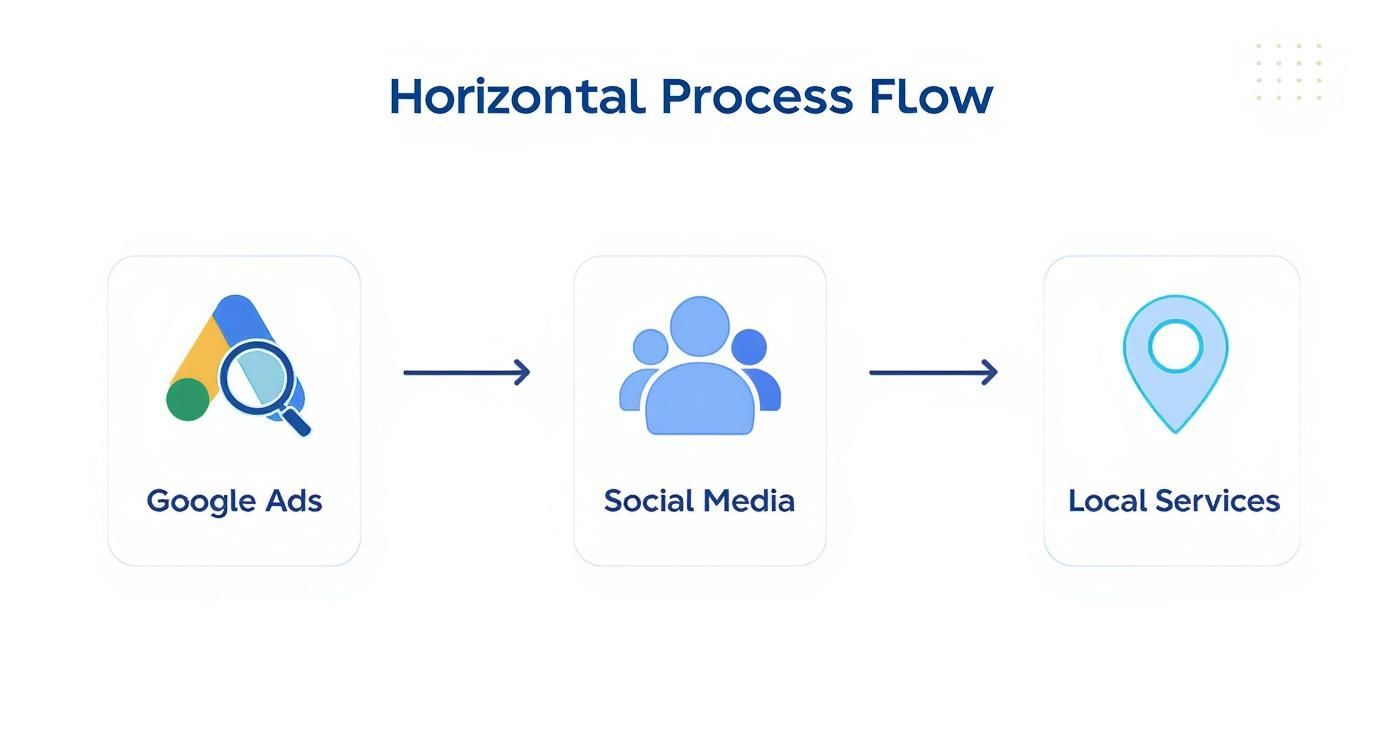
As you can see, it doesn't matter if the lead comes from a search ad, a social media campaign, or a local listing—every interaction is trackable and can be measured against your firm's goals.
Closing the Loop with a CRM
Now for the most important step, the one most firms miss: linking your marketing spend to actual, signed cases. The only reliable way to do this is with a Client Relationship Management (CRM) system built for law firms, like Clio or Lawmatics.
This is where you finally "close the loop." By using UTM parameters—little snippets of code added to the end of your ad URLs—you can pass campaign details directly into your CRM every time a new lead comes in. You'll know precisely which ad, keyword, or campaign brought them to your door.
When a lead that came from your "Google Ads – Car Accident Campaign" signs on as a new client six weeks later, your CRM will hold that data. This is how you finally calculate your true Cost Per Acquisition (CPA) and Return on Ad Spend (ROAS).
This level of tracking turns your advertising from a murky expense into a predictable investment. It’s also a vital piece of a much larger strategy for website optimization for law firms, ensuring every digital touchpoint is laser-focused on acquiring new clients. Without this final CRM connection, you're only seeing half the story of your advertising's true impact.
From Data Overload to Actionable Insights
Collecting data is one thing. Actually using it to make smart, fast decisions is where the real advantage lies.
If you have the right framework, you can stop staring at spreadsheets and start confidently pinpointing which campaigns, keywords, and ads are bringing in your most valuable leads.
This process turns measuring advertising effectiveness from a simple reporting chore into a strategic weapon. The whole point is to build a clear, repeatable method for analyzing performance so you can double down on what works and cut what doesn't—without a moment's hesitation.
Calculating Your True Return on Ad Spend
One of the most powerful numbers you can track is your Return on Ad Spend (ROAS). It’s a simple but ruthless calculation that tells you exactly how much revenue you’re getting back for every dollar you put into advertising.
The formula is pretty straightforward:
ROAS = (Total Revenue from Ads / Total Ad Spend) : 1
Let's walk through a real-world scenario. Imagine your personal injury firm spent $2,000 on a targeted Google Ads campaign last month. That campaign generated two new signed clients, and your firm’s average initial case value is $5,000.
- Total Ad Spend: $2,000
- Total Revenue: 2 clients x $5,000 = $10,000
- ROAS Calculation: ($10,000 / $2,000) = 5
That gives you a ROAS of 5:1. For every single dollar you spent, you brought in five. That one number gives you immediate clarity on whether the campaign was actually profitable.
This focus on linking ad spend directly to real business outcomes is driving a major shift. In fact, the market for advertising effectiveness tools is projected to hit $16.4 billion by 2034, mostly because firms are tired of guessing and are demanding clear proof of performance through metrics like ROAS. You can dig deeper into this trend in this detailed analysis of advertising effectiveness.
Pinpointing Your Client Acquisition Cost
While ROAS is all about profitability, Client Acquisition Cost (CAC) is about efficiency. This metric tells you exactly how much it costs to get one new, signed client from a specific campaign.
CAC = (Total Ad Spend / Number of New Clients Acquired)
Let's use the same example:
- Total Ad Spend: $2,000
- New Clients: 2
- CAC Calculation: ($2,000 / 2) = $1,000
Your CAC is $1,000 per client. So, is that a good number? It depends entirely on your Client Lifetime Value (CLV). If your average CLV is $20,000, then spending $1,000 to acquire that client is an incredible investment.
By consistently calculating both ROAS and CAC for every single campaign, you create a powerful feedback loop. You're no longer guessing; you're making data-driven decisions based on the financial reality of your marketing.
This numbers-first approach lets you make strategic changes with total confidence. If one ad set has a 5:1 ROAS and another is limping along at 2:1, you know exactly where to shift your budget next month to fuel your firm's growth.
Answering the Tough Questions About Ad Performance
Even with the best tools and a solid plan, measuring ad performance isn't a one-and-done task. It's a constant loop of testing, learning, and tweaking your strategy. You're going to have questions.
Let's tackle some of the most common hurdles I see law firms run into. Here are some straight, practical answers to help you get confident in your marketing measurements.
How Long Should My Ad Campaign Run Before I Judge It?
There’s no magic number here, but you need enough data to make a smart call. For fast-moving digital ads on platforms like Google or Meta, I always recommend letting them run for at least 30 days. Or, wait until you have a statistically significant number of conversions—not just clicks.
Why so long? Because this window helps you get past the initial, often chaotic, performance swings and see what real users are actually doing. A campaign's first week is notoriously volatile as the platform's algorithm figures things out. Pulling the plug after three days because you're nervous is one of the most classic mistakes you can make.
Set your review period in advance and stick to it. Patience is a powerful tool in ad measurement. For broader brand awareness campaigns, you might need a full quarter to see real shifts in direct website traffic or branded searches.
What’s a Good Return on Ad Spend for a Law Firm?
A "good" Return on Ad Spend (ROAS) is completely dependent on your firm’s profit margins and average case value. I see the 4:1 ratio ($4 in revenue for every $1 spent) thrown around as a benchmark, but honestly, that can be wildly misleading for law firms.
A high-value personal injury practice, for example, might need a 10:1 ROAS or even higher to be truly profitable once you factor in case costs and how long they take to resolve. On the other hand, a firm with steady, recurring revenue from business clients might find a 3:1 ratio is a huge win.
Before you do anything else, calculate your break-even point. Figure out the absolute minimum ROAS you need just to avoid losing money. Then you can set an ambitious, but realistic, target.
My Ads Get Clicks but No Clients. What Do I Fix?
This is an incredibly common—and frustrating—problem. The good news is that it almost always points to a breakdown after the click. If your ad is getting engagement, it's probably doing its job. The real investigation begins on the other side of that click.
- Audit Your Landing Page: Does the headline and content perfectly match what you promised in the ad? Is the call to action clear and impossible to miss? A high bounce rate on your landing page is a massive red flag telling you there's a disconnect.
- Re-examine Your Targeting: Are your keywords too broad? You could be attracting searchers with the wrong intent. Is your social media audience defined too loosely, bringing in curious browsers instead of actual potential clients?
- Look at Your Intake Process: This is the silent killer of marketing ROI. I've seen it time and time again. If qualified leads are filling out your forms but no one contacts them quickly and professionally, you're lighting money on fire. The ad did its job perfectly, but the follow-through failed.
Finally, make sure every ad you run is up to professional standards. Navigating the rules of legal marketing isn't just about compliance; it's about protecting your firm's integrity. For a deeper dive, check out our guide to ethical attorney advertising in California, which offers key insights for running effective and compliant campaigns.
At Case Quota, we specialize in turning advertising data into client growth for law firms. If you're ready to stop guessing and start making data-driven decisions, visit us at https://casequota.com to learn how we can help.