

Growth focused American law firms in Southern California face fierce competition as over 65 percent of new clients now research multiple providers before making their decision. Standing out against larger firms means adopting smarter legal lead generation systems tailored to your practice area and client demographics. This article gives you actionable techniques that help your firm pinpoint high quality client sources, maintain compliance, and harness modern technology to boost acquisition results.
Table of Contents
- Step 1: Define Legal Lead Sources For Your Market
- Step 2: Set Up Compliant Data Capture Systems
- Step 3: Implement AI-Powered Campaign Strategies
- Step 4: Refine Lead Nurturing And Qualification Processes
- Step 5: Verify Performance And Compliance Metrics
Quick Summary
| Key Point | Explanation |
|---|---|
| 1. Identify Lead Sources | Map out channels where potential clients discover your practice, such as digital platforms and referrals. |
| 2. Compliant Data Capture | Establish secure systems for collecting client information to protect privacy and maintain integrity. |
| 3. Utilize AI Marketing Tools | Implement AI-driven strategies for targeting, personalization, and data analysis in client acquisition. |
| 4. Structured Lead Qualification | Develop systematic methods to evaluate and nurture potential clients through scoring and engagement. |
| 5. Monitor Performance and Compliance | Track key metrics and compliance indicators to evaluate the effectiveness of your lead generation efforts. |
Step 1: Define legal lead sources for your market
Successfully generating leads for your law firm requires a strategic approach to identifying potential client channels. This step focuses on mapping out the precise sources where your target clients are most likely to originate.
Legal lead sources essentially represent the various pathways potential clients might discover and connect with your law practice. Understanding legal lead generation strategies involves examining multiple channels such as digital platforms, referral networks, community connections, and targeted advertising methods. For law firms in Southern California, these sources typically include organic search results, social media platforms, professional networking sites like LinkedIn, Google Local Services Ads, targeted pay per click campaigns, and specialized legal referral networks.
Your lead source strategy should consider your specific practice area and ideal client demographics. Personal injury practices might prioritize online search and digital advertising, while business litigation firms could focus more on professional referral networks and industry event sponsorships. By carefully analyzing where your most valuable clients originate, you can allocate marketing resources more effectively and build a sustainable client acquisition pipeline.
Pro tip: Track the conversion rates and client acquisition costs for each lead source to continuously refine your marketing strategy and maximize return on investment.
Here’s a quick comparison of common legal lead sources and their typical client quality for Southern California law firms:
| Lead Source Type | Example Platforms | Expected Client Quality |
|---|---|---|
| Organic Search | Google, Bing | High due to intent |
| Legal Referral Networks | Avvo, FindLaw | Medium to high, pre-vetted |
| Social Media | Facebook, Instagram | Variable, often awareness |
| Professional Networking | High for B2B matters | |
| Paid Digital Ads | Google LSAs, PPC | Medium, depends on targeting |
| Community Connections | Local Events, Sponsorships | High for trust-building |
Step 2: Set up compliant data capture systems
Law firms must establish robust and legally compliant systems for collecting potential client information that protect both client privacy and firm integrity. This step involves creating a strategic framework for capturing lead data while maintaining strict adherence to professional standards.

Implementing data protection protocols requires a comprehensive approach that addresses technological safeguards, staff training, and ongoing compliance monitoring. Your data capture system should incorporate secure web forms with encrypted submission channels, clear consent mechanisms, and detailed privacy policy disclosures. This means designing intake forms that collect only necessary information, using HTTPS secure connections, implementing robust data storage solutions with access controls, and ensuring all digital touchpoints meet American Bar Association guidelines for client information protection.
Specifically for Southern California law firms, your data capture strategy must account for California Consumer Privacy Act regulations, which impose stringent requirements on how personal information is collected, stored, and managed. This includes providing clear opt out mechanisms, maintaining transparent data usage policies, and implementing rigorous cybersecurity measures that prevent unauthorized access or potential data breaches.
Pro tip: Conduct quarterly compliance audits of your data capture systems to identify and address potential vulnerabilities before they become significant risks.
Below is a summary of data protection elements Southern California law firms should prioritize:
| Compliance Element | Description | Impact on Firm |
|---|---|---|
| Secure Web Forms | Use HTTPS and encryption for submissions | Reduces data theft risks |
| Clear Consent Mechanisms | Gain explicit contact permission | Ensures regulatory compliance |
| Privacy Policy Disclosure | Inform clients of data handling | Builds client trust |
| Access Controls | Limit access to private client data | Prevents internal misuse |
| Opt-Out Mechanisms | Allow clients to withdraw consent | Meets CCPA requirements |
Step 3: Implement AI-powered campaign strategies
AI has transformed legal marketing by enabling more precise targeting, personalized communication, and data driven decision making for law firms seeking to optimize their lead generation efforts. This step focuses on strategically integrating artificial intelligence technologies into your marketing workflow to enhance client acquisition and engagement.
Advanced AI marketing strategies require a sophisticated approach that balances technological capabilities with ethical considerations specific to the legal profession. For Southern California law firms, this means leveraging machine learning algorithms to analyze potential client data, predict conversion opportunities, and create highly targeted marketing content. Your AI implementation should include predictive lead scoring systems that evaluate prospect quality, automated personalization tools for email and social media outreach, and intelligent chatbots designed to provide initial client screening and engagement.
Successful AI campaign strategies demand continuous refinement and human oversight. While AI can dramatically improve efficiency, law firms must maintain a strategic human touch that ensures compliance, maintains professional ethics, and delivers the nuanced communication clients expect from legal professionals. This involves regularly auditing AI generated content, training your systems on relevant legal marketing datasets, and developing clear guidelines that prevent over reliance on automated technologies.
Pro tip: Implement a quarterly review process to assess your AI marketing tools performance, ensuring they consistently align with your firms strategic goals and ethical standards.
Step 4: Refine lead nurturing and qualification processes
Successful lead nurturing requires a strategic approach that transforms initial client contacts into meaningful legal relationships. This step focuses on developing a systematic method for evaluating and advancing potential client interactions through precise qualification techniques.
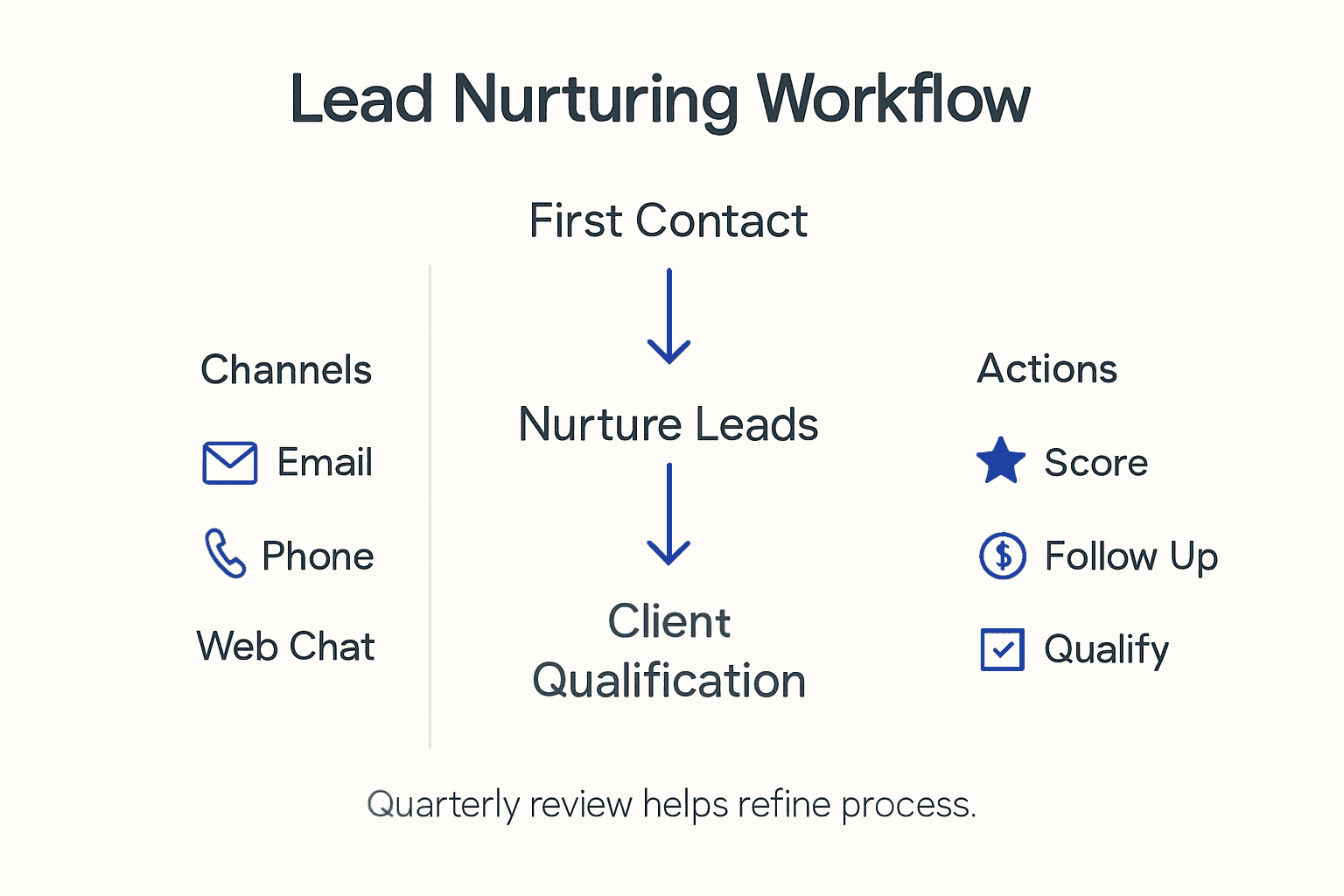
Strategic lead development frameworks demand a multifaceted approach that goes beyond simple contact management. For Southern California law firms, this means implementing a comprehensive qualification process that evaluates potential clients across multiple dimensions including case complexity, financial viability, alignment with firm expertise, and potential long term value. Your lead nurturing strategy should incorporate a scoring system that ranks prospects based on specific criteria such as initial consultation responsiveness, case merit, potential billable hours, and strategic fit with your firm specialized practice areas.
Effective lead qualification involves creating a structured communication pathway that progressively builds trust and extracts critical information. This requires developing a sophisticated multi touch engagement strategy that combines automated follow up systems with personalized attorney interactions. Southern California law firms should design a qualification process that includes initial screening mechanisms, targeted communication sequences, and clear progression milestones that help determine which prospects warrant deeper investment of firm resources.
Pro tip: Create a standardized lead scoring template that assigns weighted values to different client interaction signals, allowing for more objective and consistent prospect evaluation.
Step 5: Verify performance and compliance metrics
Ensuring your law firm maintains rigorous performance standards requires a systematic approach to tracking and evaluating key metrics that reflect both operational effectiveness and regulatory compliance. This step focuses on developing a comprehensive verification framework that provides transparent insights into your lead generation workflow.
Comprehensive compliance monitoring strategies demand a multidimensional approach that goes beyond simple numerical reporting. For Southern California law firms, this means creating a robust metrics framework that captures critical performance indicators across multiple dimensions including lead conversion rates, client acquisition costs, engagement quality, ethical compliance, and overall marketing effectiveness. Your verification process should incorporate both quantitative measurements and qualitative assessments that provide a holistic view of your firms lead generation performance.
Effective metrics verification involves establishing clear benchmarks, implementing regular audit processes, and creating transparent reporting mechanisms that allow for continuous improvement. This requires developing a sophisticated tracking system that not only monitors key performance indicators but also identifies potential areas of risk or inefficiency. Southern California law firms should design a verification approach that includes periodic comprehensive reviews, real time monitoring tools, and structured feedback loops that enable rapid adaptation and strategic refinement of their lead generation workflows.
Pro tip: Develop a standardized quarterly compliance dashboard that integrates both performance metrics and ethical compliance indicators to provide a comprehensive view of your firms lead generation ecosystem.
Boost Your Law Firm’s Lead Generation with Tailored Digital Marketing Solutions
The article highlights the critical challenges Southern California law firms face in mastering lead generation workflows, including identifying the right legal lead sources, ensuring compliance in data capture, leveraging AI-powered campaigns, refining lead nurturing, and verifying performance metrics. These pain points demand a focused and personalized strategy to turn potential prospects into loyal clients while maintaining regulatory standards.
At Case Quota, we understand the importance of these exact elements. Our expertise lies in crafting customized digital marketing strategies that align with your firm’s goals and optimize every stage of the lead generation process. From SEO-optimized web design and AI-enhanced pay-per-click advertising to Google Local Services Ads and sophisticated social media marketing, we deliver solutions shaped by 15 years of digital results and deep knowledge of California legal marketing.
Unlock a competitive edge by partnering with a team that focuses solely on helping law firms grow their client base through proven, ethical, and strategic methods. Discover how our fractional CMO services and performance-driven digital campaigns translate complex marketing concepts into clear growth for your firm.
Are you ready to transform your lead generation workflow and attract high-quality clients consistently?

Start now by visiting https://casequota.com to explore tailored marketing solutions designed for your firm’s unique needs and gain the advantage your practice deserves.
Frequently Asked Questions
What are the primary lead sources for law firms?
Legal lead sources for law firms typically include organic search results, social media platforms, professional networking sites like LinkedIn, Google Local Services Ads, and specialized legal referral networks. Identify the channels most likely to connect with your target clients and prioritize them in your marketing strategy.
How can I ensure compliance when capturing lead data?
To maintain compliance, establish secure data capture systems with encrypted web forms and clear consent mechanisms for client information. Review your intake processes regularly to ensure they align with data protection regulations, thus safeguarding client privacy and your firm’s integrity.
What is the role of AI in lead generation for law firms?
AI enhances lead generation by enabling precise targeting, personalized communication, and data-driven decision-making. Implement AI tools to analyze client data and optimize marketing campaigns, but ensure to maintain a balance between technological capabilities and ethical considerations in legal practice.
How do I develop an effective lead nurturing process?
An effective lead nurturing process includes evaluating potential clients based on case complexity and financial viability while creating structured communication pathways. Design a multi-touch engagement strategy to build trust and progressively qualify leads over time.
What metrics should I track to verify lead generation performance?
Focus on tracking key performance indicators such as lead conversion rates, client acquisition costs, engagement quality, and compliance with ethical standards. Set benchmarks and conduct regular audits to measure these metrics, allowing for continuous refinement of your lead generation efforts.
How can I improve my lead qualification process?
Enhance your lead qualification process by creating a standardized scoring system that evaluates potential clients based on defined criteria like case merit and strategic fit. Regularly review this template to ensure it facilitates a more objective and efficient evaluation of prospects.