
When you boil it down, law firm lead generation is all about creating a predictable system that brings potential clients to your door. It’s the difference between relying on sporadic referrals and building a reliable engine for growth, using smart digital marketing to find people who are actively looking for the legal help you provide.
Set Up Your Digital Foundation for a Steady Stream of Leads
Before you even think about running a single ad, you need to get your digital house in order. Your firm’s website is the absolute cornerstone of every lead generation effort you’ll make. It’s the central hub where potential clients get their first real impression of you, and it has to do more than just exist—it needs to be a machine built to convert visitors into qualified inquiries.
Think of your website as your digital office. It must be professional, intuitive, and instantly communicate your expertise. I’ve seen high-value clients click away from a poorly designed or slow-loading site in seconds, sending them right into the arms of a competitor. This is where you establish authority and build trust before you ever spend a dime on advertising.
Getting Your Marketing Channels to Work Together
A truly effective strategy doesn’t rely on a single platform. The goal is to create an interconnected system where all your channels—SEO, paid ads, social media—work in concert to produce a consistent flow of new cases. This integrated approach makes sure your firm is visible and credible wherever potential clients are searching.
Here are the core lead generation channels and how they fit together.
Core Lead Generation Channels for Law Firms
| Channel | Primary Goal | Best For Practice Areas Like… |
|---|---|---|
| Website | Convert visitors into leads | All practice areas; it’s the central hub. |
| SEO | Attract long-term organic traffic | Personal Injury, Family Law, Estate Planning |
| Paid Ads (PPC/LSAs) | Generate immediate, high-intent leads | Criminal Defense, Bankruptcy, Mass Torts |
| Social Media | Build brand and top-of-mind awareness | Business Law, IP Law, Employment Law |
By weaving these elements together, you build a resilient marketing foundation that isn’t vulnerable to a single point of failure. If you’re looking for a more in-depth breakdown, our complete guide on how to market a law firm is a great place to start. A diverse marketing mix is the only way to achieve sustainable, long-term growth.
Where Are Your Leads Really Coming From?
To build that strong foundation, you have to know where your leads originate. While referrals are great, the digital world has opened up a massive opportunity. This chart gives you a quick visual breakdown of the most common lead sources for modern law firms.
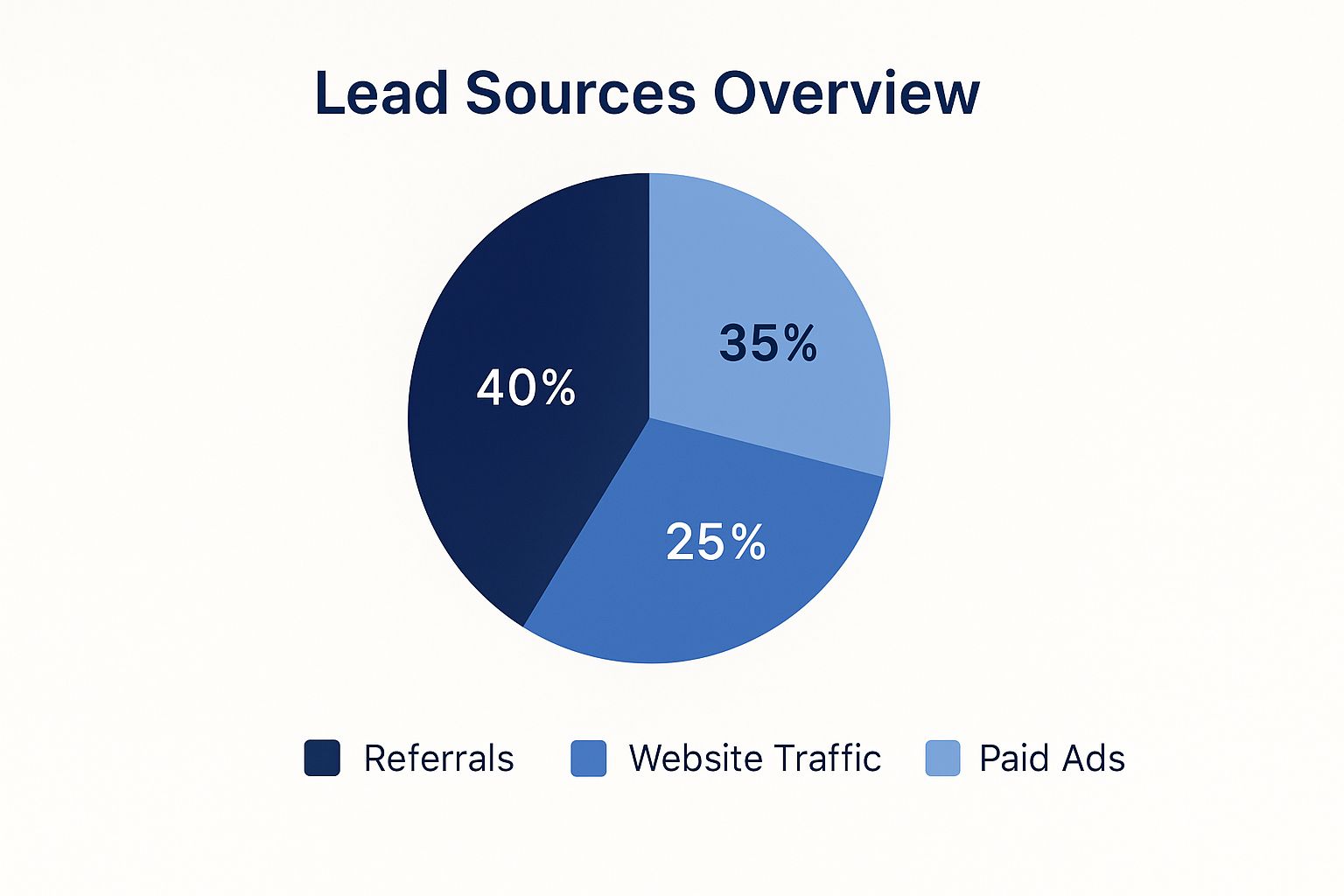
As you can see, while referrals are still a major piece of the puzzle, digital channels like your website and paid ads represent a huge opportunity for predictable growth.
The legal market is brutally competitive. A diversified marketing approach isn’t just a good idea anymore—it’s a requirement for survival. Recent data shows that 39% of law firms now point to their website as their main source of leads. And get this: 71% of lawyers have successfully landed new cases directly through social media. LinkedIn, in particular, is a powerhouse, with 34% of attorneys calling it their most effective platform for driving business.
But remember, it takes an average of 13.4 leads to sign just one new client. That number alone highlights why you need a robust, multi-channel strategy that fires on all cylinders.
Your firm’s website is your most valuable marketing asset. It works for you 24/7, qualifying prospects and building credibility while you focus on practicing law. Neglecting it is like leaving your front door locked during business hours.
Mastering Search Engines to Attract High-Intent Clients

Let’s be blunt: when someone has a serious legal problem, their first move isn’t to the Yellow Pages. It’s to Google. This is precisely why Search Engine Optimization (SEO) is the single most powerful long-term strategy for generating a steady, predictable flow of new cases for your law firm.
Think of it this way. Paid ads are like renting an audience—the traffic stops the second you turn off the spend. A strong SEO presence, on the other hand, is an asset you own. It builds equity over time, establishing your firm as the trusted authority and capturing people at the exact moment they need legal help.
These aren’t just tire-kickers. They’re people with immediate needs, typing queries like “car accident lawyer near me” or “best divorce attorney in Los Angeles.” You want to be the firm they find.
Dominate the Local Map Pack with Your Google Business Profile
For almost every law firm, the new client battle is won or lost on a local map. Your most critical weapon in this fight is your Google Business Profile (GBP). This free listing is what gets you into the coveted “map pack”—that block of three local businesses Google shows at the very top of the search results.
Getting your GBP right isn’t just a good idea; it’s non-negotiable. It’s often the first real interaction a potential client has with your firm. A sloppy, incomplete profile screams “lack of attention to detail,” which is the absolute last impression you want to give.
Get started by making sure every part of your profile is filled out meticulously:
- Nail Your NAP: Your firm’s Name, Address, and Phone number must be perfectly identical everywhere online. Even small inconsistencies can confuse Google and hurt your ranking.
- Show, Don’t Just Tell: Upload professional, high-quality photos of your office (inside and out), your attorneys, and your team. This builds instant trust and humanizes your practice.
- Describe Your Services: Clearly list every single practice area. Don’t use legalese; use the exact words your clients would use to describe their problems.
A well-optimized Google Business Profile is like having the best-located, most inviting office on the digital main street. It draws in local foot traffic—or in this case, click traffic—from people in your immediate service area who are ready to take action.
But the real game-changer? Reviews. A steady stream of positive client reviews is arguably the single biggest factor for your GBP. They provide powerful social proof and are a massive ranking signal to Google. Make asking for reviews a standard part of your process when you close a case.
Build Real Authority with Targeted Practice Area Pages
While your GBP puts you on the map, it’s your website’s content that truly seals the deal and helps you rank for a much wider net of valuable search terms. A generic “Our Services” page just doesn’t cut it anymore. You need to create specific, in-depth pages for each practice area and every location you serve.
For instance, instead of a single, broad “Family Law” page, you should build out separate, detailed pages for:
- Divorce Proceedings in [Your City]
- Child Custody Agreements and Negotiations
- Alimony and Spousal Support Law
This laser-focused approach works wonders for two reasons. First, it lets you rank for high-intent, long-tail keywords like “contested divorce lawyer in Santa Monica,” which have much higher conversion rates. Second, it proves your expertise to a potential client, showing them you understand the specific nuances of their legal issue.
Each of these pages needs to be a rich resource. Answer common questions, explain the legal process, and end with a clear, direct call-to-action to book a consultation. For firms in brutally competitive markets, this depth of content is essential. We explore this strategy in our guide on SEO strategies for PI firms in crowded markets like Los Angeles.
When you combine a dominant local presence with authoritative, topic-specific content, you create a powerful SEO engine that consistently brings high-quality leads right to your doorstep.
Using Paid Advertising for Immediate Lead Flow

While SEO is fantastic for building long-term authority, it doesn’t pay the bills tomorrow. For that, you need something that delivers right away.
This is where paid advertising comes in. It’s the most direct path to getting a consistent flow of new inquiries, fast. When a potential client has an urgent legal problem, a well-placed ad puts your firm at the very top of their search results, grabbing their attention at the exact moment they need help.
Think of it as the digital version of having an office on the busiest street in town. You’re paying for a premium spot to attract people who are actively searching for a solution. It’s a core part of modern law firm lead generation because it produces predictable, measurable results from day one.
Getting a Handle on Google Ads
Pay-per-click (PPC) advertising, especially through Google Ads, is an incredibly powerful tool for law firms. The concept is simple: you bid on specific keywords—think “criminal defense attorney” or “car accident lawyer near me”—and your ad shows up at the top of Google. The best part? You only pay when someone actually clicks.
This model works so well because it targets people based on their immediate intent. Someone typing those phrases into Google isn’t just browsing; they have a real problem and they need a solution now.
The secret to a successful campaign is precision. You have to target:
- Specific Legal Issues: Don’t just bid on a generic term like “lawyer.” Get granular with phrases like “DUI first offense,” which attracts a much more qualified prospect.
- Geographic Areas: You can narrow your ads down to specific zip codes, making sure your marketing budget is only spent on potential clients you can actually serve.
A well-structured PPC campaign is like a finely tuned engine. Every part—from the keywords you choose to your ad copy and landing page—has to work together perfectly to turn clicks into clients. It demands constant attention and optimization.
The Power of Local Service Ads
For a lot of law firms, Google Local Service Ads (LSAs) have been a total game-changer. These ads appear even above the traditional PPC results and come with one massive advantage: the “Google Screened” badge.
This little checkmark tells potential clients that Google has vetted your firm, instantly building a layer of trust that other ads just can’t compete with.
Unlike PPC, LSAs work on a pay-per-lead model. You aren’t paying for clicks or views. You only pay when a qualified potential client calls or messages you directly through the ad. This often results in a much higher return on your investment since you’re paying for a direct contact, not just a website visit. The process to get “Google Screened” involves a background check and verifying your license, but the credibility it brings is priceless.
Turning Clicks into Consultations
Getting traffic to your site is just step one. To make sure your ad spend isn’t wasted, you absolutely need a high-converting landing page. This is a standalone web page built specifically for one purpose: to capture the lead from your ad. It’s where a user “lands” after they click.
An effective law firm landing page must have:
- A Clear, Compelling Headline: It should mirror the ad copy and speak directly to the visitor’s legal issue.
- A Simple Contact Form: Only ask for the essentials. Name, phone, email, and a short message about their case is usually enough.
- Trust Signals: Prominently display client testimonials, case results, and awards to build immediate confidence.
- A Strong Call-to-Action (CTA): Be direct. Use phrases like “Schedule Your Free Consultation” or “Get a Free Case Review.”
Tracking your performance is non-negotiable. It’s the only way to make smart, data-driven decisions that will actually grow your firm. By analyzing metrics like cost-per-lead and conversion rate, you can constantly refine your campaigns and put your money where it works best. If you’re just getting started, understanding the basics of how to get clients for a law firm can provide a solid foundation for folding paid ads into your overall strategy.
Getting Your Client Intake and Response System Right
So, you’ve got leads coming in. That’s a huge win, but it’s only half the game. The most brilliant law firm lead generation campaign on the planet will fall flat if those potential clients are met with silence. Your intake and response system is where the rubber meets the road—it’s what turns a lead into a signed client.
Think about it from the potential client’s perspective. They’re often stressed, anxious, and urgently looking for help. Every minute you make them wait, that urgency drives them to the next law firm on their Google search. They aren’t just sitting by the phone; they’re filling out another contact form. The first firm that makes a real, human connection usually gets the case.
This isn’t just a hunch; it’s a hard truth in legal marketing. The speed and quality of that first touchpoint set the entire tone for the relationship and have a massive impact on your conversion rates.
The Five-Minute Rule: Today’s Standard for Client Conversion
That window of opportunity to connect with a new digital lead? It’s shockingly small. The most critical period is the first five minutes after they hit “submit” or dial your number. If you can respond within that timeframe, your chances of actually connecting with and qualifying them go through the roof.
Wait just 30 minutes, and you’ll see your conversion rates plummet. By then, that prospect might have already chatted with two or three of your competitors. A fast, professional response signals that your firm is organized, on the ball, and genuinely wants their business—exactly what every client is looking for in their legal counsel.
The data backs this up. A recent industry study shows just how critical response time has become. By 2025, 74% of law firms were responding to online leads within a week, a big jump from just 59% in 2021. But here’s the kicker: 25% of firms now respond within that crucial five-minute window, a number that has nearly doubled in four years. This shift is happening because firms are finally dialing in their intake processes and using automation. You can dig into the numbers yourself in the 2025 lead response time study.
Choosing the Right Way to Reach Out
How you respond is just as critical as how fast. There’s no single perfect method; the best strategy usually involves a smart mix of communication channels.
Here’s a quick look at your main options:
- Phone Calls: Still the undisputed champion. A phone call is personal, direct, and lets you qualify someone on the spot. It’s no surprise that 87% of law firms still count on phone calls to build that instant rapport.
- Email: You need both automated and personal emails in your toolkit. An instant auto-response confirms you got the inquiry and manages expectations. A personalized follow-up from a real person a few minutes later shows you’re paying attention.
- Text Messaging (SMS): This is a powerful channel, but you have to be careful. Texts have incredible open rates, but you must be mindful of TCPA regulations. They work best for things like appointment reminders or quick follow-ups after you’ve already made initial contact.
No matter which channels you use, especially automated ones, you have to stay on the right side of your ethical obligations. Our guide on navigating attorney advertising rules is a great resource for staying compliant.
Building a System Built for Speed
Hoping someone remembers to check an email inbox for new leads is a recipe for disaster. To win, you need a systematic, tech-powered approach that gives every single lead the immediate attention it deserves.
A Customer Relationship Management (CRM) system is the command center for a modern intake process. A good legal-specific CRM automates the grunt work and ensures nothing ever slips through the cracks.
Here’s what a solid intake system should be doing for you:
- Capture Leads Instantly: Forms from your website, Google Ads, and social media should all pour directly into your CRM in real-time. No manual entry.
- Trigger Smart Automations: The second a lead hits your system, an automated email or text should go out. It confirms you received their message and tells them what to expect next.
- Alert the Right People: Your system needs to immediately notify your intake team or a designated attorney. We’re talking email, text, and desktop alerts—whatever it takes to get their attention.
- Prompt the Human Follow-Up: This is the most important part. The technology handles the first few seconds, but then a person needs to take over. The intake specialist’s one and only goal should be to get that prospect on the phone, listen to their story, and schedule a proper consultation.
Your client intake process is the final, and most important, step in your marketing funnel. It’s where you turn an expensive click into a valuable client. Investing in the right people and technology here will generate a higher ROI than any other marketing adjustment you can make.
Put Technology to Work for Smarter Lead Generation

Relying on a steady stream of referrals and a bit of networking is a risky way to grow a modern law firm. Today, the most competitive firms are leaving that inconsistent model behind. They’re embracing technology to build predictable, data-driven strategies for attracting new clients.
This shift is all about using the right tools to automate, analyze, and fine-tune every part of your intake process. When you integrate the right tech, you don’t just get more leads—you get better leads and a clear line of sight into what’s actually driving your firm’s growth.
Use AI Chatbots to Qualify Leads Instantly
Imagine having someone on your website 24/7, ready to greet every single visitor, answer their initial questions, and get their contact info. That’s exactly what an AI-powered chatbot does for you. These aren’t just annoying pop-ups; they’re sophisticated first responders for your digital front door.
A well-configured chatbot can:
- Engage visitors immediately the second they land on your site, keeping them from clicking away.
- Ask smart qualifying questions to see if a visitor’s problem matches your practice areas.
- Capture essential contact information like a name, phone number, and email address.
- Book consultations right into your calendar, saving you the headache of back-and-forth emails.
This initial screening frees up your team’s time to focus on high-intent prospects who have already been vetted. No potential client is ever lost just because they visited your site after hours.
Make Data-Driven Decisions with Analytics
Guesswork has no place in your marketing budget. You need to know what’s working, what isn’t, and where to put your money for the best possible return. That’s where analytics tools come in.
Tools like Google Analytics give you a crystal-clear picture of how your website is performing. You can track key numbers that tell the real story behind your lead generation efforts.
Essential Metrics to Watch
| Metric | Why It Matters for Getting New Cases |
|---|---|
| Organic Traffic | Shows how many people find you on Google. It’s a direct reflection of your SEO health. |
| Conversion Rate | The percentage of visitors who actually do something, like fill out a contact form. This is huge. |
| Bounce Rate | Tells you if your content is engaging or if people are leaving without taking any action. |
| Cost Per Lead | Calculates exactly how much you’re spending in ads to get a single, qualified lead. |
When you review this data regularly, you can make smart, informed decisions. For example, if a practice area page gets tons of traffic but has a horrible conversion rate, you know it’s time to tweak that page’s content or call-to-action.
Automate Your Follow-Up with a CRM
A Customer Relationship Management (CRM) system should be the central nervous system for your firm’s entire intake process. It’s the machine that turns raw leads into signed clients through organized, persistent follow-up.
A CRM built for law firms gets rid of repetitive tasks and makes sure no lead ever slips through the cracks. It lets you track every single touchpoint with a potential client, from their first visit to your website all the way to a signed retainer agreement.
A CRM isn’t just a fancy address book; it’s a system for consistent communication. By automating follow-up emails and reminders, your firm stays top-of-mind while your competitors are still trying to figure out who to call back.
Moving to AI tools and a data-first mindset is a complete game-changer for law firms. While traditional methods like referrals give you unpredictable results, these structured strategies create a scalable pipeline of qualified prospects.
The most successful firms blend paid channels like Google Ads with strong organic growth tactics. Things like AI chatbots and CRMs then supercharge the process by improving response times and follow-up—which is critical when a potential client expects to hear from you now.
To dive deeper into building a powerful marketing engine for your firm, check out our guide on the 10 powerful law firm marketing strategies for 2025.
Answering Your Law Firm’s Lead Generation Questions
It’s only natural to have questions when you’re navigating the world of digital marketing. Let’s tackle some of the most common ones we hear from attorneys who are ready to take their firm’s growth seriously.
How Much Should My Law Firm Budget for Marketing?
This is the big one, and there’s no single magic number. A solid benchmark, though, is to set aside anywhere from 2% to 10% of your firm’s gross revenue for marketing.
If you’re a newer firm just breaking into the market or you’re in a fiercely competitive space like personal injury, you’ll want to lean toward the higher end of that range. This gives you the firepower needed to establish a strong foothold and get noticed.
The most important thing is to stop thinking of marketing as an expense and start treating it as an investment. You don’t need to break the bank from day one. Start with a budget you’re comfortable with and track your return on investment (ROI) like a hawk. When you know your cost per lead and, more importantly, your cost per signed client, you can confidently scale what’s working and cut what isn’t.
What’s the Fastest Way to Get New Leads in the Door?
When you need the phone to ring now, nothing beats paid advertising. Specifically, Google Local Service Ads (LSAs) and traditional Google Ads (PPC) are built for speed.
LSAs are especially powerful for law firms. Why? Because you’re paying for a qualified lead, not just a click. Plus, earning that “Google Screened” badge instantly builds trust with potential clients who are in the middle of an urgent search for legal help.
SEO is the engine for long-term, sustainable growth and almost always delivers a better ROI over time. But it’s a marathon, not a sprint—it can take months to see significant results. A smart strategy uses paid ads to generate immediate cash flow while you build up your organic SEO foundation for the future.
Should My Firm Really Be Using Social Media for Leads?
Absolutely, but you have to play the game by its rules. Platforms like LinkedIn, Facebook, and Instagram are completely different from Google. On social media, you’re interrupting someone’s feed, not answering their direct, active search for a lawyer.
The best approach is to use social media to build authority and stay top-of-mind. Share valuable content, celebrate firm wins, post client testimonials, and offer genuinely helpful legal tips. It’s about building a brand, not just chasing a lead.
For direct lead generation, social media ads can be incredibly effective when done right. With precise targeting, you can reach people based on their location, interests, and even major life events. This works exceptionally well for practice areas like:
- Family Law
- Estate Planning
- Bankruptcy Law
You can get your message in front of people who may not even realize they need a lawyer yet.
At Case Quota, we specialize in building these comprehensive, multi-channel marketing systems that drive predictable growth for law firms. If you’re ready to move beyond inconsistent referrals and build a reliable engine for new client acquisition, we should talk. Learn more about our approach and schedule a consultation at https://casequota.com.
Article created using Outrank