

At its core, lawyer lead generation is all about strategically attracting potential clients who need your specific legal services. It's not just about getting clicks or calls; it's about building a predictable system that identifies, engages, and converts real people searching for legal help into qualified new cases for your firm.
Building Your Lead Generation Foundation
Jumping straight into Google Ads or social media marketing without a solid plan is the fastest way to burn through your budget. I've seen it happen time and again. Real success in generating legal leads doesn't come from random tactics—it starts with a deliberate, data-backed foundation that guides every single decision you make.
This foundational work is what ensures your marketing dollars are spent efficiently, attracting the right clients, not just any clients.
Define Your Ideal Client Avatar
First things first: you have to move beyond a vague idea of who you serve. You need to define your ideal client with almost uncomfortable precision.
Who are you really trying to reach? Just saying "personal injury clients" is far too broad. Think about a specific person. For a Southern California firm, this could be:
- A 35-year-old construction worker in Riverside County who was injured on the job.
- A high-net-worth couple in Irvine looking for sophisticated estate planning advice.
- A tech startup founder in Santa Monica who needs help protecting their intellectual property.
Creating these detailed "avatars" is a game-changer. It helps you tailor your messaging, pick the right marketing channels, and speak directly to the frustrations and goals of the people you actually want to serve.
This process highlights the crucial first steps in any effective lead generation strategy: defining your client, sizing up the competition, and then carving out your unique space in the market.
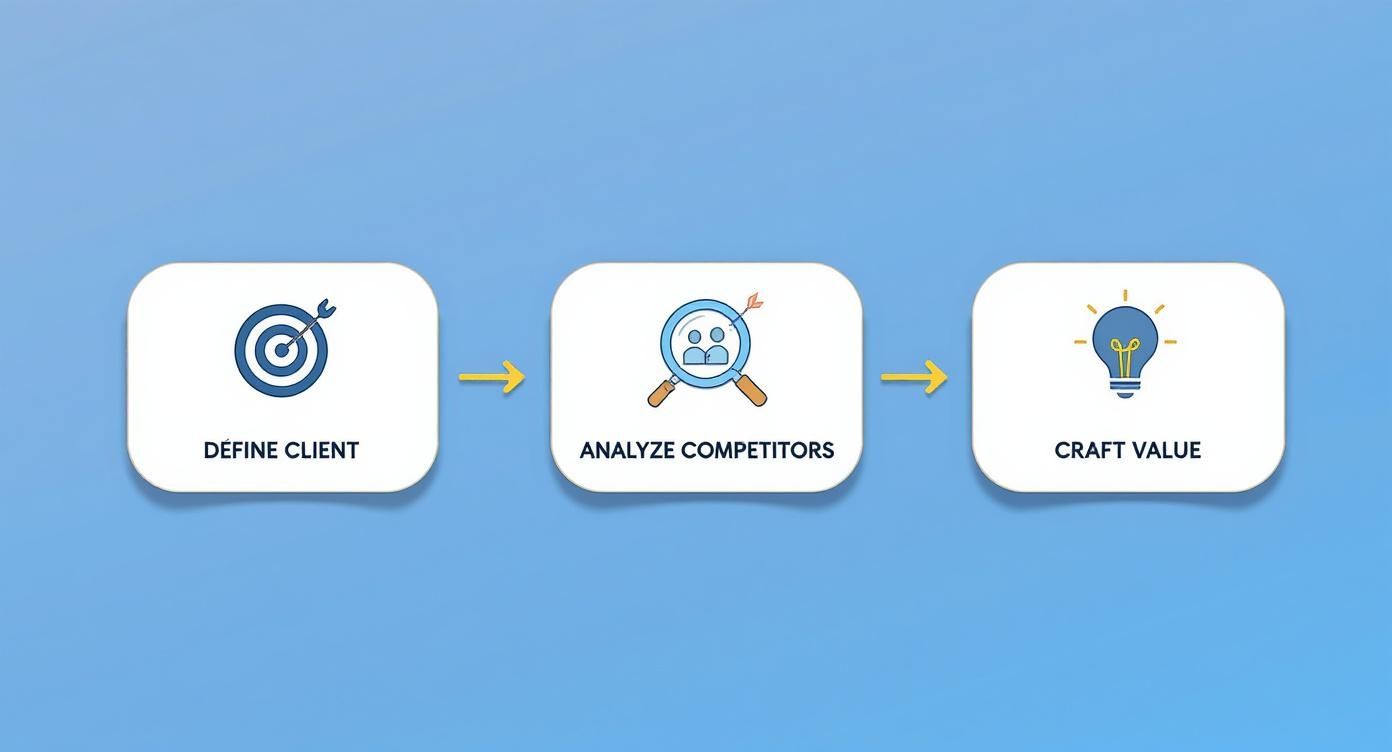
As you can see, a winning strategy is a logical progression. It always starts with a deep understanding of your target audience before you ever spend a dime trying to reach them.
Conduct a Real Competitive Analysis
Once you know exactly who you’re targeting, you need to get a clear picture of the competitive landscape. A quick Google search isn't enough. You need to dig in and see what the top-ranking local firms are actually doing right.
Use marketing tools to analyze their website's user experience, the quality of their blog content, and where they're getting their backlinks from.
The goal here isn’t to just copy your competitors. It's to find their weaknesses and exploit them. If their website is slow and looks terrible on a phone, that’s your opening. If their content is generic and full of legalese, your specialized, hyper-local articles can easily win over clients.
Find the gaps in their strategy and position your firm as the obvious solution. For a modern take on engaging and qualifying those initial website visitors, look into implementing lead generation chatbots.
Craft Your Unique Value Proposition
Finally, you'll combine what you've learned about your ideal client and your competition to answer one critical question: Why should a potential client choose your firm over any other?
Your Unique Value Proposition (UVP) is the answer. It’s a clear, powerful statement that communicates what makes you different and better. It might be your incredible track record with a specific case type, your promise of constant client communication, or your deep roots in the local Southern California community.
For a more detailed breakdown, check out our complete guide on building a resilient law firm marketing strategy.
This UVP becomes the DNA of your marketing. It informs your website copy, your ad campaigns, and your social media presence, ensuring every single effort you make is built for success from day one.
Dominating Local Search with Targeted SEO

Let’s be honest. When someone in Southern California urgently needs a lawyer, they aren't digging through a phone book. They’re grabbing their phone and searching on Google. Being the firm that shows up in that critical moment is the entire game.
For lawyers today, effective lead generation is all about mastering local search.
This isn't just about ranking for generic keywords. It's about becoming the undisputed, go-to legal authority in your specific community, whether that's Newport Beach, Downtown LA, or Temecula. You have to optimize for how real people actually look for legal help.
Make no mistake, online channels are the primary battleground for new clients. In fact, a staggering 96% of potential clients now begin their hunt for legal help online. It’s why law firms now pour an average of 65% of their marketing budgets into digital strategies like SEO. You can discover more insights about these legal marketing statistics that paint a very clear picture of where your focus needs to be.
Your Google Business Profile Is Your Digital Front Door
Think of your Google Business Profile (GBP) as your firm's digital storefront. For local searches like "personal injury attorney near me," it's often the very first impression a potential client gets. A neglected profile is a huge, self-inflicted wound.
An optimized GBP is so much more than your address and phone number.
- Fill Out Everything: Don't skip any sections. Services, hours, accessibility info—the more complete your profile is, the more Google trusts it and the higher you'll rank.
- Use High-Quality Photos: Show off your office, your team, and get professional headshots. This builds an immediate human connection and signals legitimacy.
- Post Regularly: Use Google Posts to share firm news, blog articles, or community involvement. This tells Google your firm is active, engaged, and relevant right now.
Most importantly, you need a relentless strategy for getting client reviews. Positive reviews are the most powerful trust signal on your GBP. They directly impact both your search ranking and whether a client decides to call you over a competitor.
A consistent flow of five-star reviews is non-negotiable. It tells both Google and potential clients that your firm delivers. Make asking for a review a standard part of your case-closing process.
Create Content That Speaks to Your Community
Generic, keyword-stuffed articles are a waste of time and money. To own local search, you have to create content that answers the specific legal questions and anxieties of people in your Southern California community.
This is how you become a valuable local resource, not just another faceless website.
A personal injury firm in Los Angeles, for instance, could write the definitive guide on navigating a car accident on the 405. A family law practice in Orange County might create a detailed blog post on the unique procedures for filing for divorce in that specific county courthouse.
This hyper-local approach does two crucial things:
- It pulls in highly qualified traffic from people searching for specific, location-based answers.
- It builds your topical authority with search engines, proving you are the expert for that geographic area.
For a deeper dive, check out these additional law firm SEO tips to really sharpen your content game.
Build Local Authority with Citations and Backlinks
Finally, your firm's authority is cemented by who vouches for you online. In the world of SEO, that means citations and backlinks.
A citation is simply a mention of your firm's Name, Address, and Phone number (NAP) on other websites, like legal directories. The key here is absolute consistency. Your NAP must be identical everywhere.
Backlinks, which are links from other websites pointing to yours, are powerful votes of confidence. Getting links from high-authority local sources tells Google that your firm is a respected and integral part of the community.
You should be actively trying to earn links from places like:
- Local bar associations
- The Chamber of Commerce
- Local business journals and news outlets
- Sponsorships for local charities or events
By combining a perfect GBP, hyper-local content, and authoritative local backlinks, your firm stops just existing online. You become the go-to legal authority that Google is confident in recommending to its users, driving a predictable flow of high-quality local leads right to your door.
Driving Immediate Leads with Paid Ads

While SEO is the long game—a marathon that builds your firm's foundational strength over time—paid advertising is the sprint. It’s built for one thing: getting your phone to ring right now.
For any SoCal law firm that needs to fill its pipeline today, mastering paid ads isn't optional. This isn't about just throwing money at Google and hoping for the best. A smart paid ad strategy is surgical. It’s about targeting people at the exact moment they desperately need legal help and convincing them to call you instead of the dozens of other firms on the page.
Mastering Google Ads For High-Intent Keywords
Google Ads remains the 800-pound gorilla of paid advertising for one simple reason: intent.
When someone searches "DUI lawyer in Santa Monica" or "car accident attorney Los Angeles," they aren't just browsing. They have an urgent, specific problem. Your goal is to be the first and most convincing solution they see.
A winning campaign starts with meticulously researched keywords. You have to think like your potential client.
- Practice Area + Location: "probate attorney Orange County"
- Problem-Based Queries: "what to do after a truck accident"
- Urgent Needs: "emergency criminal defense lawyer"
Your ad copy then needs to speak directly to those searches. Keep it concise, highlight what makes you different (like "Free Consultation" or "24/7 Availability"), and have a strong, obvious call-to-action.
A critical mistake I see firms make constantly is sending paid traffic to their generic homepage. Every single ad campaign needs its own dedicated, high-converting landing page. That page must have a headline matching the ad, zero distractions, and a simple contact form or a huge, clickable phone number.
The Power Of The Google Screened Badge
Beyond the classic pay-per-click ads, Google's Local Services Ads (LSAs) have completely changed the game for attorneys. These are the ads you see at the very top of the search results, often sitting above everything else.
The real magic of LSAs is the "Google Screened" badge. To get it, your firm has to pass Google's background and license checks. This badge is a powerful, third-party stamp of approval that instantly builds a level of trust other ads just can't buy.
Even better, the LSA model is different. You don't pay for clicks; you pay for qualified leads—a direct phone call or message from a potential client. This pay-per-lead model often delivers a much more predictable and higher ROI, making it an essential piece of any modern lawyer's marketing budget.
Reaching Clients Before They Even Search
While Google Ads grabs active searchers, platforms like Facebook and LinkedIn let you get in front of potential clients based on their life events, demographics, and interests. This is proactive marketing, not reactive.
For instance, a family law attorney can target users who recently updated their status to "Engaged" with ads for prenuptial agreements. An estate planning lawyer could target users in their 50s and 60s who have shown an interest in retirement planning.
Success on social media is about providing value, not just a hard sell. For firms looking to build brand awareness beyond digital, exploring TV advertising specifically for law firms can also be a powerful move. And to get a handle on creating social campaigns that actually connect with people, our deep dive into Facebook advertising for attorneys lays out the strategies you need.
To help you decide where to focus your budget, here's a quick look at how different channels typically perform.
Lead Generation Channel Performance Snapshot
This table offers a general comparison of what you can expect from various channels, helping you prioritize where to put your marketing dollars for the best return.
| Channel | Average Conversion Rate (Lead to Client) | Best For |
|---|---|---|
| Google Local Services Ads | 10% – 20% | Generating immediate, high-intent phone calls. |
| Google PPC (Search Ads) | 5% – 10% | Capturing active searchers for specific legal needs. |
| Local SEO (Organic Search) | 3% – 7% | Building long-term, sustainable, and cost-effective lead flow. |
| Social Media Ads (Facebook) | 1% – 3% | Proactive targeting based on demographics and life events. |
| Referrals | 25% – 40%+ | High-quality, warm leads from trusted sources. |
Keep in mind that these are averages; your firm's actual performance will depend entirely on the quality of your campaigns, your reputation, and how quickly you follow up.
By combining the intent-driven power of Google with the proactive targeting of social media, you create a complete advertising engine. This approach ensures you’re catching clients who are looking for you today while also planting the seeds for tomorrow’s business.
Using Content to Build Authority and Trust
For a law firm, content and social media have nothing to do with chasing viral trends or racking up millions of views. It’s about something far more valuable for generating leads: deliberately proving your expertise and building real connections with potential clients, often before they even know they need to hire you.
A smart content plan turns your website from a static digital business card into a dynamic, lead-nurturing machine. It’s how you become the first—and only—firm someone thinks of when a legal problem pops up.
Creating Content That Solves Problems
Let's be blunt: potential clients aren't searching for legalese or abstract legal theory. They have specific, often stressful, problems and they're desperately looking for clear answers. Your content needs to give them those answers.
Start by thinking about the actual questions your ideal clients in Southern California are typing into Google. A personal injury firm in San Diego, for instance, could shoot a short, practical video titled "The First 5 Things to Do After a Car Accident on I-5." That’s instantly useful and positions the firm as a helpful authority, not just another advertiser.
Likewise, an employment lawyer in Riverside could publish a blog post breaking down what a new California labor law really means for local small business owners. This kind of content pulls double duty:
- It speaks directly to the immediate concerns of a very specific audience.
- It showcases your deep, practical knowledge of local and state-specific legal nuances.
The most effective content for lawyers isn't self-promotional. It’s educational and empathetic. When you help people understand their situation, you build the trust they need to take the next step and pick up the phone.
Choosing the Right Platforms for Your Practice
Not all social media platforms are created equal, especially for lawyers. Where you share your content is just as important as what you're sharing. Different platforms are built for different purposes and attract entirely different types of clients.
LinkedIn for B2B and Professional Networking
For any B2B practice—think business litigation, intellectual property, or employment law—LinkedIn is the undisputed king. It’s a professional environment where you can connect directly with business owners, C-suite executives, and other attorneys for high-value referrals.
Use it to share insightful articles on industry trends, offer commentary on breaking legal news, and publish case studies that highlight your expertise in complex commercial disputes.
Facebook for Community Engagement and B2C Law
For consumer-facing practices like family law, estate planning, or criminal defense, Facebook is your arena. Its power lies in community building and reaching people based on specific life events.
You can join local community groups (ethically, of course), run highly targeted ad campaigns, and share content that connects on a more personal level, like client success stories or simple guides to navigating the local court system. Our guide on law firm content marketing dives much deeper into creating platform-specific strategies.
Leveraging Social Media as a Lead Channel
When it's done right, social media is so much more than a branding exercise. The data is clear: these platforms have become a primary source of new business for law firms. An incredible 71% of attorneys report that they have successfully landed new clients directly from platforms like Facebook and LinkedIn.
LinkedIn, in particular, has proven to be the most potent channel for legal professionals. A full 34% of lawyers now identify it as their top source for driving new client leads. You can read the full research on legal marketing statistics to see just how essential these platforms are now. This isn't some niche tactic anymore; it's a core pillar of modern lawyer lead generation.
By consistently creating and sharing valuable, problem-solving content on the right platforms, you build a reputation as a trusted legal resource. This approach doesn't just get you followers; it builds a pipeline of informed, pre-qualified leads who already see you as the expert they need.
Turning Inquiries into Signed Retainers
Getting a lead is just the starting line; the real race is won in the moments that follow. When a potential client reaches out, you're holding a fragile opportunity in your hands. How your firm handles that first interaction—your client intake process—is what separates a signed retainer from a missed connection who ends up calling your competitor down the street.
Speed is everything here. Someone with a pressing legal issue isn’t going to wait around for a callback tomorrow. The data is clear: the first firm to respond usually gets the case. This is where a modern, systematized intake process creates a massive competitive advantage.
Building a System for Instant Response
To capture every single opportunity, your firm needs a system built for immediate engagement, no matter when an inquiry comes in. "We'll get back to you next business day" is a death sentence in the world of lawyer lead generation.
Your intake toolkit needs to be on point:
- 24/7 Live Chat: An AI-powered or human-operated chat on your website can answer basic questions, qualify leads, and schedule consultations instantly—even at 2 AM on a Sunday.
- Online Scheduling Tools: Let potential clients book a consultation directly on your calendar. This kills the endless game of phone tag and captures their commitment while their intent is at its peak.
- Automated Intake Forms: A basic "Contact Us" form just doesn't cut it. Use smart forms to gather essential case details upfront. This helps your team prepare for the initial call and makes the potential client feel heard from the very beginning.
These tools aren't just about efficiency; they completely transform the client experience. And the firms that get this right see incredible results. In fact, firms using advanced client-facing tech have reported a 53% increase in revenue and a 48% growth in client lead acquisition.
Navigating Ethical and Compliance Guardrails
As you streamline your intake, you have to operate within some very strict ethical and legal boundaries. A slick, automated system is worthless if it violates state bar rules or excludes potential clients.
First, every digital communication must comply with your state bar's advertising rules. This means clear disclaimers on your website and in automated emails to ensure you aren't accidentally forming an attorney-client relationship before a retainer is ever signed.
Your website isn't just a marketing tool; it's a public accommodation. Ensuring it's accessible to people with disabilities isn't just good practice—it's a legal requirement under the Americans with Disabilities Act (ADA).
An inaccessible website can alienate a huge number of potential clients and expose your firm to serious legal risk. Simple audits and updates can ensure your site is usable for everyone. Of course, building a strong online reputation is the foundation for attracting these clients in the first place. You can learn more about managing your firm's digital presence in our guide on reputation management for attorneys.
Ultimately, a winning intake process creates a seamless, professional, and compliant experience. It reassures potential clients that your firm is organized, responsive, and trustworthy from the very first click, making sure your hard-earned leads never fall through the cracks.
Measuring What Matters for Firm Growth

Here's a hard truth about marketing: if you aren't measuring, you're just guessing. Gut feelings don't grow a law firm. Data does.
Too many attorneys get caught up in "vanity metrics" like website visits or social media likes. It feels good to see those numbers go up, but they don't pay the bills. The real difference between a firm that’s thriving and one that's just treading water is a relentless focus on the numbers that actually drive revenue.
This is how you build a predictable, scalable engine for signing new cases. You figure out what works, double down on it, and cut the rest loose.
Defining Your Core Marketing Metrics
To get a real handle on your lawyer lead generation, you only need to track a few critical metrics. Don't let the acronyms intimidate you; these are straightforward concepts that tell you the real story of your marketing spend.
Here are the non-negotiables:
- Cost Per Lead (CPL): This one's simple. Take your total monthly spend on a channel (like Google Ads) and divide it by the number of leads it produced. It tells you exactly what you paid for every single phone call and form submission.
- Cost Per Acquisition (CPA): This is the big one. It's your total marketing spend divided by the number of new signed clients. This is the ultimate bottom-line number—how much it actually costs to put a new case file on your desk.
- Client Lifetime Value (CLV): This is the total revenue you can expect from a typical client over the entire time they work with your firm. Knowing your CLV is the key to understanding how much you can (and should) be willing to pay for a new client.
Tracking these numbers is where the magic happens. You might discover your Facebook ads have a low CPL, but those leads never convert, giving you a terrible CPA. At the same time, your expensive PPC campaign might have a high CPA, but the clients it brings have a massive CLV, making it an incredibly profitable investment. Without the data, you’d never know.
Simple Tools for Powerful Insights
You don’t need a team of data scientists to do this. A basic CRM or even a well-managed spreadsheet is more than enough to get started.
The most powerful tool in your arsenal is a simple question you must ask every single person who contacts your firm: "How did you hear about us?"
Train your intake team to ask it religiously. That one piece of information, combined with basic data from a tool like Google Analytics, gives you everything you need to calculate your CPL and CPA for each marketing channel.
Suddenly, the fog lifts. Let's say you spent $2,000 on Google Ads last month and signed four new clients from it. Your CPA is $500. If the average CLV for those cases is $5,000, you’ve just turned $2,000 into $20,000. Now that’s a real metric. This clarity empowers you to stop guessing and start making strategic decisions that reliably grow your practice.
Your Top Questions Answered
When you're diving into lead generation, it's easy to get bogged down with questions. We hear them all the time from firms across Southern California. Let's clear up a few of the most common ones.
How Much Should a Law Firm Spend on Marketing?
The old rule of thumb is 5% to 10% of your gross revenue, but honestly, that’s just a starting point. It’s not one-size-fits-all.
If you’re launching a new firm in a dog-eat-dog market like Los Angeles, you’ll probably need to push that number higher just to get noticed. But if you’re an established practice with a steady stream of referrals, you might be perfectly fine at the lower end. It really comes down to your growth ambitions and how crowded your practice area is.
What's the Single Best Lead Generation Source for Lawyers?
There isn't one. The real "best" source is a smart, diversified strategy.
If you’re playing the long game for sustainable growth, you absolutely cannot ignore SEO and your Google Business Profile. It’s non-negotiable. This is how you build authority and create a consistent flow of cases over time.
For high-intent clients who need help right now, nothing beats Google Ads and Local Services Ads (LSAs). You’re meeting potential clients at the exact moment they’re searching for a solution.
A winning lead generation plan doesn't put all its eggs in one basket. It’s a strategic mix of organic and paid channels that builds a reliable, predictable system for signing new clients, no matter how the market shifts.
How Long Does SEO Take to Actually Generate Leads?
This is where you need to be patient. SEO is an investment, not an overnight fix. While you might see some early movement from a few technical tweaks or a hyper-local blog post in the first few months, the real results take time.
Realistically, you should expect to see a significant, reliable stream of qualified leads after about 6 to 12 months of consistent work. Think of it as building a valuable piece of digital real estate for your firm—one that will pay dividends for years to come.
Ready to build a predictable client pipeline without all the guesswork? The team at Case Quota focuses on data-driven marketing strategies that deliver real, measurable results for Southern California law firms. Schedule your free strategy session with us today.