

More than seventy percent of American consumers begin their search for legal help online, yet most small and mid-sized firms in Southern California struggle to stand out against larger competitors. For partners and marketing managers, clear attorney branding can make the difference between simply surviving and becoming the top choice for clients. Uncovering the real keys to digital marketing success helps your firm transform its online presence into a magnet for the right clients.
Table of Contents
- 1. Clear Attorney Branding And Unique Value Proposition
- 2. Mobile-Friendly Design With Fast Loading Times
- 3. Prominent Calls To Action For Lead Generation
- 4. Client Testimonials And Case Results For Trust
- 5. Easy-To-Find Contact Information And Location
- 6. Seo-Optimized Content Targeting Legal Niches
- 7. Secure, Ada-Compliant Site With Privacy Protections
Quick Summary
| Key Message | Explanation |
|---|---|
| 1. Establish a Unique Brand Identity | Craft a clear value proposition that highlights what sets your firm apart from competitors and resonates with potential clients. |
| 2. Optimize for Mobile Usability | Ensure your website is responsive and fast-loading for effective access on all devices, enhancing user experience. |
| 3. Implement Strong Calls to Action | Place visually engaging and clearly articulated calls to action throughout your site to convert visitors into leads. |
| 4. Showcase Testimonials and Case Results | Use authentic client testimonials and detailed case results to build trust and showcase your firm’s capabilities. |
| 5. Ensure Easy Access to Contact Information | Make contact details visible and easily accessible to facilitate prompt communication from potential clients. |
1. Clear Attorney Branding and Unique Value Proposition
Your law firm’s brand is more than a logo or a website design. It’s the strategic narrative that communicates why clients should choose your legal services over countless competitors. Developing a clear and compelling value proposition transforms your firm from just another legal practice into a distinctive professional solution.
Successful attorney branding requires understanding what truly differentiates your practice. This means identifying strategic market positioning that goes beyond listing practice areas. Some firms distinguish themselves through specialized industry knowledge, while others highlight their track record of precedent setting cases or innovative technological approaches.
The key is crafting a narrative that answers fundamental client questions: What makes your firm unique? How can you solve their specific legal challenges better than anyone else? Your value proposition should articulate the tangible benefits clients receive working with your team.
Effective branding requires distilling complex legal expertise into clear, relatable messaging. This might mean emphasizing your team’s specialized knowledge in specific sectors, your commitment to personalized client communication, or your history of achieving exceptional outcomes. The goal is creating an emotional and rational connection that makes potential clients feel confident in choosing your firm.
Pro tip: Conduct client interviews to understand what they truly value about your services and use those insights to refine your unique brand positioning.
2. Mobile-Friendly Design with Fast Loading Times
In today’s digital world, your law firm’s website must perform seamlessly across smartphones, tablets, and desktop computers. Responsive web design ensures potential clients can access your legal services from any device without frustration.
Mobile friendly design goes beyond simply shrinking website content. It requires creating a flexible layout that adapts to different screen sizes while maintaining readability and functionality. This means strategic placement of contact information, easy to tap navigation buttons, and clear presentation of your legal services that looks professional whether viewed on a smartphone or computer monitor.
Website loading speed is equally critical. Potential clients searching for legal representation will quickly abandon sites that take more than a few seconds to load. Fast performance signals professionalism and technological competence to visitors. Slow websites not only frustrate users but also negatively impact search engine rankings, reducing your firm’s online visibility.
Implementing mobile friendly design requires technical expertise. Work with web designers who understand responsive optimization techniques that ensure your site looks crisp, loads quickly, and provides an excellent user experience across all devices.
Pro tip: Regularly test your website on multiple devices and use free online speed testing tools to identify and resolve performance bottlenecks.
3. Prominent Calls to Action for Lead Generation
Your law firm’s website is not just an online brochure it is a powerful tool for attracting and converting potential clients. Calls to action serve as critical conversion mechanisms that transform casual website visitors into actual leads. Lead generation strategies are fundamental to growing your legal practice in the digital landscape.
Effective calls to action go beyond simple contact buttons. They must be strategically placed, visually compelling, and communicate clear value to potential clients. This means creating buttons and links that speak directly to a visitor’s specific legal needs such as “Schedule a Free Consultation” or “Get Personalized Legal Advice.”
The placement of these calls to action is just as important as their design. Prominent CTAs should appear above the fold on your homepage, within service description pages, and at the conclusion of compelling content. Each CTA needs to address a specific client pain point and offer an immediate solution that feels personalized and low risk.
Psychologically compelling CTAs leverage urgency and demonstrate immediate value. Instead of generic phrases like “Contact Us,” use more engaging language such as “Protect Your Rights Now” or “Get Immediate Legal Guidance.” These actionable phrases create emotional resonance and motivate potential clients to take the next step.
Pro tip: A/B test different CTA designs, colors, and messaging to discover which combinations generate the highest conversion rates for your specific legal practice.
4. Client Testimonials and Case Results for Trust
Client testimonials are the digital equivalent of word of mouth marketing for law firms. They transform abstract legal services into tangible human experiences that potential clients can trust and relate to. Ethical testimonial practices are critical for building genuine credibility.
Authentic testimonials do more than showcase success. They provide social proof that demonstrates your firm’s ability to solve real legal challenges. Potential clients want to see concrete evidence of your expertise through the voices of those who have already navigated similar legal journeys. This means selecting testimonials that highlight specific outcomes and personal experiences rather than generic praise.
When displaying case results, transparency is key. Showcase specific details that illustrate your firm’s capabilities without violating client confidentiality. Anonymized stories that explain the challenge, your strategic approach, and the successful resolution can be incredibly powerful. Potential clients want to understand not just that you won, but how you won.
It is crucial to follow Federal Trade Commission guidelines when presenting testimonials. This means ensuring all reviews are voluntary, truthful, and not misleading. Avoid incentivizing testimonials or presenting results that might suggest guaranteed outcomes for future clients.
Pro tip: Rotate testimonials periodically and include diverse client experiences to demonstrate your firm’s breadth of expertise across different legal scenarios.
5. Easy-to-Find Contact Information and Location
Potential clients should never have to hunt for ways to reach your law firm. Your website needs to make contact information as visible and accessible as possible. Contact details are critical for building trust and facilitating immediate communication.
The most effective law firm websites place contact information in multiple prominent locations. This means having a dedicated contact page, phone numbers and email addresses in the header and footer of every page, and clear location details that include a physical address with an embedded Google Maps view. Your goal is removing any potential friction that might prevent a prospective client from reaching out.
Beyond just listing contact information, consider the user experience. Include multiple contact methods such as phone, email, online contact forms, and even text messaging options. Some potential clients prefer different communication channels, so offering variety increases the likelihood of engagement. Make sure phone numbers are clickable on mobile devices and email addresses are easily copyable.
Geographic location matters significantly for local law practices. Your website should clearly communicate your service areas, include your physical office address, and provide context about your proximity to local courthouses or major city centers. This helps potential clients understand not just how to contact you, but where you are situated in relation to their legal needs.
Pro tip: Embed a click to call button for mobile users and include your business hours to set clear expectations for when potential clients can reach you.
6. SEO-Optimized Content Targeting Legal Niches
SEO for law firms is not about generic website optimization it is about strategic content that speaks directly to potential clients searching for specific legal solutions. Crafting targeted legal content strategies helps your firm stand out in a crowded digital marketplace.
Successful legal SEO requires deep understanding of your practice areas and the precise language potential clients use when seeking legal assistance. This means developing content that goes beyond basic practice area descriptions and instead addresses specific client pain points. For instance, a personal injury lawyer might create content about workplace accident claims in specific industries, using keywords potential clients would naturally search.
Niche targeting involves more than just inserting keywords. Your content must demonstrate genuine expertise and provide real value. This means creating comprehensive guides, answering frequently asked legal questions, and developing content that shows your understanding of complex legal challenges. The goal is positioning your firm as a thought leader in your specific legal specialty.
Geographic specificity is crucial for local law firms. Your content should incorporate location based keywords and address legal issues specific to your region. This means mentioning local courts, regional legal regulations, and community specific legal challenges that demonstrate your deep local understanding.
Pro tip: Create a content calendar that maps out detailed, niche specific legal topics and rotate your focus to cover different aspects of your practice areas systematically.
7. Secure, ADA-Compliant Site With Privacy Protections
Your law firm’s website is more than a digital brochure it is a critical touchpoint that must be accessible, secure, and welcoming to all potential clients. ADA website compliance is not optional it is a legal and ethical obligation.
Web accessibility means creating a digital environment that can be navigated by people with various disabilities. This involves implementing technical standards that allow screen readers to interpret content, ensuring keyboard navigation works seamlessly, providing alternative text for images, and creating clear color contrast. Your goal is removing digital barriers that might prevent potential clients from accessing your legal services.
Privacy protection goes hand in hand with accessibility. Law firms handle sensitive personal information, which demands robust digital security measures. This includes using SSL certificates, implementing secure contact forms, protecting client data through encrypted connections, and maintaining clear privacy policies that explain how user information is collected and stored.
Compliance with Web Content Accessibility Guidelines (WCAG) involves more than technical adjustments. It represents a commitment to inclusivity and demonstrates your firm’s dedication to serving all potential clients regardless of their physical capabilities. Regular accessibility audits and staying updated on current standards are crucial for maintaining an inclusive digital presence.
Pro tip: Conduct periodic accessibility testing using automated tools and consider hiring users with disabilities to provide real world navigation feedback on your website.
Below is a comprehensive table summarizing strategies and tips for optimizing attorney websites as discussed in the article.
| Section | Key Points | Recommendations |
|---|---|---|
| Clear Attorney Branding | Develop a compelling narrative highlighting the firm’s unique value proposition. | Conduct client interviews to refine the positioning of expertise, commitment, or outcomes. |
| Mobile-Friendly Design | Ensure responsive web design for compatibility with various devices and improve loading speeds. | Implement responsive optimization techniques and regularly test on multiple devices. |
| Prominent Calls to Action | Strategically develop and place conversion-oriented calls to action. | Use engaging language in CTAs that address client needs directly and test effectiveness. |
| Client Testimonials | Showcase specific testimonials and transparent case results to build credibility. | Follow ethical testimonial practices and rotate displayed content periodically. |
| Contact Information | Make communication details easily accessible throughout the website. | Include phone, email, and embedded maps in prominent locations paired with clear instructions. |
| SEO for Legal Niches | Create SEO-optimized, geographically and contextually targeted content. | Develop a content calendar focusing on client-specific and local keyword integration. |
| Website Accessibility | Ensure ADA compliance and secure data handling for inclusivity and privacy. | Conduct regular accessibility audits and integrate SSL certificates for security. |
Unlock Your Law Firm’s Full Potential With Expert Digital Marketing
The article highlights critical challenges such as developing a clear attorney branding, creating mobile-friendly websites with fast loading times, and crafting compelling calls to action that convert visitors into clients. If you are a Southern California law firm struggling to stand out or generate quality leads online, these pain points may feel overwhelming. You want a website that not only looks professional but also embodies your unique value proposition while targeting your niche with SEO-optimized content and maintaining ADA compliance.
Case Quota specializes in helping law firms overcome these exact hurdles. Our tailored legal marketing solutions combine proven SEO strategies, high-impact web design, and performance-driven lead generation that elevate your online presence and drive client growth. From pay-per-click advertising powered by AI tools to Google Local Services Ads, we offer sophisticated tools that small to mid-size firms need to compete with larger competitors.
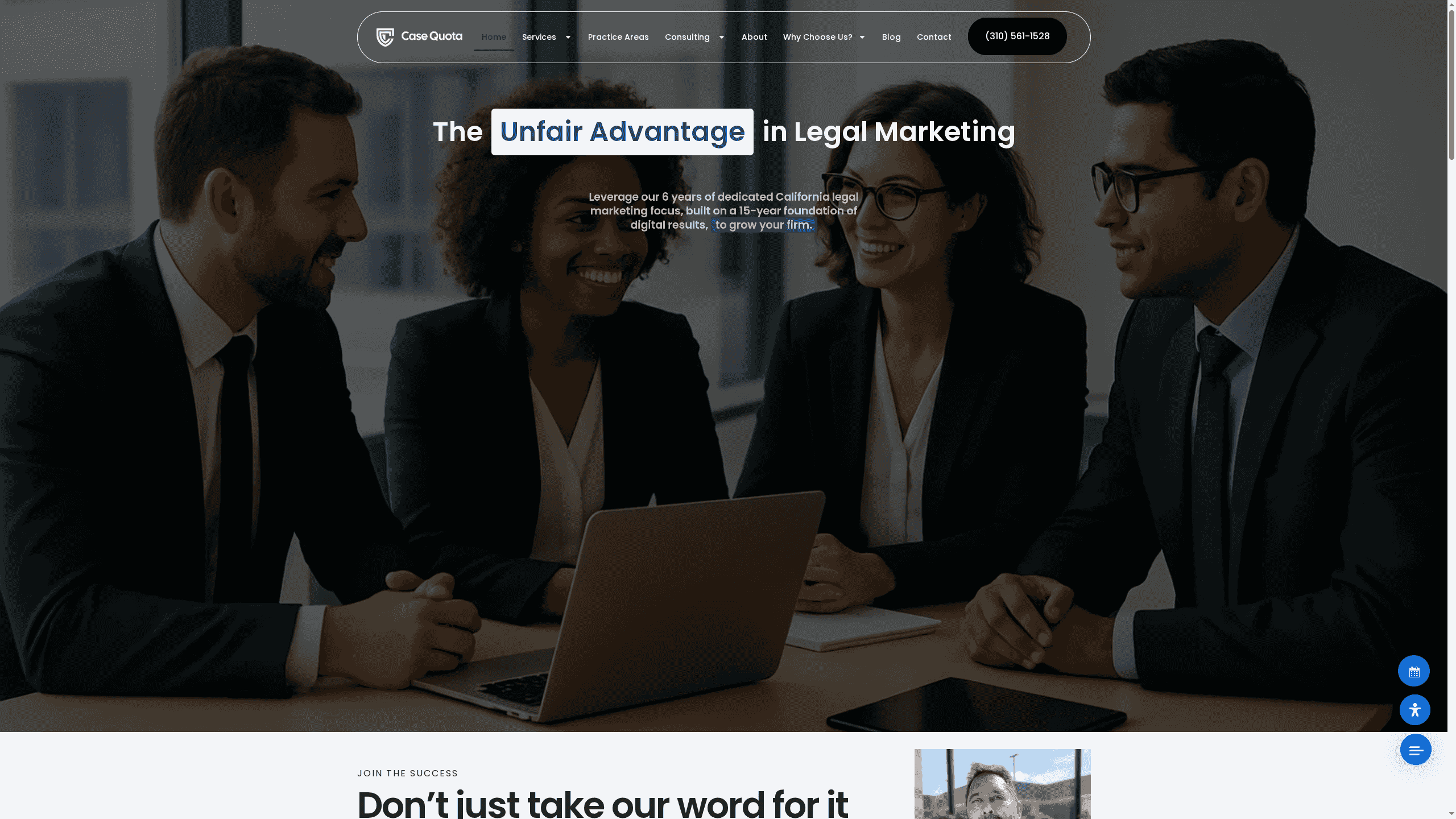
Ready to revolutionize your firm’s website into a powerful client acquisition machine? Visit Case Quota to see how our customized digital marketing approaches can transform your practice. Explore our SEO-Optimized Strategies and discover how expert marketing leadership can give you the competitive edge needed now to expand your client base. Don’t wait for another potential client to turn away because of a slow or unengaging site. Take action today!
Frequently Asked Questions
What elements are essential for a successful law firm website?
A successful law firm website should include clear attorney branding, mobile-friendly design, prominent calls to action, client testimonials, easily accessible contact information, SEO-optimized content, and secure, ADA-compliant features. Start by evaluating your current website against these elements to identify areas for improvement.
How can I create a unique value proposition for my law firm?
To create a unique value proposition, identify what sets your legal services apart from competitors, such as specialized expertise or successful case outcomes. Conduct interviews with clients to gather insights on what they value, and use this information to refine your messaging.
Why is mobile-friendly design important for a law firm website?
Mobile-friendly design ensures your law firm’s website is accessible and functional on smartphones and tablets, improving user experience and engagement. Test your website on various devices to ensure it loads quickly and maintains readability for all users.
How do I optimize my law firm’s website for search engines?
Optimize your law firm’s website for search engines by creating targeted content that addresses specific legal questions and issues relevant to your practice areas. Research keywords potential clients use and incorporate them naturally into your website’s content and meta descriptions.
What types of client testimonials should I include on my law firm website?
Include authentic client testimonials that highlight specific outcomes and personal experiences rather than generic praise. Showcase diverse legal scenarios and rotate testimonials periodically to illustrate your firm’s range of expertise and build trust with potential clients.
How can I ensure that my law firm website is accessible to all users?
To ensure your law firm website is accessible, implement web accessibility standards such as keyboard navigation, alternative text for images, and clear color contrast. Conduct regular accessibility audits and seek feedback from users with disabilities to identify any barriers.