

When we talk about calculating marketing ROI for a law firm, we're really just asking one question: for every dollar we spend, how much are we getting back?
The simplest way to look at it is with a straightforward formula: (Revenue from Marketing – Cost of Marketing) / Cost of Marketing x 100. This calculation cuts through the noise and gives you a clear percentage that tells you what's working and what's not.
Setting the Stage for an Accurate ROI Calculation

Before you even think about plugging numbers into a formula, you have to lay the groundwork. This is the most important part, and it's where most firms get it wrong. The numbers you calculate are totally meaningless if you haven't defined what you're measuring in the first place.
So, your first job is to decide what a "win" actually looks like for your practice.
Is it a scheduled consultation? A qualified lead who fits your ideal client profile? Or is it nothing less than a signed retainer? The right answer depends entirely on your firm. A personal injury practice chasing high-value cases will define a win very differently than an estate planning firm focused on volume.
This one decision anchors your entire ROI calculation in reality, so don't skip it.
Defining Your Marketing Goals
Flying blind is a terrible strategy. Vague goals like "get more leads" are useless because you can't measure them effectively. Instead, you need to set specific, concrete targets that connect every single dollar you spend to a real-world outcome.
Here’s what that looks like in practice:
- Google Ads: The goal isn't just clicks; it’s hitting a Cost Per Qualified Lead of under $250.
- Local SEO: Success isn't just ranking higher; it's generating 15 new phone calls a month directly from organic search.
- Content Marketing: The objective isn't just website traffic; it's capturing 20 new email subscribers for your estate planning newsletter each month.
Getting this specific is absolutely essential. A well-defined goal is what separates firms that guess if their marketing works from those that know its exact value.
A critical mistake many firms make is treating all marketing activities the same. The ROI expectation for a long-term SEO strategy will—and should—be vastly different from a short-term pay-per-click campaign designed for immediate calls.
Connecting Actions to Outcomes
Once you have clear goals, you can start building a framework that directly links your marketing investment to actually signing new clients. This process ensures your final ROI numbers are not only meaningful but also give you clear, actionable insights. You’re essentially writing the plot points ahead of time so the data can tell a coherent story.
For instance, recent data shows that in 2024, 65% of law firms named their website—the central hub for all their SEO efforts—as their highest ROI channel. This makes perfect sense when you consider SEO's scalability, especially when stacked against old-school networking. You can dig into more insights in the 2024 legal marketing statistics report.
This foundational work is what turns a simple ROI percentage into a powerful tool for making smarter decisions. If you need a hand structuring these objectives, a good law firm marketing plan template can provide the framework to get you started on the right foot.
Getting to Grips with CAC and LTV
If you really want to know if your marketing is profitable, you have to look past the surface-level vanity metrics. It all comes down to two key figures: Client Acquisition Cost (CAC) and Lifetime Value (LTV).
These two numbers are the absolute foundation of any real conversation about marketing ROI. They tell you exactly what you spend to get a client in the door and what that client is actually worth to your firm over time.
Firms that can dial in these numbers are the ones who can prove their marketing works. The relationship between CAC and LTV is the ultimate health check for your marketing and a clear indicator of your firm's ability to grow sustainably.
Nailing Your Client Acquisition Cost
Your Client Acquisition Cost is, quite simply, the total amount of money it takes to sign a new, paying client. A classic mistake is to only count your ad spend. That’s not the whole picture. A truly accurate CAC includes every single dollar tied to your marketing and sales efforts over a specific period.
This isn't optional if you want a real number.
To get your CAC, you just add up all those marketing and sales costs for a given period—say, a quarter—and divide that total by the number of new clients you signed in that same timeframe.
So, what goes into that total cost?
- Ad Spend: The obvious one. This is what you pay Google, Facebook, or any other ad platform.
- Agency Fees: The monthly retainer you pay your marketing agency or consultants.
- Software & Tools: Your CRM subscription, call tracking service, email marketing platform—all of it.
- Salaries: A portion of the salaries for any in-house team members who touch marketing or intake.
- Creative Costs: Any money spent on video production, professional blog content, or graphic design.
Let's run a quick example. Imagine a personal injury firm spends a total of $30,000 in one quarter across all of those categories. During that time, they signed 10 new clients. Their CAC is $3,000 ($30,000 / 10). That number now becomes the benchmark for everything they do.
Knowing your CAC with this level of precision is a complete game-changer. It lets you set realistic budgets, judge how well different channels are performing, and forecast growth with actual confidence. It turns your marketing from a line-item expense into a predictable revenue engine.
Figuring Out Client Lifetime Value for Your Practice
While CAC tells you what it costs, Lifetime Value (LTV) tells you what you get back. LTV is the total net profit you can reasonably expect from the average client throughout their entire relationship with your firm.
This gets particularly interesting in the legal world because it changes so much from one practice area to another.
The LTV for a criminal defense client who you help once is worlds apart from an estate planning client who comes back for trust updates, or a business client you keep on a monthly retainer.
For a practice area with lots of repeat business, you might calculate it like this:
(Average Case Value) x (Number of Repeat Cases) x (Average Client Lifespan in Years) – (Your Costs to Serve Them)
But for more transactional practices, like personal injury, the LTV often just equals the net profit from that one case. In those scenarios, the most important analysis is comparing your Average Case Value directly against your CAC.
A healthy firm needs an LTV that is significantly higher than its CAC. The go-to benchmark is an LTV:CAC ratio of 3:1 or better. If your average case is worth $15,000 (LTV) and it costs you $3,000 to get it (CAC), your ratio is a fantastic 5:1. That’s a sign of a highly profitable marketing machine. If you're looking to bump that ratio up, refining your approach to lead generation for lawyers is the perfect place to start.
We see mid-sized firms get really good at optimizing this. By digging into their data, they can often improve their consult-to-client conversion rates from 20% to 30%. That simple improvement can boost their ROI from 5x to 8x without spending a single extra dollar on ads. You can see more data on this in these legal marketing statistics on andava.com.
Building a Bulletproof ROI Tracking System
Accurate numbers don't just happen. They’re the result of a deliberate, well-built system. If you want to calculate your marketing ROI with any real confidence, you absolutely have to build a robust tracking ecosystem first.
The goal is to create a seamless flow of data that connects every single marketing touchpoint—every click, call, and form submission—directly to a specific client and their case value. This is how you transform your marketing from a guessing game into a predictable science. You're building the plumbing that lets you track every dollar from its source all the way to a signed retainer.
This visual breaks down the powerful, yet simple, relationship between what you spend (CAC), what you earn (LTV), and your resulting profit.
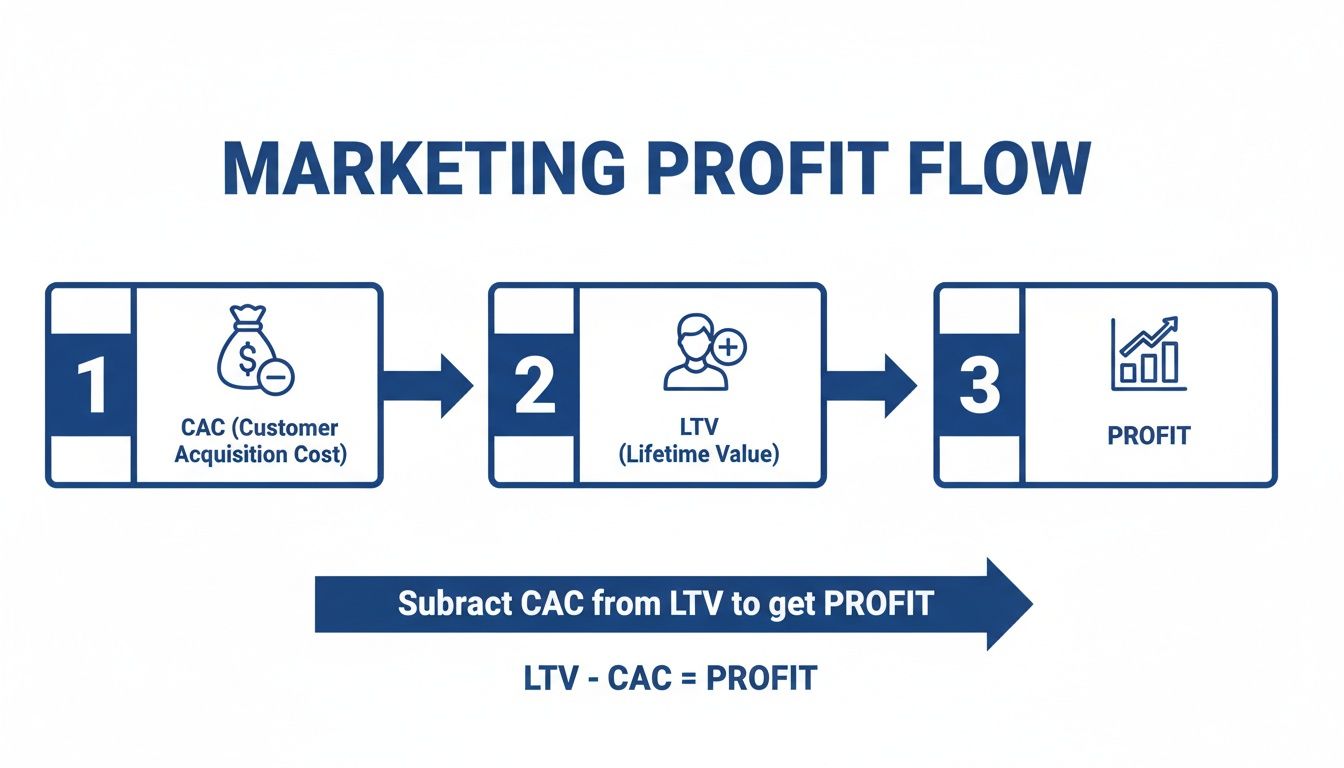
The takeaway here is crystal clear: sustainable growth only happens when the value a client brings to your firm is significantly higher than what it cost to acquire them.
Mastering UTM Parameters for Digital Campaigns
The very first brick in this foundation is knowing exactly where your leads are coming from. This is where Urchin Tracking Module (UTM) parameters become your best friend. They're just simple snippets of code you add to the end of a URL, but they tell Google Analytics precisely how a visitor found your website.
Think of them as digital breadcrumbs. When someone clicks a link with a UTM tag, you can see the exact source, medium, and campaign that brought them to your door.
You should be using them for everything:
- Google Ads: To see which campaigns, ad groups, or even specific ad creatives are driving the best leads.
- Social Media: To track whether a click came from a Facebook post or the link in your LinkedIn bio.
- Email Newsletters: To measure which calls-to-action in your monthly update are actually generating consultations.
- Guest Posts: To see how many referrals that backlink from another legal blog is sending your way.
Without UTMs, all of this valuable traffic gets dumped into generic buckets like "direct" or "referral," leaving you blind to what’s really working. For a deeper dive, our guide on how to measure advertising effectiveness walks you through the technical side.
To track your firm's marketing performance and get the data you need for ROI calculations, you can also use specialized social media monitoring tools.
Why Call Tracking Is Non-Negotiable
For so many law firms—especially in personal injury or criminal defense—the phone call is the single most valuable lead. It’s also the hardest to attribute correctly if you don't have the right tools. This is precisely why dedicated call tracking numbers are an absolute must.
Call tracking software assigns a unique, trackable phone number to each of your marketing channels. You get one number for your Google Business Profile, another for your PPC landing page, and a third for your billboard. When a potential client dials one of these numbers, the system forwards the call to your main office line while simultaneously logging the source.
This simple technology instantly solves one of the biggest attribution headaches for law firms. You’ll know with 100% certainty that a call came from your SEO efforts, not your direct mail campaign, allowing you to allocate your budget based on what truly drives valuable inquiries.
Connecting the Dots with Your CRM
The final piece of this puzzle is integrating all this data with your Customer Relationship Management (CRM) or case management software. Your website analytics and call tracking tell you where leads came from. Your CRM tells you which of those leads became actual clients and how much their cases were worth.
This connection is what closes the loop.
When a lead fills out a website form, their UTM data should automatically populate fields in their new CRM profile. When a tracked call comes in, the source data should be logged right alongside the new contact. This creates a single source of truth for every client, from their very first click to their final case value.
Here's a look at the essential tools that make this kind of detailed tracking possible.
Essential Tracking Tools for Law Firm ROI
This table breaks down the core tools you'll need to accurately attribute leads and calculate the ROI on your firm's marketing efforts.
| Tool | Primary Function | Example for a Law Firm |
|---|---|---|
| Google Analytics 4 (GA4) | Tracks website traffic, user behavior, and online conversions. | Monitors which blog posts about "DUI defense strategies" lead to the most contact form submissions. |
| Call Tracking Software | Assigns unique phone numbers to marketing channels to track inbound calls. | Uses a specific number on a billboard to measure how many calls the ad generates versus a Google Ad. |
| CRM/Case Management | Manages client relationships, case details, and tracks lead status. | Logs a new lead from a "Google Ads" source and follows their journey from "potential" to "signed client." |
| UTM Builder | Creates tagged URLs to precisely track the source of website clicks. | Generates a unique link for an email newsletter to see how many recipients clicked the "Schedule a Consultation" button. |
Each tool plays a critical role. When they all work together, they give you an undeniable, data-backed picture of your marketing performance.
This integrated system is the engine that powers your ROI calculations. It’s how you can definitively say, "Our Google Ads campaign spent $5,000 last month, generated 15 qualified leads, and resulted in 2 new cases worth $30,000." That kind of clarity isn't just powerful—it's essential for smart, sustainable growth.
Choosing the Right Attribution Model for Your Firm
So, how do you give credit where credit is due?
That’s the central question of marketing attribution. It’s the framework you use to assign value to all the different touchpoints a potential client interacts with on their journey to signing with your firm. Without it, you're just guessing.
Imagine a really common scenario for a family law practice: A potential client sees one of your Facebook ads. They don't click, but they remember your name. A week later, they search for your firm directly on Google and read a few of your blog posts. A month after that, they finally decide to act, click on one of your Google Ads, and call your office.
Which channel gets the credit? The Facebook ad that planted the seed? The blog content that built trust? Or the final Google Ad that prompted the call? Your attribution model is what answers that question, and the one you pick will dramatically change the ROI you see for every channel.
Common Attribution Models Explained
Getting a handle on the main attribution models is the first step. Each one tells a different story about your client’s journey, so picking the right one is crucial if you want to calculate marketing ROI accurately.
There's no single "best" model here. The right choice depends entirely on your firm's goals and how your clients typically find and vet you.
Let's break down the most common options:
- First-Touch Attribution: Simple and clean. This model gives 100% of the credit to the very first interaction a client has with your firm. In our example, the Facebook ad would get all the glory. It’s great for figuring out which channels are best at generating initial awareness and getting your name out there.
- Last-Touch Attribution: The polar opposite. This model gives 100% of the credit to the final touchpoint before the conversion. That Google Ad that led to the phone call would be the sole winner here. This model is incredibly useful for identifying what finally pushes clients over the edge to take action.
- Linear Attribution: This model is all about teamwork. It spreads the credit out equally across every single touchpoint. The Facebook ad, the organic search, and the final Google Ad would each get 33.3% of the credit. It’s built on the idea that every step played a part in the final decision.
Choosing a model isn't just a technical decision—it’s a strategic one. A last-touch model might undervalue the long-term brand building of your SEO efforts, while a first-touch model could completely ignore the power of a well-timed retargeting ad.
Which Model Is Right for Your Law Firm?
The best model for your firm depends heavily on your practice area and the length of your typical client's decision-making process.
An urgent-need criminal defense firm might find a last-touch model works perfectly. The client journey is often short and direct—someone gets arrested, they search for a lawyer, they call. That last click is often the most important one. Many firms in this boat explore paid search, and you can see how different platforms stack up in our guide comparing Local Service Ads vs. Google Ads.
On the flip side, a corporate law or complex estate planning firm will likely get a much clearer picture from a linear or position-based model. Here, the client journey can span months, involving extensive research, multiple visits to your site, and several different touchpoints. Giving all the credit to the final click would completely ignore the crucial role your educational content and initial brand exposure played in building trust.
This is especially true for long-game strategies like SEO. Analysis shows it takes about 14 months on average to recoup SEO investments, with the full payoff not realized until year three. A last-touch model would make SEO look like a failure for that entire first year, even as it’s building a powerful, long-term foundation for growth. You can dig into more data like this in these comprehensive legal marketing statistics.
Getting to Your Final Marketing ROI Number

Alright, you’ve got your tracking in place and your costs nailed down. Now it’s time for the moment of truth—translating all that data into a single, powerful percentage that tells you exactly how your marketing is performing. This final number is what cuts through the noise and gives you real clarity on your investment.
Calculating marketing ROI for a law firm all boils down to a simple but mighty formula:
(Revenue from Marketing – Cost of Marketing) / Cost of Marketing x 100
This is your north star. It's the core equation that tells you if your efforts are paying off. And the potential payoff can be huge. Recent data shows that a well-executed SEO strategy can net law firms an average 526% ROI over three years. That’s the kind of long-term value we’re talking about.
But let's get out of theory and into the real world.
Practical ROI Calculation Examples
Seeing the formula in action with real numbers is where it all clicks. The key is to plug in realistic figures for your own practice area and marketing channels, because context is everything.
Personal Injury Firm Using Google Ads
Imagine a PI firm going after high-value cases in a competitive market. They're spending big on Google Ads to get in front of the right people at the right time.
- Monthly Google Ads Spend: $10,000
- Agency Management Fee: $2,500
- Total Monthly Marketing Cost: $12,500
- New Clients Signed from Ads: 2
- Average Case Value (Net Fee): $35,000
- Total Revenue from Marketing: $70,000
Let's run the numbers:( ($70,000 - $12,500) / $12,500 ) x 100 = 460% ROI
A 460% ROI is a fantastic result. It shows the campaign is incredibly profitable, turning every dollar spent into $5.60 in revenue. That's a green light to keep going.
Criminal Defense Firm Investing in SEO
Here’s a firm playing the long game with SEO, aiming to capture local clients who need a lawyer now.
- Monthly SEO & Content Cost: $4,000
- Total Monthly Marketing Cost: $4,000
- New Clients Signed from Organic Search: 5
- Average Retainer Fee: $5,000
- Total Revenue from Marketing: $25,000
And the ROI calculation:( ($25,000 - $4,000) / $4,000 ) x 100 = 525% ROI
That impressive 525% ROI proves their investment in organic visibility is paying off big time. They're generating a steady stream of high-quality leads without paying for every single click.
To give you a better feel for how these numbers can vary, here's a look at some hypothetical scenarios across different practice areas and channels.
Sample ROI Calculation Across Practice Areas
| Practice Area | Marketing Channel | Monthly Cost | New Clients/Month | Avg. Case Value | Monthly Revenue | Calculated ROI |
|---|---|---|---|---|---|---|
| Personal Injury | Google Ads | $12,500 | 2 | $35,000 | $70,000 | 460% |
| Criminal Defense | Local SEO | $4,000 | 5 | $5,000 | $25,000 | 525% |
| Estate Planning | LinkedIn Ads | $3,000 | 3 | $4,000 | $12,000 | 300% |
| Family Law | Social Media Ads | $5,000 | 4 | $6,000 | $24,000 | 380% |
These examples illustrate how the same formula applies universally, but the inputs and outcomes will be unique to your firm's specific market and strategy.
What to Do With Your ROI Results
Getting the number is just step one. Knowing what to do with it is how you actually grow your firm. Think of your ROI not as a final report card, but as a roadmap for your next move.
A strong, positive ROI is a clear signal to double down. If a channel is working, it’s time to scale. Can you increase the budget? Expand your keyword targets? Pouring more resources into what’s already proven to work is the fastest path to growth. For a deeper look at platform-specific numbers, you can explore resources on LinkedIn costs and ROI.
But what if you get a negative number? Don’t panic. A negative ROI doesn't automatically mean a campaign has failed.
Context is everything. A brand-new SEO campaign might show a negative ROI for the first 6-12 months while it builds authority. This isn't a failure; it’s a leading indicator of future organic growth. You're building an asset that will pay dividends for years to come.
Before you pull the plug on a channel with low ROI, you need to ask some hard questions:
- Is the timeframe too short? Some strategies, like content marketing or even old-school billboards, need time to mature. We dive into this in our article on how to calculate marketing ROI for law firms with https://casequota.com/billboard-roi-what-every-socal-law-firm-must-know-before-signing-a-contract/.
- Is there an attribution problem? Are you 100% sure your tracking is catching every conversion?
- Can we optimize it? Could better ad copy, a higher-converting landing page, or a more refined audience turn the numbers around?
A low ROI is often an opportunity to optimize, not a reason to quit. Use these numbers as a diagnostic tool to find leaks in your funnel, refine your strategy, and turn an underperformer into a growth engine.
Answering the Tough Questions About Legal Marketing ROI
Even with a perfect formula on paper, the real world of ROI calculation is messy. Attorneys and their marketing teams always run into the same practical hurdles when trying to connect the dots between spending and revenue.
Let's tackle the most common questions head-on. These aren't just theoretical exercises; they're the real-world problems that can derail your entire marketing strategy if you don't have clear answers.
What’s a “Good” Marketing ROI for a Law Firm, Anyway?
This is the million-dollar question, and the honest answer is: it depends. There's no single magic number, but a healthy benchmark to shoot for is a 5:1 ratio. That translates to a 500% ROI, meaning for every dollar you spend, you bring in five dollars in fees.
But "good" is all about context. The right target varies dramatically by practice area.
- High-Volume, Lower-Fee Practices: An estate planning or traffic law firm might be perfectly happy with a 3:1 ratio. If their client acquisition is consistent and predictable, that's a win.
- High-Value, Contingency Practices: A personal injury firm should be aiming much higher, maybe for a 10:1 ratio or more. A single seven-figure case can justify a massive marketing investment, so the potential upside changes the math entirely.
The most important thing is this: your ROI needs to be high enough to comfortably cover all your marketing costs, case expenses, and firm overhead, while still leaving a healthy profit. A 2:1 ratio might look positive, but after you pay for everything else, you're likely not left with enough to fuel real growth.
How Long Do I Have to Wait to Measure ROI?
This is where a lot of firms make costly mistakes. The timeline for measuring ROI is one of the most misunderstood parts of the process, and getting it wrong can lead you to kill a winning strategy just before it pays off.
You can't measure a short-term sprint and a long-term marathon with the same stopwatch.
For direct-response campaigns like Google Ads or Local Service Ads, you should be able to calculate an initial ROI within 30 to 90 days. These channels are built for immediate action. If they aren't working relatively quickly, something is wrong.
But for your long-game strategies, you have to be patient.
- SEO & Content Marketing: Don't even think about calculating a final ROI for at least 6 to 12 months. It takes time to build authority with Google, earn valuable rankings, and see that organic traffic turn into signed cases. Measuring too early is a recipe for disappointment.
- Brand Awareness Campaigns: The ROI from building your firm's brand is notoriously hard to pin down with a simple formula. It unfolds over years, not months, showing up in things like lower client acquisition costs across the board and more people searching for your firm by name.
Can I Even Calculate ROI Without a CRM?
Technically, you could. But it would be a painful, manual, and wildly inaccurate process. You’d be trying to piece together a story from scattered spreadsheets, intake notes, and billing software, and you would inevitably miss the most important connections.
A Customer Relationship Management (CRM) system is your single source of truth. It’s what connects a lead’s first click on an ad to their final case value. Without that central hub, you're just guessing.
Trying to calculate marketing ROI without a CRM is like trying to win a case without any evidence. You might have a gut feeling about what works, but you can’t prove it. Investing in even a basic CRM is one of the smartest decisions you can make if you're serious about your firm's growth.
How Do I Track Cases That Come from Offline Marketing?
Attributing cases from a billboard, radio spot, or print ad is a classic marketing challenge, but it's completely solvable. The key is to build a trackable bridge from that offline ad to an online action.
The most effective tool for the job is call tracking.
By assigning a unique, trackable phone number to each offline campaign, you get immediate clarity. When a potential client sees your billboard and dials that specific number, your call tracking software instantly logs them as a lead from that exact source. Simple.
Another great trick is to use unique, easy-to-remember URLs (vanity URLs) in your ads. Something like "YourFirm.com/WIN" that redirects to a specific landing page on your site. This lets you see precisely how many website visitors came directly from that offline ad.
With these simple tools, you can bring the same data-driven clarity to your traditional marketing that you have for all your digital efforts.
At Case Quota, we build these exact data-driven marketing systems for law firms. We don't just run ads; we engineer a clear path from your investment to your revenue, so you always know your ROI. If you’re ready to stop guessing and start growing with confidence, learn more about our approach.