
Before you ever dream of spending a single dollar on Google Ads, you have to build a rock-solid foundation for your campaigns. This isn't just a best practice; it's non-negotiable. The goal is to create a structure that perfectly mirrors your firm's practice areas, ensuring every click has the highest possible chance of turning into a high-value case.
A granular, hyper-organized account is the secret sauce to high relevance, better Quality Scores from Google, and, most importantly, a lower cost per lead.
Building Your Campaign Foundation for High-Value Cases
I've seen it time and time again: attorneys making the classic mistake of lumping all their services into one or two generic campaigns. That approach treats a multi-million dollar truck accident case the same as a simple uncontested divorce, and it's a recipe for burning through your ad budget on junk leads.
The key is to get inside the head of a potential client. You need to structure your account to match their specific, often urgent, legal needs. This foundational setup is about way more than just picking a few keywords; you're creating a logical hierarchy that tells Google's algorithm exactly who to show your ads to. Think of it as the blueprint for your entire paid search strategy.
Mirroring Your Practice Areas
The most effective campaign structure I've ever used is one that directly reflects the firm's main practice areas. The first move is to create a separate, dedicated campaign for each distinct legal service you offer. This initial separation is absolutely critical for controlling your budget and tracking what's actually working.
For a multi-practice firm targeting Southern California, that would look something like this:
- Campaign 1: Personal Injury: This is the home for all ad groups related to accidents and injuries.
- Campaign 2: Family Law: This will contain specific ad groups for divorce, child custody, and other related matters.
- Campaign 3: Criminal Defense: Here’s where you'll target searches for DUI, assault, and other criminal charges.
This separation immediately gives you control. Personal injury keywords are notoriously expensive, so that campaign will demand a much bigger budget than, say, one for estate planning.
From there, you have to drill down into ad groups. Within that "Personal Injury" campaign, you wouldn't just have one generic ad group. Not even close. You need to create hyper-specific ad groups for every single type of case you handle.
A granular structure is your biggest competitive advantage. You need an ad group for "Truck Accident Lawyer Los Angeles" that is completely separate from one for "Motorcycle Accident Lawyer Orange County." This lets you write incredibly specific ad copy and send that traffic to a dedicated landing page about that exact case type. That's how you dramatically increase your conversion rates.
This visual breaks down the essential flow for setting up a law firm ad campaign that actually gets results.
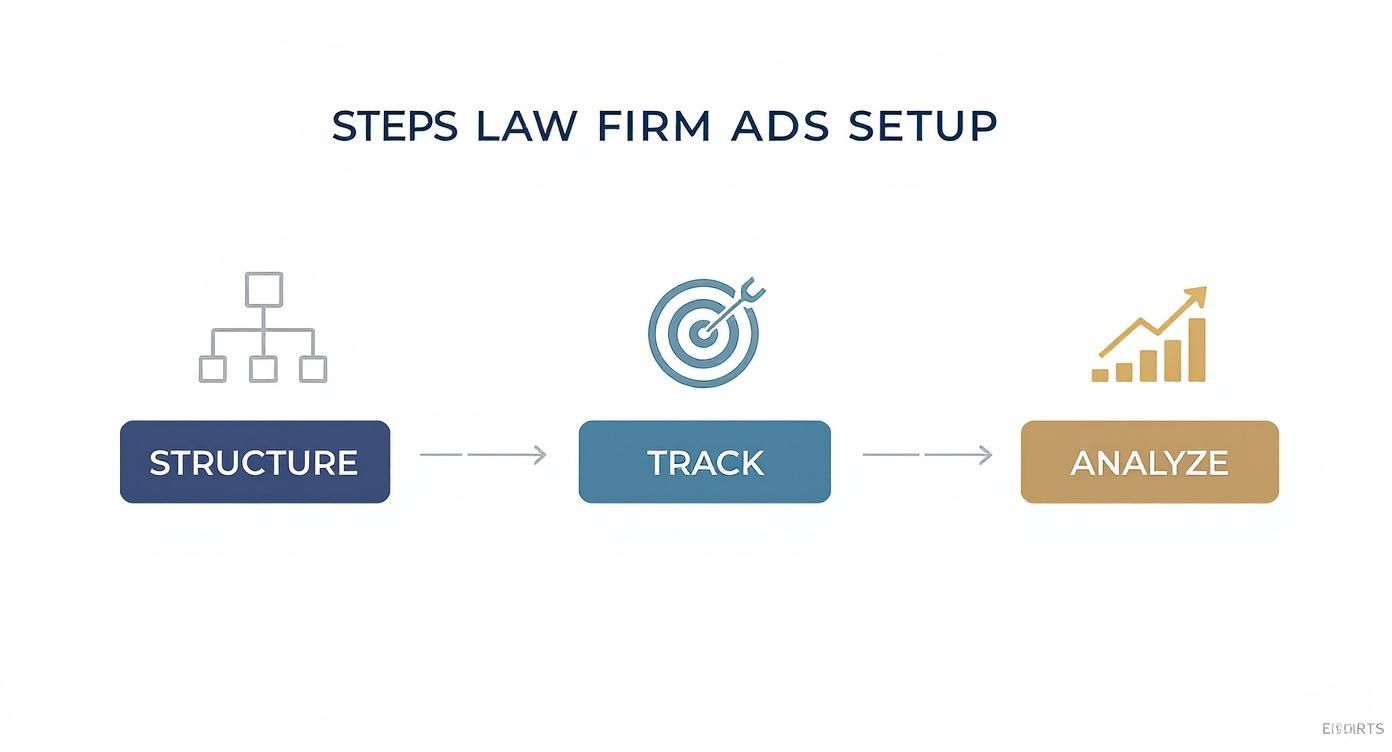
It really highlights how a successful outcome depends on that logical progression from a solid structure to precise tracking and, finally, insightful analysis.
Implementing Essential Tracking and Targeting
Once your structure is mapped out, it's time to wire everything up so you can actually measure what's happening. Without proper tracking, you’re flying blind. You have no real way of knowing which ads are making your phone ring and which are just draining your bank account.
First and foremost, get your conversion tracking set up. And I don't mean just counting clicks. You need to track the meaningful actions that signify a real, potential client.
- Phone Calls: Use Google's call tracking to measure every call that comes directly from your ads and from your website after a click.
- Form Submissions: Track every single "Contact Us" or "Free Case Evaluation" form fill.
- Live Chat Initiations: If you have a chat service on your site, make sure you're tracking how many conversations are started by users who came from your ads.
Connecting your Google Ads account to Google Analytics is another must-do. This gives you the full story of the user's journey, showing you what they do after they click your ad. Of course, paid ads don't exist in a vacuum. A strong local presence is vital, so make sure you're optimizing your Google My Business profile to dominate local searches.
For a deeper dive into making all your marketing channels work together, our guide to https://casequota.com/attorney-search-engine-marketing/ offers more strategies to build a truly powerful online presence.
Developing a Keyword Strategy That Attracts Ready-to-Hire Clients

If your account structure is the engine, your keywords are the fuel. This is where most law firms burn through their ad budget, bidding on broad, vanity terms that get plenty of clicks but generate zero signed retainers.
The right keywords attract clients with urgent problems who are ready to hire you. The wrong ones bring in window shoppers and tire-kickers. A winning Google Ads strategy for any law firm comes down to one thing: a deep, practical understanding of client intent.
You have to get inside the head of someone who needs an attorney right now and distinguish their search from someone just doing academic research. The specific words they type into Google tell you everything.
Distinguishing High-Intent from Low-Intent Keywords
Not all searches are created equal. Someone typing "what are my rights after a car accident" is in the research phase. They're a low-intent searcher, and while they might need a lawyer eventually, they aren't looking for one at this exact moment.
Now, compare that to someone searching for "car accident lawyer near me free consultation." The difference is night and day. This person isn’t just researching; they’re actively trying to hire legal help. This is a high-intent, bottom-of-the-funnel keyword, and it’s where your money should go.
- Low-Intent (Informational): These queries often contain words like "what," "how," "rights," or "definition." Think "what is negligence" or "how to file for divorce." You can target these with content marketing, not expensive ads.
- High-Intent (Transactional): These are the money-makers. They usually include "lawyer," "attorney," "firm," "near me," "hire," or "consultation." Examples are "Los Angeles DUI attorney" or "workers comp lawyer for construction injury."
Focusing your budget squarely on high-intent keywords ensures your ads are served to people who are most likely to pick up the phone and become a client.
Mastering Keyword Match Types
Google gives you several tools to control exactly which searches trigger your ads. These are called match types, and using them properly is the difference between a profitable campaign and a money pit. Think of them as a dial, letting you go from incredibly broad to surgically precise with your targeting.
Your goal isn't to get the most clicks; it's to get the most valuable clicks. Using the right match types is the fastest way to stop paying for searches that will never turn into a case, immediately boosting your ROI.
This choice is especially critical in the legal world. With average costs per lead hitting $131.63 and hyper-competitive keywords like "car accident lawyer" costing as much as $258 per click, you can’t afford to be sloppy.
Precision is everything. Below is a simple framework for how to think about and use match types for your firm's campaigns.
Keyword Match Type Strategy for Law Firms
| Match Type | Primary Use Case | Example Search Query Triggered | Control vs. Reach |
|---|---|---|---|
| Broad Match | Keyword discovery and audience expansion in new campaigns. Use with extreme caution. | cost for a lawyer for divorce (if keyword is 'divorce lawyer') | Low Control, High Reach |
| Phrase Match | The workhorse for most campaigns, offering a solid balance of reach and relevance. | best divorce lawyer for men in Irvine | Medium Control, Medium Reach |
| Exact Match | Targeting your highest-value, most specific keywords for maximum control and efficiency. | divorce lawyer near me | High Control, Low Reach |
For most law firms, I recommend building your campaigns primarily around Phrase Match and Exact Match for your core, high-intent keywords. If you want to experiment, you can use Broad Match, but do it in a separate, low-budget campaign specifically to discover new search terms you might have overlooked.
The Power of an Aggressive Negative Keyword List
Just as critical as the keywords you target are the ones you actively block. A negative keyword tells Google, "Do not show my ad if the search contains this word." This is not a set-it-and-forget-it task; it's an ongoing process and one of the single best ways to stop wasting money.
A personal injury firm, for example, absolutely must add negatives for terms related to:
- Jobs: "paralegal jobs," "attorney careers," "legal assistant salary"
- Pro Bono: "free legal aid," "pro bono lawyer," "legal aid society"
- DIY/Informational: "how to represent yourself," "legal forms," "court filing fees"
- Unrelated Services: "criminal lawyer," "family law attorney" (if you don't practice that)
Every week, you should be digging into your "Search Terms" report inside Google Ads. It shows you the exact queries that triggered your ads. Find the junk, add it to your negative list, and watch your lead quality improve.
This kind of disciplined management can save you thousands of dollars. Of course, Google Ads is just one piece of the puzzle; for a broader view, it's worth exploring other proven lead generation strategies for lawyers to build a more resilient client pipeline.
Writing Ad Copy and Landing Pages That Convert
You can have the most dialed-in campaign structure and the smartest keyword strategy on the planet, but it all falls apart if your ad copy doesn't connect. Think of your ad as the first handshake with a potential client. In the legal world, that's not just a formality—it’s a critical moment where you meet someone who is stressed, scared, and looking for immediate help.
Your ad copy has to do a lot of heavy lifting in a tiny space. It must project empathy, establish authority, and offer a clear solution to their problem, all within a few dozen characters. This is your one shot to cut through the noise and earn that high-intent click.
Crafting Ad Copy That Resonates
Generic ad copy is a death sentence. It’s the fastest way to blend in with every other firm on the search results page. To write copy that actually works, you have to get inside the user's head, speak directly to their pain point, and show them a clear path forward.
A headline like "Award-Winning Law Firm" means nothing to someone in crisis. It's forgettable.
Now, compare that to "Injured in a Truck Accident? Free Case Evaluation." It’s direct, specific, and offers a no-risk next step. That's the level of clarity you need to compete and win.
Here are a few principles I always follow for compelling ad copy:
- Mirror the Keyword: If they searched for a "DUI lawyer in Santa Monica," your headline needs to say that. It's an instant signal that they're in the right place.
- Focus on Benefits, Not Features: Don't say "We have 30 years of experience." Instead, try "30 Years of Winning Cases for Clients Like You." One is about you; the other is about them.
- Include a Clear Call to Action (CTA): Never be passive. Use direct, urgent language like "Call Us 24/7 for Help," "Schedule Your Free Consultation," or "Get Your Case Reviewed Now."
Your ad is competing for attention against three to four other firms at the very top of the page. The winning ad is almost always the one that most clearly and quickly communicates: "I understand your exact problem, and I can solve it."
Beyond your main headlines and descriptions, ad extensions are your secret weapon. They let you take up more screen real estate and give users more ways to connect. Use sitelinks to point to specific practice pages, call extensions for one-tap mobile calls, and location extensions to show you're a local, trusted firm.
The Landing Page: The Critical Next Step
Getting the click is only half the battle. The real test is what happens next. If your ad promises a "Free Consultation for Dog Bite Injuries" but dumps the user on your generic homepage, you've just created a jarring, confusing experience. That disconnect is why so many law firm ad campaigns burn cash without generating leads.
Your landing page has to be a seamless continuation of the ad's promise. This is a core marketing principle called message match. If the ad is about truck accidents, the landing page's headline, text, and photos better be all about truck accidents.
A landing page has one job: convert a visitor into a lead. It’s not the place for lengthy legal treatises or links to your blog. Every single element should be laser-focused on building trust and guiding the user to contact you.
The anatomy of a high-converting landing page includes:
- A Compelling Headline: Reiterate the promise from your ad.
- Trust Signals: Case results, client testimonials, and attorney awards need to be front and center.
- Clear Calls-to-Action: Use big, obvious buttons and phone numbers that tell the user exactly what to do.
- Simple Contact Form: Ask only for what you absolutely need: name, email, phone, and a quick message.
- Mobile-First Design: The vast majority of legal searches happen on a phone. Your page must load in a snap and be dead simple to use on a small screen.
This relentless focus on user experience is non-negotiable. Our guide on web design for attorneys dives deeper into how a professionally built site can make or break your conversion rates.
Remember, the modern legal consumer lives online. With Google handling around 8.5 billion searches a day and 96% of people starting their search for legal advice online, your digital storefront has to be perfect. The data is clear: firms that invest in sharp PPC campaigns and high-quality landing pages are the ones that see a real return. You can read the full research about these legal marketing statistics on seoprofy.com.
Getting Your Bids and Budget Right for Maximum ROI

Let's talk about the money. Managing a Google Ads budget in the hyper-competitive legal world demands a razor-sharp, strategic game plan. When you're dealing with keywords that can cost hundreds of dollars per click, every single dollar has to be deliberate and optimized. This isn't a "set it and forget it" situation; it's about making smart, data-backed decisions that drive real return.
The first step is setting a realistic budget. For any firm in a hot market like Southern California, you could be looking at anywhere from a few thousand to tens of thousands of dollars a month, all depending on your practice area.
The trick is to view your initial budget as an investment in data. You're paying to learn what works so you can scale confidently.
Choosing Your Bidding Strategy
Once your budget is in place, you have to tell Google how to spend it. This is your bidding strategy, and it’s a decision that will directly shape your campaign's performance and how much control you have over the process.
Many firms start with Manual CPC (Cost-Per-Click), and for good reason. It gives you absolute control. You get to set the maximum price you’re willing to pay for any given click, which is fantastic for learning the ropes and making sure you don't blow your budget in the first week. The downside? It’s a ton of work and can’t react to real-time auction signals the way Google's AI can.
Sooner or later, most firms should shift to automated or "smart" bidding strategies. These use machine learning to chase specific goals, saving you an enormous amount of time and usually producing far better results.
Don't be afraid to let Google's AI do some of the heavy lifting. Strategies like 'Maximize Conversions' or 'Target CPA' are incredibly powerful once your campaign has enough conversion data. They analyze thousands of signals in real-time to find users who are most likely to become a client—something no human can do manually.
To make sense of the options, it helps to see them side-by-side.
Choosing the Right Bidding Strategy
| Bidding Strategy | Best For | Primary Goal | Level of Control |
|---|---|---|---|
| Manual CPC | New campaigns or those with very limited data and a tight budget. | Controlling costs and learning click value. | High |
| Maximize Clicks | Driving as much traffic as possible within a set daily budget. | Website traffic and brand awareness. | Medium |
| Maximize Conversions | Campaigns with a healthy amount of conversion data (30+ per month). | Generating the most leads possible. | Low |
| Target CPA | Mature campaigns where you know your ideal cost per lead. | Acquiring leads at a specific cost. | Low |
Making the right choice here depends entirely on where your campaign is in its lifecycle and what you're trying to achieve right now.
The Rhythm of Ongoing Optimization
I have to say it again: Google Ads is not a slow cooker. You can't just set it and forget it. The difference between a profitable campaign and a money pit comes down to consistent, methodical optimization. You need a routine for reviewing performance and making adjustments.
I always recommend a weekly and monthly review cycle.
Your Weekly Check-In (30-60 minutes):
- Dig into the Search Term Report: This is your gold mine. Find all the irrelevant searches that triggered your ads and add them to your negative keyword list immediately. This one task alone can save you thousands.
- Check Your Budgets: Make sure no single campaign is eating the whole budget and that your top performers have enough fuel to run all day.
Your Monthly Deep Dive (2-4 hours):
- Analyze Performance by Segment: How are you doing on mobile versus desktop? Which specific cities or zip codes are bringing in the best leads? Adjust your bids up or down based on this data.
- A/B Test Your Ad Copy: Always be testing. Try out new headlines and descriptions. Pause the ads with lower click-through rates (CTR) and conversion rates, and then try to beat your winners.
Navigating the competitive landscape of Google Ads for law firms often means bringing in expert management to handle compliance and maximize ROI. The best agencies balance precision with scalability, integrating services to boost returns while sticking to all ethical guidelines. For instance, full-service agencies like Silverback Strategies are pros at building campaigns that capture high-intent legal leads—a crucial factor for any firm serious about getting a strong ROI.
Of course, to get a complete picture, you have to know which metrics actually matter. To dive deeper into that, our guide on measuring advertising effectiveness provides a detailed framework.
Maintaining Ethical Compliance with Advanced Targeting
Running Google Ads for a law firm isn't just about outspending the competition. It's about upholding your professional integrity. Legal advertising is tangled in a web of strict ethical duties and state bar regulations that you absolutely cannot afford to ignore. A single misstep can have serious consequences, making compliance just as crucial as your conversion rate.
At the heart of it all is a simple mandate: be transparent and honest. Every claim you make in an ad must be verifiable and completely free of misleading language. The second you cross the line from confident assertion to an outright guarantee, you're stepping into very dangerous territory.
Avoiding Common Ethical Pitfalls
The most frequent violations often come from seemingly harmless marketing phrases. Words that are standard practice in other industries can be major red flags in the legal field. Upholding your duty to the public and the profession means being incredibly deliberate with every word you choose.
First and foremost, never guarantee an outcome. Phrases like "We'll win your case" or "Guaranteed settlement" are strictly forbidden. They can get you into a world of trouble. Your ads can absolutely highlight your track record and experience, but they must never promise a specific result for a potential client’s unique situation.
Be just as cautious with superlatives. Calling your firm the "best" or "#1" personal injury firm in Los Angeles is a claim that's nearly impossible to substantiate and is often prohibited. Stick to objective, verifiable facts. "Over $100 Million Recovered for Clients" or "Former Prosecutor on Your Side" are powerful and, more importantly, defensible.
Every ad you run is a public statement made on behalf of your firm. Treat it with the same level of professional scrutiny as a legal brief. Before you launch any campaign, ask yourself: "Can I defend every single word in this ad to the state bar?" If the answer is no, it's time to rewrite.
Finally, don't forget the disclaimers. Many jurisdictions require legal ads to be clearly identified as such. A simple phrase like "This is an advertisement" or "Advertising Material" on your landing page satisfies this requirement and builds trust through transparency. For a deeper dive, especially in a market like this, understanding ethical attorney advertising in California is a must.
Advanced Targeting with a Compliant Mindset
Once you've internalized these ethical guardrails, you can start using advanced targeting tactics that go far beyond simple keywords. These strategies let you reach high-value potential clients with incredible precision, but they still have to be used responsibly.
Remarketing is a fantastic tool for re-engaging people who visited your website but didn't make contact. You can show them follow-up ads as they browse other sites, keeping your firm top-of-mind. The key is to be subtle and respectful, not intrusive. You must not create ads that could reveal sensitive information about their potential legal issue.
- Do: Run a general brand awareness ad like, "Still seeking legal advice? [Your Firm Name] is here to help."
- Don't: Run a hyper-specific ad like, "Need a DUI lawyer after your arrest? Contact us now."
That subtlety is everything when it comes to respecting user privacy and staying compliant.
Another powerful tactic is leveraging Google's In-Market Audiences. This feature lets you target users whose online behavior signals they are actively looking for legal services right now. Google identifies these people based on their recent search history and site visits, giving you a direct line to prospects who are ready to hire an attorney.
Geo-Targeting for High-Value Jurisdictions
Lastly, don't sleep on the power of precise geographic targeting. For a firm in Southern California, not all zip codes are created equal. Your own data might show that clients from Beverly Hills or Newport Beach tend to have higher-value cases for your specific practice area.
Within Google Ads, you can apply bid adjustments to bid more aggressively for users in these specific, high-value zip codes. This tells Google you're willing to pay more to show up for a search coming from that area, boosting your visibility right where it matters most. It’s this combination of advanced audience targeting and strict ethical adherence that allows you to connect with the best potential clients while upholding the standards of your profession.
Common Questions About Google Ads for Law Firms

Even with a solid game plan, I find that most firms still have a few lingering questions before they're ready to jump into the competitive arena of Google Ads. It's totally understandable. You're dealing with real money, real expectations, and a real commitment of resources.
This section is all about giving you direct, no-fluff answers to the questions attorneys ask me most often. Think of it as a quick briefing on the practical realities of making Google Ads for law firms a success.
How Much Should a Law Firm Budget for Google Ads?
I get this one all the time, and the honest answer is: there's no magic number. Your ideal budget comes down to your practice area, your specific market, and how fierce the competition is.
A family law attorney in a smaller suburb might start to see traction by testing a budget of $2,000 to $5,000 a month. But for a personal injury firm targeting a massive, cutthroat market like Los Angeles? You could easily be looking at $25,000+ per month just to have a seat at the table.
The smartest way to start is with a dedicated test budget for a 90-day period. Pick one high-value service, track your cost per qualified lead like a hawk, and prove the model works. Once you see a positive ROI, you can scale up with confidence.
Are Google Ads Better Than SEO for Attorneys?
This isn't an "either/or" scenario; it's a "both/and" strategy. Google Ads and SEO solve different problems, but when they work together, the synergy is incredibly powerful.
- Google Ads deliver instant results. They put your firm at the top of the page and can start generating calls and form fills from day one. It's the perfect solution for firms that need to sign new cases right now.
- SEO is a long-term asset. It's about building organic authority and trust over time, which ultimately drives down your cost-per-lead and creates a sustainable pipeline of cases.
The most successful firms I've worked with use both. They lean on Google Ads for immediate cash flow and client intake while investing in a rock-solid SEO strategy to build a powerful, long-term asset for the future. You get the best of both worlds: short-term wins and long-term stability.
What Is a Good Conversion Rate for a Law Firm?
In the legal space, a solid conversion rate—meaning the percentage of people who click your ad and then either call or fill out a form—is typically between 4% and 8%. The truly elite, highly-tuned campaigns can even break the 10% mark.
But here’s the thing: the raw conversion rate isn't the metric you should obsess over. The real measure of success is the quality of those leads.
I'd take a 4% conversion rate that consistently produces high-value, signable cases over a 10% rate that just brings in a flood of unqualified looky-loos any day of the week.
You absolutely must have a system to track leads all the way from the first click to a signed retainer. That's the only way to know your true return on ad spend. It's also helpful to understand how different ad platforms perform; you can dig deeper into the Local Service Ads vs. Google Ads comparison to see how they stack up for different goals.
At Case Quota, we specialize in building and managing high-performance Google Ads campaigns that deliver qualified leads, not just clicks. If you're ready to build a predictable pipeline of new cases for your firm, let's talk.