

Every Southern California law firm faces the challenge of standing out when bigger competitors seem to have every advantage. The rapid growth of Artificial Intelligence in legal marketing is reshaping this dynamic, allowing small to mid-size firms to gain sharper insights and create more personalized connections with potential clients. By embracing AI-powered personalization and strategic decision-making, your team can not only level the playing field but carve out lasting competitive advantages in client acquisition.
Table of Contents
- Defining AI in Legal Marketing Today
- AI-Powered Tools for Law Firm Growth
- Personalization Strategies with AI Technology
- Regulatory Compliance for AI-Driven Campaigns
- Risks, Costs, and Common Pitfalls to Avoid
Key Takeaways
| Point | Details |
|---|---|
| AI is Transforming Legal Marketing | AI provides small to mid-size law firms competitive opportunities by optimizing marketing channels and client engagement strategies. |
| Personalization is Key | Implementing AI-driven personalization enhances client experiences and allows firms to tailor their services to individual needs. |
| Regulatory Compliance is Essential | Law firms must prioritize compliance with data privacy and ethical standards to mitigate risks associated with AI technologies. |
| Cautious Implementation Recommended | Firms should adopt a phased approach to AI integration, starting with low-risk applications to build expertise and confidence. |
Defining AI in Legal Marketing Today
Artificial Intelligence (AI) has emerged as a transformative technology reshaping the legal marketing landscape, offering small to mid-size law firms unprecedented opportunities to compete with larger competitors. Stanford Law School’s research reveals that AI technologies are increasingly aiding legal professionals in research, professional services, and strategic decision-making.
In legal marketing, AI represents more than just a technological tool—it’s a strategic approach to understanding client needs, optimizing marketing channels, and delivering targeted messaging. The core capabilities of AI in this domain include:
- Predictive client behavior analysis
- Automated content personalization
- Advanced audience segmentation
- Intelligent lead scoring
- Real-time performance optimization
The transformative potential of AI extends beyond simple automation. Harvard Law’s research indicates that AI is fundamentally reshaping traditional law firm business models, challenging long-standing practices like the billable hour and introducing new paradigms of client service and engagement.
Law firms leveraging AI can expect significant competitive advantages, including more efficient marketing processes, deeper client insights, and the ability to create highly personalized marketing strategies. By integrating AI tools strategically, smaller firms can effectively level the playing field against larger, more resource-rich competitors.
Pro tip: Start small by implementing one AI-driven marketing tool and gradually expand your technology stack as you understand its impact on your firm’s client acquisition strategy.
AI-Powered Tools for Law Firm Growth
The legal industry is experiencing a technological revolution, with AI-powered tools offering unprecedented opportunities for law firms to streamline operations and enhance client services. Emerging AI technologies from American Bar Association research are transforming traditional legal workflows by introducing intelligent solutions that boost productivity and strategic decision-making.
Key AI-powered tools that are driving law firm growth include:
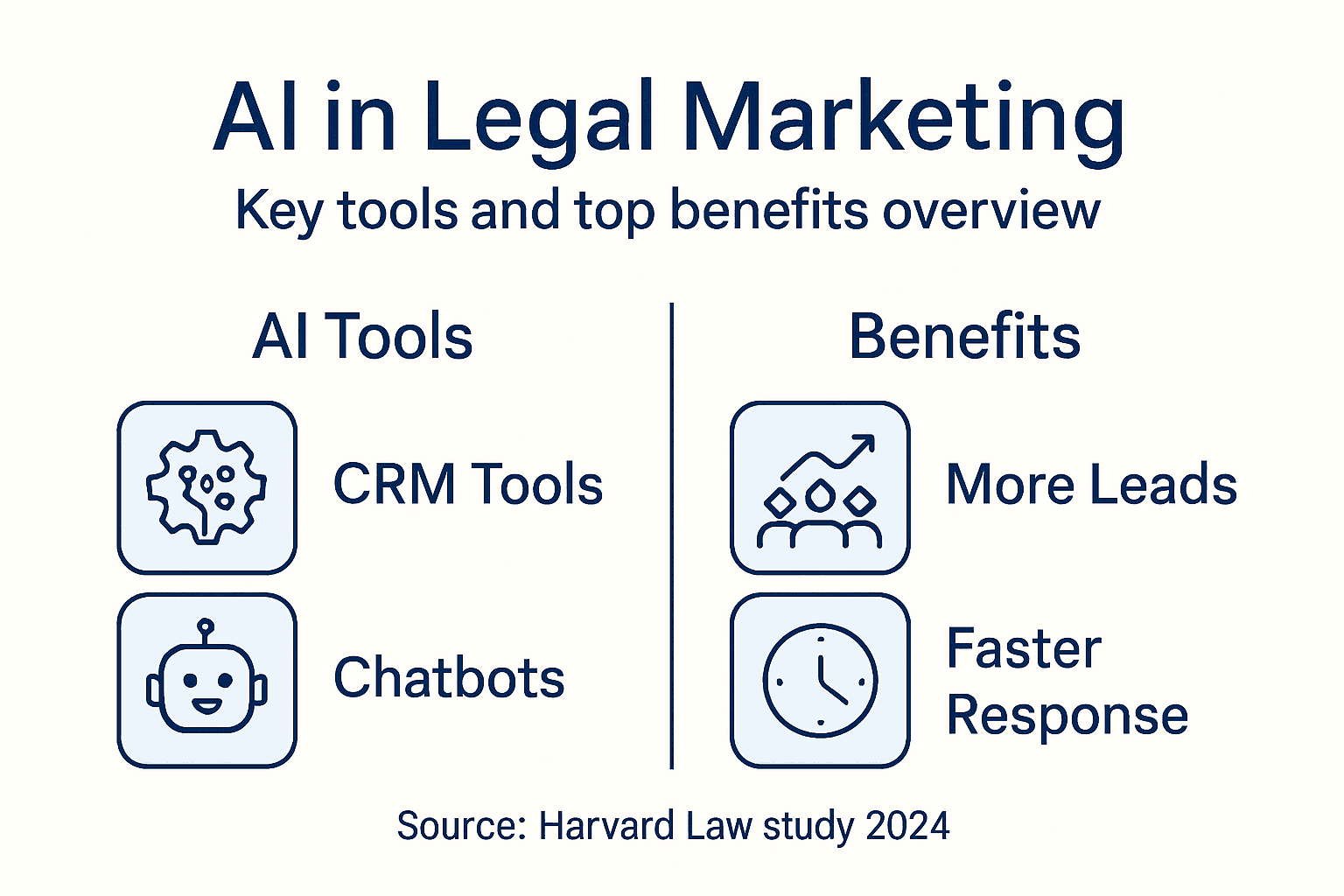
- Client relationship management systems
- Automated legal research platforms
- Predictive analytics for case outcomes
- Intelligent document drafting software
- AI-enhanced marketing and communication tools
Harvard Law’s comprehensive research reveals that AI implementation significantly impacts revenue models and operational efficiency. These tools can automate repetitive tasks, reduce human error, and allow legal professionals to focus on high-value strategic work that directly contributes to firm growth.

For small to mid-size law firms, AI tools represent a critical competitive advantage. By leveraging intelligent technologies, firms can optimize their marketing efforts, improve client engagement, and create more personalized legal services. The ability to process and analyze large volumes of data quickly enables more informed decision-making and targeted client acquisition strategies.
Here’s how common AI-powered tools benefit law firms:
| AI Tool Type | Primary Benefit | Business Impact |
|---|---|---|
| CRM Systems | Centralize client data | Boost client retention |
| Legal Research Platforms | Speed up case research | Save attorney time |
| Predictive Analytics | Forecast case outcomes | Improve strategy decisions |
| Document Drafting Software | Automate paperwork | Reduce error risk |
| Marketing Automation | Streamline outreach | Attract more clients |
Pro tip: Invest in AI tools that integrate seamlessly with your existing technology stack and provide clear, measurable improvements in workflow efficiency and client service.
Personalization Strategies with AI Technology
In the competitive legal marketing landscape, AI-driven personalization has emerged as a game-changing strategy for law firms seeking to connect more meaningfully with potential clients. Cutting-edge personalization research demonstrates the critical balance between delivering tailored experiences and maintaining ethical data practices.
Key personalization strategies for law firms include:
- Dynamic content adaptation
- Behavioral targeting
- Predictive client journey mapping
- Individualized communication workflows
- Contextual recommendation engines
Advanced AI personalization methodologies enable law firms to create highly customized marketing approaches that resonate with specific client segments. By analyzing individual user data, AI tools can generate targeted content, recommend relevant legal services, and predict potential client needs with remarkable precision.
For small to mid-size law firms, AI personalization represents an opportunity to compete with larger competitors by delivering more intimate, responsive client experiences. The technology allows firms to segment audiences more granularly, craft messages that speak directly to individual pain points, and create marketing strategies that feel genuinely personal and relevant.
Pro tip: Start with basic personalization techniques like segmented email campaigns and gradually expand to more sophisticated AI-driven personalization strategies.
Regulatory Compliance for AI-Driven Campaigns
Law firms implementing AI-driven marketing strategies must navigate a complex landscape of legal and ethical considerations to ensure responsible technology deployment. Emerging legal frameworks highlight the critical importance of understanding potential risks associated with AI-generated content and marketing campaigns.
Key regulatory compliance considerations for AI marketing include:
- Data privacy protection
- Intellectual property rights
- Consent and transparency requirements
- Algorithmic bias prevention
- Accurate content representation
Comprehensive AI governance strategies emphasize the need for robust frameworks that balance technological innovation with legal and ethical responsibilities. Small to mid-size law firms must develop proactive approaches to mitigate potential legal risks, including conducting thorough risk assessments and implementing stringent data management protocols.
For Southern California law firms, regulatory compliance means more than just avoiding legal pitfalls. It represents an opportunity to differentiate themselves by demonstrating ethical leadership, building client trust, and showcasing a commitment to responsible technological innovation. The most successful firms will view compliance not as a constraint, but as a strategic advantage in a rapidly evolving digital marketing landscape.
Compare key regulatory challenges and opportunities for AI-driven legal marketing:
| Regulatory Focus | Challenge Faced | Opportunity for Firms |
|---|---|---|
| Data Privacy | Handling sensitive data | Strengthen client trust |
| IP Compliance | Protecting legal rights | Showcase ethical standards |
| Algorithmic Fairness | Preventing bias | Lead in responsible tech |
| Transparency | Ensuring clear intent | Build market credibility |
Pro tip: Consult with a legal technology compliance expert to develop a comprehensive AI governance framework tailored to your firm’s specific marketing needs and risk profile.
Risks, Costs, and Common Pitfalls to Avoid
Small to mid-size law firms in Southern California must approach AI-driven marketing with strategic caution, understanding the potential risks and challenges inherent in emerging technologies. Legal technology research reveals critical challenges that can derail AI implementation if not carefully managed.
Common risks and pitfalls in AI marketing include:
- Confidentiality breaches
- Algorithmic bias and discrimination
- Inaccurate content generation
- High implementation costs
- Overreliance on automated systems
- Potential job displacement concerns
AI application evaluations underscore the importance of maintaining rigorous human oversight and understanding AI’s limitations. Small law firms must recognize that AI is a tool to augment, not replace, human expertise and judgment. The most significant risks emerge when firms treat AI as an autonomous solution rather than a collaborative technology requiring constant monitoring and strategic integration.
Successful AI adoption demands a nuanced approach that balances technological innovation with ethical considerations. Law firms must invest in comprehensive training, develop robust governance frameworks, and continuously assess AI tools’ performance and alignment with their strategic objectives. The goal is not just to implement AI, but to do so in a manner that enhances client service, maintains professional standards, and creates genuine competitive advantages.
Pro tip: Develop a phased AI implementation strategy that starts with low-risk applications and progressively expands as your team’s expertise and technological understanding grow.
Amplify Your Law Firm’s Growth with AI-Driven Legal Marketing
The challenge of competing with larger firms equipped with bigger marketing budgets is real for many small to mid-size law firms in Southern California. This article highlights how AI-powered personalization, predictive analytics, and automated marketing tools can level the playing field by enabling firms to deliver highly targeted, client-centered campaigns. If your firm is struggling to harness AI technology effectively or worried about navigating the complexities of AI-driven marketing compliance and costs, you are not alone. The key is to integrate AI tools strategically while preserving human insight and control to maximize client acquisition and retention.
At Case Quota, we specialize in helping law firms like yours overcome these challenges with customized digital marketing solutions tailored specifically for the legal industry. Our services include SEO-optimized web design, pay-per-click advertising using AI-powered tools, Google Local Services Ads, and fractional CMO leadership to guide your marketing strategy. We understand the importance of ethical AI use, regulatory compliance, and innovative personalization strategies, delivering measurable results that give your firm a competitive edge.
Elevate your marketing and start turning AI insights into client growth today.
Take the first step by exploring how our AI-powered marketing solutions can transform your outreach and client engagement.

Don’t let the complexity of AI marketing hold your firm back. Visit Case Quota now to connect with experts who will guide you through every stage of your growth journey. Unlock your firm’s full potential with targeted, compliant, and effective marketing strategies designed for Southern California law firms.
Frequently Asked Questions
What are the key benefits of using AI in legal marketing?
AI provides law firms with predictive client behavior analysis, automated content personalization, advanced audience segmentation, intelligent lead scoring, and real-time performance optimization, all of which enhance their marketing efforts and competitiveness.
How can small law firms leverage AI tools effectively?
Small law firms should start small by implementing one AI-driven marketing tool, such as a client relationship management system, and gradually expand their technology stack as they understand its impact on client acquisition and overall efficiency.
What are the risks associated with implementing AI in legal marketing?
Common risks include confidentiality breaches, algorithmic bias, and overreliance on automated systems. It’s crucial for law firms to maintain human oversight and ensure compliance with ethical standards.
How can law firms ensure compliance with regulations while using AI marketing tools?
Law firms should focus on data privacy protection, intellectual property rights, transparency, and algorithmic fairness. Developing a comprehensive AI governance framework and consulting legal technology compliance experts can help mitigate legal risks.