

For many Southern California law firms, breaking through the noise of bigger competitors can feel like an uphill climb. Choosing the right approach matters because buyers now start their search for legal help online, comparing firms in real time. Digital marketing gives you the power to connect directly with people seeking your services and track exactly what turns prospects into clients. This overview clarifies what digital marketing means for law firms and highlights why a targeted, data-driven strategy helps your practice stand out, attract high-quality leads, and build lasting client relationships.
Table of Contents
- Digital Marketing Defined For Law Firms
- Key Digital Marketing Strategies Explained
- How Digital Marketing Drives Client Growth
- Financial Impact Versus Traditional Marketing
- Risks, Ethical Issues And What To Avoid
Key Takeaways
| Point | Details |
|---|---|
| Digital Marketing Essentials | Digital marketing leverages online channels to target potential legal clients effectively, contrasting with traditional methods. |
| Measurable Strategies | Digital marketing allows for precise tracking of client acquisition efforts, enabling law firms to adjust their strategies based on performance data. |
| Content as Authority | Creating informative content positions law firms as experts and builds trust with prospective clients, essential for engagement. |
| Ethical Considerations | Adhering to legal ethical standards is crucial in digital marketing to maintain client confidentiality and avoid deceptive practices. |
Digital Marketing Defined for Law Firms
Digital marketing for law firms refers to the strategic use of online channels and technology to attract clients, build your firm’s reputation, and engage prospects where they are already searching. Unlike traditional marketing methods that cast a wide net, digital marketing uses websites, social media platforms, email campaigns, and search engines to deliver targeted messages to people actively looking for legal services. The Legal Marketing Association defines it as the use of online channels including websites, social media, and email to build brand awareness, attract clients, and enhance client service specifically tailored for law firms.
For Southern California law firms competing against larger practices, this distinction matters enormously. You’re not buying expensive billboard space or hoping someone sees your Yellow Pages listing. Instead, you’re meeting potential clients at the exact moment they search “personal injury lawyer near me” or “family law attorney in San Diego.” Digital marketing transforms how you reach prospects by enabling interactive, measurable, and targeted strategies that let you see exactly who’s clicking your ads, reading your content, and requesting consultations. You know what’s working and what’s not, down to the dollar spent.
The toolkit is varied and interconnected. Search engine optimization (SEO) gets your website ranked higher when people search for legal services. Pay-per-click advertising puts your firm at the top of search results immediately. Content marketing positions you as the expert by publishing thoughtful articles about legal issues your clients face. Social media builds relationships and showcases your firm’s personality. Digital marketing strategies designed specifically for law firms combine these channels into a cohesive system rather than random, disconnected efforts. The goal is simple: be visible to the right people, at the right time, through the right channel.
What makes this powerful for firms your size is measurability. You can track conversions, monitor which practice areas generate the most leads, and adjust your budget based on real performance data. A traditional marketing investment was often a gamble. Digital marketing is a calculated investment with clear returns.
Pro tip: Start by auditing which channels your ideal clients actually use before spreading yourself thin across every platform. A family law firm and a commercial real estate firm need different digital strategies, so match your marketing to where your specific target audience spends time online.
Key Digital Marketing Strategies Explained
When it comes to growing your law firm, having the right digital marketing strategies in place makes the difference between blending into the background and standing out in your market. The core strategies work together as an interconnected system, not isolated tactics. Content marketing, social media marketing, SEO, email marketing, and paid advertising form the foundation of most successful law firm digital marketing efforts. Understanding how each one operates and why it matters to your specific practice area is critical before you invest resources or budget.
Search Engine Optimization (SEO) ensures potential clients find your website when they search for legal services. If someone in Orange County searches “employment lawyer near me” or “real estate attorney,” your firm should appear in those results. SEO involves optimizing your website’s content, structure, and technical elements so Google recognizes your firm as relevant and trustworthy. It takes time, but it delivers consistent, long-term results. Content marketing works alongside SEO by positioning you as the expert in your field. You publish articles, guides, and resources that answer the legal questions your clients actually ask. This builds trust and demonstrates your knowledge before anyone picks up the phone.

Paid advertising through Google Ads and social media platforms delivers immediate visibility. Unlike SEO, which takes months to produce results, paid ads put your firm at the top of search results and in front of targeted audiences right away. You only pay when someone clicks your ad, making it measurable and cost-effective when done correctly. Email marketing nurtures relationships with past clients and prospects who have shown interest in your services. A well-timed email about a legal change relevant to their situation keeps your firm top of mind. Social media marketing humanizes your firm and builds community. It’s where you share insights, respond to client questions, and show the personality behind the practice.
Video marketing deserves special mention because it captivates audiences in ways text and static images cannot. A short video explaining a complex legal concept or introducing your team builds connection and increases engagement. When marketing strategies combine emerging digital technologies with thoughtful execution, they create measurable outcomes across multiple channels. The key is selecting strategies that align with where your target clients spend time and what problems they need solved. Not every strategy applies equally to every firm.
Pro tip: Start with one or two strategies you can execute well rather than attempting all of them poorly, then layer in additional tactics as you prove results and free up resources.
Here’s a comparison of key digital marketing strategies for law firms:
| Strategy | Main Purpose | Time to Impact | Notable Benefit |
|---|---|---|---|
| SEO | Improve organic website visibility | 6-12 months | Sustainable lead generation |
| Paid Advertising | Gain immediate visibility | Days to weeks | Fast client acquisition |
| Content Marketing | Build trust and authority | 3-6 months | Educates and nurtures leads |
| Social Media Marketing | Increase engagement and reach | Weeks to months | Showcases firm personality |
| Email Marketing | Maintain client relationships | Ongoing | Drives repeat and referral business |
| Video Marketing | Boost engagement and understanding | Weeks to months | Explains complex topics easily |
How Digital Marketing Drives Client Growth
Digital marketing doesn’t just make your firm visible online. It directly drives client growth by connecting you with people actively seeking legal help and converting them into paying clients. The mechanics are straightforward: when someone searches for a lawyer, your firm appears through SEO and paid ads. They click through to your website, read your content, and gain confidence in your expertise. They fill out a contact form or call your office. That’s a new client acquisition. Digital marketing enables law firms to attract and retain clients by increasing online visibility and engagement, which is exactly what separates firms that grow from those that stagnate.
The real power lies in data. Unlike traditional marketing where you can’t track results, digital marketing gives you precise analytics about what’s working. You see exactly how many people searched for your services, clicked your ad, visited your website, and requested a consultation. You can measure the return on investment for every dollar spent. This allows you to optimize campaigns for maximum client acquisition. If your personal injury ads generate more qualified leads than your employment law ads, you shift budget accordingly. If a particular keyword consistently converts prospects into clients, you invest more in that area. This continuous refinement means your marketing gets smarter and more effective over time.
Lead quality matters more than lead quantity. A targeted digital marketing campaign that attracts five genuinely interested prospects is worth far more than a broad campaign that reaches five hundred disinterested people. When you use AI and digital marketing technologies to automate routine marketing tasks, you free up time to focus on what actually converts prospects into clients: building relationships and delivering exceptional service. Paid advertising lets you target by geography, practice area, and demographics. SEO reaches people organically over months. Content marketing builds authority. Email marketing maintains relationships with past clients who might refer you or return with new legal needs. Social media humanizes your firm and builds community trust.
For mid-sized Southern California law firms competing against larger players, this is your advantage. Larger firms may have bigger budgets, but they often lack the agility to optimize quickly or personalize their outreach. You can test messaging, adjust rapidly, and double down on what resonates with your specific market. A family law firm in San Diego can target recently divorced individuals in their service area with messaging that speaks directly to their situation. A business law firm can reach startup owners searching for incorporation guidance. This precision targeting means you attract clients who actually need your services and can afford your fees, shortening sales cycles and improving profitability.
Pro tip: Track not just new leads but lead quality by monitoring which marketing channels produce clients who pay promptly, stay longer, and refer others, then allocate more budget to those high-value channels.
Financial Impact Versus Traditional Marketing
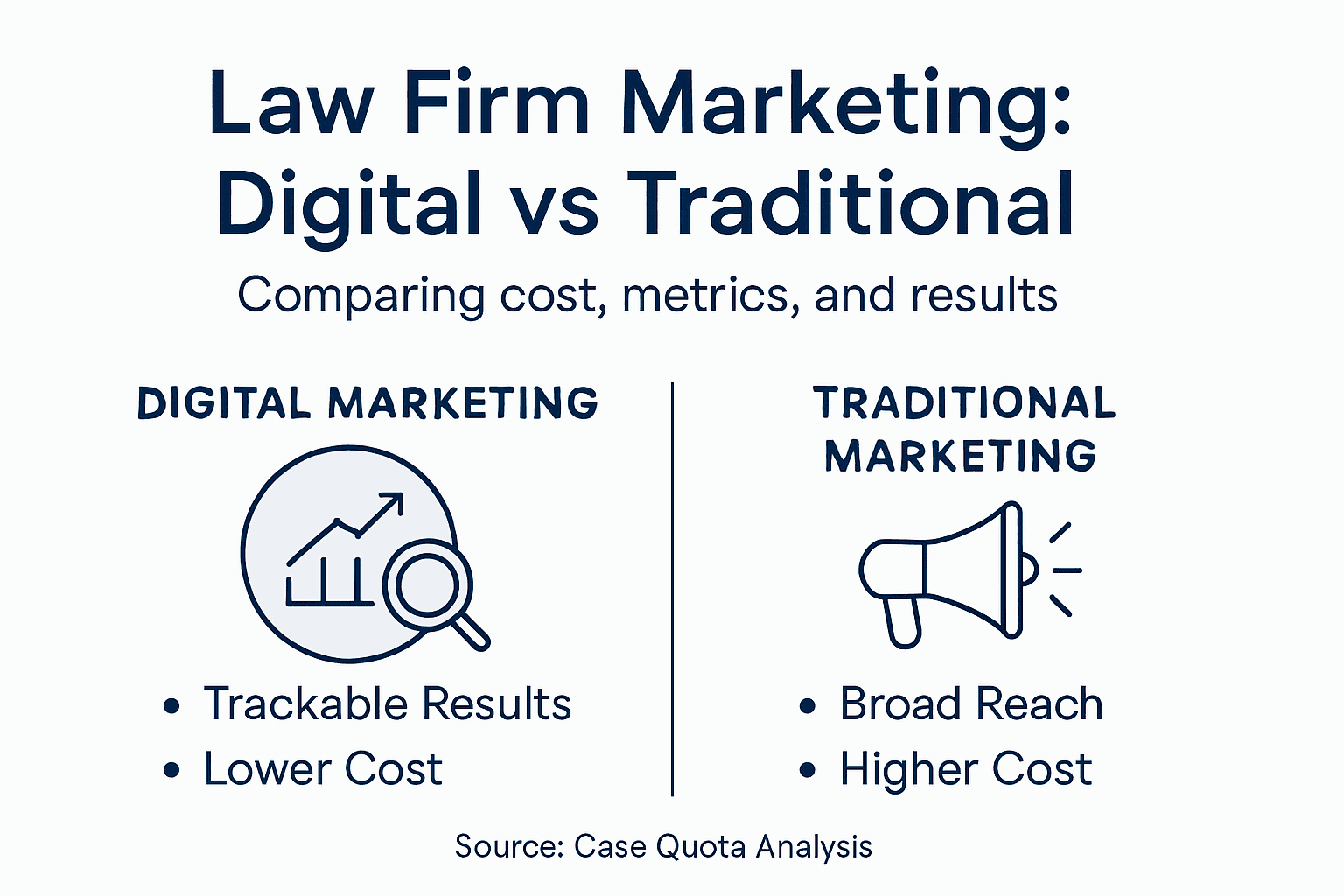
Let’s talk dollars and cents. A full-page print advertisement in a local publication costs between $1,500 and $5,000 per month. You have no idea who sees it, whether they need a lawyer, or if it generates a single client inquiry. A billboard runs $1,200 to $3,000 monthly. Radio spots and direct mail campaigns consume similar budgets with limited measurability. Now compare that to digital marketing. You can launch a targeted Google Ads campaign for the same budget and track exactly how many people clicked your ad, visited your website, and requested a consultation. You know your cost per lead and your return on investment. Digital marketing typically offers higher return on investment compared to traditional marketing due to its targeted nature and measurable results, which is why so many firms are shifting their budgets.
Traditional marketing builds brand awareness through broad exposure. If your goal is to be recognized as “the personal injury firm in San Diego,” a billboard and local radio spots help achieve that. But brand awareness doesn’t pay your bills. Client inquiries do. Digital marketing excels at converting awareness into action. Someone searching “car accident attorney near me” isn’t just aware of law firms in general. They actively need one right now. They’re ready to call. That’s why digital marketing generates more qualified leads at lower cost. Your cost per lead through digital channels might be $50 to $150, depending on your market and practice area. Through traditional channels, it often exceeds $300 or becomes unmeasurable altogether.
The data advantage is overwhelming. With digital marketing, you see performance metrics in real time. You know which keywords drive the most calls. You understand which geographic areas produce the best clients. You can identify which practice areas generate the highest-value cases. This intelligence allows you to continuously optimize your spending. A poorly performing campaign gets paused or adjusted within days. A traditional marketing initiative requires months or years to evaluate. The agility of digital marketing means your marketing budget works harder and smarter. For mid-sized law firms with limited budgets competing against larger players, this efficiency gap is your competitive advantage. You can outmaneuver firms with bigger budgets by spending smarter.
Integration matters. Digital marketing’s data-driven nature facilitates better financial outcomes and adaptability to client behavior changes, but that doesn’t mean abandoning traditional methods entirely. A hybrid approach often works best. Maintain some brand-building activities through traditional channels while allocating the majority of your budget to digital tactics with proven returns. This balanced strategy maximizes both awareness and conversion. However, your profit margins will improve dramatically when digital marketing becomes your primary acquisition engine.
Pro tip: Calculate your actual cost per client by dividing total marketing spend by new clients acquired from each channel, then shift budget toward digital channels that consistently produce the lowest cost per client.
To highlight the financial impact, see how digital and traditional marketing compare for law firms:
| Attribute | Digital Marketing | Traditional Marketing |
|---|---|---|
| Cost per Lead | $50 – $150 | $300+ or unmeasured |
| Measurability | Real-time, detailed | Minimal to none |
| Targeting | Highly specific audiences | Broad, less precise |
| Adjustment Speed | Immediate or daily | Slow, months required |
Risks, Ethical Issues and What to Avoid
Digital marketing power comes with responsibility. As a law firm, you handle sensitive client information and operate under strict ethical rules. The California State Bar and American Bar Association have clear standards about advertising, client confidentiality, and conduct. Digital marketing introduces new ways to violate these standards if you’re not careful. The good news is that understanding the risks upfront lets you avoid them entirely. Privacy concerns due to collection and use of personal data require careful attention when running digital campaigns. You’re collecting email addresses, phone numbers, and potentially even geographic location data. You must handle this data securely, use it only as promised, and protect it from breach.
Deceptive advertising is a serious trap. Never make claims you can’t substantiate. Never promise specific results or guaranteed outcomes. Never use testimonials that misrepresent client experiences. The line between confident marketing and false advertising is real, and the State Bar takes violations seriously. Misleading paid ads, fabricated reviews, or exaggerated case results create liability. If a prospect later claims you misrepresented your qualifications or success rate, you’re vulnerable. Stick to truthful statements supported by evidence. Your track record speaks for itself. If you’ve handled 200 employment discrimination cases with strong settlements, say that. Don’t claim you win 99 percent of cases or that results are guaranteed.
Client confidentiality remains paramount. Never mention specific clients or cases in marketing without explicit permission. Never use client testimonials without written consent. Never share case details that could identify a client, even in anonymized form. Social media makes this tempting. A great settlement photo opportunity or a heartfelt thank you from a satisfied client feels like perfect marketing material. It’s not. Keep your marketing separate from your client relationships. The bar’s rules around confidentiality don’t change because you’re marketing digitally. Additionally, navigating regulations such as GDPR and CCPA ensures lawful and fair handling of personal data is essential. Even though your firm operates in California, if you collect data from residents in other states or countries, you must comply with their privacy laws.
Avoid manipulative tactics entirely. Don’t use aggressive retargeting that follows prospects around the web incessantly. Don’t employ dark patterns that trick users into signing up for newsletters or calls. Don’t buy email lists from brokers and send unsolicited bulk emails claiming special offers. This damages your reputation and violates anti-spam laws. Your marketing should feel trustworthy, not invasive. Be transparent about how you use data, what communications people will receive, and how they can opt out. This builds trust, protects you legally, and actually improves results because people who choose to engage with you are genuinely interested.
Pro tip: Before launching any digital marketing campaign, have your marketing materials reviewed by someone familiar with bar ethics rules, especially testimonials, performance claims, and data collection practices.
Unlock Your Law Firm’s Growth with Strategic Digital Marketing
Law firms often struggle to stand out against larger competitors with bigger marketing budgets. The article “Why Invest in Digital Marketing for Law Firms” highlights challenges like measuring marketing effectiveness, targeting the right audience, and generating high-quality leads. Your goal is clear: get your firm found by the right clients at the right time through proven strategies such as SEO, pay-per-click advertising, and tailored content marketing.
Case Quota specializes in empowering Southern California law firms just like yours to overcome these hurdles by delivering customized digital marketing solutions. With over 15 years of digital results and six years focusing exclusively on California legal marketing, Case Quota offers advanced services including SEO-optimized web design, AI-powered pay-per-click campaigns, video marketing, and strategic leadership like fractional CMO services.

Ready to transform your client acquisition efforts and finally see measurable returns from your marketing spend? Explore how our dedicated legal marketing expertise can put your firm in front of the clients who need you most. Visit Case Quota now and start building your competitive edge with digital marketing strategies that deliver real results.
Frequently Asked Questions
Why should law firms consider digital marketing?
Digital marketing allows law firms to reach potential clients actively searching for legal services, providing a targeted approach that is often more effective than traditional marketing methods.
What are the key digital marketing strategies for law firms?
The main strategies include search engine optimization (SEO), content marketing, paid advertising, social media marketing, email marketing, and video marketing, all of which work together to enhance visibility and engagement.
How can digital marketing drive client growth for a law firm?
Digital marketing connects law firms with individuals actively seeking legal help, converting them into clients through SEO, paid ads, and engaging content that builds trust and authority.
What are the financial advantages of digital marketing over traditional marketing?
Digital marketing typically offers a lower cost per lead, provides measurable results, and allows for quick adjustments, making it a more cost-effective and data-driven approach compared to traditional marketing channels.