

Before you even think about scheduling a call with a digital marketing agency, the most important work happens right inside your own firm.
This is the part most law firms skip. They have a vague idea—"we need more leads"—and hope an agency will just figure it out. This almost always leads to mismatched expectations, wasted money, and a whole lot of frustration.
Let's get this right from the start.
First, Get Specific About Your Goals

Think of it like preparing for trial. You wouldn't show up in court without a detailed case strategy, clear objectives, and a specific vision of a successful outcome. The same discipline applies here. An agency can’t build a winning marketing strategy on a weak or undefined foundation.
You need to provide the "case brief"—the specific, measurable goals that will drive every decision they make.
"We need more leads" is a wish, not a goal. A personal injury firm's needs are wildly different from an estate planning practice, and your goals have to reflect that reality. To get past the vague stuff, you need to drill down and get concrete.
To help you get started, we've put together a table with some key questions. Think of this as a checklist to clarify your thinking before you engage with potential partners.
Key Questions to Define Your Law Firm's Marketing Needs
| Area of Focus | Guiding Question | Example for a PI Firm |
|---|---|---|
| Practice Area Growth | Which specific practice areas do we want to grow? | Increase qualified motor vehicle accident leads by 25% in the next 12 months. |
| Geographic Dominance | Where do we want to be the go-to firm? | Rank in the top 3 on Google Maps for "truck accident lawyer" in downtown Chicago. |
| Client Value (LTV) | What is a new case worth to us? | The average MVA case is worth $15,000, so we can't spend more than $3,000 to acquire one. |
| Brand Reputation | How do we want to be perceived in the market? | Position the firm as the leading authority on catastrophic injury cases in our state. |
| Competitive Edge | Who are our top 3 competitors, and what are their weaknesses? | Competitor A has bad reviews; we can highlight our 5-star rating. Competitor B has a slow website. |
Answering these questions transforms your evaluation process. It moves you from a subjective "gut feeling" about an agency to an objective, data-driven decision based on whether they can actually hit your specific targets.
Next, Set a Realistic Budget
With clear goals in hand, it’s time to talk money. Your budget isn't just a number you feel comfortable with; it's a direct reflection of your ambition. If your goal is to unseat the top PI firm in a major city, a shoestring budget just won't cut it.
Having a solid budget shows potential agencies you're serious. It also acts as a great filter. When an agency knows what you're willing to invest, they can build a realistic proposal that focuses on the channels most likely to deliver a return for your firm. For a deeper dive, check out our law firm marketing plan template.
It’s also smart to look at the agency’s financial health. With nearly 23% of agencies seeing revenue drops recently, partnering with a stable, growing firm is a good way to minimize your risk. The industry's average growth rate has been 12% annually over the last five years, so you want a partner who is thriving, not just surviving. That stability is a strong signal they can deliver consistent, long-term results.
Vetting an Agency's Legal Industry Experience

Let’s be blunt: marketing a law firm isn't like marketing a pizza shop or a clothing brand. The legal world operates under a completely different set of rules, ethical obligations, and client expectations that a generalist agency just won't get.
Hiring a partner without deep experience in the legal sector is a huge gamble.
General marketing playbooks often backfire because they don’t account for State Bar advertising rules, attorney-client privilege, or the subtle but critical nuances that separate practice areas. A campaign that’s a home run for an e-commerce site could be an ethical minefield for a personal injury firm. This is why digging into an agency's legal background isn't just a good idea—it's essential.
You need a team that speaks your language. A team that understands success isn't measured in likes or impressions, but in qualified, signed cases.
Moving Beyond a Generalist Portfolio
When you start talking to agencies, their portfolio is one of the first things you'll see. Many will proudly show off flashy results from all sorts of industries, but you have to push past that. The single most important question to ask is: "Have you successfully marketed a law firm just like mine?"
The needs of a suburban family law practice are worlds apart from a corporate litigation firm in a downtown high-rise. An agency that's only worked with dentists won't have a clue about the cutthroat competitive landscape of PI law.
Look for specific, directly relevant experience. Don't be shy about asking pointed questions about their work in your specific practice area. This step alone will help you quickly weed out the agencies that simply don’t have the specialized knowledge to navigate your market. For a better sense of what elite legal marketing entails, reviewing guides on the best attorney SEO practices can give you a solid baseline for your conversations.
Key Indicators of Genuine Legal Marketing Expertise
As you size up potential partners, you need to look for concrete proof of their experience. Here are a few things to dig into:
- Law Firm Case Studies: Ask for detailed case studies from firms similar to yours in both size and practice area. The metrics should be about what actually matters: cost per lead, cost per signed case, and the growth in overall case volume.
- Knowledge of Ethical Rules: A legitimate legal marketing agency should be able to discuss State Bar advertising rules without breaking a sweat. They'll know what you can and can't say, and what could land your firm in hot water.
- Understanding of Disclaimers: They should know instinctively that disclaimers like "attorney advertising" are non-negotiable and understand exactly where they need to be placed across your website and ad campaigns.
- Experience with Legal Intake: Do they get how client intake works? A great agency knows that getting a form fill is only half the job; the follow-up, qualification, and handoff process is just as crucial to your success.
A true legal marketing partner doesn’t just build campaigns; they build compliant, effective client acquisition systems. They understand that every piece of content, every ad, and every landing page must uphold the professional integrity of your firm while simultaneously driving growth.
Questions to Uncover an Agency's Real Experience
During your initial calls, the right questions can reveal everything. Go beyond the generic "What services do you offer?" and ask targeted questions that expose their true level of experience.
Strategic Questions to Ask:
-
"Walk me through a successful campaign you ran for a [Your Practice Area] firm. What were the biggest challenges, and how did you measure success?"
This question forces them to talk specifics, not theory. Listen for details about their keyword strategy, ad copy, and how they tracked leads all the way through to signed cases. -
"How do you stay on top of the attorney advertising guidelines in our state?"
Their answer tells you if compliance is a core part of their process or just an afterthought. A confident, detailed response is a very good sign. -
"What's your process for reporting on metrics that matter to a law firm, like cost per qualified lead and return on ad spend?"
This question filters out the agencies that focus on vanity metrics (like impressions or clicks) from those who focus on actual business results. A skilled partner will talk about connecting every dollar you spend directly to your bottom line.
By making their specific legal experience the focus of your vetting process, you change the conversation from what an agency can do to what they have done for firms just like yours. This is the surest way to find a partner who will become a true engine for your practice's growth.
Assessing an Agency's Technical and Strategic Skills
A slick sales deck is one thing. Actually executing a complex marketing strategy that brings in high-value cases day after day? That’s a whole different ballgame. When you start digging into an agency's real capabilities, you're moving past their promises and into the world of proven expertise.
This is where you separate the pros from the pretenders. A top-tier agency doesn’t just list services on a proposal; they demonstrate a deep, strategic grasp of how every technical piece—from SEO to paid ads—works together to hit your firm's specific growth targets.
Beyond the SEO Buzzwords
For most law firms, Search Engine Optimization (SEO) is the bedrock of digital marketing. It’s the engine that drives sustainable, long-term growth by getting you in front of potential clients at the exact moment they’re looking for help. But let’s be clear: not all SEO is created equal.
You need an agency that can articulate a strategy that goes way beyond just "ranking for keywords." Their approach should be a three-legged stool:
- Technical SEO: Can they talk specifics like site speed, schema markup for legal services, and Core Web Vitals? A technically sound website is the foundation. Without it, everything else crumbles.
- Local SEO: For most firms, winning the local battle is everything. Ask them how they optimize a Google Business Profile, manage local citations, and generate reviews to dominate the local map pack.
- Content Strategy: What's their plan for creating content that showcases your firm's expertise, authority, and trustworthiness (E-A-T)? They need to explain how they target different stages of a potential client's journey, from early research to being ready to hire.
Expertise in high-ROI channels like SEO and paid media is non-negotiable. Global digital ad sales are projected to hit $715 billion in 2025, and digital channels now command 72.7% of worldwide ad investment. With nearly 97% of websites getting zero organic traffic from Google and the search giant handling 13.7 billion searches a day, you can't afford to hire a generalist.
Evaluating Paid Media and PPC Prowess
Pay-Per-Click (PPC) advertising on platforms like Google Ads gives you immediate visibility in a way that organic SEO can't. It's an incredibly powerful tool. But without an expert at the controls, it can quickly become a very expensive way to generate useless clicks. When evaluating an agency's skill here, their understanding of modern search marketing intelligence in the AI era is critical.
Your goal is to find a partner who treats your ad spend like it's their own money.
Any agency can spend your budget. A great agency optimizes it for maximum return. They focus relentlessly on driving down your cost per qualified lead and increasing your cost per signed case.
Ask them to walk you through their process for a typical law firm campaign. They should be able to clearly explain their playbook for:
- Keyword Targeting: How do they separate high-intent keywords (like "car accident lawyer near me") from purely research-based terms?
- Ad Copywriting: What's their strategy for writing compelling, compliant ad copy that speaks directly to a potential client's pain points and prompts a call?
- Landing Page Optimization: Do they just dump traffic onto your homepage, or do they build dedicated, high-converting landing pages for their campaigns? (Hint: It should be the latter).
- Budget Management: How do they allocate your budget and adjust bids to maximize performance, ensuring you aren't getting fleeced on every click?
The Importance of Analytics and Transparent Reporting
All the technical skill in the world means nothing if an agency can't prove its value. This is where analytics and reporting come in. A transparent partner will give you clear, concise reports that tie their work directly to your firm's bottom line.
Vague reports filled with vanity metrics like "impressions" or "clicks" are a massive red flag. You need data that tells a story about your firm's growth. Look for an agency that provides a custom dashboard tracking the numbers that actually matter to a law firm.
Essential Metrics for a Law Firm Dashboard
| Metric | Why It Matters | What a Good Report Shows |
|---|---|---|
| Cost Per Lead (CPL) | Shows you exactly what you're spending to get the phone to ring. | A clear dollar amount, tracked over time, for each marketing channel. |
| Cost Per Signed Case | The ultimate measure of ROI, connecting your marketing spend to actual revenue. | This is the gold standard. It requires integration with your intake system, but it's what truly counts. |
| Lead-to-Client Rate | Measures the quality of the leads being generated. Are they tire-kickers or real clients? | A percentage that shows how many inquiries convert into paying clients. |
| Organic Rankings | Tracks your visibility for the high-value keywords that actually generate cases. | Shows your position for a curated list of target keywords, not just a bunch of random terms. |
An agency that embraces this level of transparency is confident in its ability to deliver results. They aren’t hiding behind confusing data; they’re using it to prove their direct impact on your firm’s success. For more on this, our guide to attorney search engine marketing offers a deeper dive.
Alright, the proposals are starting to roll in. This is where the real work begins. It’s easy to get wowed by a slick presentation or big promises, but now you’ve got to put on your analytical hat and dig into the details.
A great proposal isn't just a sales pitch; it's a strategic plan for your law firm's growth. Your job is to cut through the marketing fluff and find the substance. Does their strategy actually align with the goals you laid out? Are the deliverables clear and specific, or are they hiding behind vague jargon? Think of it this way: a solid proposal is a roadmap, while a weak one is a map with no street names.
Breaking Down the Proposal: What Really Matters
A quality proposal should feel like a continuation of your initial conversations. It needs to show they were listening and that they understand your firm, your specific practice areas, and what you’re trying to achieve. If it feels like a generic template they could send to any law firm, that's your first major warning sign.
The document should lay out a clear scope of work, detailing the exact activities they plan to execute each month. You need to see specifics—numbers, timelines, and tangible outcomes. "Improve SEO" is meaningless. "Conduct a full technical site audit in month one and write 10 new, optimized pages for your family law practice in month two" is a real plan.
This infographic breaks down the core services you should expect to see clearly detailed.
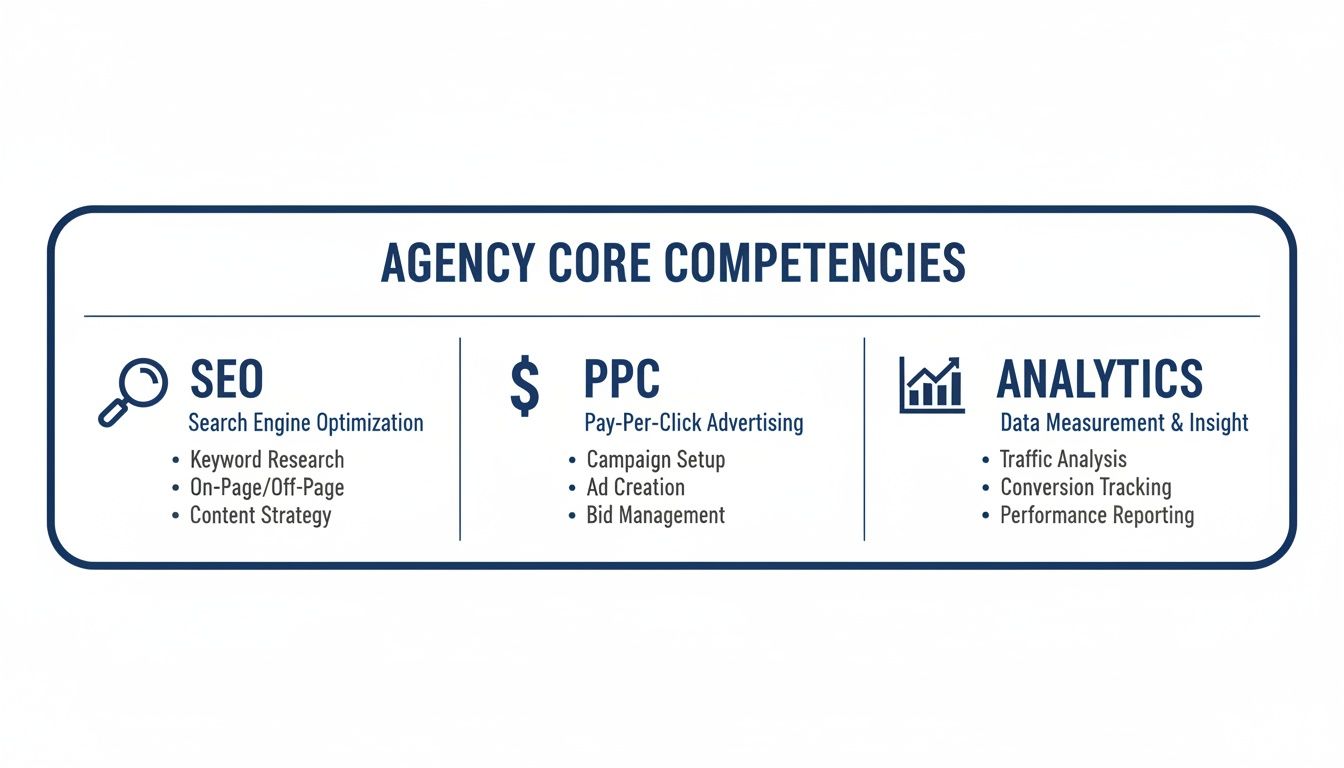
When a proposal clearly itemizes deliverables for core areas like SEO, PPC, and analytics, it’s a strong signal that the agency values transparency and is ready to be held accountable for results.
Pay close attention to their reporting process. How will they show you what's working? Knowing the top SEO reporting tools for agencies can give you a leg up here, as it helps you spot a partner committed to transparency. They need to tell you exactly what metrics they’ll track, how often you’ll see reports, and—most importantly—how those metrics tie back to your firm’s bottom line.
How to Spot the Red Flags Before It’s Too Late
While you're looking for all the right things, it’s just as crucial to watch out for the warning signs. Some red flags are subtle, but others are blaring sirens that can help you dodge a very expensive bullet.
One of the oldest tricks in the book is the promise of guaranteed results, especially the infamous "guaranteed #1 ranking on Google." Let's be clear: no legitimate agency can promise that. They don't own Google's algorithm. It’s a classic bait-and-switch line designed to get you to sign on the dotted line.
Another huge red flag is a lack of transparency around pricing. If their proposal just gives you a single, bundled price without breaking down where your money is going, hit the brakes. You have a right to know exactly how much is being spent on ads versus what you're paying them in management fees. If you want to get smarter on this, digging into how to approach measuring advertising effectiveness can provide some great perspective.
A great agency partner operates like an open book. They are confident enough in the value they provide to show you exactly where every dollar is going and what kind of return you can realistically expect. Vague answers are almost always a cover for inexperience or, worse, poor performance.
To make it easier, I've put together a quick checklist to help you separate the real contenders from the pretenders.
Agency Red Flag Checklist
Here’s a simple breakdown of what to watch out for versus what you should be looking for in a great partner.
| Red Flag (Warning Sign) | Green Flag (Positive Indicator) |
|---|---|
| Guaranteed #1 Rankings | Focuses on a data-driven strategy to improve visibility for valuable keywords over time. |
| Vague, Unclear Deliverables | Provides a detailed monthly scope of work with specific, measurable tasks and outcomes. |
| Opaque Pricing Models | Offers a transparent breakdown of costs, clearly separating ad spend from management fees. |
| Cookie-Cutter Strategy | Presents a custom proposal that directly addresses your firm's unique goals and challenges. |
| Poor Communication Early On | Is responsive, professional, and proactive in their communication from the very first interaction. |
At the end of the day, analyzing proposals is about more than just comparing prices. It's about finding a partner who shares your firm's commitment to transparency, accountability, and getting real results. By taking the time to dissect each proposal and keep an eye out for these red flags, you’re setting your law firm up for a strategic partnership that will actually drive growth for years to come.
Reviewing Contracts and Planning for a Smooth Start
You’ve done the hard work. You’ve vetted the experience, picked apart the proposals, and finally chosen the agency you believe can take your firm to the next level.
But before you pop the champagne, there's one final, crucial step: the contract.
This document is far more than a formality. It’s the blueprint for your entire partnership, outlining every expectation, responsibility, and rule of engagement. Don’t just skim it. A careful review now will save you from massive headaches later.
Key Contract Clauses to Scrutinize
Before you put pen to paper, you need absolute clarity on a few critical points. Vague language is a major red flag. A truly professional agency will have a straightforward, comprehensive contract that protects both of you.
Pay close attention to these areas:
- Ownership of Assets: This is non-negotiable. Who owns the website, content, and ad accounts created during your partnership? The answer must always be you. Your firm has to retain full ownership and administrative access to everything, including your Google Ads account, Google Analytics profile, and all creative assets.
- Term Length and Termination Policy: Be very wary of agencies trying to lock you into long, rigid contracts. A fair and common structure is an initial term of six months, which then rolls into a month-to-month agreement. Most importantly, understand the termination clause. How do you end the partnership if things aren't working out? A 30-day written notice is standard and reasonable.
- Scope of Services and Deliverables: The contract needs to be an exact reflection of the proposal you agreed to. It should explicitly list every service, define all deliverables, and confirm the timelines and reporting schedule you've discussed.
A transparent contract is the sign of a confident, professional agency. If a potential partner gets cagey about asset ownership or tries to lock you into a long-term, ironclad agreement, it's a serious warning that their interests might not align with yours.
Setting the Stage for a Successful Onboarding
Once the ink is dry, the agency’s onboarding process kicks in. This initial phase will tell you a lot about how organized and professional they really are.
A chaotic, disorganized start is often a preview of a rocky relationship. A smooth, structured onboarding, however, sets a positive tone for everything to come.
This is all about getting aligned and handing over the keys. The agency should be in the driver's seat, guiding you through every step. A well-prepared team will come to the table with a clear checklist to make sure nothing gets missed.
Here’s what a great onboarding process should cover:
- Kickoff and Strategy Meeting: This is a formal sit-down (virtual or in-person) to introduce the key players on both sides. You’ll review your goals one last time and lock in the strategic plan for the first 90 days.
- Access and Credentials Handoff: They should have a secure, organized method for you to provide access to your website backend, social media profiles, and any existing analytics or ad accounts.
- Communication Channels: You’ll establish a primary point of contact and set up your day-to-day communication tools, whether that’s a shared Slack channel or a project management board.
- Reporting Schedule Confirmation: You'll agree on the exact day of the month you’ll receive your performance reports and get your regular review calls locked into the calendar.
A seamless start doesn’t happen by accident; it’s the direct result of a well-honed process. This period is the first real test of whether the agency can deliver on its promise to be a true partner in your firm’s growth.
Building a Future-Proof Digital Marketing Partnership
Choosing the right marketing agency isn't just about plugging a hole in your lead generation today. It's about securing your law firm's growth for the next five years. The legal marketing world changes fast, and an agency that's always reacting is an agency that's always one step behind. You need a partner who sees what's coming and keeps you ahead of the curve.
Think of it this way: you're not just hiring a vendor; you're bringing on a strategic partner. They should feel like an extension of your own team, flawlessly executing the current plan while proactively bringing you new ideas that push the firm forward. That's the difference between a simple service provider and a genuine growth partner.
Embracing Innovation and Adaptability
A top-tier agency is obsessed with what's next. They know that a strategy crushing it today might be completely irrelevant in 18 months. When you're interviewing potential agencies, get specific. Don't just ask if they're "innovative."
Ask them pointed questions about the trends that are reshaping the industry right now:
- Artificial Intelligence: How are you actually using AI? Are you running more efficient PPC campaigns with it? Are you using it to find competitive weaknesses? Get them to show you, not just tell you.
- The Evolution of Video: What’s the plan for short-form video on YouTube Shorts versus the longer, educational content that builds authority? They should have a clear perspective on both.
- The Cookieless Future: With privacy changes shaking up ad targeting, how are they preparing? What's their strategy for reaching your ideal clients when the old methods die out?
Their answers will tell you everything you need to know. Are they leading the charge or just following the crowd?
The digital ad market is on track to grow from $734.24 billion in 2024 to a staggering $843.48 billion in 2025. The agencies that master these new tools will be the ones capturing that market share for their clients. In fact, AI-related services in agencies are expected to jump from 10% in 2023 to 17% by 2025. You can dig into more of the data on these digital marketing trends if you want to see just how fast things are moving.
A future-proof partner doesn't just react to trends; they build them into your strategy from day one. They see change not as a threat, but as a massive opportunity to get you better results and a higher ROI.
This forward-thinking mindset is what keeps your firm competitive and ensures every dollar you invest in marketing is working as hard as it possibly can. For more on this, check out our complete guide to building a modern law firm marketing strategy.
A Few Common Questions We Hear
Choosing a digital marketing partner is a big step, and naturally, it comes with a lot of questions. Here are some of the most common ones we get from law firms, along with some straight answers to help you navigate the process.
How Much Should a Law Firm Actually Budget for Digital Marketing?
The textbook answer is somewhere between 7-12% of your firm's gross revenue. But let's be realistic—that's just a guideline.
A brand-new firm or one trying to break into a hyper-competitive market (think personal injury in a major city) will need to be more aggressive with their initial investment to even get noticed. A trustworthy agency won't throw a generic price at you. They'll sit down with you, understand your specific growth goals, and build a budget based on the actual work needed to hit those targets.
Should We Hire a Huge Agency or a Niche Legal Marketing Specialist?
It can be tempting to go with a big, generalist agency that offers a laundry list of services. The problem? Your law firm often ends up as a small fish in a very big pond, and the personal attention you need just isn't there.
A boutique agency that only does legal marketing brings something much more valuable to the table: deep, specific industry knowledge. They already get the State Bar advertising rules and the ethical tightropes you have to walk. They tend to be more agile and responsive. For most law firms, a specialist who lives and breathes your world will deliver far better results and value.
SEO is a marathon, not a sprint. Any agency promising instant first-page rankings is selling a fantasy. True, sustainable growth takes time, expertise, and a consistent, strategic effort.
What’s a Realistic Timeline to See Real SEO Results?
Patience is key here. SEO is a long-term play, an investment in your firm’s future visibility.
While you might notice the effects of some technical fixes within a few weeks, seeing significant movement in search rankings and a real uptick in qualified traffic usually takes 4-6 months of consistent, dedicated effort. For incredibly competitive keywords like "personal injury lawyer," that timeline can easily stretch even longer.
At Case Quota, we focus on one thing: crafting targeted digital marketing strategies that drive measurable growth for law firms. With over 15 years of dedicated legal marketing experience, we know the unique challenges you face. Learn more about how we can help you attract more of the cases you actually want.