

Outspending larger competitors rarely guarantees better results for small to mid-sized law firms in Southern California. What truly shifts the playing field is building a marketing strategy grounded in meaningful metrics and measurable goals. By setting clear objectives and tracking the right key performance indicators, you can outmaneuver bigger firms and reclaim control over your marketing ROI. Discover how precise goal setting and robust tracking empower your law firm to attract more clients strategically and efficiently.
Table of Contents
- Step 1: Define Measurable Marketing Goals And KPIs
- Step 2: Set Up Tracking Tools And Integrate Data Sources
- Step 3: Collect And Organize Marketing Performance Data
- Step 4: Analyze ROI Metrics And Identify High-Value Channels
- Step 5: Refine Marketing Strategies Based On Data Insights
Quick Summary
| Key Takeaway | Explanation |
|---|---|
| 1. Set SMART marketing goals | Creating Specific, Measurable, Achievable, Relevant, and Time-bound goals guides your marketing strategy effectively. |
| 2. Utilize integrated tracking tools | Use analytics platforms to consolidate data and track performance metrics across all marketing channels. |
| 3. Regularly analyze ROI by channels | Identify which marketing channels deliver high-quality leads and maximize return on investment for better resource allocation. |
| 4. Automate data collection processes | Streamline marketing data gathering to improve accuracy and save time, enabling more effective strategy adjustments. |
| 5. Conduct monthly performance reviews | Regular reviews of marketing data foster continuous improvement and help fine-tune marketing strategies based on actual results. |
Step 1: Define measurable marketing goals and KPIs
Successful legal marketing starts with establishing clear, quantifiable objectives that align with your law firm’s growth strategy. When you define precise marketing goals, you create a roadmap for tracking performance and making data-driven decisions.
To develop effective marketing goals, use the SMART framework: Specific, Measurable, Achievable, Relevant, and Time-bound. For law firms, this might mean setting objectives like increasing client acquisition by 20% within six months, improving website conversion rates by 15%, or generating a specific number of qualified leads through targeted digital marketing campaigns. Your key performance indicators (KPIs) should directly reflect these goals, allowing you to track progress with concrete metrics such as website traffic, engagement rates, consultation requests, and client conversion percentages.
By establishing clear marketing goals and KPIs, you transform marketing from a guessing game into a strategic, accountable process. You will be able to identify which strategies generate the best results, allocate your marketing budget more effectively, and continuously optimize your approach to attract and retain clients.
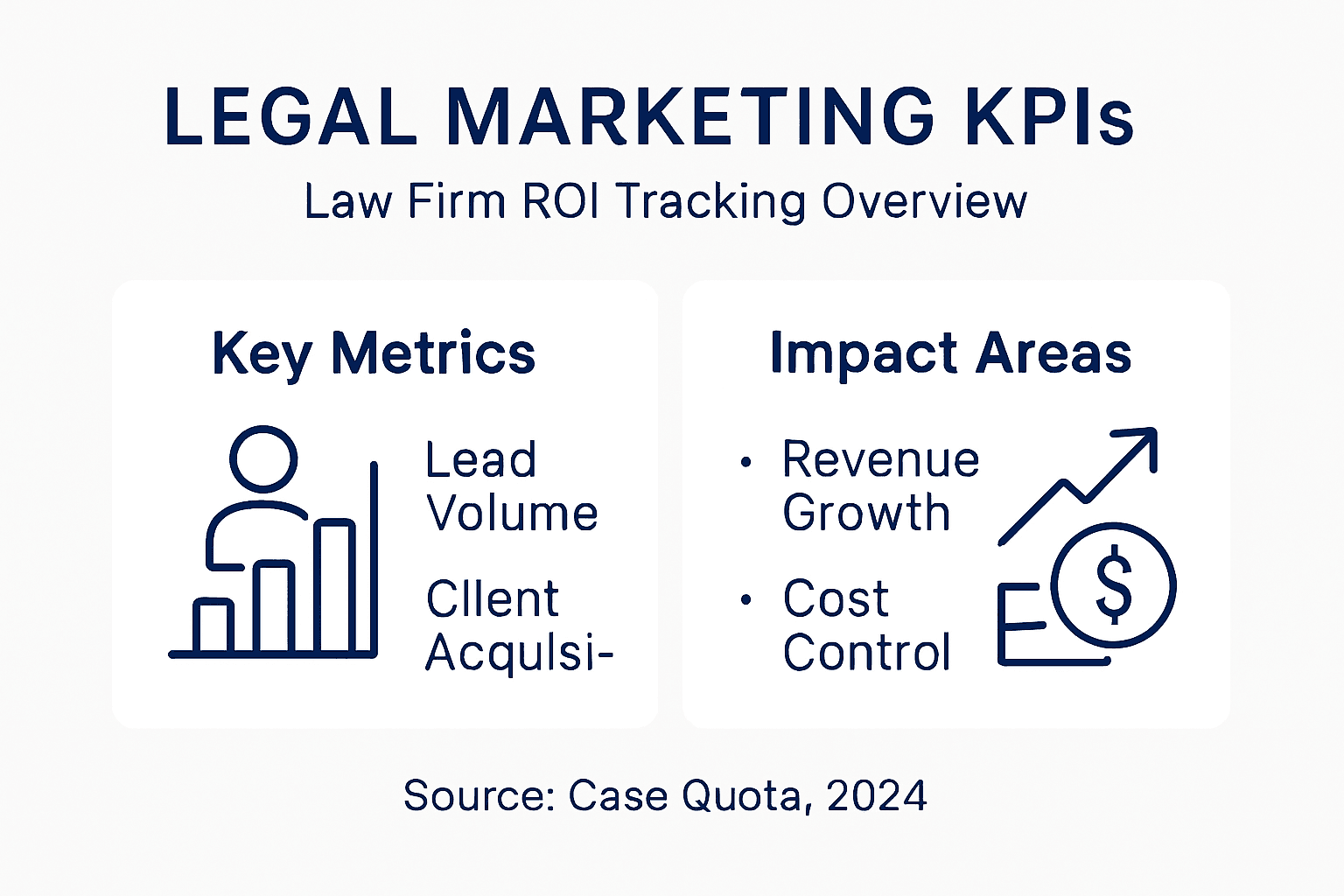
Here’s how different marketing metrics help law firms assess performance:
| Metric | What It Measures | Business Impact |
|---|---|---|
| Website Traffic | Number of visitors | Identifies outreach success |
| Conversion Rate | Leads turned to clients | Shows sales effectiveness |
| Engagement Rate | Interaction level | Tracks audience relevance |
| Client Acquisition Cost | Cost per client gained | Guides budget allocation |
| Lifetime Value | Revenue per client | Informs marketing investment |
Pro Tip: Review and adjust your marketing KPIs quarterly to ensure they remain aligned with your firm’s evolving business objectives and market dynamics.
Step 2: Set up tracking tools and integrate data sources
To transform your legal marketing strategy from guesswork to precision, you need robust tracking tools that capture and synthesize data across multiple marketing channels. Marketing analytics platforms enable you to collect comprehensive performance metrics from websites, social media, email campaigns, and client interactions.
Start by selecting an integrated analytics platform that can consolidate data from Google Analytics, customer relationship management (CRM) systems, social media platforms, and advertising dashboards. Look for tools that offer real-time reporting, custom dashboard creation, and the ability to track key metrics like website traffic, lead generation, conversion rates, and client acquisition costs. Focus on creating a centralized data ecosystem that provides a holistic view of your marketing performance, allowing you to identify which strategies generate the most valuable leads and highest return on investment.
Consistent data integration and regular performance analysis will help you make strategic marketing decisions that directly impact your law firm’s growth. By connecting various data sources and establishing a comprehensive tracking system, you can continuously refine your marketing approach and allocate resources more effectively.
Pro Tip: Choose marketing analytics tools with robust API integration capabilities to ensure seamless data synchronization across different platforms and minimize manual reporting efforts.
Step 3: Collect and organize marketing performance data
Capturing and structuring your law firm’s marketing data is critical for understanding your true performance and making informed strategic decisions. Systematic performance data collection requires a strategic approach that transforms raw numbers into actionable insights.
Begin by establishing a centralized data repository that integrates information from multiple sources including your website analytics, customer relationship management system, social media platforms, advertising campaigns, and client intake records. Create standardized templates and reporting frameworks that allow you to track key metrics consistently over time. Focus on both quantitative data like conversion rates and lead generation numbers and qualitative insights such as client feedback and engagement quality. Your goal is to develop a comprehensive view of marketing effectiveness that goes beyond surface level metrics and provides deep understanding of your firm’s marketing performance.

Implement automated data collection processes wherever possible to reduce manual entry errors and ensure real time accuracy. Schedule regular data review sessions to analyze trends, identify opportunities for improvement, and adjust your marketing strategies based on empirical evidence. By transforming data collection from a mundane administrative task into a strategic intelligence gathering process, you will position your law firm to make more precise and profitable marketing decisions.
Pro Tip: Invest in cloud based data management tools that offer seamless integration and real time reporting capabilities to streamline your marketing performance tracking.
Step 4: Analyze ROI metrics and identify high-value channels
Successfully tracking your law firm’s marketing performance requires a deep dive into marketing effectiveness analysis that goes beyond surface level numbers and reveals true business impact. Understanding which marketing channels generate the most valuable client leads is crucial for strategic resource allocation and sustainable growth.
Start by calculating key performance metrics for each marketing channel including customer acquisition cost, conversion rates, and client lifetime value. Compare these metrics across different platforms such as Google Ads, social media campaigns, organic search, referral networks, and email marketing. Pay special attention to not just the volume of leads generated but their quality and potential revenue contribution. For instance, a digital advertising campaign might generate 100 leads, but if only two convert into high value cases, its actual return on investment could be significantly lower than a more targeted referral marketing approach that produces fewer but more lucrative client opportunities.
Implement a systematic approach to tracking and comparing these metrics monthly, creating visual dashboards that allow you to quickly identify trends and make data driven decisions. By continuously refining your understanding of channel performance, you can progressively optimize your marketing budget to focus on strategies that deliver the most substantial and consistent returns for your law firm.
The following table compares common legal marketing channels by key performance factors:
| Channel | Lead Quality | Typical Cost Level | ROI Potential |
|---|---|---|---|
| Google Ads | Medium to High | High | Moderate to High |
| Social Media Ads | Low to Medium | Moderate | Variable |
| Referral Network | Very High | Low | High |
| Organic Search | Medium | Low (ongoing effort) | Strong long-term |
| Email Marketing | Medium | Low | High with good list |
Pro Tip: Develop a weighted scoring system that evaluates marketing channels not just on lead volume, but on potential case value and long term client relationship potential.
Step 5: Refine marketing strategies based on data insights
Transforming raw marketing data into actionable strategies requires a systematic approach that continuously adapts to performance insights. By treating your marketing analytics as a dynamic roadmap, you can make precise adjustments that incrementally improve your law firm’s client acquisition efforts.
Begin by conducting monthly comprehensive reviews of your marketing performance metrics. Analyze each channel not just on lead volume, but on key indicators like cost per acquisition, conversion quality, and potential case revenue. Identify which strategies are delivering the highest return and which require recalibration or potential elimination. For example, if your social media advertising generates numerous leads but minimal high value case conversions, you might redirect those resources toward more targeted referral marketing or search engine optimization strategies that attract more qualified potential clients.
Create a structured process for iterative strategy refinement where data drives decision making. This means being willing to experiment quickly, measure results objectively, and pivot rapidly when performance metrics indicate a need for change. Your marketing approach should become a continuously evolving system that learns and improves with each campaign, ensuring your resources are always allocated toward the most effective client acquisition methods.
Pro Tip: Develop a quarterly marketing strategy review meeting where key team members analyze performance data collaboratively and brainstorm innovative refinement strategies.
Unlock Precise Legal Marketing ROI with Expert Support
Tracking your law firm’s marketing performance is essential to growing your client base with confidence. The article highlights the challenge of defining clear goals, integrating data from multiple sources, and analyzing high-value marketing channels to refine strategies based on real insights. If you find yourself overwhelmed by tracking tools, uncertain about which KPIs truly matter, or unsure how to optimize your budget for maximum client acquisition, you are not alone.
At Case Quota, we specialize in helping Southern California law firms overcome these exact hurdles. With over fifteen years of digital marketing experience and six years focused on California legal marketing, our tailored services include AI-powered pay-per-click advertising, SEO-optimized web design, and strategic marketing leadership through fractional CMO offerings. We help you transform raw marketing data into actionable strategies that deliver measurable growth.
Elevate your marketing performance today by partnering with an agency that understands the complexities of legal marketing ROI.
Take the next step now and discover how our customized solutions can align your marketing goals with results. Visit Case Quota, explore how we integrate cutting-edge tools and data-driven strategies, and see why law firms trust us to grow their client base efficiently.

Ready for a clear path to higher client acquisition and ROI? Connect with us at Case Quota and start optimizing your marketing strategy with confidence.
Frequently Asked Questions
How do I define measurable marketing goals for my law firm?
To define measurable marketing goals, use the SMART framework: Specific, Measurable, Achievable, Relevant, and Time-bound. For instance, you might aim to increase client acquisition by 20% over the next six months.
What key performance indicators (KPIs) should I track for legal marketing?
Key performance indicators for legal marketing include website traffic, conversion rates, engagement rates, client acquisition costs, and client lifetime value. Focus on these metrics to ensure you can evaluate the effectiveness of your marketing strategies effectively.
How can I set up tracking tools for my law firm’s marketing efforts?
Select a comprehensive analytics platform that can integrate data from various sources, including Google Analytics and social media analytics. Start the setup process by creating a centralized system to collect and analyze this data regularly.
What methods can I use to analyze my law firm’s marketing ROI?
To analyze your marketing ROI, calculate key metrics like cost per acquisition and conversion rates across all channels. Compare these to determine which strategies yield the highest return, allowing you to optimize your budget allocation.
How often should I review my law firm’s marketing performance data?
It is recommended to conduct a comprehensive review of your marketing performance data on a monthly basis. This allows you to identify trends, adjust strategies, and make data-driven decisions that enhance your firm’s growth.
What steps should I take to refine my marketing strategies based on data insights?
Analyze your marketing performance data monthly to understand which strategies are effective and which are not. Adjust your tactics accordingly, such as reallocating resources to high-performing channels, to boost client acquisition consistently.
Recommended
- Complete Guide to Digital Marketing for Legal Firms: Strategies That Drive Results – Case Quota
- Law Firm Marketing Plan Template | Build Your Winning Strategy
- measuring advertising effectiveness: A Guide for Law Firms
- How to Get More Clients as a Lawyer in a Digital World
- Prisoner Legal Aid – Professional Legal Document Preparation Services