
To get more clients from your website, you have to stop thinking of it as a digital brochure and start treating it as your most important client acquisition tool. It's about fixing the technical hiccups like slow page loads, sharpening your message to build immediate trust, and making every button and form an effortless next step for a potential client.
Your goal is to make it dead simple for someone in crisis to contact you.
Why Most Law Firm Websites Fail to Attract Clients
Let's be blunt: most law firm websites are underperforming assets. They exist, but they aren't pulling their weight by consistently generating qualified leads. The problem usually boils down to a huge disconnect between what the firm says and what a potential client desperately needs to hear.
Visitors land on your site looking for fast answers, a dose of reassurance, and a clear path forward. Too often, they’re met with a wall of confusing legalese.
Picture someone who just got into a car accident. They're stressed, hurting, and searching for an expert on their phone. If your site takes forever to load, is a nightmare to navigate on a small screen, or sounds like a generic textbook, they're gone in seconds. This isn't just a missed click; it's a failure to connect with someone who came to you for help.
Moving Beyond a Digital Brochure
Your website's main job is to build trust and get someone to take action. So many sites stumble because they don't answer the fundamental questions running through a potential client's mind. They fail because they don't adequately address what clients look for when choosing a personal injury attorney. You have to get ahead of their worries and give them clear, compelling answers.
This means you need to fundamentally shift how you think about your website. It's not a portfolio of your past wins; it's your best, most diligent intake specialist, working 24/7.
To do its job right, it must be exceptional at:
- Building Instant Credibility: Showcasing your specific expertise, client testimonials, and clear case results (while staying within ethical guidelines, of course).
- Creating a Human Connection: Using real photos of your team—not stock images—and sharing your firm's story helps you become more than just a faceless business.
- Providing a Frictionless Path to Contact: Your phone number, contact forms, and live chat options should be impossible to miss.
The hard truth is that turning a visitor into a client is a tough gig in any industry. Global e-commerce conversion rates hover around 1.9%. While some studies show a broader average of 2.9% across different sectors, professional services like law face an even higher bar for trust and performance.
Ultimately, a high-converting law firm website understands that effective website design for law firms is about building trust quickly. When you make clarity, speed, and user experience your top priorities, you align your digital presence with the real-world needs of your potential clients. That's how you turn clicks into consultations.
Where to Start: Your First Step to a Higher Conversion Rate
Before you spend a single dollar on a flashy redesign or a new marketing campaign, you need a baseline. To actually move the needle on your website's conversion rate, you have to first understand where potential clients are getting stuck and why they're leaving.
This initial audit isn’t about becoming a data scientist overnight. It’s about using simple, powerful tools to find the biggest, often easiest, wins.
The best place to begin is by digging into your website’s traffic patterns. Using a free tool like Google Analytics, you can quickly spot your highest-traffic pages that also have suspiciously high exit rates. If your “Family Law Services” page gets thousands of visitors but most of them leave without clicking anywhere else, you’ve found a major leak in your client intake funnel. This data tells you exactly where to focus your attention first.
This common, frustrating journey is exactly what happens when a potential client lands on a site that fails to meet their needs. It leads directly to lost opportunities and revenue.
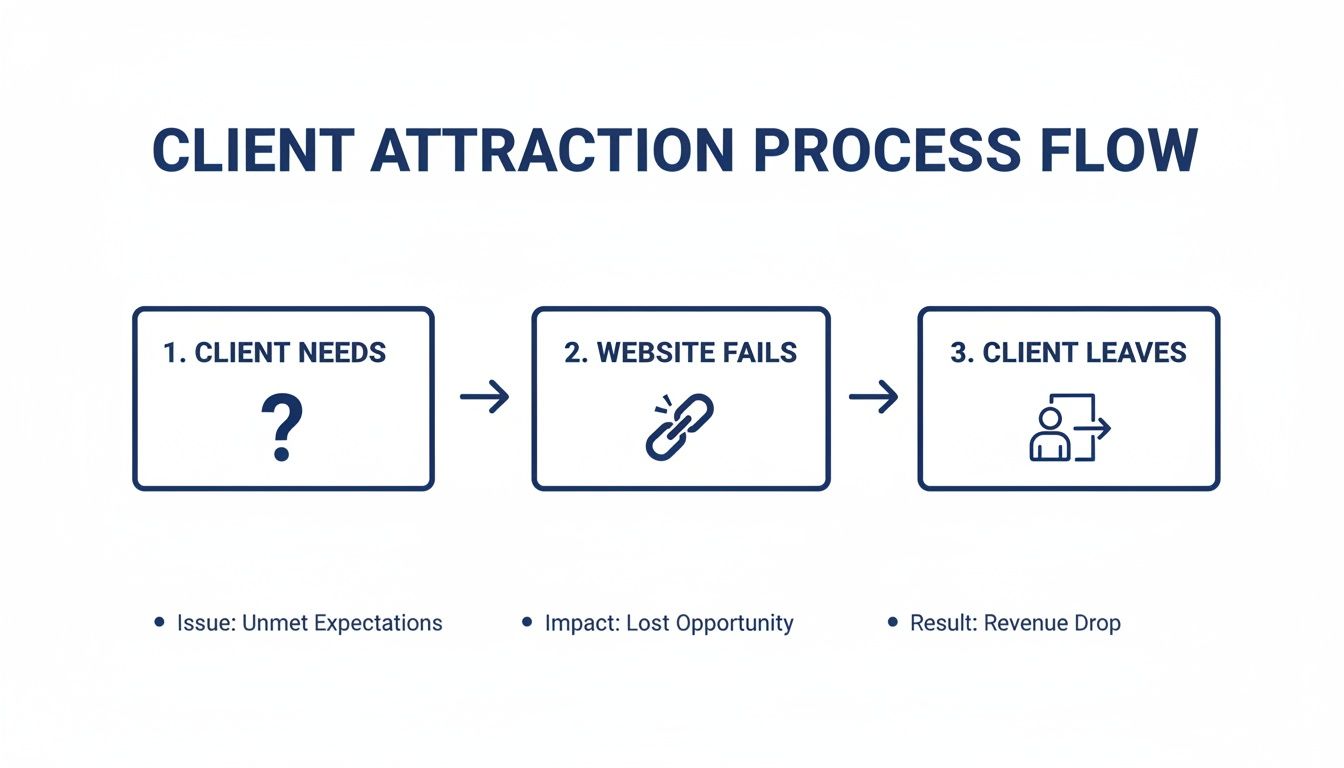
As you can see, a website that doesn’t immediately solve a visitor's problem and offer a clear path forward is a dead end.
Go Beyond Basic Analytics
Numbers only tell part of the story. To understand the why behind the what, you need to see your site through a visitor’s eyes. This is where user behavior tools are indispensable.
Consider using a tool like Hotjar to watch session recordings. These are anonymous recordings of real user visits, showing you exactly where people move their mouse, where they click, and where they get frustrated enough to leave. You might discover that potential clients are repeatedly clicking on an image that isn't a link or can't find your phone number on their mobile device.
These insights are pure gold because they remove all the guesswork. For a deeper dive, exploring tools for automating sales, support, and marketing with Facebook chatbots can also reveal common client questions and pain points that your website fails to address.
I once worked with a family law firm whose contact form submissions were mysteriously low. Session recordings revealed that on mobile, the keyboard completely covered the “Submit” button, making the form impossible to complete for over 50% of their visitors. That was an invisible problem a standard analytics report would never catch.
To get your audit started, here's a checklist covering the essential areas you need to investigate. This will help you systematically uncover the hidden friction points on your website.
Essential CRO Audit Checklist for Law Firms
| Audit Area | What to Check | Tools to Use |
|---|---|---|
| Analytics Review | Top landing pages, high exit rate pages, bounce rates, traffic sources. | Google Analytics, Adobe Analytics |
| User Behavior | Watch session recordings, analyze heatmaps to see where users click. | Hotjar, Crazy Egg, Microsoft Clarity |
| Technical Health | Page load speed (mobile and desktop), check for broken links/404 errors. | Google PageSpeed Insights, GTmetrix |
| On-Page Messaging | Is the value proposition clear? Are headlines compelling and benefit-oriented? | Five-second test (see below), user surveys |
| Calls-to-Action (CTAs) | Are CTAs visible? Is the language clear and action-oriented? | Visual inspection, A/B testing tools |
| Form Analysis | Are forms too long? Do they work on mobile? Are there error messages? | Form analytics tools (in Hotjar), manual testing |
Running through these checks will give you a clear, data-backed roadmap, ensuring that every change you make is targeted at solving a real problem.
Perform a Simple Clarity Check
Your firm’s unique value needs to be understood in seconds. Not minutes.
Try this simple “five-second test”:
- Find someone who knows nothing about your law firm.
- Show them your homepage for exactly five seconds, then close the browser.
- Ask them three simple questions:
- What type of law does this firm practice?
- What makes this firm different or special?
- What is the main thing the site wants you to do?
If they hesitate or can’t answer these questions instantly, your core message is too complicated. Simplifying your headline and primary call-to-action can have a massive impact on keeping visitors engaged and moving them toward a consultation.
Quick Fixes That Deliver Immediate Results

After a full audit, your to-do list is probably packed with big ideas and long-term projects. That's great, but you don't have to wait months to start seeing real improvement.
There are a handful of foundational fixes that can deliver a noticeable lift almost immediately. These aren't complex overhauls; they're the low-effort, high-impact changes that create a better experience for potential clients and start boosting your lead flow right away.
Make Your Website Faster This Week
Think about your ideal client. They're often in a state of distress or urgency. The last thing they have time for is a slow-loading website. Every second they wait is another opportunity for them to hit the "back" button and call your competitor.
The data here is staggering. We've seen that pages loading in just 1 second have conversion rates three times higher than pages that take a sluggish 5 seconds. This isn't a minor tweak—it's a massive multiplier for your case intake. You can find more data on the impact of site speed on conversions on wordstream.com.
Here are a couple of quick wins to tackle site speed now:
- Compress Your Images: Large, unoptimized images are the #1 killer of website speed. Run your photos through a free online tool like TinyPNG to shrink their file size without any noticeable loss in quality. It's a five-minute job.
- Check Your Hosting: If you’re paying a few bucks a month for a basic shared hosting plan, your site is sharing server resources with hundreds of others. It's a recipe for slow performance. Upgrading to a quality managed host or a better plan can make a night-and-day difference.
You can get a quick diagnosis using Google's PageSpeed Insights, a free tool that grades your site's performance and tells you exactly what to fix.
Prioritize the Mobile Experience
A huge number of your potential clients will find you on a smartphone. They might be searching on their lunch break, on the side of the road, or in a moment of immediate need. If your website is a pain to use on their phone, you are actively losing business.
Yes, your site needs to be "responsive"—meaning it automatically adjusts to different screen sizes. But it goes deeper than that. Is the text actually readable without pinching and zooming? Are the buttons big enough for a thumb to tap easily? Can someone find your phone number in two seconds?
If you do only one thing for your mobile site, make sure your phone number is a “click-to-call” link. A visitor must be able to tap that number and instantly start a call. Removing that tiny bit of friction is one of the easiest conversion wins you can get.
Simplify Your Website Navigation
A potential client lands on your site with a specific problem. If they can't figure out how to find information about their legal issue, they'll assume you can't help them. A confusing menu is a dead end.
Take an honest look at your main navigation bar. Is it cluttered with a dozen different links? Does it immediately tell a visitor what you do and who you help?
Pare it down to the absolute essentials. Most high-performing law firm sites stick to a simple, clear structure:
- Home: Your digital front door.
- About Us: Introduce your team, build trust.
- Practice Areas: Clearly list the services you provide.
- Contact: Make it incredibly easy to get in touch.
These fixes might feel basic, but they target the most common points of frustration that cause visitors to leave. By speeding up your site and making it effortless to navigate, you build a foundation of trust before they even pick up the phone. And for those visitors who leave without converting, you may want to learn what is retargeting advertising to bring them back.
Crafting a Message That Builds Unshakable Trust

Fixing technical issues like site speed is a great start, but that just gets a potential client to your digital front door. To actually invite them in, you need to build immediate, unshakable trust. For law firms, trust isn't a feature; it's the entire product.
Your website copy has to do more than just list credentials or practice areas. It needs to connect with someone who is likely stressed, confused, and looking for an advocate. It should anticipate their unspoken questions and reassure them they've finally found the right place.
Move Beyond Generic Clichés
Let's be honest: too many law firm websites sound exactly the same. We've all seen the tired phrases like "we fight for you" or "aggressive representation." They've been used so often they've become meaningless background noise.
The key is to shift your language from what you are to what you do for the client. They aren't just searching for a lawyer; they're desperately looking for a solution to a painful, complicated problem that's taken over their life.
- Instead of: "Experienced Personal Injury Lawyer"
- Try: "Helping Accident Victims Get the Compensation They Need to Rebuild Their Lives"
See the difference? One is a label, the other is a promise. Focusing your messaging on their desired outcome shows you understand what's really at stake. This approach is a cornerstone of effective content marketing for law firms, where every piece of content works to build authority and trust.
Strategically Showcase Your Credibility
Social proof is your single most powerful tool for building instant credibility online. Visitors are actively hunting for signals that you are a legitimate, respected, and, most importantly, successful firm. Don't make them dig for it.
Research shows that website visitors who interact with reviews and testimonials are 58% more likely to convert. That isn't just a statistic—it shows how heavily people rely on others' experiences when the stakes are high.
Sprinkle these trust signals prominently across your site, especially on the homepage and your most important practice area pages.
Essential Trust-Building Elements:
- Client Testimonials: Use real quotes from actual clients. Adding a first name and even a photo (with their permission, of course) makes the testimonial feel so much more authentic.
- Case Results: Highlight significant verdicts and settlements. Just be sure to follow all ethical guidelines by providing proper context and never guaranteeing future results.
- Professional Awards & Badges: Logos from Super Lawyers, Avvo, your local Bar Association, or other legal organizations are powerful visual shortcuts. They instantly signal expertise and peer recognition.
Humanize Your Firm to Make a Real Connection
At the end of the day, people hire people—not faceless corporate entities. This is doubly true when they're facing a personal legal crisis. Your website has to break down that wall and show the human side of your team.
Start by getting rid of the generic stock photos. Invest in high-quality, professional headshots of your actual attorneys and staff. A single warm, approachable photo can do more to ease a visitor's anxiety than a whole paragraph of text.
Your "About Us" page is another goldmine. Don't just list where everyone went to law school. Tell the story of why the firm exists. What's your mission? Sharing what genuinely drives your passion helps potential clients see the people they'll be working with, making that first call feel a lot less intimidating.
Turning Clicks Into Consultations
All the hard work you've put into your messaging and building trust comes down to this one make-or-break moment: turning a passive visitor into an active lead. This is where you have to convert interest into a concrete action.
Unfortunately, it's also where countless law firm websites drop the ball by creating pointless friction right at the finish line.
The contact form is usually the biggest culprit. A potential client is ready to reach out, but they're hit with a massive, intimidating form asking for every single detail about their case. That immediately causes hesitation. For that initial contact, all you really need is a name, email, and phone number to get the ball rolling.
I’ve seen law firms boost their form submissions by over 30% just by cutting out the unnecessary fields. Your first goal isn't to get their entire case history; it's to start a conversation.
Simplify your forms. Lower the barrier to entry and make it incredibly easy for someone to take that crucial first step.
Crafting Calls-to-Action That Actually Convert
Your call-to-action (CTA) button is probably the single most important button on your entire website. And yet, so many firms default to lazy, uninspired phrases like "Submit" or "Contact Us." They're passive and do nothing to communicate real value.
A great CTA uses specific, action-oriented language that lines up with what the potential client is trying to accomplish. It needs to feel like the next logical step, not just a command. A powerful CTA should finish the sentence, "I want to…"
This small change in wording frames the action as a direct benefit to them. We go much deeper into this in our guide on powerful lead generation for lawyers.
To put this into practice, here are some examples of how to transform generic CTAs into high-converting ones for different legal fields.
High-Converting CTA Examples for Law Firms
| Practice Area | Generic CTA | High-Converting Alternative |
|---|---|---|
| Personal Injury | Submit | Get My Free Case Evaluation |
| Family Law | Contact Us | Schedule a Confidential Consultation |
| Criminal Defense | Send | Request a Free Legal Defense Review |
| Estate Planning | Learn More | Start Building My Free Estate Plan |
| Immigration Law | Inquire Now | Check My Eligibility for a Visa |
| Bankruptcy | Get Help | See If I Qualify for Debt Relief |
Notice how the alternatives are specific, value-driven, and directly address the user's immediate need. This small shift can make a huge difference in your conversion rates.
Capturing Hesitant Visitors with Live Chat
Let's be real—not every visitor is ready to fill out a form or pick up the phone. Some people just have a quick question or aren't ready to commit to a formal consultation just yet. This is where a live chat feature becomes an absolute game-changer.
Live chat gives potential clients an immediate, low-pressure way to get answers from a real person. You can have it staffed by a paralegal, an intake specialist, or even a professional legal answering service.
This simple tool is incredible for engaging visitors who would otherwise just leave your site. By answering a simple question like, "Do you handle cases in my city?", you can smoothly guide a hesitant prospect right into your intake process. You just captured a lead that would have been lost forever.
Your Top CRO Questions, Answered
When I talk to law firms about conversion rate optimization, the same questions almost always pop up. Most attorneys are worried it’s too complex or that they don’t have enough time, but the truth is, small, focused changes can make a huge impact.
Let's dig into some of the most common concerns I hear.
"How Much Website Traffic Do I Need to Start?"
This is a big one. You don't need a flood of visitors to get started. While having thousands of visitors a month lets you run A/B tests faster, firms with more modest traffic can still get incredible insights. Tools like heatmaps and session recordings show you exactly where people are getting stuck, no matter how many visitors you have.
"Isn't This Going to Be Expensive?"
It absolutely doesn't have to be. Many of the best CRO tools have free versions that are more than powerful enough to get you started. Think Google Analytics, Hotjar, and Google Optimize. The goal here is to make decisions based on data, not to sink your budget into fancy software you don't even need yet.
What Is a Good Conversion Rate for a Law Firm?
This is the million-dollar question, but there's no single right answer. It completely depends on your practice area. A "good" rate for a high-volume personal injury firm might be 2-4% for contact form submissions. But for a corporate law firm closing multi-million dollar deals, even a 1% conversion rate could be a massive win.
Instead of getting hung up on an industry benchmark, focus on your own numbers. If you're currently converting at 0.8%, a great initial goal is to push that to 1.2%.
Your most important metric is your own progress. A consistent upward trend means you're turning more visitors into potential clients, and that's what directly grows your firm.
How Do I Know If My Changes Are Actually Working?
This is where the rubber meets the road. Making changes without measuring the outcome is just guessing. You need a rock-solid way to track your results.
This starts by setting up specific goals in Google Analytics for every important action a visitor can take—filling out a form, clicking to call your office, or engaging with your live chat. When you track these micro-conversions, you can draw a straight line between the changes you made and the results you're getting.
Truly understanding how to measure advertising effectiveness and on-site tweaks is the difference between hoping for growth and building a predictable system for it. This data-first approach is how you turn your website from a digital brochure into a client-generating machine.
At Case Quota, we specialize in turning law firm websites into powerful client acquisition engines. If you're ready to stop guessing and start getting measurable results, learn more about our data-driven marketing strategies at https://casequota.com.