
When most lawyers think about getting new clients online, their minds immediately jump to Google. And for good reason—it’s where people go when they have a problem and need an answer now. But what if you could reach them before they even type that frantic "divorce lawyer near me" search?
That’s where Facebook advertising comes in. It flips the script entirely. Instead of waiting for a potential client to find you, you find them. It’s a proactive strategy that connects you with a massive audience that isn't actively looking for legal help but desperately needs it.
Why Facebook Ads Are a Game Changer for Law Firms
I get it. Most attorneys see Facebook as a place for vacation photos and political arguments, not a serious client acquisition tool. That perception is costing firms a fortune in missed opportunities.
While Google Ads are fantastic for capturing "search intent," Facebook targets users in the "discovery" phase. Think about the subtle signals people give off online long before they realize they need a lawyer. No one posts a status update announcing they need to file for bankruptcy, but their online behaviors, life events, and interests paint a pretty clear picture. Facebook's algorithm is designed to read that picture with stunning accuracy.
Reaching Clients Before the Search Begins
Imagine being able to put your firm in front of people who recently changed their relationship status to "separated." Or those who are members of motorcycle enthusiast groups and have been engaging with content about biker safety. Or even users whose online behavior indicates they recently visited a local hospital.
This is the real power of Facebook ads for law firms. You get to introduce your firm as a helpful resource right when a problem is bubbling to the surface. It’s about building brand awareness and trust before they ever hit Google, giving you a massive head start on the competition.
The numbers don't lie. A staggering 82% of law firms with a social media presence are on Facebook, making it the legal industry's go-to platform. And when it comes to paid ads, 28% of firms actually prefer Facebook Ads over Google Ads.
Facebook Ads vs Traditional Legal Marketing
To put this into perspective, let's see how Facebook stacks up against the old-school marketing channels many firms still rely on. The difference in precision and cost-effectiveness is night and day.
| Metric | Facebook Ads | Local TV/Radio | Print/Billboards |
|---|---|---|---|
| Reach | Hyper-targeted to specific demographics, interests, and life events. | Broad, untargeted audience in a specific geographic area. | Very broad, location-based exposure with zero demographic targeting. |
| Cost | Highly controllable budget (from $5/day) with clear ROI tracking. | Extremely high production and airtime/space costs. | High cost for placement, difficult to measure direct impact. |
| Targeting | Pinpoint precision: age, location, income, job title, recent life events. | None beyond general time slots or station/publication audience. | None beyond the physical location of the ad. |
As the table shows, the ability to zoom in on your ideal client is what truly sets Facebook apart. You're not just casting a wide net and hoping for the best; you're using a laser-guided system.
A Different Kind of Client Connection
This isn’t just about running ads; it’s about starting a conversation. By offering valuable content—like an article on "5 Things to Do After a Car Accident"—you position your firm as an authority and a trusted guide. You’re not just another name on a billboard; you're the firm they remember seeing when they first started worrying about their situation.
For a deeper look into this, check out these specific advertising strategies for law firms.
The key takeaway is simple: Facebook allows you to find clients who need you but don't know it yet. It turns passive social media scrolling into an active lead generation channel for your specific practice areas.
Once you grasp this fundamental shift from search to discovery, you open up a powerful new channel for growing your firm. Our comprehensive guide on social media advertising for lawyers dives even deeper into building a winning strategy from the ground up.
Building Your Foundation for a Winning Campaign
Jumping straight into Facebook Ads Manager without a solid plan is like walking into a courtroom without preparing your case—it’s a recipe for burning through your budget with nothing to show for it. I’ve seen it happen time and again. A successful Facebook advertising for lawyers campaign begins long before you ever click "publish." It starts with a clear strategy, built on concrete goals and a real understanding of who you're trying to reach.
First things first, you have to define what a "win" actually looks like for your firm. Are you aiming to book five new personal injury consultations every week? Or maybe your goal is to get your firm’s name out there for a new estate planning division in a specific county. Vague goals like "getting more leads" just don't cut it.
Your goal dictates every single decision you'll make, from the words you use in your ad to how much you're willing to spend to get a click. Be specific.
Defining Your Ideal Client
Once you know what you want to achieve, you have to know who you're talking to. This means creating an "ideal client avatar," and it's more than just listing age and location. We need to get into their heads—their worries, what motivates them, and where they spend their time online.
Think about it in practical terms:
- For a family law firm: Your target might be "Sarah," a 38-year-old mother of two. She's been reading articles on co-parenting and just recently joined a few Facebook groups for single parents. She's worried about her kids' future and looking for a compassionate, but firm, advocate.
- For a business litigation practice: You might be looking for "David," a 45-year-old small business owner in Los Angeles who follows pages like Inc. and Entrepreneur. He's probably shown interest in financial software and is concerned about protecting the business he's built.
When you know these details, you can craft messages that actually connect. Your ad stops being an annoying interruption and starts feeling like a timely solution.
Technical Must-Haves for Success
With your strategy mapped out and your client avatar in mind, it's time to get the technical pieces in place. This is a non-negotiable step where many firms drop the ball. You absolutely need two things: the Facebook Pixel and a dedicated landing page.
The Facebook Pixel is a simple snippet of code that you install on your website. It's your tracking device, letting you see exactly which ads are leading to contact form submissions or phone calls. Without it, you're just guessing. You have no real way to prove your return on investment.
Just as critical is where you send people who click your ad. Never, ever send them to your generic homepage. It’s a huge and costly mistake. You need a high-converting landing page built specifically for that ad campaign. This page needs a single, clear call-to-action and copy that speaks directly to the client's problem. Our guide on website optimization for law firms dives deeper into creating pages that actually turn visitors into leads.
Here’s a simple visual of how this all works together, taking a user from seeing your ad to becoming a potential client.
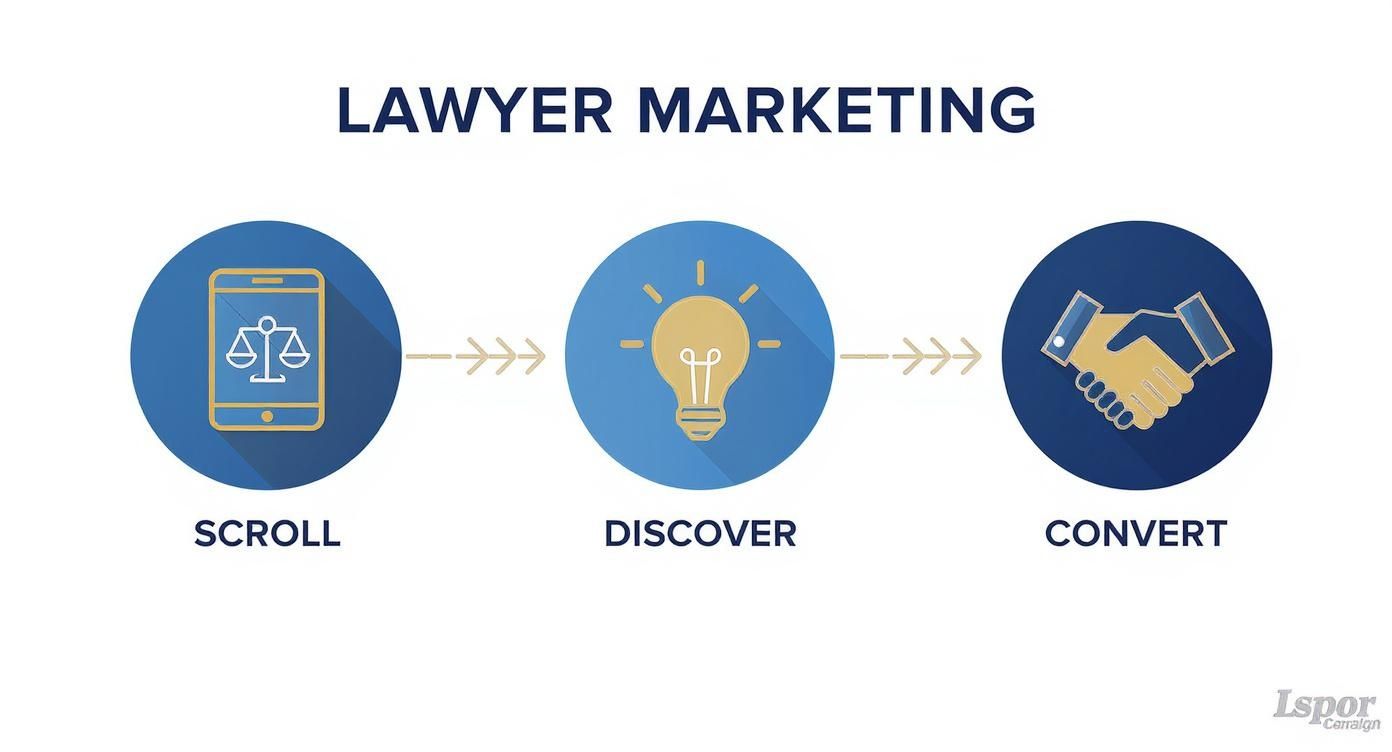
This whole process has to be seamless. As you get these foundational pieces set up, you'll also want to think about how to grow your efforts efficiently. For a really deep dive into managing multiple campaigns as you grow, this ultimate guide to scaling Facebook and Instagram ad campaigns is an excellent resource to have bookmarked.
Finding Your Ideal Clients Through Masterful Audience Targeting
Successful Facebook advertising for lawyers isn’t about casting the widest net possible. It’s about precision. It's about reaching the right people, and this is where Facebook's platform really shines. It lets you go way beyond basic demographics to pinpoint your ideal clients with surgical accuracy, so you stop wasting your budget on people who will never need your services.
The platform's real power is its ability to find users based on their behaviors, interests, and major life events—often before they even realize they need a lawyer. This is a complete game-changer, shifting you from passively waiting for a Google search to proactively finding your next client.

Unlocking the Power of Lookalike Audiences
One of the most potent tools in your advertising arsenal is the Lookalike Audience. The concept is brilliant in its simplicity: you upload a list of your past or current clients (an email or phone number list works great), and Facebook’s algorithm gets to work. It analyzes their shared characteristics—demographics, online behaviors, interests—and then builds a new audience of people who are remarkably similar.
Essentially, you're turning your existing client base into a roadmap for future growth. You’re telling Facebook, "Go find me more people just like my best clients." The result is a pre-qualified audience that is statistically much more likely to need your specific legal services.
Pro Tip: For the best results, use a client list of at least 1,000 to 5,000 contacts. This gives the algorithm enough data to spot meaningful patterns and build a truly potent Lookalike Audience. You can use a smaller list, but bigger is almost always better for accuracy.
Targeting by Practice Area: Real-World Scenarios
Let's get practical. The secret is to think like your potential client and look for the digital breadcrumbs they leave behind.
-
For a Personal Injury Firm: Don't stop at age and location. Layer on interests like "motorcycle clubs," "Harley-Davidson," or "cycling." Think even more strategically: you can target users who have recently interacted with content from local hospitals or auto repair shops, which could signal a recent accident.
-
For a Family Law Practice: Go deeper than just "married." Target users whose relationship status recently changed to "separated" or "divorced." You can also find individuals who show interest in pages about "co-parenting," "divorce support groups," or "child custody." These are strong indicators.
-
For an Estate Planning Attorney: Life event targeting is your gold mine. Zero in on users who are "newly engaged," "newly married," "new parents," or have an anniversary coming up in the next 60-90 days. You can also target by job titles common among high-net-worth individuals or people who show an interest in financial planning topics.
The Magic is in the Layers
This is where it all comes together. The real power move is to layer these targeting options. For example, an estate planning attorney could build an audience of users who are both "new parents" and show an interest in "personal finance." This simple combination can shrink a massive, generic audience of millions down to a few thousand highly relevant individuals.
This level of detail ensures your ad budget is aimed squarely at those most likely to become a client, making your campaigns incredibly efficient. Getting this right is a cornerstone of effective lead generation for lawyers, because you’re filling your pipeline with qualified prospects right from the start.
When you master these targeting techniques, your message doesn't just get seen—it gets seen by the right person, at the right time. This strategic approach transforms Facebook from a social network into a powerful client acquisition machine for your firm.
Crafting Ads That Convert While Staying Compliant
Great targeting gets your ad in front of the right people, but it’s the creative that makes them actually stop scrolling and pay attention. A successful ad in the legal space has to do three things at once: grab attention, build immediate trust, and push for action—all while navigating a minefield of advertising rules.
The secret? Shift your focus from what your firm does to what your potential client is experiencing.
Your ad copy needs to speak directly to a person's pain points using clear, empathetic language. Ditch the confusing legal jargon. Instead of "tenacious legal representation for matrimonial disputes," try something like, "Feeling overwhelmed by the divorce process? We can help you find a clear path forward." This approach connects on a human level and shows you actually get it.
Balancing Visuals and Messaging
The images and videos you choose are just as critical as the words. A stuffy headshot or a generic stock photo of a gavel might feel safe, but they’re also completely invisible in a crowded newsfeed.

Here's what works better:
- Authentic Video: A short, sincere video of an attorney explaining a common legal question can build immense trust. It puts a face to the name.
- Real-World Images: If you stick with static images, aim for authenticity. A photo of your team working together feels far more approachable than a formal, stiff portrait.
The goal is to appear both professional and human. Potential clients are often in a vulnerable state; your ad should offer reassurance and competence, not intimidation. Finding that balance is everything.
The Non-Negotiable Rules of Ethical Compliance
Navigating the ethical rules of Facebook advertising for lawyers isn't optional. Getting it wrong can lead to serious consequences, including sanctions from your state bar.
Every single ad must be truthful and not misleading. This means you can't even hint at a guaranteed outcome. Words like "promise," "guarantee," or "best" need to be permanently removed from your advertising vocabulary.
Most states also require a clear disclaimer, like "This is an advertisement" or "Advertising Material." You also have to be extremely careful with client testimonials and past case results, as those are heavily regulated. For a deeper dive, our guide to navigating ethical attorney advertising rules is an essential read.
By pairing powerful copy and visuals with a strict adherence to ethical guidelines, you can create a campaign that doesn't just generate leads but also upholds your firm's professional integrity.
Smart Budgeting and Bidding to Maximize Your ROI
Let's get into the numbers behind a profitable Facebook ad campaign. Setting the right budget and picking a smart bidding strategy are what separate the firms getting a real return from those just burning through cash. The goal isn't just to get leads; it's to acquire signed cases at a cost that makes sense for your bottom line.
A lot of lawyers think you need a massive budget right out of the gate, but that's a common mistake. A realistic starting point of $50 to $100 per day is plenty for a small or solo firm to start testing. This lets you gather crucial data on which audiences and ads are actually working before you even think about scaling up.
Choosing the Right Bidding Strategy
Facebook gives you a few ways to bid for ad placements, but for law firms, two strategies really stand out. Knowing when to use each one is the key to keeping your costs under control while hitting your goals.
Here’s a quick breakdown:
- Lowest Cost (Highest Volume): This tells Facebook, "Get me the most leads you can within my budget." It’s perfect when you're just starting out and need to collect data as quickly as possible. The only downside is that your cost per lead can fluctuate a bit.
- Cost Cap: This is where you tell Facebook the absolute maximum you're willing to pay for a result, like a form submission. It gives you much more control over your cost-per-lead (CPL) and is ideal for firms that have already figured out their target acquisition cost.
For example, a personal injury firm might run on a "Lowest Cost" strategy for a couple of weeks to see what their average CPL shakes out to be. Once they see leads are consistently coming in around $45, they can confidently switch to a "Cost Cap" strategy and set the cap at $50 to lock in their profitability.
Shifting Focus From CPL to Cost-Per-Signed-Case
The single most important number in your campaign isn't your cost-per-lead; it’s your cost-per-signed-case. A campaign that generates leads for $20 a pop is completely useless if none of them ever convert into actual clients. You'd be far better off paying $100 for a lead that has a high probability of signing a retainer.
The real measure of success is connecting your ad spend directly to revenue. It requires a shift in mindset from chasing cheap leads to investing in high-quality opportunities that grow your firm.
This is where Facebook advertising truly shines from a cost perspective. It gives law firms a much more affordable alternative to traditional PPC channels like Google Ads. While a single click for a competitive keyword on Google can easily cost $100 or more, Facebook can generate qualified leads for a fraction of that. We've seen well-run campaigns bring in leads for under $20.
Ultimately, tracking this metric is what it's all about. You can learn more about measuring advertising effectiveness to make sure your budget is driving real growth. Smart budgeting isn't about spending less—it's about making informed financial decisions that directly contribute to your firm's success.
Common Questions About Facebook Ads for Law Firms
Jumping into Facebook advertising brings up a lot of valid questions, especially for lawyers who have to navigate a maze of ethical rules and professional standards. Getting straight, practical answers is the only way to move forward with confidence and build a campaign that actually brings in cases without damaging your firm’s reputation.
Let's tackle some of the most common questions we hear from attorneys before they get started.
How Can I Ensure My Facebook Ads Comply With Bar Association Rules?
This is the big one, and for good reason. Compliance is non-negotiable. The first step, always, is to dig into your specific state bar’s advertising guidelines. They're all different, but some core principles are pretty much universal. You have to steer clear of any language that sounds misleading or, even worse, guarantees an outcome.
It's also standard practice to include a clear disclaimer, something as simple as "Advertising Material." If you're thinking about using client testimonials (which can be incredibly powerful), you absolutely must get written consent and ensure they are presented truthfully, without any embellishment.
The smartest, safest move you can make is to have all your ad creative—the copy, the images, the videos—reviewed by a legal marketing ethics expert before you launch. A small investment upfront can save you from a massive headache later.
Getting that expert sign-off ensures your Facebook advertising for lawyers strategy is built on a solid, ethical foundation from the get-go.
Which Practice Areas Get the Best Results on Facebook?
Some practice areas just naturally perform better on a platform like Facebook, mainly because of how people use it. Think about it: Facebook is a discovery-based platform. People aren't necessarily searching for a lawyer, but they are open to seeing a solution to a problem they're facing.
This is why consumer-facing legal services tied to major life events tend to get the most traction. We consistently see strong results in areas like:
- Family Law: Divorce and child custody are deeply personal. People often research their options quietly and privately online before ever picking up the phone.
- Personal Injury: An accident is a sudden, jarring event. The individuals involved, or their families, often turn to social media for immediate information, support, and recommendations.
- Bankruptcy: Financial trouble is another sensitive topic. People will often look for advice and solutions in a less direct way before making that official call to a law firm.
- Estate Planning: Getting married, having a baby, buying a home—these are the moments that prompt people to start thinking about their long-term plans and protecting their family's future.
On the other hand, highly specialized B2B legal services—think international patent litigation or complex corporate mergers—are usually a much tougher sell to a broad Facebook audience.
What Is the Best Way to Handle Negative Comments on My Ads?
Your first instinct might be to just hit "delete," but that can backfire and make you look like you're hiding something. Unless a comment is obvious spam or uses abusive, hateful language, you should never ignore it.
First, respond publicly with a professional and empathetic tone. You don't need to get into the weeds of their complaint. A simple, "We're sorry to hear you had this experience. Please contact our office directly so we can better understand and address your concerns," works wonders. It shows everyone else reading the comments that you're accountable and responsive.
After that public post, your next move is to take the conversation private. Shift the discussion to a phone call, email, or direct message. This protects everyone's privacy and lets you have a real conversation to resolve the issue. It's surprising, but a negative comment handled with grace can actually build more trust with potential clients than an ad with no comments at all.
At Case Quota, we specialize in creating compliant, high-performing digital marketing strategies that connect law firms with the clients who need their help. If you're ready to grow your firm with a team that gets the legal world, visit us at Case Quota to learn more.