

Attorney content marketing isn't just about churning out blog posts. It's the strategic process of creating genuinely helpful online content—articles, videos, guides—that answers the real questions your potential clients are asking. The goal? To build trust and establish your firm as the go-to authority, which naturally leads to more qualified cases. This is a non-negotiable part of any serious law firm marketing strategy today.
Building Your Client Attraction Foundation

Forget the generic advice you’ve read on a dozen other legal marketing blogs. Real, effective content marketing isn't about random acts of publishing. It’s about building a solid foundation designed to attract the right clients, consistently.
This work starts long before you ever write a single headline. It begins with an almost forensic understanding of who you want to represent. Learning how to properly develop a content marketing strategy is what separates the firms that get sporadic traffic from those that generate a predictable stream of high-quality leads. Let's move from a scattershot approach to a deliberate, client-focused system.
Define Your Ideal Client with Surgical Precision
First things first: you need to create a detailed Ideal Client Persona (ICP). And no, I don't mean just jotting down basic demographics like age or income. A truly powerful ICP for a law firm gets into the psychographics—the anxieties, goals, and specific questions that keep a potential client up at night.
Get granular. Ask yourself the questions that really matter:
- What exact phrases are they typing into Google? Think "how to contest a will" versus a generic search for "estate lawyer." The difference is huge.
- What is their single biggest fear related to this legal issue? Is it losing their home? Damaging their professional reputation?
- What do they really want from an attorney? Aggressive, bulldog representation? Or compassionate, steady guidance?
- Where are they already looking for answers online? Are they on specific local forums, reading the city's news site, or scrolling through LinkedIn?
Answering these questions allows you to craft content that speaks directly to their pain points, making them feel heard and understood before they ever dial your number. A personal injury firm, for example, would have far more success with an article on "how to pay medical bills after a car accident" than another generic post about negligence.
Key Takeaway: Your content needs to feel like the answer to a question someone is desperately asking. When you map out your ideal client's emotional and practical journey, you can create touchpoints that build unshakable trust.
To help you get started, here's a worksheet designed to put you in your ideal client's shoes. Fill this out for each practice area you serve.
Ideal Client Persona Worksheet for Attorneys
A framework to help law firms define their target audience by outlining key demographic, psychographic, and behavioral traits.
| Attribute | Guiding Questions | Example (Personal Injury Client) |
|---|---|---|
| Demographics | Age, gender, location, occupation, income, family status? | Maria, 42, married with two kids, lives in a suburb of Dallas, works as a project manager, household income of $120k. |
| Pain Points & Fears | What is their immediate problem? What are they most afraid of? What keeps them up at night? | Rear-ended on the highway. Immediate pain, missed work. Fears mounting medical bills, dealing with insurance adjusters, and not being able to provide for her family. |
| Goals & Motivations | What does a successful outcome look like for them? What do they want to achieve? | Wants her medical bills covered, lost wages reimbursed, and fair compensation for her pain. Her primary motivation is to get her life back to normal. |
| Watering Holes | Where do they get information online? Social media platforms, forums, news sites, influencers? | Active on Facebook community groups, reads the local newspaper's website, might search WebMD for her symptoms, and looks at reviews on Google and Avvo. |
| Search Behavior | What specific questions or phrases are they typing into Google? | "Dallas car accident lawyer," "what to do after a rear-end collision," "how much is my injury claim worth," "neck pain after car accident." |
Take the time to do this right. A well-defined persona is the bedrock of a content strategy that actually generates cases.
Translate Client Insights into a Powerful Brand Voice
Once you know who you’re talking to, you can figure out how to talk to them. Your brand voice is your firm's personality, and it needs to be rock-solid consistent across your website, blog, and social media.
Are you authoritative and direct? Reassuring and empathetic? A pragmatic mix of both? This voice must show up everywhere. Consistency builds familiarity and trust—two of the most critical factors when someone is choosing a lawyer. Today’s legal clients are searching for a human connection, not just a list of credentials.
This isn’t just a hunch; the data backs it up. An astounding 96% of people seeking legal advice start with a search engine, and a huge chunk of them do extensive online research before ever making contact. This foundational work isn't optional if you want to grow.
Establish Your Technical Groundwork
Finally, even the best content in the world will fail if it's built on a shaky technical platform. This means ensuring your firm's website is set up for success from the ground up.
There are two non-negotiables here: a clean SEO structure and full ADA compliance.
A well-structured site makes it incredibly easy for Google to crawl and index your pages, which dramatically improves your chances of ranking for those high-value keywords. At the same time, making your website accessible to people with disabilities (ADA compliant) is not only the right thing to do, but it also opens your doors to a wider pool of potential clients. This technical groundwork ensures your brilliant content actually gets seen.
Creating Legal Content That Actually Ranks

Effective content marketing for attorneys isn't about just having a blog. It’s a deliberate process—creating specific pieces of content that answer the exact questions your ideal clients are typing into Google when they desperately need help.
This is where your legal expertise meets the science of search engine mechanics.
The goal isn't just to write. It's to build resources so genuinely helpful that they become the go-to answer for a potential client's problem. This is how you build authority, earn trust, and, most importantly, drive qualified leads straight to your firm.
Uncovering High-Intent Keywords
Everything begins with getting inside the head of a potential client. You need to understand the exact words they use when they're worried, confused, and searching for answers. They aren't Googling "tortious interference"; they're searching for things like "can a competitor steal my biggest client?"
Your focus should be on high-intent, long-tail keywords. These are the longer, more specific phrases that signal someone is getting close to making a decision.
- Informational Keywords: These are your top-of-funnel queries. Think "what is the statute of limitations for car accidents in California?" Answering these positions you as the expert.
- Transactional Keywords: This is where the money is. Phrases like "personal injury lawyer for truck accidents near me" or "hire a criminal defense attorney for DUI" show an immediate need. Your most important service pages have to be laser-focused on these terms.
Targeting these specific queries is the difference between casting a giant net and catching a bunch of junk, and using the right bait to land the exact fish you want.
Your best content ideas come directly from your clients. Listen closely to the questions they ask in consultations. If one person is asking you, you can bet hundreds more are asking Google.
Mapping Keywords to the Client Journey
Once you have a solid list of keywords, you need to map them to the different stages of a client's journey. Not everyone who lands on your website is ready to call you. Your content has to meet them where they are.
This strategic mapping ensures you have content that nurtures someone from their first "what if?" search to their final decision to hire you. This thoughtful approach is central to any successful https://casequota.com/content-marketing-law-firms-guide/ and is absolutely essential for turning website traffic into actual cases.
| Client Journey Stage | Client Mindset | Example Keyword | Content Type |
|---|---|---|---|
| Awareness | "I have a problem, but I don't know what to do." | "symptoms of whiplash after accident" | Blog Post, Infographic |
| Consideration | "I need a professional. What are my options?" | "how to choose a personal injury lawyer" | Detailed Guide, Comparison Page |
| Decision | "I'm ready to hire. Who is best for my case?" | "best car accident attorney in Santa Monica" | Service Page, Case Studies |
Crafting a Comprehensive Content Brief
Never, ever start writing without a plan. A content brief is your blueprint. It's a detailed set of instructions that ensures every piece of content is comprehensive, optimized for search, and perfectly aligned with your firm's goals. Think of it as the instruction manual for your writer—even if that writer is you.
A good brief should always include:
- Primary & Secondary Keywords: The main search term and a handful of related phrases.
- Target Audience: A quick snapshot of the Ideal Client Persona this is for.
- Key Questions to Answer: Pull these directly from the "People Also Ask" section in Google.
- Proposed Structure: A rough outline of H2s and H3s.
- Internal Linking Opportunities: Notes on which of your other pages to link to.
Putting in this work upfront saves countless hours on the back end and dramatically increases the odds that your content will actually rank. It forces strategic thinking before a single word is typed. And as you start using AI to assist, understanding what search engines actually prioritize is critical. To get ahead, it helps to know the key ChatGPT ranking factors that can help you refine your briefs for much better performance.
Smart Content Distribution for Maximum Reach

Creating an authoritative, well-researched article is a huge lift. But let's be clear: hitting "publish" is the starting line, not the finish. The most brilliant legal analysis is useless if it never reaches the people who desperately need it.
This is where smart distribution comes in. It’s how you turn that content investment into actual phone calls and signed retainers.
This isn’t about just blasting links everywhere and hoping something sticks. It's a calculated strategy to place your expert insights directly in front of ideal clients, referral sources, and the local community. Think of it as building multiple roads that all lead back to your firm. A solid multichannel approach ensures your message isn't just a shout into the void—it's a conversation happening exactly where your audience already is.
Dominate Local Search with Your Google Business Profile
For most law firms, local visibility is everything. Your Google Business Profile (GBP) is, without a doubt, your most powerful free marketing tool, and it absolutely thrives on fresh content.
Gone are the days when GBP was a static, digital business card. It's now an active, dynamic platform for client engagement. Your goal is to use every single feature Google gives you. This creates powerful local signals that tell the search algorithm you’re an active, authoritative voice in your city.
- Google Posts: Get in the habit of sharing regular updates that link back to your latest blog posts. Frame them as immediately useful tips. A family law firm might post, "Considering a prenup? We break down the key things you must discuss in our latest guide."
- Q&A Section: Don't wait for people to ask. Proactively populate this section by asking and answering the common questions you hear from clients every single day. Think of it as a mini-FAQ right there on the search results page. Answering "How long does probate take in California?" establishes immediate expertise.
- Services and Products: Get granular. Instead of just listing "Personal Injury," break it down into "Car Accidents," "Truck Accidents," and "Slip and Fall Cases," each with detailed descriptions and a link to its corresponding service page.
Consistent activity on your GBP is a non-negotiable part of modern attorney marketing. It directly impacts your ranking in the coveted "Map Pack," which is where your most qualified local leads come from.
Use Social Media for Authority, Not Just Clicks
Most attorneys get social media completely wrong. They drop a link with a boring, generic caption and call it a day. If you want to build a real brand, you have to use platforms like LinkedIn to share genuine insights, not just to broadcast your latest article.
Here’s how to do it right. Instead of just posting the link to your piece on "5 Estate Planning Mistakes," pull out one of those mistakes. Write a short, insightful post explaining that single point and why it's so critical. Then, you can add, "This is just one of the common pitfalls we cover in our full guide, which you can read here."
This simple shift reframes you from a content promoter to a genuine expert who is actively sharing valuable knowledge. It invites discussion, which the platform's algorithm rewards with far greater reach.
This is a core pillar of any successful multichannel marketing for law firms strategy, making sure every channel is actively building your authority.
Turn Readers Into Leads with Email Nurturing
Think about it: someone who just read your entire 2,000-word blog post on "DUI defense strategies" is an incredibly warm lead. They have a specific, urgent problem, and they've already spent time with your expert advice.
An email nurture sequence is how you gently guide them from reader to client without being pushy or salesy.
Set up a simple automated sequence for anyone who downloads a guide or subscribes to your list:
- Email 1 (Immediate): Delivers the resource they asked for and a simple thank you.
- Email 2 (2 Days Later): Offers a related piece of content, like a short video or another relevant article.
- Email 3 (4 Days Later): Shares a client success story or case study related to their area of interest.
- Email 4 (7 Days Later): A soft call-to-action inviting them to a no-obligation consultation to discuss their specific situation.
Unlock a Wider Audience Through Syndication
One of the most powerful and underutilized tactics out there is content syndication. This means republishing your articles on larger, reputable legal or news websites.
Doing this exposes your firm to a massive, pre-built audience and can generate powerful backlinks that boost your own site's authority. Look for legal industry publications, local news sites with community contributor sections, or platforms like JD Supra.
This is a huge opportunity. A staggering 64% of law firms do not syndicate their content at all. That oversight is your competitive advantage. It's a clear opening for you to amplify your reach and dominate the conversation while everyone else is just talking to themselves.
Using AI and Paid Ads to Accelerate Growth
Let's be honest: building organic traffic is a long game. It's an incredibly powerful asset, but it doesn't happen overnight. If you need to see results sooner, you can dramatically shorten the timeline by intelligently layering AI and targeted paid advertising into your content strategy.
Think of AI not as a replacement for your legal mind, but as the most efficient marketing paralegal you've ever had. Its real power is in tackling the repetitive, time-sucking tasks that bog down most attorneys. This frees you up to focus on high-value strategy and, of course, practicing law.
AI as Your Content Workflow Accelerator
The goal here is efficiency, not abdication of your expertise. You are the legal authority; AI is just the tool that helps you scale that authority. Relying on it to write full articles is a huge mistake—potential clients can spot generic, robotic content a mile away, and it instantly shatters the trust you're trying to build.
Instead, get surgical. Use AI for specific, targeted tasks within your existing workflow:
- Brainstorming and Topic Expansion: Give it a core topic like "commercial lease disputes" and ask for ten specific blog titles a small business owner would actually type into Google.
- Structuring Your Thoughts: Provide your target keyword and a quick description of your ideal client. Then, ask for a structured blog post outline with H2s and H3s. This gives you a solid blueprint to fill in with your own case stories and insights.
- Repurposing with a Click: Paste the text from a finished article and ask it to generate five engaging LinkedIn posts, each highlighting a different key takeaway.
- Breaking the Blank Page: Use it to draft the more straightforward, foundational sections of an article. From there, you can go in and heavily edit, infuse your firm's unique voice, and add the real-world examples that only you can provide.
This approach keeps your firm’s authentic voice and deep experience front and center, while AI handles the grunt work.
Pouring Fuel on the Fire with Paid Amplification
Once you see a piece of content starting to get traction on its own, you're holding a proven asset. You know the topic resonates, the headline grabs attention, and the information is valuable. This is the perfect time to amplify what's already working with a strategic ad spend.
You're no longer guessing what ad creative might connect with your audience. You're investing in content that has already proven its ability to attract and engage the right people. It’s a data-driven move that takes a huge amount of risk out of your ad budget.
Key Takeaway: Promoting your top-performing organic content is one of the smartest ways to use paid ads. You're not gambling on a new idea; you're putting money behind a proven winner to get it in front of a much larger, highly targeted audience almost instantly.
This synergy between great organic content and smart paid promotion is a cornerstone of effective attorney search engine marketing. It creates a powerful growth loop for your firm.
Choosing Your Channels for Maximum Impact
Where you run your ads is just as important as what you're promoting. You have to meet your potential clients where they already are. The platform you choose should align perfectly with your practice area and ideal client profile.
| Platform | Best For | Example Use Case |
|---|---|---|
| Google Ads | Capturing high-intent search traffic | Promoting a detailed guide on "California DUI Penalties" to people actively searching for those exact legal terms in your county. |
| LinkedIn Ads | B2B, corporate law, employment law | Targeting an article on "Updating Employee Handbooks for 2024" to a custom audience of HR managers and business owners in specific industries. |
| Facebook/Instagram Ads | B2C, family law, estate planning | Promoting a helpful video on "5 Things to Know Before Filing for Divorce" to users based on demographics, life events (like "newly separated"), and interests. |
When you combine the efficiency of AI-assisted content creation with the targeted reach of paid advertising, you build a formidable system for client acquisition. This integrated approach allows your firm to build long-term authority through organic content while generating short-term leads and consultations right now, accelerating your growth far beyond what any single channel could achieve on its own.
How to Know if Your Content Marketing is Actually Working
You've invested the time, you've spent the money, and you've published some great content. Now what? If you aren't tracking what happens after you hit publish, you're flying blind.
Proving the value of your content isn't about chasing vanity metrics like page views or social media likes. It’s about drawing a straight line from your blog posts and articles directly to your firm's bottom line. Measuring your Return on Investment (ROI) is how you find out what's really working so you can double down on the strategies that generate high-quality cases and ditch the ones that are just draining your budget.
This isn't about justifying expenses—it's about making smarter, data-driven decisions that fuel real, sustainable growth.
Go Deeper Than Vanity Metrics
First thing's first: you have to filter out the noise. It’s always nice to see a blog post get a surge of traffic, but that traffic is completely useless if it doesn't translate into potential clients. For law firms, the only numbers that truly matter are the ones that represent a step closer to a signed retainer agreement.
You need to be laser-focused on these Key Performance Indicators (KPIs):
- Growth on "Money" Keywords: Are you climbing the ranks for high-intent searches like "car accident lawyer near me" or "how to file for divorce in California"? A bump in these rankings means you're reaching people who are actively looking to hire an attorney right now.
- Consultation Form Submissions: This is your most direct lead generation metric. How many people who landed on your content actually took the next step and filled out your contact form?
- Lead Quality: Not all leads are created equal. It's crucial to track how many form submissions turn into qualified consultations. A high volume of spam or irrelevant inquiries is a big red flag that there's a disconnect between your content and your ideal client.
- Client Acquisition Cost (CAC): This is the ultimate scorecard. Calculate the total cost of your content efforts over a specific period and divide it by the number of new clients you signed from that content. The goal is simple: get this number trending down over time.
The Only Two Tools You Really Need
You don't need a complicated, expensive analytics suite to get started. In fact, two free tools from Google are more than powerful enough to give you every insight you need. Getting a handle on your data is a core part of measuring advertising effectiveness and making sure every dollar you spend is working for you.
Google Analytics 4 (GA4)
Think of GA4 as your digital office, showing you exactly how people behave once they're on your website. The key is to set up "conversion events" to track every time a user does something important, like submitting a form or clicking to call your office. This lets you see precisely which blog posts or service pages are driving the most valuable actions.
Google Search Console (GSC)
Google Search Console is your direct line to Google. It tells you exactly how your site is performing in search results, showing you which queries are bringing people to your site and which pages are ranking for those terms. It's fantastic for finding "striking distance" keywords—those terms you're ranking for on page two that just need a little optimization to jump to page one and bring in a flood of new traffic.
Tracking this is so critical because organic traffic is a goldmine for law firms. The data shows that organic SEO traffic converts at an average rate of 7.4% for law firms—a remarkably strong conversion rate. It's why firms wisely allocate around 45% of their marketing budgets to SEO, with some achieving a staggering 526% ROI over three years. Discover more insights about these attorney marketing statistics.
Putting It All Together: A Simple Monthly Report
All this data is useless unless you can translate it into a clear, simple story that anyone at your firm can understand. Your report should answer one question: "We invested X, and it resulted in Y."
A simple table is often the best way to track progress and spot trends.
Essential KPIs for Attorney Content Marketing
This table breaks down the most important metrics to track. It shows what each KPI actually measures and the go-to tool for finding that data.
| Metric (KPI) | What It Measures | Primary Tool for Tracking |
|---|---|---|
| Organic Traffic | The number of visitors arriving from search engines like Google. | Google Analytics 4 |
| Keyword Rankings | Your website's position in search results for target keywords. | Google Search Console |
| Form Submissions (Leads) | The number of potential clients who contacted you via your website. | Google Analytics 4 (with conversion tracking) |
| Lead-to-Consultation Rate | The percentage of leads that become qualified consultations. | Your CRM or internal tracking system |
| Client Acquisition Cost (CAC) | The total marketing cost to acquire one new client. | Your CRM or internal tracking system |
By tracking these core metrics, you move beyond guesswork. You can see exactly what content is resonating, what's driving real business, and where to invest your resources for maximum impact. This straightforward reporting connects the dots from content creation to revenue, proving the immense value of your work and guiding your future strategy.
Your First 90 Days: A Practical Launch Plan
Knowing what to do is one thing. Actually doing it, consistently, is what separates the law firms that see real results from those that just spin their wheels. This isn't theory; it's a week-by-week playbook to get your content marketing engine running.
Think of this as your checklist. It’s designed to kill the guesswork and build momentum from day one. We’ll start with a solid foundation, move into actually creating content, and finish with promotion and measurement. This is your path from a plan on paper to tangible leads.
Month 1: The Foundation (Days 1-30)
The first 30 days are all about prep work. The single biggest mistake I see firms make is rushing this stage. Getting the foundation right makes everything else you do exponentially more effective. This is where you do the strategic thinking.
Your main goal here is to get crystal clear on who you're talking to and what they need from you. It also means taking a hard look under the hood of your website to make sure it's ready for a major content push.
- Week 1: Nail Down Your Client Personas & Brand Voice. Dust off those Ideal Client Persona worksheets. Better yet, interview your intake team or even a few trusted former clients to get real-world insights. Then, solidify your brand voice. Are you the compassionate guide? The aggressive courtroom advocate? The technical expert? Document it.
- Week 2: Run a Technical SEO & Website Audit. Fire up a tool like Semrush or Ahrefs and run a full audit of your site. Your mission: find and fix broken links, improve site speed, and double-check that your site is mobile-friendly and ADA compliant. This ensures your new content has a healthy home.
- Week 3: Map Out Core Topics & Keywords. Based on your client personas, map out your first three "topic clusters." For a family law firm, this might be "The Divorce Process," "Child Custody Agreements," and "Dividing Marital Assets." For each cluster, identify the main "pillar" keyword and a handful of supporting long-tail keywords.
- Week 4: Build Your Content Calendar & First Briefs. Map out a content calendar for the next 60 days. Don't go crazy, just get the main topics down. Then, create detailed content briefs for your first four articles—one big cornerstone piece for each topic cluster and one supporting blog post to start.
Month 2: The Creation Phase (Days 31-60)
With your strategy locked in, month two is all about production. This is where the work gets done and you start creating the valuable assets that will attract and convert potential clients. The focus here is 100% on quality, not quantity.
You'll write and publish your first pieces of cornerstone content—those massive, comprehensive guides that will become the definitive resource for your topic clusters. You'll also start beefing up your most important existing pages.
- Weeks 5-6: Write & Publish Cornerstone Content. Pour all your energy into writing and publishing your first two cornerstone articles. Your goal is to make them the absolute best, most comprehensive resource on that topic online. This means custom graphics, plenty of internal links, and clear calls-to-action.
- Weeks 7-8: Write Supporting Content & Optimize Service Pages. Now, write and publish your first two supporting blog posts, making sure they link up to their respective cornerstone articles. After that, go back and rewrite your two most important service pages using your new keyword research and brand voice.
Month 3: Promotion and Measurement (Days 61-90)
Hitting "publish" is not the last step. The final 30 days are all about getting your content in front of the right eyeballs and setting up the systems to measure what's actually working.
This is when you start actively pushing your new content out across different channels and building the analytics dashboard that will guide your strategy for months to come.
Key Insight: Don't wait for people to find your content. You must proactively place it where your ideal clients are already spending their time. Consistent promotion is what turns a blog post into a lead-generation asset.
This is the phase where measuring your ROI becomes critical. The process is simple, but powerful.
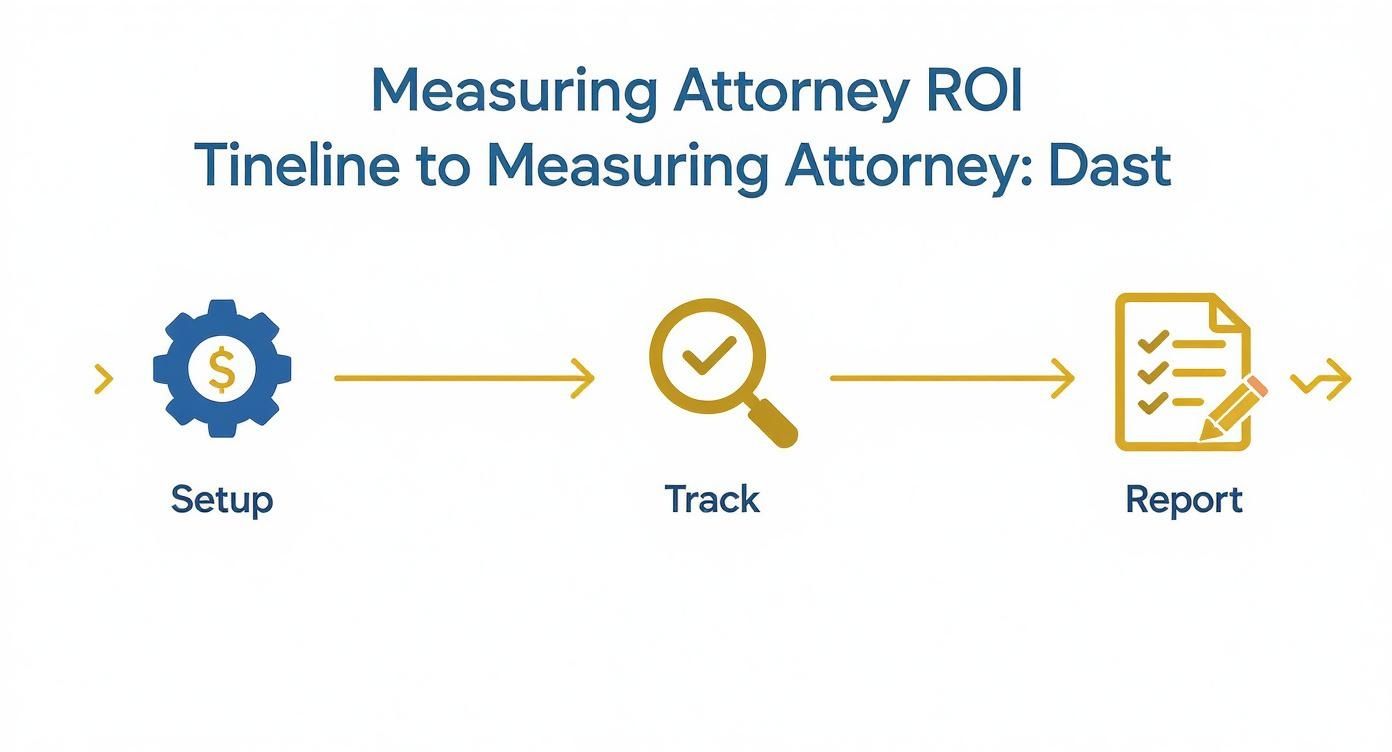
First, you set up your tracking tools. Then, you actively monitor performance. Finally, you report on the outcomes to make smarter decisions next time. It's a continuous loop.
- Weeks 9-10: Push it Out on Social & Local. Schedule a month's worth of social media posts for LinkedIn and Facebook. Don't just drop a link; pull out valuable snippets and tips from your articles. Then, head over to your Google Business Profile and create a few "Updates" that link back to your new content.
- Weeks 11-12: Set Up Analytics & Email. Inside Google Analytics 4, configure goals to track every time someone fills out a contact form. Then, put together a simple email newsletter to send to your existing contacts, featuring your best new article.
- Week 13: Review & Plan Ahead. It's time for your first monthly content review. Pull up the data. Which articles are getting traffic? Are people actually reading them? Use these early insights to plan your content calendar for the next 90 days.
Frequently Asked Questions About Attorney Content Marketing
Even with the best playbook in hand, a few questions always pop up. That’s completely normal. The world of attorney content marketing has its own rhythms and rules, but getting a handle on a few key benchmarks can make all the difference.
Let’s tackle some of the most common questions we hear from law firms ready to get serious about their content.
How Much Should a Law Firm Spend on Content Marketing?
Honestly, there's no single magic number that fits every firm. The best way to think about it is as a percentage of your firm's total revenue.
A good starting point for your entire marketing budget is somewhere in the ballpark of 7-12% of your gross revenue.
Content and SEO should represent a healthy slice of that budget. A personal injury firm trying to make a name for itself in a cutthroat market like Los Angeles is going to need a much bigger war chest than, say, a probate attorney in a small town.
The key is to start with a number you can consistently stick with. You can always ramp it up once the results start rolling in and you see a clear return on your investment.
How Long Does It Take for Content Marketing to Work?
This is the big one. Content marketing is a marathon, not a sprint. It’s about building a valuable asset over time, not flipping a switch for overnight leads.
You might see some encouraging signs within the first 3-4 months—think better rankings for a few keywords or a small bump in organic traffic. But the real, business-changing results take patience.
Expect it to take 6-12 months of consistent, high-quality work to see a significant impact. We're talking about a reliable flow of qualified leads and signed cases that you can trace directly back to your content.
This timeline all depends on where you're starting from, how fierce the competition is in your practice area, and most importantly, your consistency.
Can I Use AI to Write All My Law Firm Content?
Let me be blunt: using AI to write all of your content from start to finish is a huge mistake.
Think of AI as a fantastic paralegal. It's great for helping with research, brainstorming topic ideas, and creating rough outlines. But it is not a lawyer. It cannot replace genuine legal expertise and hard-won experience.
Legal content requires a level of accuracy, nuance, and authority that today's AI just can't deliver. Your firm's reputation is your single most important asset, and you can't risk it on a shortcut. Use AI tools to make your workflow faster, but make sure a qualified attorney reviews, edits, and injects their unique insights into every single article before it goes live.
Ready to stop guessing and start getting cases from your content? The team at Case Quota has over 15 years of experience building high-performance marketing systems for law firms just like yours. Let's talk about building a strategy that drives real growth for your firm.