

Let's be honest, social media for lawyers often feels like an afterthought—something you should do, but who has the time between billable hours and case prep? But here's the reality: treating social media as an optional extra is a fast track to getting left behind. It's no longer just for brand building; it's a core part of client acquisition.
Having a smart, active presence on platforms like LinkedIn and even Facebook lets you build trust and showcase your expertise long before a potential client actually needs to hire you. It turns your online profile into a powerful, consistent source for new cases.
Why Social Media Is a Must-Have for Modern Law Firms
I get it. Many attorneys still see social media as a distraction. But that view misses a massive shift in how clients find, research, and ultimately select their legal counsel. The journey to your office door doesn't start with a referral alone anymore. It starts with a Google search, which almost always leads to a social media check.
Think of it this way: potential clients are vetting you online. They're scrolling through your feed to get a feel for your professionalism, your specific expertise, and whether you seem approachable. A well-tended social media profile is your digital handshake. It’s your first and best chance to make a strong impression and start building a foundation of trust before you ever speak a word.
Connecting Where Your Clients Are
Today’s social platforms aren't just for sharing vacation photos. They've become primary channels for communication and, more importantly, for validation. When you're active, you can:
- Pinpoint Your Niche Expertise: Regularly posting about the nuances of your practice area—whether it's complex IP litigation, sensitive family law matters, or personal injury cases—positions you as the go-to authority.
- Humanize Your Firm: Sharing a team photo, highlighting community involvement, or offering a quick behind-the-scenes glimpse makes your firm feel more relatable and far less intimidating to a person facing a legal crisis.
- Open a Low-Pressure Line of Communication: Social media gives potential clients a way to ask a simple question without the formality of a phone call, building rapport from the very first interaction.
This kind of consistent engagement keeps your firm at the top of their minds. So, when a legal need finally arises, you’re the first person they think of. This is a crucial piece of any modern law firm marketing strategy.
The Hard Numbers: It's All About ROI
Still not convinced? Let's talk about the return on investment, because the data is undeniable. A dedicated social media strategy for lawyers isn't just a branding exercise; it delivers real, measurable results.
The numbers don't lie. A staggering 71% of lawyers have generated new client leads directly from their social media efforts. And with 85% of law firms now using these platforms, being absent means you're already behind the competition.
The financial upside is just as compelling. The average three-year ROI for social media marketing in the legal field is around 526%. That's not a typo. Strategic, consistent effort on the right platforms leads to serious business growth. This isn't just about posting random updates; it's about building an automated client acquisition engine that works for you 24/7.
Key Social Media Platforms for Lawyers at a Glance
Choosing where to invest your limited time is critical. Not all platforms are created equal for law firms. This table breaks down the best options to help you focus your efforts where they'll have the most impact.
| Platform | Primary Use Case for Lawyers | Target Audience |
|---|---|---|
| Professional networking, B2B lead generation, establishing expertise | Business owners, executives, professionals, referral sources | |
| B2C client acquisition, community engagement, brand humanization | General public, local community, family law, PI clients | |
| X (Twitter) | Real-time commentary, engaging with journalists, sharing news | Journalists, media, legal peers, tech-savvy clients |
| Visual storytelling, humanizing the firm, younger audience reach | Younger demographics, creative industries, brand-focused |
Each platform serves a distinct purpose. LinkedIn is your professional powerhouse for building a referral network, while Facebook is often where you connect directly with individuals in your local community seeking help with personal injury or family law matters. The key is to pick one or two and do them exceptionally well, rather than spreading yourself too thin.
Picking the Right Social Media Platforms for Your Firm
One of the biggest mistakes I see law firms make is trying to be on every single social media platform. It’s a recipe for burnout and, frankly, it just doesn’t work. The goal isn’t to be everywhere; it’s to be where your ideal clients are. A focused, strategic approach on one or two key platforms will always beat a scattergun effort.
It all comes down to a simple question: where do your clients hang out online? A B2B corporate lawyer advising tech startups will find their people on LinkedIn. It's the digital water cooler for founders, VCs, and executives. But if you’re a family lawyer, you’re far more likely to build real connections in local Facebook Groups, where people are discussing the very issues you can help with.
Your immediate goals should steer this decision. Are you trying to amplify your firm's already strong reputation, or are you actively hunting for new cases? This simple decision tree can point you in the right direction.
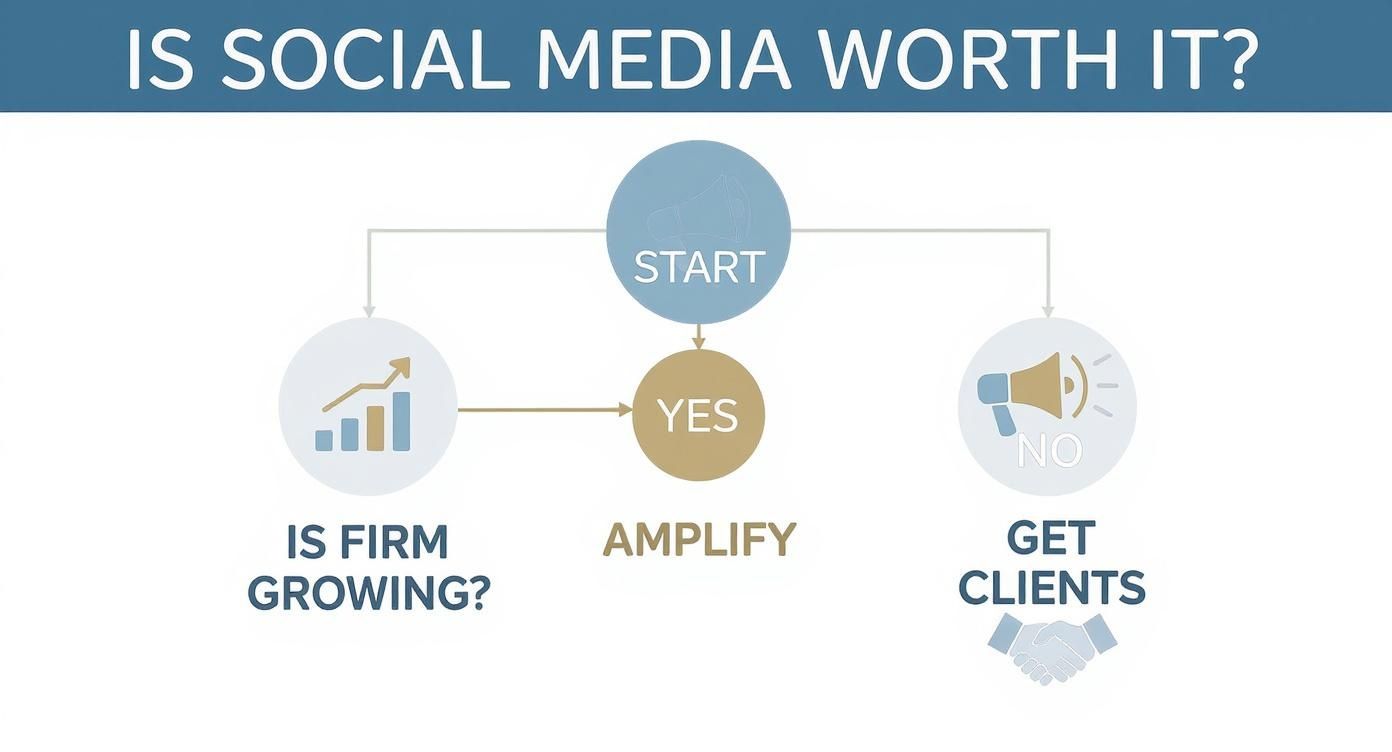
As you can see, social media really boils down to two core functions for a law firm: building on your existing authority or generating new client leads.
Know Your Client, Know Your Platform
First things first, you need to get crystal clear on who you're trying to reach. "Anyone who needs a lawyer" is not an answer. You need to build an ideal client profile.
Think about:
- Demographics: How old are they? Where do they live? What do they do for a living?
- Challenges: What specific legal problems are keeping them up at night?
- Online Behavior: When they need professional advice, where do they look online?
Once you have this nailed down, you can match it to where those people actually spend their time. This isn't just a hunch. Recent data shows that while Google is still king, plenty of clients are doing their homework on social media. Facebook is used by 24.7% of potential clients during their research, with Yelp at 24.3% and YouTube close behind at 20.4%. It’s proof that being active and credible on these platforms is essential for getting on a client’s shortlist.
LinkedIn: The Professional Powerhouse
For almost any lawyer, LinkedIn needs to be on the radar. It is the place for professional networking, B2B lead generation, and cementing your reputation as an expert in your field.
LinkedIn isn't just an online resume; it's a content platform. Lawyers who consistently share sharp analysis, comment on industry news, and participate in professional groups become the go-to experts for referrals from other lawyers, accountants, and financial advisors.
Imagine a real estate attorney posting a quick breakdown of a new zoning law. That post gets seen by commercial developers and brokers in their network. Suddenly, that attorney is top-of-mind, leading directly to high-value referrals. It's the digital version of speaking at an industry conference, but you can do it from your desk.
Facebook: Connect with Your Community
While LinkedIn is all about professional clout, Facebook is the undisputed champion of B2C community building. If your practice areas are things like family law, personal injury, or estate planning, this is where you connect with people on a human level.
The game here isn't about professional thought leadership; it’s about providing helpful, easy-to-understand advice and showing the human side of your firm.
You can build that trust by:
- Sharing relatable content: Think short videos answering common questions, like "What are the first steps to creating a will?"
- Engaging in local groups: Become a recognized local resource by participating constructively in community forums (always keeping ethics rules in mind).
- Running targeted ads: Facebook's ad tools are incredibly powerful for reaching specific demographics in your city or county.
A personal injury lawyer, for instance, could run a campaign aimed at people in their city who are part of motorcycle clubs. The ad could offer a free guide on rider safety and legal rights. You're providing real value upfront, building a relationship long before they might need to call you. To really get the most out of it, you need to understand the specifics of attorney advertising on Facebook.
By choosing your platforms with care, based on your firm’s goals and your ideal client, social media stops being a chore and becomes a powerful, precise tool for bringing in new business.
Crafting Content That Builds Trust and Authority

Effective social media for lawyers boils down to a single, powerful principle: give value before you ask for anything. Your feed shouldn't look like a digital billboard constantly flashing "Hire Me!" Instead, it needs to be a trusted resource that educates, informs, and cements your reputation as an approachable expert.
The attorneys who win on social media aren't just selling their services; they're generously sharing their knowledge. This approach builds a deep foundation of trust. When a follower eventually finds themselves needing legal help, you’re the first person they think of calling. It's a long game that flips the script from chasing clients to attracting them.
Adopt a Content Pillar Approach
One of the biggest roadblocks for any firm is the relentless pressure to come up with new post ideas. This is where the content pillar strategy becomes your best friend. It’s a simple, repeatable system for creating a month’s worth of posts from just a handful of core ideas.
Start by picking a broad topic central to your practice. Let's say you're an intellectual property attorney who works with startups. Your content pillar could be something like "IP Protection for New Founders."
From that one pillar, you can easily spin off a whole host of smaller "micro-content" pieces:
- A quick video explaining the difference between a trademark and a copyright.
- An infographic that lays out the patent application timeline.
- A text post on the top three IP mistakes most startups make.
- A "Meet the Team" post featuring the paralegal who handles your trademark searches.
- An ethically-framed case study (anonymized, of course) about securing a game-changing patent for a client.
Just like that, one big idea has given you a full week of diverse, valuable content. Do this with four pillars, and your entire month is planned out. This system doesn't just save you time; it establishes you as a genuine subject-matter expert. It's a fundamental part of any strong content marketing plan for your law firm.
Define Your Firm's Voice
How you say something is every bit as important as what you say. Your brand voice is the personality your firm projects online, and consistency is everything. Are you authoritative and direct? Empathetic and reassuring? Maybe even a bit witty and modern?
There's no single "right" voice. It has to align with your practice area and ideal client. A criminal defense attorney's tone is naturally going to be different from an adoption lawyer's.
Your brand voice should be an authentic reflection of your firm's values. It’s the consistent thread that ties all your content together, making your firm recognizable and relatable to your target audience. Trying to be someone you're not is unsustainable and comes across as inauthentic.
Once you’ve defined your voice, make sure it’s applied to every single post, comment, and direct message. That consistency is what builds a predictable and trustworthy brand personality that clients can actually connect with.
Content That Connects and Converts
Knowing your strategy and voice is great, but what should you actually be posting? The goal is a healthy mix of content that educates your audience, engages them in conversation, and humanizes your firm. For a deeper dive into what works, you can explore these proven LinkedIn content strategies, which are perfect for engaging a professional audience.
Here are a few content types I've seen work time and time again for lawyers:
1. Educational Posts
These are the absolute backbone of your content strategy. Your mission here is to answer the questions your potential clients are already asking.
- Explainers: Break down complex legal terms in short videos or simple text posts.
- Myth-Busting: Tackle common misconceptions in your field. Think, "No, you don't always have to go to court for a divorce."
- Checklists: Create shareable graphics like a "5-Point Checklist for After a Car Accident."
2. Behind-the-Scenes Content
This is what makes your firm feel real. It shows the people behind the legal advice and builds a human connection.
- Team Spotlights: Introduce your attorneys and staff. Share a bit about their background or what they love to do outside of work.
- Community Involvement: Post about the charity events, local sponsorships, or pro bono work your team is passionate about.
- A Day in the Life: Give a (non-confidential) peek into what it's really like to work at your firm.
3. Social Proof
This is where you ethically showcase your wins and build undeniable credibility.
- Anonymized Case Studies: Briefly walk through a client's problem, your solution, and the positive outcome—always protecting confidentiality.
- Testimonial Graphics: With permission, turn a great client email or Google review into a clean, branded image for your feed.
By rotating through these content types, you create a dynamic and interesting feed that provides real value. This is how you make sure your social media efforts aren't just adding to the noise, but are actively building your authority and attracting the right kind of clients.
Navigating Ethics and Professional Compliance Online

This is the part where every lawyer needs to pause before hitting "post." While social media is a powerful tool for growth, it exists within the rigid framework of State Bar advertising rules and professional conduct. The abstract legalese can feel a world away from the fast-paced nature of likes and shares, creating ethical minefields for even the most careful attorneys.
The goal isn't to scare you away from the conversation. It's about translating those dense regulations into a practical, everyday guide for your online activity. This is how you engage confidently, protecting your clients, your firm's reputation, and your license to practice.
Avoiding Accidental Attorney-Client Relationships
One of the biggest tripwires for lawyers on social media is unintentionally creating an attorney-client relationship. It’s shockingly easy to do. A seemingly helpful reply in a direct message or a public comment can cross the line if a person believes they've received specific legal advice for their unique situation.
Imagine someone DMs you on LinkedIn with a detailed story about a dispute with their business partner. If you reply, "It sounds like you have a strong case for breach of contract, you should send them a demand letter immediately," you've probably just given specific legal advice. That simple message can create a duty of care and spark potential conflicts of interest down the line.
To stay on the right side of this, you need firm boundaries:
- Never give legal advice online. Period. Keep all your communications, public and private, general and educational in nature.
- Redirect every inquiry. When someone asks for specific advice, your only response should be to invite them to schedule a formal, confidential consultation.
- Use clear disclaimers. Your profile bio and relevant posts must state that your content is for informational purposes only and does not constitute legal advice or create an attorney-client relationship.
Steering Clear of Prohibited Claims
Most State Bar rules are crystal clear about prohibiting false, misleading, or unsubstantiated claims. In the world of social media, this issue pops up most often with superlatives and guarantees.
Calling yourself "the best trial lawyer in Miami" or promising "we guarantee the highest settlement" is not just fluff—it's a direct violation of advertising rules in most states. These claims are unverifiable, create unrealistic expectations, and are considered inherently misleading.
Instead of making bold, subjective claims, stick to objective, verifiable facts. Showcase your credentials, years of experience, and specific practice areas. You can also present ethically-approved case results (always anonymized and compliant with local rules). Let your demonstrated expertise do the talking for you.
To see how these rules look in a specific jurisdiction, you can explore a guide to ethical attorney advertising in California.
The Power of the Disclaimer
Think of disclaimers as your first line of defense against ethical missteps online. They set clear expectations for your audience and can be a crucial shield against liability. While they aren't a magic bullet for every situation, they are an essential best practice you can't afford to skip.
A solid social media disclaimer should live in a few key places: your main profile bio, at the end of informational videos, and often in the caption of any post discussing legal topics.
Feel free to adapt this sample language:
"This post is for informational purposes only and does not constitute legal advice. No attorney-client relationship is formed by viewing this content or engaging in comments. Past results do not guarantee future outcomes. Licensed to practice in [Your State]."
This simple block of text addresses several key ethical concerns at once. It clarifies your content is not advice, explicitly negates the formation of a professional relationship, and includes the required warning about past results. By making this disclaimer a standard part of your content workflow, you build a strong foundation for compliant and effective social media marketing.
Using Paid Ads to Amplify Your Reach
Relying purely on organic content is like building a practice one handshake at a time. It works, but it’s painfully slow. Paid social media advertising, on the other hand, is your tool for precise, accelerated growth. It lets you get your message in front of the exact people who need your help, right when they need it.
This isn't about blanketing your city with generic ads and hoping for the best. It's about surgical precision. Platforms like Facebook and LinkedIn have become incredibly sophisticated advertising engines, allowing you to move far beyond simple demographics.
Pinpoint Targeting Your Ideal Client
The real power here lies in the sophisticated targeting options. You can layer different criteria to build a highly specific audience profile, making sure every dollar of your ad budget is spent reaching qualified potential clients, not the general public.
Let’s say you’re a personal injury attorney. With paid ads, you could run a campaign that targets:
- Individuals in your specific zip codes.
- Who have recently visited a hospital or emergency room (based on location data).
- And have shown an interest in things like motorcycles or cycling clubs.
This level of detail means you aren't just hoping the right person sees your ad; you're actively placing it in their feed based on behaviors that signal a potential need for your services. This transforms your marketing from a shot in the dark into a calculated, high-return strategy.
Setting a Smart Budget and Clear Goals
You don't need a massive budget to get started with paid ads. Even a modest, controlled spend can drive a significant volume of qualified inquiries when your campaign is set up correctly. The key is to define your goal from the outset.
What do you actually want to achieve?
- Lead Generation: Your main objective is getting potential clients to fill out a contact form or call your office. Your ad copy needs a strong call to action, like "Schedule a Free, Confidential Consultation."
- Brand Awareness: You want to establish your firm as the go-to expert in a specific practice area. In this case, your ads might promote a helpful guide or an educational video instead of going for the hard sell.
A small initial budget of a few hundred dollars is perfect for testing the waters. You can run different ad versions (A/B testing) to see which headlines, images, and targeting parameters deliver the lowest cost per lead. Once you find a winning formula, you can scale your investment with confidence. For a deeper dive into this process, check out our complete guide to social media advertising for lawyers.
The rise of paid social media advertising is reshaping law firm marketing. With over 4.9 billion people using social media, firms that invest in targeted ads gain a clear competitive advantage by reaching potential B2B and consumer clients with personalized, platform-specific content. Discover more insights about 2025 advertising trends for law firms.
Crafting Ad Copy That Connects
Your ad creative—the text and visuals—has to do more than just announce your services. It needs to connect with a person's specific legal problem and offer a clear, immediate solution.
Take an estate planning attorney, for example. An effective ad could target users whose relationship status on Facebook recently changed to "Engaged" or "Married." The copy could be empathetic and timely:
"Starting your new life together? Congratulations! Ensure your future is protected. Our simple estate planning process gives you peace of mind. Learn more."
This ad works because it’s not a generic sales pitch. It speaks directly to a person's current life event, acknowledges their situation, and presents a logical next step. It’s helpful, not pushy. When you combine this kind of resonant messaging with precise targeting, you create a powerful system for attracting high-quality cases.
Still Have Questions About Social Media for Lawyers?
Even with a solid plan, I know a lot of attorneys still have those nagging, practical questions about what it really takes to make social media work. I see the same hurdles trip up firms time and time again when they’re just starting out.
Let's cut through the noise. Here are the most common questions I get, with direct, no-nonsense answers to help you get going.
"Seriously, How Much Time Does This Take Each Week?"
For a solo lawyer or a small firm, you can make a real impact with 3-5 hours a week. The key is not to do it all at once. If you try to cram it into one afternoon, you'll burn out.
Break it down like this:
- Content Batching (1-2 hours): Find one block of time to hammer out your posts for the week. Write them, find your images, and get them loaded into a scheduling tool. Done.
- Daily Engagement (1-2 hours total): This is your 15-20 minute daily check-in. Hop on, reply to comments, answer messages, and interact with posts from key referral sources. It's about being present, not living online.
- Quick Review (1 hour): At the end of the week, take a look at what happened. Which posts got a reaction? Which ones fell flat? This isn't about deep data science; it's about getting a feel for what your audience wants.
Remember, consistency crushes intensity every single time. A focused 30 minutes a day is far more powerful than a frantic four-hour sprint on a Friday. You're building a habit, not running a race.
"What Are the Biggest Mistakes I Need to Avoid?"
I see the same three mistakes knock otherwise smart lawyers right off track. If you can sidestep these, you're already ahead of the game.
First, stop being a walking billboard. If every single post screams "Hire Me!" or "Free Consultation!," you’re providing zero value. People will tune you out instantly. A good rule of thumb is the 80/20 rule: 80% of your content should be helpful and educational, and only 20% should be promotional.
The second killer is inconsistency. Going hard for a week and then vanishing for a month makes you look unreliable—the exact opposite of the trust you’re trying to build. A basic content calendar and a scheduling tool are your best friends here. They ensure you have a steady, professional pulse online.
Finally, don't forget the "social" part of social media. Ignoring comments and questions is like a potential client walking into your office and you turning your back on them. Every interaction is a micro-opportunity to build rapport and demonstrate that you're an approachable expert.
"Can I Actually Get Referrals From This?"
Absolutely. And when it comes to attorney referrals, LinkedIn is your powerhouse. The goal isn't just to rack up connections; it's to become the go-to expert in your niche, so other professionals have to think of you.
The strategy is simple: connect with attorneys in complementary practice areas. If you’re an estate planning lawyer, you should be connecting with family law attorneys, CPAs, and financial advisors every single week. They see clients who need your help all the time.
Referrals are born from a combination of demonstrated expertise and professional generosity. Don’t just "like" a connection's post. Leave a thoughtful comment that adds to the conversation. That one simple act keeps you top-of-mind and cements your authority.
When you consistently share sharp insights and engage with others, you build a reputation. So, when one of your connections runs into a legal issue in your wheelhouse, your name is the one that pops into their head.
"How Do I Know if Any of This is Actually Working?"
Measuring the ROI of your social media efforts means looking at two different kinds of results: the direct and the indirect. You need both to see the full picture.
Tracking direct ROI is the easy part. You can do this by:
- Checking Google Analytics: See how much traffic is landing on your website from your social profiles.
- Adding One Field to Your Intake Form: Simply ask, "How did you hear about us?"
- Tracking DMs: Keep a running log of qualified inquiries that come straight from your social media messages.
Indirect ROI is about tracking the things that lead to future business—your brand's momentum. This includes things like follower growth, profile views, and engagement rates.
A great starting point is to simply track the number of qualified consultations that originated from social media each month. When you combine that with your direct traffic data, you'll have a crystal-clear idea of what's working.
At Case Quota, we specialize in turning your firm's social media presence into a reliable source of new cases. We handle the strategy, content, and advertising so you can focus on practicing law. Learn how we can help your firm grow.