

SEO for law firms is all about making your website show up when potential clients search for legal help. Let's be blunt: it's no longer a "nice-to-have." This is the primary way people find a lawyer today, making it the most critical part of your client acquisition strategy.
Why SEO Is Your Firm’s Most Powerful Client Magnet

Think about your law firm's office for a second. You could be in a quiet, unmarked back alley with zero foot traffic. Or, you could have a storefront on the busiest, most valuable street in the world, with thousands of your ideal clients walking by every single day.
SEO is the difference between those two locations.
Your website is your firm’s digital front door. Without a solid SEO plan, you're basically hiding on that back alley, completely invisible to people actively looking for the expertise you offer. A strong SEO foundation, on the other hand, puts you right in front of them at their exact moment of need. It turns your website into a client-generating machine.
Connecting with Clients When It Matters Most
When someone is dealing with a legal problem, what's the first thing they do? They pull out their phone and go straight to a search engine. They’re typing in things like "car accident lawyer near me" or "how to file for divorce in California."
This is where the real power of SEO clicks. It's not about chasing down clients. It’s about being the best, most visible answer when they come looking for help.
To really get why this is so important, you need to understand what Search Engine Optimization (SEO) entails. At its heart, it’s the process of making your website more credible and visible to search engines like Google.
The opportunity here is massive. Google handles over 8.5 billion searches per day and dominates more than 92% of the entire search market. For a law firm, that translates to a nearly bottomless well of potential cases. The key is that organic search results get the lion's share of the attention, with those top few spots capturing most of the clicks.
SEO puts your firm in front of high-intent people who aren't just browsing—they're actively searching for solutions to urgent, often life-altering, legal problems. When you rank for the right keywords, you create a direct line to your next case.
The Three Pillars of Law Firm SEO
To build an SEO strategy that actually drives growth, you have to focus on three core pillars. Think of them as the foundation, walls, and roof of your digital presence. If one is weak, the whole structure is compromised.
We'll break down each of these in detail throughout this guide, but here's a quick overview of how they work together.
The Three Pillars of Law Firm SEO
| Pillar | Primary Goal | Key Activities |
|---|---|---|
| Technical SEO | Ensure search engines can easily find, crawl, and understand your website's content. | Improving site speed, ensuring mobile-friendliness, and implementing structured data (Schema). |
| On-Page SEO | Create relevant, high-quality content that answers client questions and targets specific keywords. | Developing practice area pages, attorney bios, case results, and informative blog posts. |
| Off-Page SEO | Build your firm's authority and credibility through external signals like backlinks and reviews. | Earning links from legal directories, community sponsorships, and managing online reputation. |
Getting these three pillars right is the key to creating a sustainable engine for bringing in new clients. Let's dive into how to master each one.
Dominating Local Search with Google Business Profile
For most law firms, winning at SEO means winning right here at home. Your potential clients aren't just searching for "personal injury lawyer"; they're typing "personal injury lawyer near me" into their phones. This is where your Google Business Profile (GBP) becomes your single most powerful marketing tool.
Forget thinking of GBP as just another online listing. It's your firm's digital front door—the modern equivalent of the yellow pages, a business card, and a referral all rolled into one. When you get it right, it's what lands you in the coveted "local map pack," that box of three businesses that Google shows at the very top of local search results.
A well-managed profile transforms you from just a name in a directory into the obvious, immediate choice for local clients. It gives them everything they need to decide in a heartbeat: your location, hours, phone number, and most importantly, social proof from client reviews.
Optimizing Your Profile for Maximum Impact
Nailing the basics on your Google Business Profile is non-negotiable. This isn’t about tricking the system; it’s about giving Google and potential clients the most accurate and compelling information about your firm. The first step is simple: fill out every single section.
A complete profile signals to Google that your firm is active, legitimate, and worthy of a high ranking. This goes way beyond just your name and address. To truly make an impact, you need a meticulous approach. For a complete walkthrough, our guide on how to optimize a Google Business Profile for law firms offers a step-by-step checklist.
Here are the key areas to lock down:
- Business Categories: Be specific. Choose "Personal Injury Attorney" as your primary category, not just "Law Firm." Then, add secondary categories for everything else you do, like "Criminal Justice Attorney" or "Family Law Attorney."
- Services: List every single legal service you provide. If someone is searching for "car accident representation," having that listed as a service drastically increases your chances of showing up.
- Business Description: Write a client-focused description that shows what makes your firm different. You have 750 characters—use them all to explain your approach, your experience, and who you help.
Leveraging GBP Features to Attract Clients
Beyond the core info, your GBP is packed with tools to engage potential clients and showcase your firm’s expertise. Using these features consistently tells Google your firm is active and relevant, which can give your local rankings a serious boost.
Think of these features as free mini-advertisements that keep your profile fresh and engaging.
Your Google Business Profile is a living, breathing entity. Regularly updating it with Posts, photos, and Q&A responses demonstrates to both Google and potential clients that your firm is engaged and accessible.
Here’s how to put these features to work:
- Google Posts: Share firm news, link to new blog articles, highlight case results, or announce community events. Posts only last for seven days, so get into a weekly rhythm to stay visible.
- Photos and Videos: Upload high-quality photos of your office (inside and out), your team, and even firm events. A quick video tour of your office can do wonders for building trust.
- Q&A Section: Don't wait for people to ask questions. Proactively add and answer the common questions you get from clients. This lets you control the narrative and provide helpful information right away.
To really get ahead, you'll want to explore more advanced strategies to leverage your Google Business Profile. These tactics can give you a critical edge over competitors who are just doing the bare minimum. Remember, every single piece of information you add is another signal to Google that your firm is the right answer for local searchers.
Creating Content That Wins Clients, Not Just Clicks
Your SEO strategy lives and dies by its content. Think about it: every single thing we’ve talked about so far—from local signals to technical fixes—is designed to get your actual content in front of the right people.
We're not just talking about churning out generic blog posts. The goal is to create a digital library of resources that answer the urgent, specific questions your potential clients are typing into Google at 2 AM. When your content provides real value, it builds a foundation of trust long before they even think about picking up the phone. You stop being just another law firm and become the authority.
The Foundation: A Strategic Keyword Research Process
Before you write a single word, you have to know what people are actually looking for. This is what keyword research is all about—getting inside the head of your potential client and figuring out the exact words and phrases they use when they need legal help.
Let’s say you're a family law attorney. It's tempting to just target "family lawyer," but that's a drop in the ocean. A smart strategy uncovers the high-intent keywords that signal a real problem, like "child custody laws in Texas for unmarried parents" or "how to calculate alimony in Los Angeles." These aren't just searches; they're cries for help.
The sweet spot is a balance between three key factors:
- Search Volume: How many people are actually searching for this?
- Keyword Difficulty: How much of a fight will it be to rank on page one?
- Searcher Intent: Is this person just browsing, or are they ready to hire an attorney now?
Nailing this balance means you’re creating content that doesn't just get seen—it gets seen by the right people who are most likely to become your next client.
Building the Core Pages That Convert
With your keywords in hand, it's time to build the pages that will do the heavy lifting. Each one has a specific job to do, guiding a potential client from their initial frantic search to a confident consultation call.
These are the non-negotiable pages for any firm that's serious about getting cases from Google:
- High-Converting Service Pages: These are your money pages, targeting your core practice areas (e.g., "Car Accident Lawyer," "DUI Defense"). They need to be more than a simple list of services. You have to walk them through the legal process, answer their biggest questions, and make a rock-solid case for why your firm is the only choice.
- Authoritative Attorney Bios: People hire people, not logos. Your attorney bios are where trust is built. Go beyond the law school and bar association. Showcase real experience, highlight major case victories, and let your personality and expertise shine through.
- Trust-Building Case Results: Nothing convinces a potential client like seeing you've already won a case just like theirs. Detailed case results and client testimonials are the ultimate social proof. They show, not just tell, that you can deliver.
These pages are the backbone of your firm's online presence. For a much deeper dive into how to structure these critical assets, our complete guide on law firm content marketing lays out the entire playbook.
Why Quality Content Is a Non-Negotiable Investment
In a market this crowded, good content is what separates the firms that dominate search results from those that never get found. The data is overwhelming: organic search is the single biggest source of traffic for law firms, period.
In fact, organic search drives about 53% of all traffic to legal websites, blowing paid ads and other channels out of the water. The ROI is undeniable, too, with nearly 65% of firms reporting that their website brings in more business than any other marketing effort.
Content isn’t just about ranking for keywords. It’s about proving your expertise, building unshakable trust, and convincing a potential client that you are the absolute best advocate for their case—all before they ever pick up the phone.
At the end of the day, every service page, blog post, and case study you publish becomes a digital asset, working around the clock to bring you qualified leads. It’s an investment that pays dividends for years, steadily building your reputation and your bottom line.
Mastering Your Website’s Technical Health

Let's imagine your law firm's website is a high-performance vehicle. The content—your practice area pages, case results, and attorney bios—is the sleek design and premium interior that attracts clients. But technical SEO? That’s the engine humming under the hood.
If that engine isn't finely tuned, it doesn’t matter how fantastic the car looks. It’s not going anywhere fast.
Technical SEO is all about making sure search engines like Google can easily find, crawl, and understand your website. It’s the critical foundation that makes all your other marketing efforts actually work. A technically sound site gets rewarded with visibility, while one plagued with issues will be stuck in the garage, no matter how brilliant its content is.
Things like site speed, mobile-friendliness, and a secure (HTTPS) connection aren't just nice-to-haves anymore. They are the absolute table stakes in the competitive game of SEO for law firms.
Core On-Page Technical Signals
While the world of technical SEO can get incredibly complex, focusing on a few key on-page elements will give you the biggest bang for your buck. Think of these as the direct signals you send to Google telling it what each page is about. Nailing these is the first step to ensuring your practice area and attorney pages are properly understood.
- Title Tags: This is the headline of your page that shows up in the search results and at the top of a browser tab. Keep it concise (under 60 characters) and lead with your most important keyword, like "Los Angeles Personal Injury Lawyer."
- Meta Descriptions: This is the short blurb that appears under your title in the search results. While it doesn't directly influence rankings, a compelling description (under 160 characters) is your sales pitch—it convinces a searcher to click on your link instead of your competitor's.
- Header Tags (H1, H2, H3): Headers give your content structure, just like an outline for a legal brief. Your H1 is the main title of the page. The H2s and H3s break up the content into logical, easy-to-scan sections for both potential clients and search engine crawlers.
When you combine these with a logical site structure and clear internal linking, you create a roadmap that helps Google (and your visitors) find the most important information quickly. For a deeper dive into site architecture, check out our complete guide to website optimization for law firms.
Unlocking Visibility With Schema Markup
One of the most powerful, yet often overlooked, technical tools for law firms is Schema Markup. Also known as structured data, it's a special kind of code you add to your website that works like a translator for Google.
Instead of leaving Google to guess that you're a law firm, Schema lets you explicitly label key pieces of information so the search engine understands your content with perfect clarity. This is what unlocks "rich snippets" in search results—those eye-catching features like star ratings, FAQs, and event listings that can dramatically boost your click-through rate.
Schema Markup is like adding a detailed table of contents directly into your website's code for Google to read. It removes ambiguity and helps the search engine categorize your firm’s expertise with precision, which can give you a significant competitive advantage.
For any law firm, two types of Schema are absolutely essential:
LegalService: This tag identifies your business as a legal service provider. It allows you to specify practice areas, office locations, and hours with no room for misinterpretation.Attorney: This is used to mark up individual attorney profiles, highlighting credentials, bar admissions, specialties, and educational background for each lawyer at your firm.
Implementing this code helps Google connect the dots between your firm, its attorneys, and their specific practice areas, which powerfully reinforces your authority and expertise in the eyes of the search engine.
Building Authority with Ethical Link Building
If your website's content is the engine driving your SEO, then backlinks are the high-octane fuel that gives it real power. In Google's world, a link from another website to yours is like a professional referral or a vote of confidence. When a reputable site links to your firm, it sends a clear signal that your content is valuable, credible, and authoritative.
But let's be clear: not all links are created equal. The legal profession demands an approach to link building that is completely above board. This is where you need a crucial shift in mindset. Your goal isn't just to get links; it's to earn authority. This means focusing exclusively on ethical, "white-hat" strategies that build genuine relationships and create a positive digital footprint for your firm.
From Getting Links to Earning Authority
Forget about those outdated, risky tactics like buying links or getting involved in spammy "link schemes." Those shortcuts are a fast track to severe Google penalties that can wipe out your online visibility overnight. Instead, the foundation of modern link building for law firms is built on real-world community engagement and becoming a respected voice in your local area.
This approach has less to do with technical tricks and more to do with good, old-fashioned public relations. In fact, many of the best link-building activities overlap perfectly with traditional marketing and PR. To get a better handle on this, exploring strategies for effective law firm public relations can give you a powerful framework. When you become a pillar of your community, high-quality links just naturally follow.
The most powerful links aren't the ones you beg for; they're the ones you earn. They come from organizations that want to be associated with your firm because of your expertise, your contribution to the community, and your professional integrity.
Practical and Ethical Link-Building Strategies
So, how do you actually do this? It starts by looking for opportunities to add real value. Think about where your firm can make a meaningful impact and share your expertise.
Here are some of the most effective and ethical link-building tactics for attorneys:
- Secure Legal Directory Listings: First things first. Get your firm listed in reputable legal directories like Avvo, Justia, and FindLaw, as well as your state and local bar association websites. These are foundational links that solidify your professional credentials.
- Sponsor Local Events and Charities: Sponsoring a local youth sports team, a community fundraiser, or a charity 5K almost always results in a link from the organization's website. This not only builds incredible goodwill but also creates a powerful local signal for Google.
- Create a Scholarship Program: Offering a small annual scholarship for local high school or college students is a fantastic way to earn high-authority links from
.eduwebsites, which search engines value immensely. - Partner with Local Organizations: Build relationships with non-legal businesses that serve a similar clientele, like accountants, financial advisors, or therapists. You could co-host a webinar, create a shared resource guide, or simply offer to be a legal resource for their clients, often leading to natural linking opportunities.
By focusing on these relationship-driven tactics, you build a backlink profile that is not only powerful for SEO for law firms but also authentically reflects your firm’s commitment to its community.
Ethical vs. Unethical Link Building for Law Firms
Navigating the world of link building requires a clear understanding of what's safe and what's a liability. The table below breaks down the key differences between ethical strategies that build long-term authority and risky tactics that can get your site penalized.
| Strategy | Ethical Approach (Safe) | Unethical Approach (Risky) |
|---|---|---|
| Directory Listings | Submitting to respected legal directories (e.g., Avvo, FindLaw, local bar associations). | Paying for listings on thousands of low-quality, spammy, or irrelevant directories. |
| Content & Outreach | Creating genuinely useful content (e.g., legal guides, scholarships) that others link to naturally. | Publishing thin, keyword-stuffed articles on "private blog networks" (PBNs) designed solely to pass link equity. |
| Link Acquisition | Earning links through community sponsorships, partnerships, and providing expert commentary for news articles. | Directly buying links, participating in link exchange schemes ("I'll link to you if you link to me"). |
| Guest Posting | Writing an authoritative, insightful article for a relevant industry publication or local business blog. | Paying to place a low-quality guest post with an exact-match anchor text link on an unrelated website. |
| Long-Term Goal | Build genuine brand authority, community trust, and a natural, diverse backlink profile that withstands algorithm updates. | Manipulate search rankings quickly, often resulting in short-term gains followed by severe, long-lasting Google penalties. |
Ultimately, choosing the ethical path isn't just about following Google's rules; it's about protecting your firm's reputation. A strong, ethically-built backlink profile is a defensible asset that reflects the integrity of your practice.
Measuring SEO Performance and Proving ROI
https://www.youtube.com/embed/I89wnziFGlo
Investing in SEO for your law firm without tracking the results is like driving blind. You're putting in the work, but you have no real idea if you're actually getting closer to your destination—more signed cases. Any campaign worth its salt has to deliver a measurable return on investment (ROI), connecting your digital marketing directly to the firm's bottom line.
This means looking past the "vanity metrics" like raw website visits. Sure, seeing a traffic spike feels good, but the real proof is in the quality of that traffic. Are more potential clients actually calling your office? Is your intake team seeing a steady flow of contact forms from people with real, pressing legal issues?
These are the key performance indicators (KPIs) that truly matter. When you track them, SEO stops being an abstract marketing expense and transforms into a predictable, revenue-generating engine for your practice.
Key Metrics to Monitor for Law Firm Growth
To prove the value of your SEO work, you need to zero in on a handful of critical metrics that, together, tell the whole story. These numbers show more than just your online visibility; they show how that visibility translates into tangible business.
Start by focusing on these essentials:
- Organic Traffic Growth: This is the raw number of people finding your site through unpaid search results. A consistent upward trend is the first sign that your content and optimization are hitting the mark.
- Keyword Ranking Improvements: Keep a close eye on where you stand for high-value keywords like "personal injury lawyer in [Your City]." Jumping from the bottom of page one to a top-three spot can multiply your qualified leads overnight.
- Conversion Rate: This is the golden metric. It's the percentage of visitors who take the action you want them to, whether it's calling your firm or filling out a form. It tells you how effective your website is at turning traffic into potential clients.
When you look at these numbers together, you can draw a straight line from improving your Google rankings to an increase in client inquiries. For a deeper dive into this, you can learn more about measuring advertising effectiveness in our detailed guide.
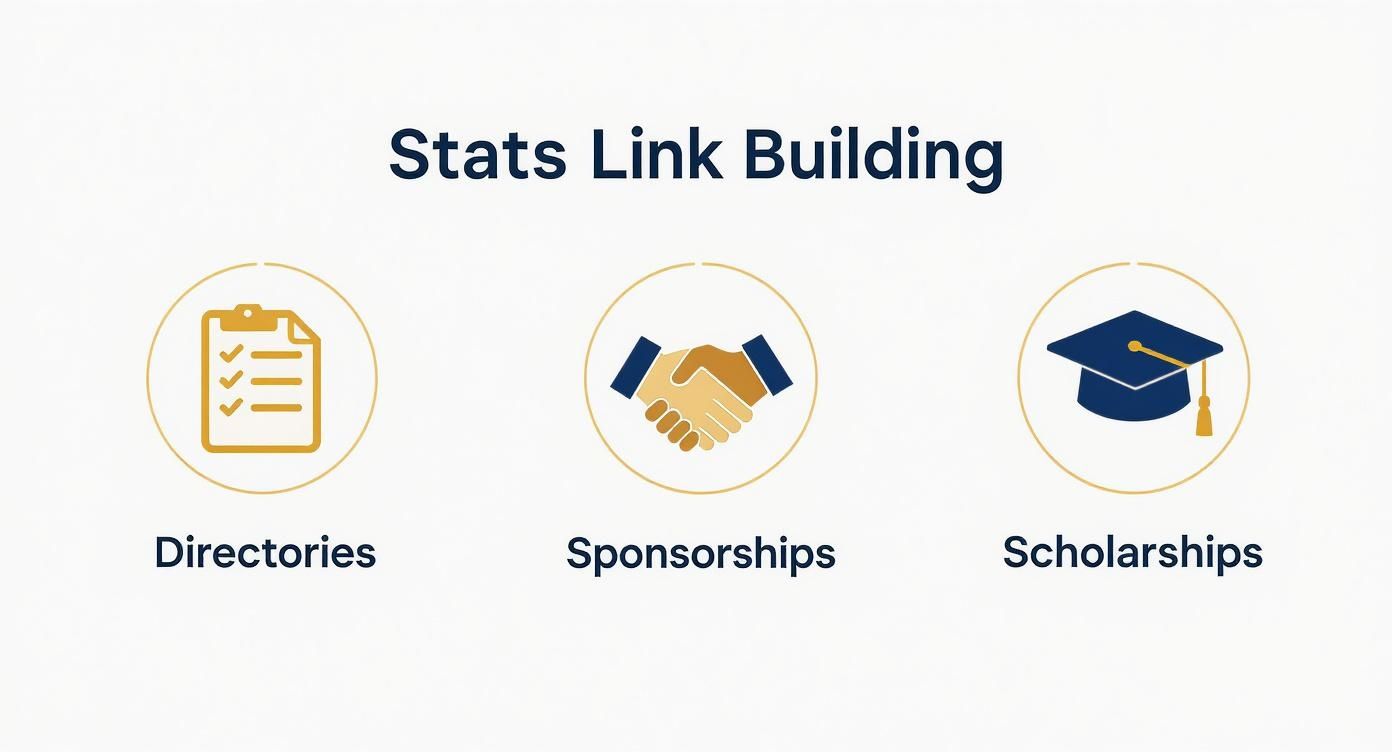
This process shows how foundational SEO efforts like link building directly contribute to the authority that drives these key metrics. By focusing on high-quality directories, local sponsorships, and scholarships, firms build an ethical and powerful backlink profile that Google respects.
Connecting SEO Efforts to Bottom-Line Results
The financial commitment to high-level SEO isn't trivial, but the returns absolutely justify the investment. On average, law firms dedicate around 65% of their marketing budgets to digital, with annual SEO spending often hitting $150,000.
So what's the payoff? Firms see an average 526% ROI on SEO within three years. Organic search isn't just a traffic driver; it's a lead-generation machine, converting at a much higher rate (7.5%) than paid ads.
The ultimate goal of all this data is to answer one simple question for your firm's partners: "How much new business is this actually generating?" By tracking calls and form submissions that originate from organic search, you can assign a real dollar value to your efforts and confidently prove your ROI.
Tools like Google Analytics 4 and Google Search Console are your command center for this data. Learning to interpret their reports lets you make smarter decisions and show exactly how your marketing investment turns into new cases for the firm.
Here are the most common questions we get from attorneys about SEO. Let's get right to it.
How Long Does SEO Take To See Results?
This is the big one, and the honest answer is: it’s a marathon, not a sprint. SEO isn't like flipping a switch. While you might see some positive movement in the first few months, it typically takes a solid three to six months to see a real, measurable impact on your firm’s bottom line—think more qualified traffic and, more importantly, more calls and consultations.
Unlike paid ads, which vanish the second you stop paying, SEO builds compounding value. The authority and rankings you earn today will continue to generate cases for your firm for years. The exact timeline always depends on how competitive your market is, the current state of your website, and how consistently you’re working on it.
What Is a Realistic SEO Budget for a Law Firm?
SEO budgets for law firms are all over the map, but this is one area where you absolutely get what you pay for. You'll see agencies offering rock-bottom prices, but for a competitive practice area in a major market, a realistic budget usually starts in the $5,000 to $10,000 per month range.
For hyper-competitive practice areas like personal injury or family law in a city like Los Angeles or San Diego, it’s not uncommon for top firms to invest $15,000 to $25,000+ per month. Think of it as an investment in your firm’s most powerful client-generating asset—because that’s exactly what it is.
Should I Focus on Local SEO or Content Marketing First?
For almost every law firm we've ever worked with, the answer is start with local SEO. It’s the fastest path to tangible results. Your best clients are right in your backyard, searching for legal help in a specific city or county. Winning the local map pack and ranking for "near me" searches will get your phone ringing faster than anything else.
Once you’ve built a rock-solid local foundation—your Google Business Profile is dialed in and you’re showing up on the map—then it’s time to expand. Broader content marketing, like in-depth legal guides and articles, builds on that local authority, helps you attract clients from a wider area, and cements your firm as the go-to expert in your practice areas.
At Case Quota, we build custom SEO strategies that drive real, measurable growth for law firms across Southern California. If you're ready to turn your website into a case-generation machine, see what we do at https://casequota.com.