

Nearly seven out of ten website visitors leave without taking action, and for many American law firms in Southern California, that means missed opportunities. Competing with larger firms is tough when potential clients slip away unnoticed. Retargeting ads give digital marketing managers a strategic edge, allowing smaller practices to re-engage those lost leads and boost client acquisition in a crowded legal market.
Table of Contents
- Retargeting Ads In Legal Marketing Explained
- Types Of Retargeting For Law Firms
- How Retargeting Ads Drive Case Leads
- Compliance, Privacy, And Ethical Boundaries
- Costs, Risks, And Common Pitfalls
Key Takeaways
| Point | Details |
|---|---|
| Retargeting Strategy | Retargeting ads reconnect law firms with potential clients who showed interest but didn’t convert, increasing engagement chances. |
| Multiple Approaches | Various retargeting methods, including site, search, and social media, offer tailored benefits for reconnecting with leads. |
| Ethical Considerations | Legal marketers must balance effective advertising with compliance to privacy regulations and ethical standards. |
| Performance Management | Regularly audit retargeting ad performance to optimize audience targeting and minimize risks of ad fatigue and budget overruns. |
Retargeting Ads in Legal Marketing Explained
Retargeting represents a sophisticated digital marketing strategy that allows law firms to reconnect with potential clients who have previously shown interest but did not convert. Behavioral retargeting enables attorneys to strategically display personalized advertisements across digital platforms, keeping their legal services top of mind for prospects who have visited their website.
The core mechanism of retargeting involves tracking website visitors through browser cookies, which enables law firms to serve targeted ads that remind potential clients about their specific legal services. When a user visits a law firm’s website and then navigates away, retargeting technology allows that firm to display relevant ads on subsequent websites the user visits. Retargeted advertising becomes most effective when deployed soon after a user’s initial website interaction, increasing the probability of re-engaging potential clients.
Legal marketing professionals can leverage multiple retargeting approaches, including site retargeting, search retargeting, email retargeting, and social media retargeting. Each method offers unique advantages:
- Site Retargeting: Showing ads to users who have previously visited the law firm’s website
- Search Retargeting: Targeting users based on their previous search engine queries related to legal services
- Email Retargeting: Displaying ads to individuals who have interacted with email marketing campaigns
- Social Media Retargeting: Presenting ads to users who have engaged with the law firm’s social media content
Pro tip: Design your retargeting ads with specific practice area imagery and clear, compelling calls to action to maximize engagement and conversion potential.
Types of Retargeting for Law Firms
Law firms can leverage multiple strategic retargeting approaches to reconnect with potential clients and maximize their digital marketing effectiveness. Several types of retargeting are used in digital marketing, each designed to track and re-engage website visitors through sophisticated browser tracking technologies that help attorneys stay connected with prospects who have shown initial interest.
Three primary retargeting strategies stand out for legal professionals. Site Retargeting allows firms to display targeted ads to users who have previously visited their website, keeping the firm’s brand visible during the client’s decision-making process. Search Retargeting enables attorneys to target potential clients based on their previous legal-related search queries, ensuring ads reach individuals actively seeking legal services. Dynamic Retargeting takes personalization a step further by showing ads featuring specific legal services or attorneys the visitor initially viewed, creating a more tailored advertising experience.
Additional retargeting methods provide law firms with nuanced approaches to client re-engagement:
- Link Retargeting: Serving ads to users who clicked on specific links related to legal services
- Email Retargeting: Targeting subscribers and past email campaign interactions
- Social Media Retargeting: Presenting ads to users who have engaged with the firm’s social media content
- Contextual Retargeting: Displaying ads on websites with content related to legal services
Pro tip: Segment your retargeting audiences by practice area and user behavior to create more precise, compelling ad campaigns that speak directly to potential clients’ specific legal needs.
Here’s a visual summary of key retargeting types and how they support legal marketing:
| Retargeting Type | Main Benefit | Best Use Case |
|---|---|---|
| Site Retargeting | Increases brand recall | Re-engaging website visitors |
| Search Retargeting | Captures active intent | Reaching service seekers |
| Dynamic Retargeting | Highlights specific services | Personalizing experience |
| Link Retargeting | Targets high-interest users | Following link engagers |
| Email Retargeting | Nurtures existing contacts | Reconnecting with subscribers |
| Social Media Retargeting | Builds audience engagement | Growing social visibility |
| Contextual Retargeting | Aligns with related content | Placing ads on legal content |
How Retargeting Ads Drive Case Leads
Retargeting ads represent a powerful mechanism for law firms to transform website visitors into potential clients by strategically re-engaging individuals who have already demonstrated initial interest. Research confirms that retargeting effectively influences consumer search behavior by targeting users who exhibited prior interest but did not convert, making it an essential tool for attorneys seeking to maximize their digital marketing efforts.

The core mechanism of retargeting involves tracking potential clients’ digital interactions and serving personalized advertisements that remind them of the law firm’s services. Empirical studies show these ads increase return visits and engagement by tailoring content to the user’s specific stage in the decision-making process. By presenting targeted ads across various online platforms, law firms can maintain visibility and gently guide potential clients back to their website, ultimately increasing the likelihood of case lead generation.
Key strategies for driving case leads through retargeting include:
- Personalized Ad Content: Create ads that reflect specific practice areas
- Timing Optimization: Display ads soon after initial website visit
- Audience Segmentation: Target users based on their browsing behavior
- Compelling Call-to-Action: Include clear, direct messaging in advertisements
- Cross-Platform Visibility: Utilize multiple digital advertising channels
Pro tip: Develop a retargeting strategy that focuses on showcasing your firm’s unique value proposition and expertise through visually engaging, practice-specific advertisements that speak directly to potential clients’ legal needs.
Compliance, Privacy, and Ethical Boundaries
Navigating the digital marketing landscape requires law firms to meticulously balance effective advertising strategies with strict ethical and legal requirements. The American Bar Association emphasizes core ethical obligations for lawyers using technological marketing approaches, highlighting the critical need for maintaining professional conduct in digital advertising, particularly when implementing retargeting ad campaigns.
Retargeting ads present unique challenges in maintaining client confidentiality and adhering to professional responsibility standards. Emerging technologies and AI-driven marketing tools have created complex ethical considerations for law firms, requiring hypervigilance in ensuring advertising practices comply with state bar regulations. Law firms must carefully craft retargeting strategies that respect individual privacy while providing meaningful legal information.
Key ethical considerations for retargeting ads include:
- Truthful Representation: Ensure all ad content accurately reflects the firm’s capabilities
- Confidentiality Protection: Prevent any potential disclosure of client information
- Transparent Targeting: Avoid invasive or overly intrusive tracking methods
- Consent Compliance: Respect user privacy preferences and data protection regulations
- Professional Tone: Maintain dignified and respectful advertising language
Pro tip: Consult with your firm’s ethics compliance officer and review state bar advertising guidelines before launching any retargeting ad campaign to ensure full regulatory adherence.
Costs, Risks, and Common Pitfalls
Retargeting ads for law firms represent a nuanced digital marketing strategy with potential financial and operational challenges that require strategic management. Costs of retargeting typically vary across different pricing models such as cost per thousand impressions (CPM), cost per click (CPC), and cost per action (CPA), demanding careful budget allocation and performance tracking.
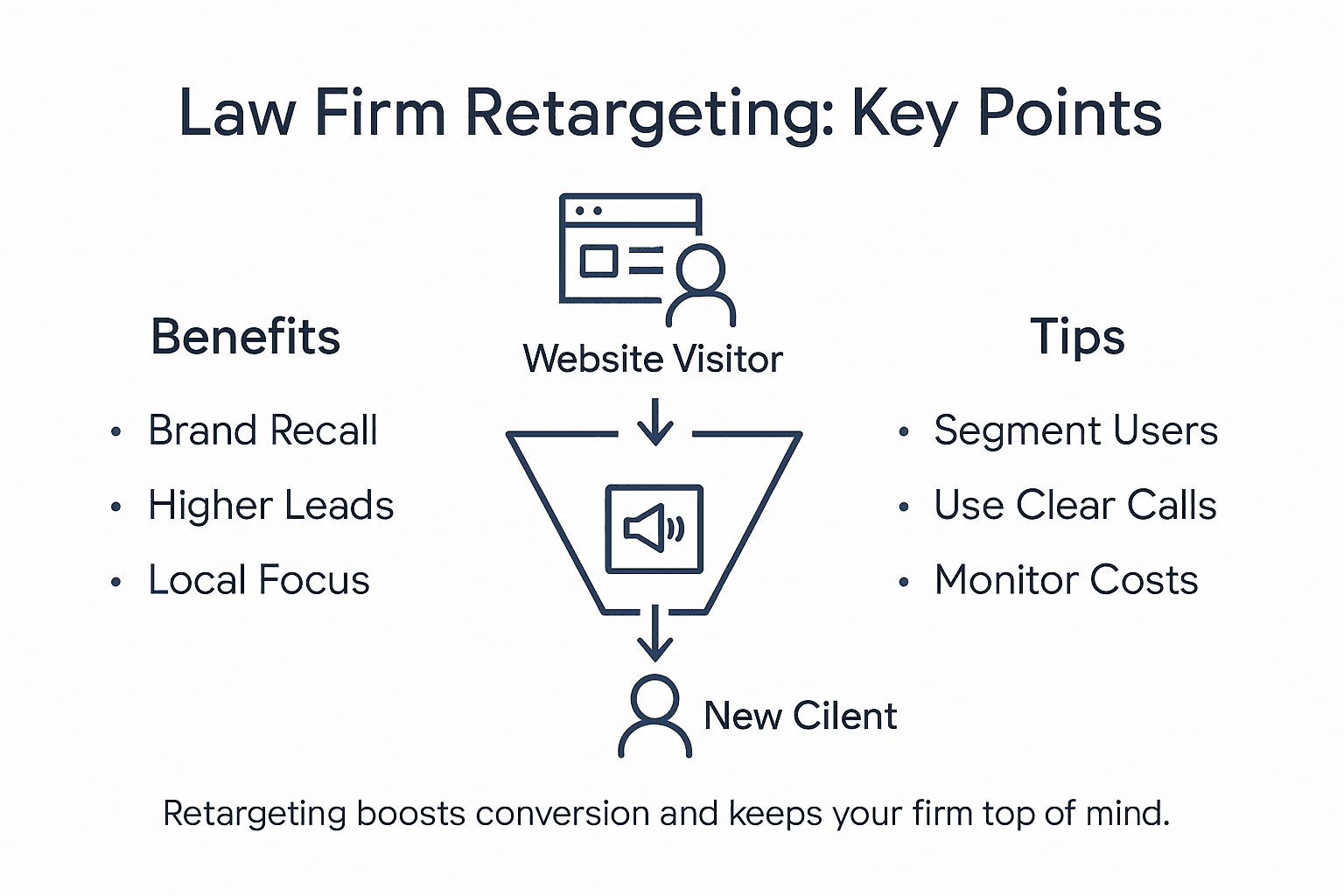
Cybersecurity vulnerabilities and privacy breaches pose significant risks when tracking technologies are not managed securely. Law firms must implement robust risk management protocols to protect potential clients’ data and maintain trust. Inefficient targeting can quickly escalate marketing expenses, making precise audience segmentation and continuous campaign optimization critical for maintaining a positive return on investment.
Common pitfalls in retargeting advertising include:
- Ad Fatigue: Overexposing potential clients to repetitive advertisements
- Privacy Violations: Failing to comply with emerging data protection regulations
- Imprecise Targeting: Creating ads that do not resonate with specific audience segments
- Excessive Spending: Allocating budget without monitoring campaign performance
- Technical Misconfiguration: Improper implementation of tracking pixels and audience lists
Pro tip: Implement a monthly review process to audit your retargeting ad performance, analyzing click-through rates, conversion costs, and audience engagement to continuously refine and optimize your marketing strategy.
Compare common retargeting risks with best practices for prevention:
| Common Risk | Possible Impact | Preventive Action |
|---|---|---|
| Ad Fatigue | Audience disengagement | Rotate creative regularly |
| Privacy Breach | Legal exposure, fines | Use consent management tools |
| Budget Overrun | Reduced ROI | Set strict bid limits |
| Technical Errors | Poor targeting, wasted ad spend | Test and audit tags monthly |
| Imprecise Audience | Low conversion rates | Refine audience segmentation |
Unlock the Power of Retargeting to Win More Local Clients
Retargeting ads can be a game changer for small to mid-size law firms struggling to compete against larger competitors with bigger marketing budgets. The article highlights the challenge of re-engaging prospective clients who visit your website but leave without contacting you. Key pain points include optimizing timing, personalizing ads by practice area, and maintaining ethical standards in digital marketing. These complex strategies require expertise in behavioral retargeting, audience segmentation, and multi-channel ad deployment to increase case leads effectively.
At Case Quota, we understand how tough it is to capture and hold attention in today’s competitive legal market. Our tailored digital marketing solutions leverage SEO-optimized web design, AI-powered pay-per-click advertising, and sophisticated social media retargeting to ensure your firm stays top of mind. We help law firms implement ethical and compliant retargeting campaigns that convert visits into new clients. You can rely on our 15 years of digital marketing experience plus six years specialized in California legal marketing to craft campaigns that deliver measurable growth.
Ready to stop losing potential clients after their first visit? Discover how our customized retargeting strategies can elevate your local client acquisition and give your firm a competitive edge.

Take the first step toward smarter client growth today by visiting Case Quota and exploring our proven legal marketing services. Learn more about how we tailor retargeting and full-funnel digital campaigns for law firms like yours here. Don’t wait another day to turn website traffic into valuable case leads.
Frequently Asked Questions
What are retargeting ads, and how do they work for law firms?
Retargeting ads are a digital marketing strategy that allows law firms to reconnect with visitors who have previously shown interest in their services but did not convert. By using tracking technologies such as cookies, these ads remind potential clients of the firm’s services across various digital platforms.
How can law firms use retargeting to increase case leads?
Law firms can increase case leads by deploying personalized ad content that reflects specific practice areas, optimizing the timing of ads after initial visits, segmenting audiences based on behavior, and including clear calls to action in their advertisements.
What are the different types of retargeting strategies available for law firms?
Law firms can utilize various retargeting strategies, including site retargeting (ads for previous website visitors), search retargeting (based on relevant search queries), email retargeting (for email campaign interactions), dynamic retargeting (showcasing specific services viewed), and social media retargeting (ads for social media engagement).
What are some common pitfalls of retargeting ad campaigns for law firms?
Common pitfalls include ad fatigue from repetitive ads, failure to comply with privacy regulations, inefficient targeting leading to wasted budget, and technical misconfigurations that affect tracking. Regular performance reviews can help mitigate these risks.