
Facebook advertising for attorneys is a powerful way to get in front of potential clients before they even realize they need legal help. It's a fundamental shift from simply capturing existing demand to actively building awareness and trust—a true game-changer for growing a modern law firm.
Why Facebook Ads Are a Must for Law Firm Growth

Most lawyers think about advertising through the lens of Google Ads, where you pay to show up when someone is actively searching for an attorney. It’s effective, for sure, but that strategy only targets a sliver of your potential market.
Facebook advertising works on a different, equally vital principle: demand generation.
Instead of waiting for a crisis, you can proactively reach people who fit your ideal client profile. This is especially critical for practice areas with longer decision cycles, like estate planning, family law, or bankruptcy. You get to educate your audience, build authority, and position your firm as the go-to resource long before they ever type "divorce lawyer near me" into a search bar.
Creating Demand Beyond the Search Bar
Here’s a simple way to think about it: Google Ads catches people with their hands already raised. Facebook Ads introduces your firm to the entire crowd before they even know they have a question.
This approach perfectly complements search advertising by creating a "warm" audience. When the time comes for them to hire a lawyer, they’ll already recognize your name and trust your expertise. It's a key part of a sophisticated law firm social media marketing strategy that builds a real, durable brand.
Facebook Ads vs Google Ads for Attracting Clients
So, where should you put your marketing dollars? Both platforms are powerful, but they serve different purposes. Here's a quick breakdown to help you decide where each fits into your strategy.
| Attribute | Facebook Ads | Google Ads |
|---|---|---|
| User Intent | Passive (Discovery) | Active (High Intent) |
| Targeting | Based on interests, demographics, life events | Based on keywords and search queries |
| Best For | Building brand awareness, generating demand, nurturing leads | Capturing immediate need, driving consultations |
| Cost Model | Generally lower cost-per-click (CPC) | Higher CPC due to competition for intent |
| Practice Areas | Estate Planning, Family Law, Bankruptcy (long cycle) | Personal Injury, Criminal Defense (urgent need) |
The smartest firms don't choose one over the other; they use them together. Facebook builds the audience, and Google captures the demand you helped create. It's a powerful one-two punch.
The Strategic Advantages for Your Practice
Weaving Facebook ads into your marketing mix isn't just about getting more clicks; it's about smart growth.
- Pinpoint Audience Targeting: You can get incredibly specific, targeting users based on demographics, online behaviors, and even life events (think "newly engaged" for family lawyers). Your message lands with exactly the right people.
- Building Trust and Authority: Sharing genuinely helpful content—blog posts, quick video tips, guides—positions you as an expert. That fosters trust, which is the foundation of every client relationship.
- Cost-Effective Brand Awareness: Pound for pound, it's one of the most affordable ways to keep your firm top-of-mind in your community. When a legal issue pops up, you're the first one they think to call.
Ultimately, the goal is a real return on your investment. To get a better handle on turning your social media efforts into actual revenue, it's worth exploring different strategies to monetize your presence on Facebook.
Setting Campaign Goals and Budgets That Win Cases
Successful Facebook advertising for attorneys starts long before you write a single line of ad copy. It begins with one simple, critical question: what are you actually trying to achieve?
Just "getting more leads" isn't a strategy. It's a recipe for burning through cash with nothing to show for it. A winning campaign needs a laser-focused, measurable goal. Are you aiming to become the go-to family law firm in your city? Or do you need a specific number of qualified personal injury case evaluations this month? These are two completely different goals that demand entirely different approaches.
Choosing the Right Campaign Objective
Facebook organizes its advertising platform around these objectives. When you choose one, you're giving the algorithm its marching orders. This directly impacts who sees your ads and what you ask them to do.
- Brand Awareness: Think of this as the long game. If you want your firm to be the first name that pops into someone's head when they need legal help, an Awareness campaign keeps you top-of-mind in your community.
- Traffic: Use this when your main goal is getting eyeballs on a specific page, like a really valuable blog post or a detailed practice area page. It’s all about educating potential clients and building trust.
- Lead Generation: This is the most direct path to new cases. This objective uses Facebook's built-in lead forms, letting potential clients hand over their contact info without ever leaving the app. It's fantastic for capturing that initial spark of interest for a consultation.
For a personal injury firm, a Lead Generation campaign is almost always the best place to start. It’s built to capture the details of people who need help now, turning your ad spend into a direct pipeline of potential clients.
Picking the right objective is how you turn random ad clicks into a predictable system. And if you're looking for more ways to get in front of the right clients, check out these other effective law firm advertising ideas.
A Practical Framework for Your Ad Budget
Budgeting for Facebook ads can feel like throwing money at a wall and hoping some of it sticks. It doesn't have to be. A smart approach makes your ad spend a predictable investment, not a gamble.
First, you’ll choose between two budget types:
- Daily Budget: You set an average amount to spend each day. This is perfect for ongoing, "always-on" campaigns where you want a consistent flow of leads.
- Lifetime Budget: You set a total amount for the entire campaign. This gives Facebook the freedom to spend more on days it thinks will get you better results, which can be useful for short, time-sensitive promotions.
For most law firms, starting with a daily budget offers more control and makes it easier to see what’s working day-to-day. A solid starting point for a single practice area in a medium-sized city is typically between $50 to $100 per day. This is enough to get the algorithm learning and for you to start seeing real data come in.
Calculating a Realistic Starting Budget
To stop guessing and start calculating, you need to know one crucial number: your target Client Acquisition Cost (CAC). In plain English, how much are you willing to spend to sign a new client?
Let’s walk through a real-world scenario for a personal injury attorney.
Scenario: Personal Injury Firm Budget
- Goal: Sign 5 new, qualified PI cases this month.
- Average Case Value: $15,000
- Target CAC: The firm is willing to invest up to 10% of a case's value. So, their target CAC is $1,500 per signed case.
- Lead-to-Client Rate: Based on past experience, they know that 1 out of every 10 qualified leads signs on as a client.
- Cost Per Lead (CPL) Goal: To sign one client for $1,500, they need 10 leads. This means they can afford to pay up to $150 per qualified lead ($1,500 / 10 leads).
Suddenly, the math becomes crystal clear.
To get 5 new clients, they need 50 qualified leads (5 clients x 10 leads each). At a target CPL of $150, their total monthly ad budget should be $7,500 (50 leads x $150/lead). This data-driven approach transforms your ad spend from a confusing expense into a predictable engine for growing your firm.
Pinpointing Your Ideal Clients on Facebook
Getting your campaign goal right is a great start, but it's only half the job. The real magic of Facebook ads for law firms is the platform's incredible ability to find the exact people who need you, often before they even start searching.
This isn't like putting up a billboard and hoping for the best. It's surgical. We're talking about reaching a recently engaged couple who might need a prenup, or a small business owner who could use your corporate law advice. It all comes down to knowing how to work the audience-building tools inside Ads Manager.
Leveraging Core Audiences for Your Practice
Your first and most fundamental layer of targeting is what Facebook calls Core Audiences. This is where you essentially build a digital sketch of your ideal client from the ground up, using all the demographic, interest, and behavioral data available.
A family law attorney, for instance, can go way beyond just age and location. They can target users with a "Life Event" status of 'Newly Engaged' or 'Newlywed.' An estate planning lawyer? They can target users over 55, who have shown interest in 'financial planning,' and maybe even by specific high-income job titles.
A little creative thinking here will put you miles ahead of the competition. Think about the real-world signals of your ideal client:
- Personal Injury Attorney: Target people with interests in motorcycles, construction trades, or even specific high-risk hobbies.
- Business Lawyer: Look for users listed as 'Small Business Owners' or who are admins of business-related Facebook Pages.
- Immigration Attorney: Target users based on the language they speak and their connection to specific expatriate communities on Facebook.
This decision tree infographic is a great way to see how your goals and targeting choices are connected.
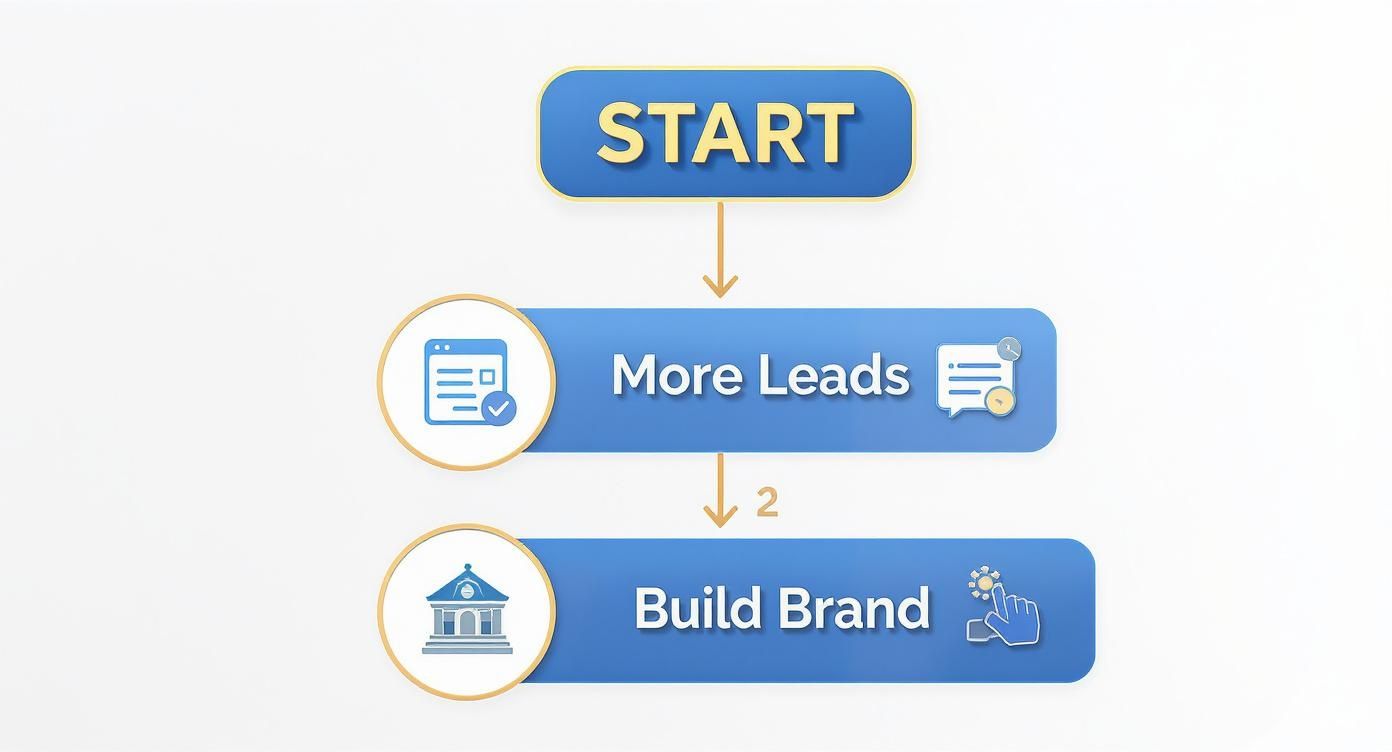
As you can see, a hard-hitting lead generation campaign will push you toward tight, specific targeting, while a brand-building campaign might call for a broader approach.
Using Your Own Data With Custom Audiences
Okay, this is where things get really powerful. Custom Audiences let you use your firm's own data to reconnect with people who already know you. It's the digital version of a warm follow-up call, and it’s incredibly effective.
You can build these audiences from a few different sources, but the most valuable for a law firm is your website traffic. By installing the Meta Pixel (a small snippet of code) on your website, you can create lists of people who visited specific pages.
Imagine someone reads your blog post, "What to Do After a Car Accident." You can automatically add them to a "PI Website Visitors" audience. A few days later, you can show them a targeted ad for a free consultation. Your ad is no longer a random interruption—it's a timely, relevant solution.
The data proves this works. A whopping 71% of law firms now generate leads from social media, and Facebook is at the top of the list.
Finding New Clients With Lookalike Audiences
Once you have a solid Custom Audience—like a list of your best past clients or people who've spent the most time on your site—you can unleash Facebook's most potent targeting tool: Lookalike Audiences.
A Lookalike Audience is exactly what it sounds like. You give Facebook a source audience (your "seed" list), and its algorithm scours the platform to find millions of other users who share similar characteristics, behaviors, and interests. It’s like cloning your best clients.
This is how you scale your campaigns from a trickle of leads to a steady flow. You're no longer guessing who to target. You’re using hard data from your most successful cases to find thousands of new potential clients who are just like them.
For a criminal defense firm, building a Lookalike Audience from a list of past client consultation forms is an absolute game-changer. For more on this, check out our deep dive on criminal defense attorney marketing.
Navigating Privacy Changes and iOS 14
Let's be real: privacy updates, especially Apple's iOS 14 changes, have thrown a wrench into tracking. It's made things more challenging, but it hasn't killed Facebook advertising. It just means you have to be smarter about your setup.
The key is to implement Facebook's Conversions API (CAPI) right alongside the Meta Pixel. The Pixel is browser-based, which means ad blockers can stop it in its tracks. CAPI, on the other hand, sends data directly from your website's server to Facebook's server.
This server-to-server connection is far more reliable. It helps fill in the tracking gaps left by privacy settings, giving you a much more accurate picture of your ad performance. This allows you to build stronger retargeting and Lookalike Audiences, even in today's privacy-first world.
Designing Compliant Ads That Actually Convert

Here's where things get tricky. Crafting a high-performing ad is a delicate balancing act. You need to grab attention and speak directly to a potential client's pain points, but you also have to navigate a minefield of state bar advertising rules and Facebook's own strict policies.
An ad that gets disapproved is frustrating. An ad that lands you in hot water with the bar is a nightmare. The secret is to build your creative to be both persuasive and meticulously compliant from the ground up.
Writing Ad Copy That Connects
The single most common mistake I see attorneys make is talking about themselves. Your years of experience and firm accolades are important, but that's not what a person in crisis cares about in that first moment of contact.
Effective ad copy always focuses on the client's problem, not your firm's solution. It should use empathetic language that acknowledges their situation and offers a clear, reassuring path forward. Your tone should be helpful and authoritative, never boastful or aggressive.
Let's look at a real-world example for a family law practice targeting people considering divorce:
- Ineffective Copy: "Jones & Smith Law has 20 years of experience in family law. We are aggressive litigators dedicated to winning. Call us for a consultation."
- Effective Copy: "Facing an uncertain future is difficult. We can help you understand your rights and options for protecting your family and your assets. Get a confidential consultation to find clarity."
The second version works because it speaks directly to the user's emotional state—uncertainty and fear—and offers a benefit they crave: clarity. This approach builds trust before you ever ask for their business.
Avoiding Facebook's Prohibited Ad Content
On top of everything else, Facebook has its own set of rules, especially its "Personal Attributes" policy. This policy is a huge deal for attorneys because it prohibits ads that imply knowledge of a user's personal, sensitive information.
You simply cannot call out a specific situation. For instance, a bankruptcy attorney's ad can't say, "Struggling with debt? File for bankruptcy today!" That phrasing implies you know the person seeing the ad is in debt, which is a major violation.
Instead, you have to frame it educationally. A compliant version would be: "Learn the options available for managing overwhelming debt. Our free guide explains the differences between debt consolidation and bankruptcy." This shifts the focus from the user's personal crisis to providing helpful information.
To stay safe, your ad copy absolutely must:
- Avoid asking direct questions about personal problems (e.g., "Were you injured in an accident?").
- Never imply you know their personal status (e.g., "As a recent DUI recipient…").
- Focus on the services you offer and the general information you can provide.
A Compliance Checklist for Attorney Advertising
Beyond Facebook's platform rules, your state bar's advertising guidelines are paramount. While the specifics vary by jurisdiction, some rules are nearly universal. Getting this wrong can have serious professional consequences.
This is a critical area where diligence pays off. If you practice in California, for example, understanding the nuances is non-negotiable. You can learn more by reading this detailed guide to ethical attorney advertising in California, which breaks down many of the core principles that apply broadly.
Before you ever launch a campaign, run through this quick checklist:
- Never Guarantee Outcomes: Ditch phrases like "we will win your case" or "guaranteed results." This is one of the most serious violations you can make.
- Use Disclaimers: Most states require disclaimers like "Attorney Advertising" or "This is an advertisement." Make sure it's clearly visible in your ad or on your landing page.
- Avoid Misleading Statements: You can't create an unjustified expectation. Calling yourself "the best personal injury lawyer" is often prohibited unless it is verifiably true.
- Respect Client Confidentiality: Never use client names, photos, or case details in an ad without their explicit, written consent. Even then, testimonials can be a compliance gray area in some states.
- Be Clear About Fees: If you mention a "no fee unless we win" model, be crystal clear about whether this excludes litigation costs and other expenses.
Getting an ad disapproved is frustrating. Getting a letter from the state bar is a disaster. Always, always err on the side of caution.
One last tip: to give potential clients instant answers and pre-qualify them before they even speak to your intake team, consider how you can integrate a Messenger chatbot. It's a powerful tool for engagement that can operate 24/7 within your compliant messaging framework.
Measuring Performance and Optimizing Your Ad Spend

Getting your campaign live is just the first step. The real work—and where most firms stumble—is in the constant cycle of measuring, learning, and refining your ads. Just throwing money at Facebook without tracking what happens is the quickest way to burn through your marketing budget with zero new cases to show for it.
Success isn't about getting the most likes or shares. It's about generating qualified leads at a cost that actually makes sense for your bottom line. To do that, you have to get comfortable with the data and know which numbers truly move the needle.
Setting Up Your Tracking Foundation
Before you spend another dime, you have to get your tracking infrastructure right. If you don't, you're just flying blind. The two non-negotiable tools here are the Meta Pixel and the Conversions API (CAPI).
- The Meta Pixel: This is a snippet of code you install on your website. It's what connects the dots, tracking actions like when someone visits a practice area page or submits a contact form, and then tying that activity back to the specific ad they clicked on.
- Conversions API (CAPI): Think of CAPI as the Pixel’s more reliable big brother. With all the privacy updates and ad blockers out there, the Pixel can miss a lot of data. CAPI sends conversion info directly from your website's server to Facebook's, giving you a much more accurate and complete picture of your campaign’s results.
Having both isn't optional anymore; it's the foundation for accurate reporting and building effective audiences in today's privacy-first world. This setup is the bedrock of any successful law firm lead generation strategy.
Key Metrics That Actually Matter for Law Firms
The Facebook Ads Manager dashboard can be overwhelming, packed with dozens of metrics. The trick is to ignore the noise and focus on the handful that truly dictate a law firm's success.
- Cost Per Lead (CPL): This is your north star. It tells you exactly how much you’re spending to get one potential client to fill out your form or call your office. If your goal is a $150 lead and you’re currently spending $300, you know it’s time to make a change.
- Click-Through Rate (CTR): This number tells you how compelling your ad is. A low CTR (anything under 1%) is a huge red flag that your ad creative or headline just isn't grabbing the attention of your target audience.
- Conversion Rate: Of all the people who clicked your ad and landed on your page, what percentage actually took action? This metric is a gut check for your landing page—if it's low, the problem might not be the ad, but the page itself.
- Return on Ad Spend (ROAS): This is the ultimate measure of profitability. It’s calculated by dividing the revenue you generated from your ads by what you spent. By 2025, an estimated 28% of law firms plan to make Facebook Ads their top paid social platform, and for good reason—the average firm sees a marketing ROI of 526% over three years.
Don't get distracted by vanity metrics like "reach" or "impressions." They have a place in broad brand awareness campaigns, but for generating actual cases, CPL and ROAS are the only numbers that tell you if your investment is growing your firm.
A Simple Framework for A/B Testing
Optimization is just a fancy word for testing. A/B testing, also known as split testing, is how you move from guesswork to a data-driven process, methodically improving your ads by changing one thing at a time.
Here's how to start:
- Isolate One Variable. This is the golden rule. Never test the image and the headline at the same time. If you do, you'll have no idea which change actually made the difference.
- Test High-Impact Elements First. Start with big swings. Test a video ad against a static image, or try two completely different headlines that take different emotional angles.
- Use a Control. Always run your original ad (the "control") against the new version (the "variation") to the same audience. This gives you a clear baseline for comparison.
- Gather Enough Data. Don't jump to conclusions after a day. Let the test run long enough to be statistically significant, which could be a few days or a week, depending on your budget.
Here’s a real-world scenario: An immigration attorney is running an image ad and getting leads for $120 each (CPL). They decide to A/B test it against a short video explaining the consultation process. After a week, the video ad's CPL drops to $85—a 30% reduction. Now they can confidently shift their budget to video, knowing it will dramatically improve their campaign's overall return. This process of continuous improvement is how you turn a good campaign into a great one. You can dive deeper into these strategies in our guide to law firm lead generation.
Your Top Questions About Facebook Ads for Attorneys, Answered
If you're thinking about using Facebook ads for your law firm, you probably have a lot of questions. That’s a good thing. It means you’re thinking strategically. Here are some straight answers to the most common questions we get from lawyers, cutting through the jargon to give you real-world advice.
How Much Should a Law Firm Spend on Facebook Ads?
There's no magic number here, but a good starting point for most firms is somewhere in the $1,000 to $3,000 per month range. That’s enough to get meaningful data flowing so you can actually test what’s working with different audiences and ad creative.
The right budget really comes down to your practice area, how fierce the competition is in your city, and—most importantly—what a new client is actually worth to your firm.
Don't just pick a number out of thin air. Work backward. Figure out your target client acquisition cost (CAC), which is just a fancy way of asking: "What am I willing to pay to sign a new case?" Start with a smaller test budget to see what your cost-per-lead (CPL) looks like. Once you have a positive return, you can confidently turn up the dial.
Is Facebook Better Than Google Ads for Lawyers?
This question comes up all the time, and the answer is that they're different tools for different jobs. The smartest marketing strategies don't pick one over the other—they use both together.
- Google Ads is all about capturing active demand. You're getting in front of people who are searching for a lawyer right now. Think of someone frantically typing "car accident lawyer near me" into their phone from the side of the road. Their intent is sky-high.
- Facebook Ads is for creating future demand. It lets you get in front of people who match your ideal client profile but aren't necessarily looking for an attorney at this very moment. You’re building brand awareness and trust, so when they do need legal help, your firm is the first one they think of.
A personal injury firm uses Google to catch the person who just had an accident. They use Facebook to become the most recognized PI firm in the community, so they're top-of-mind before that accident even happens.
Can I Run Facebook Ads Myself or Should I Hire Someone?
You can technically run your own campaigns, but let's be honest—the learning curve is steep. For lawyers who aren't marketing experts, the risk of burning through cash by targeting the wrong people or, even worse, breaking compliance rules is incredibly high.
For most attorneys, your time is far more valuable handling billable work.
Hiring a specialized legal marketing agency almost always delivers a much better ROI. They've already spent years figuring out what works for legal audiences, what ad creative is compliant, and how to optimize campaigns. They let you skip the expensive trial-and-error phase.
If you’re determined to go the DIY route, you have to commit to learning. And please, start with a very small, tightly controlled budget to test your ideas before you even think about scaling up.
What Are the Biggest Compliance Mistakes Attorneys Make?
This is where the stakes get really high. A simple advertising mistake can land you in hot water with your state bar. Here are the most common—and most dangerous—compliance traps we see:
- Promising specific outcomes: Language like "We will win your case" is the cardinal sin of legal advertising. You can never, ever guarantee a result.
- Using testimonials improperly: Many states have incredibly strict rules about client testimonials. You often need explicit consent and disclaimers, and some places just ban them outright.
- Creating misleading impressions: You can't overstate your experience or create an unjustified expectation about the results you can achieve for a client.
- Forgetting required disclaimers: Most states mandate that your ads include a disclaimer like "Attorney Advertising" or "This is an advertisement." Don't forget it.
- Using deceptive imagery: That stock photo of a happy family could imply an attorney-client relationship that doesn't exist. It's a frequent and risky mistake.
Always, without exception, have your state bar's advertising rules open in another tab before you spend a single dollar on ads.
Ready to grow your firm with a proven marketing strategy? The team at Case Quota has over 15 years of experience helping attorneys in Southern California attract the right clients through targeted, compliant, and effective advertising. Get in touch with us today to see how we can help you hit your case quota.