

When it comes to personal injury claims, the clock is always ticking. Every state has a strict deadline for filing a lawsuit, known as the statute of limitations. Miss it, and your right to seek compensation is usually gone for good.
Most states give you two or three years from the date you were injured to file a claim, whether it’s from a car wreck or a slip and fall. But don't get too comfortable with that number. Some states are far less generous, offering as little as one year, while a few others extend the deadline up to six.
Understanding the Deadline to File Your Injury Claim

So, what exactly is a statute of limitations? It's a law that sets the maximum time you have to initiate legal proceedings after an event. For personal injury cases, that "event" is almost always the date the injury happened, which is when the legal clock—the claim "accrual"—starts running.
These laws exist for a practical reason: they make sure claims move forward while evidence is still available and memories are fresh. It keeps things fair for everyone involved.
Why These Deadlines Are Non-Negotiable
The legal system needs these time limits to create predictability for both the person who was hurt (the plaintiff) and the person being blamed (the defendant). Without a hard cutoff, defendants would constantly be looking over their shoulder, never knowing if a lawsuit from years ago might surface.
For plaintiffs, knowing the personal injury statute of limitations by state is one of the most important parts of their case. The consequences of getting it wrong are devastating.
- Your Case Gets Dismissed: File even one day late, and the other side will immediately ask the court to throw out your case. The judge will almost certainly agree.
- You Lose All Bargaining Power: Your ability to negotiate a settlement with an insurance company vanishes once the deadline passes. Why would they pay if you can no longer sue them?
A Quick Look at State Variations
To give you a sense of the landscape, here's a quick summary of how these deadlines shake out across the country.
Quick Overview of State Personal Injury Filing Deadlines
This table summarizes the general range of personal injury statute of limitations across the United States to provide a quick reference.
| Time Limit Range | Number of States (Approx.) | Common Examples |
|---|---|---|
| 1 Year | 2-3 | Kentucky, Louisiana, Tennessee |
| 2 Years | ~20 | California, Texas, Georgia, Illinois |
| 3 Years | ~20 | New York, Massachusetts, Colorado |
| 4+ Years | ~10 | Florida, Utah, Maine, North Dakota |
As you can see, there's no single rule, which makes things complicated, especially if you were injured while traveling out of state.
These aren't just obscure legal technicalities; they have real-world impact. Research suggests that a staggering 15–20% of personal injury claims are thrown out each year simply because they were filed too late. It’s a common and costly mistake. For a deeper dive into how these deadlines affect cases nationwide, check out Martinian Law's national report.
This guide is here to help you make sense of it all. We'll provide a comprehensive, state-by-state breakdown so you can protect your rights and file on time.
State-by-State Personal Injury Statute of Limitations Table
When handling a personal injury case, the statute of limitations is the single most important deadline. It's the ticking clock that dictates a client's right to file a lawsuit, and it varies wildly from state to state. For any practicing attorney, a reliable, quick-glance reference isn't just helpful—it's essential for protecting a client's claim from being extinguished before it even begins.
What follows is a comprehensive table breaking down the personal injury statute of limitations by state. We've built this as a practical tool for quick lookups, covering general personal injury, medical malpractice, and wrongful death claims. And to ensure you can confidently cite your source, we've linked directly to the relevant state code or an authoritative legal resource for every single entry.
How to Use This Reference Table
Think of this table as your first stop for confirming state-specific filing deadlines. Here’s what you’re looking at in each column:
- State: The jurisdiction where the injury took place. It’s a critical reminder: the law of the state where the incident occurred almost always governs the claim, not where your client lives.
- General Personal Injury: This is your go-to deadline for the most common claims—car accidents, slip and falls, dog bites, and other standard torts.
- Medical Malpractice: These cases often get their own, sometimes shorter, and more complex deadlines. The clock might start ticking from the date of the negligent act or, in many states, from the date the injury was "discovered."
- Wrongful Death: When an injury proves fatal, the surviving family members can file a wrongful death action. These claims have their own unique statutes of limitations, which must be carefully calculated.
- Statute Citation/Source Link: This is your direct line to the primary source. Use this link to verify the information and dig deeper into the statutory language and any relevant case law.
Always remember, this table is a powerful starting point, not the final word. Countless exceptions and tolling rules can shift these deadlines. Nothing replaces a thorough review of the law for the specific facts of your case.
Crucial Takeaway: Never, ever assume a deadline. A miscalculation can get a case dismissed with prejudice, permanently barring a client from any chance at recovery. The very first step in any new client intake should be to verify the statute of limitations.
Personal Injury Statute of Limitations By State
Here is a detailed breakdown of the personal injury, medical malpractice, and wrongful death statutes of limitations for all 50 states and the District of Columbia, complete with citable sources.
| State | General Personal Injury | Medical Malpractice | Wrongful Death | Statute Citation/Source Link |
|---|---|---|---|---|
| Alabama | 2 years | 2 years | 2 years | Ala. Code § 6-2-38 |
| Alaska | 2 years | 2 years | 2 years | Alaska Stat. § 09.10.070 |
| Arizona | 2 years | 2 years | 2 years | Ariz. Rev. Stat. § 12-542 |
| Arkansas | 3 years | 2 years | 3 years | Ark. Code § 16-56-105 |
| California | 2 years | 1 year (from discovery) or 3 years (from injury) | 2 years | Cal. Civ. Proc. Code § 335.1 |
| Colorado | 2 years (most torts), 3 years (auto accidents) | 2 years | 2 years | Colo. Rev. Stat. § 13-80-101 |
| Connecticut | 2 years | 2 years | 2 years | Conn. Gen. Stat. § 52-584 |
| Delaware | 2 years | 2 years | 2 years | Del. Code tit. 10 § 8119 |
| District of Columbia | 3 years | 3 years | 2 years | D.C. Code § 12-301 |
| Florida | 2 years (effective 3/24/23) | 2 years | 2 years | Fla. Stat. § 95.11 |
| Georgia | 2 years | 2 years | 2 years | Ga. Code § 9-3-33 |
| Hawaii | 2 years | 2 years | 2 years | Haw. Rev. Stat. § 657-7 |
| Idaho | 2 years | 2 years | 2 years | Idaho Code § 5-219 |
| Illinois | 2 years | 2 years | 2 years | 735 Ill. Comp. Stat. 5/13-202 |
| Indiana | 2 years | 2 years | 2 years | Ind. Code § 34-11-2-4 |
| Iowa | 2 years | 2 years | 2 years | Iowa Code § 614.1 |
| Kansas | 2 years | 2 years | 2 years | Kan. Stat. § 60-513 |
| Kentucky | 1 year (most torts), 2 years (auto accidents) | 1 year | 1 year | Ky. Rev. Stat. § 413.140 |
| Louisiana | 1 year | 1 year | 1 year | La. Civ. Code art. 3492 |
| Maine | 6 years | 3 years | 2 years | Me. Rev. Stat. tit. 14 § 752 |
| Maryland | 3 years | 3 years (from discovery) or 5 years (from injury) | 3 years | Md. Cts. & Jud. Proc. Code § 5-101 |
| Massachusetts | 3 years | 3 years | 3 years | Mass. Gen. Laws ch. 260, § 2A |
| Michigan | 3 years | 2 years | 3 years | Mich. Comp. Laws § 600.5805)/mileg.aspx?page=getObject&objectName=msl-600-5805) |
| Minnesota | 2 years (most torts), 6 years (negligence) | 4 years | 3 years | Minn. Stat. § 541.07 |
| Mississippi | 3 years | 2 years | 3 years | Miss. Code § 15-1-49 |
| Missouri | 5 years | 2 years | 3 years | Mo. Rev. Stat. § 516.120 |
| Montana | 3 years | 2 years | 3 years | Mont. Code Ann. § 27-2-204 |
| Nebraska | 4 years | 2 years | 2 years | Neb. Rev. Stat. § 25-207 |
| Nevada | 2 years | 1 year (from discovery) or 3 years (from injury) | 2 years | Nev. Rev. Stat. § 11.190 |
| New Hampshire | 3 years | 3 years | 3 years | N.H. Rev. Stat. § 508:4 |
| New Jersey | 2 years | 2 years | 2 years | N.J. Stat. § 2A:14-2 |
| New Mexico | 3 years | 3 years | 3 years | N.M. Stat. § 37-1-8 |
| New York | 3 years | 2.5 years | 2 years | N.Y. C.P.L.R. § 214 |
| North Carolina | 3 years | 3 years | 2 years | N.C. Gen. Stat. § 1-52 |
| North Dakota | 6 years | 2 years | 2 years | N.D. Cent. Code § 28-01-16 |
| Ohio | 2 years | 1 year | 2 years | Ohio Rev. Code § 2305.10 |
| Oklahoma | 2 years | 2 years | 2 years | Okla. Stat. tit. 12 § 95 |
| Oregon | 2 years | 2 years | 3 years | Or. Rev. Stat. § 12.110 |
| Pennsylvania | 2 years | 2 years | 2 years | 42 Pa. Cons. Stat. § 5524 |
| Rhode Island | 3 years | 3 years | 3 years | R.I. Gen. Laws § 9-1-14 |
| South Carolina | 3 years | 3 years | 3 years | S.C. Code § 15-3-530 |
| South Dakota | 3 years | 2 years | 3 years | S.D. Codified Laws § 15-2-14 |
| Tennessee | 1 year | 1 year | 1 year | Tenn. Code § 28-3-104 |
| Texas | 2 years | 2 years | 2 years | Tex. Civ. Prac. & Rem. Code § 16.003 |
| Utah | 4 years | 2 years | 2 years | Utah Code § 78B-2-307 |
| Vermont | 3 years | 3 years | 2 years | Vt. Stat. tit. 12 § 512 |
| Virginia | 2 years | 2 years | 2 years | Va. Code § 8.01-243 |
| Washington | 3 years | 3 years | 3 years | Wash. Rev. Code § 4.16.080 |
| West Virginia | 2 years | 2 years | 2 years | W. Va. Code § 55-2-12 |
| Wisconsin | 3 years | 3 years | 2 years | Wis. Stat. § 893.54 |
| Wyoming | 4 years | 2 years | 2 years | Wyo. Stat. § 1-3-105 |
Making Sense of the Variations
As you can see, there is no “standard” deadline. The time limits swing from a dangerously short one year in states like Kentucky, Louisiana, and Tennessee to a much more forgiving six years in Maine and North Dakota. This is exactly why identifying the correct jurisdiction from the outset is paramount.
For attorneys, a robust system for tracking these deadlines is non-negotiable. Missing one isn't just a simple mistake; it's a catastrophic, case-ending error. This is where sharp law firm management intersects with smart digital marketing. Having efficient internal processes and clear, authoritative online content is key to attracting and successfully representing clients. You can dive deeper into this with The Complete SEO Guide for Personal Injury Attorneys, which outlines how to generate more clients by building that essential online trust.
The complexity goes even deeper than the general deadlines. Pay close attention to how many states carve out different rules for specific types of cases.
- Medical Malpractice Nuances: Many states apply a "discovery rule" in medical malpractice claims. This means the clock doesn't start ticking when the mistake happened, but when the patient discovered—or reasonably should have discovered—the harm. California, for example, gives a plaintiff one year from discovery but imposes an absolute limit of three years from the date of the injury itself.
- Wrongful Death Timelines: These claims also operate on their own timelines. The statute of limitations usually begins on the date of the person's death, which could be days, weeks, or even years after the initial act of negligence that caused the fatal injury.
Grasping these distinctions is fundamental to calculating the correct filing deadline. This table gives you the foundation, but a deep dive into that state's specific laws, including recent court rulings, is always the final, necessary step.
How Tort Reform and Court Rulings Shape These Deadlines
https://www.youtube.com/embed/v_jmXJL9f-U
The statute of limitations in any given state isn't a rule that was carved in stone and forgotten. Far from it. These deadlines are living things, constantly being shaped and reshaped by legislative action, major court decisions, and sweeping policy shifts like tort reform.
That reform movement, which really picked up steam in the late 20th century, was all about curbing litigation, capping damages, and bringing down liability insurance premiums. Supporters will tell you it cuts down on frivolous lawsuits, but critics argue it slams the courthouse door on legitimately injured people. One of the most common battlegrounds? Shortening the time victims have to file a claim.
The Impact of Legislative Changes
When a state legislature decides to tinker with its statute of limitations, the effect is immediate and profound. These changes are often a barometer of the state's political and economic climate, showing a push-and-pull between protecting corporate interests and preserving an individual's right to seek justice.
Take Texas, for example. The state made huge changes to its legal landscape back in the early 2000s. Lawmakers shortened the general personal injury statute of limitations, and the result was a dramatic drop in lawsuit filings. In the decade that followed, the number of personal injury suits filed each year in Texas plummeted by about 35%. For a deeper dive into these kinds of state-by-state trends, you can check out valuable resources like 50-state legal surveys.
This chart gives you a quick visual on how deadlines can vary, even within the same state.
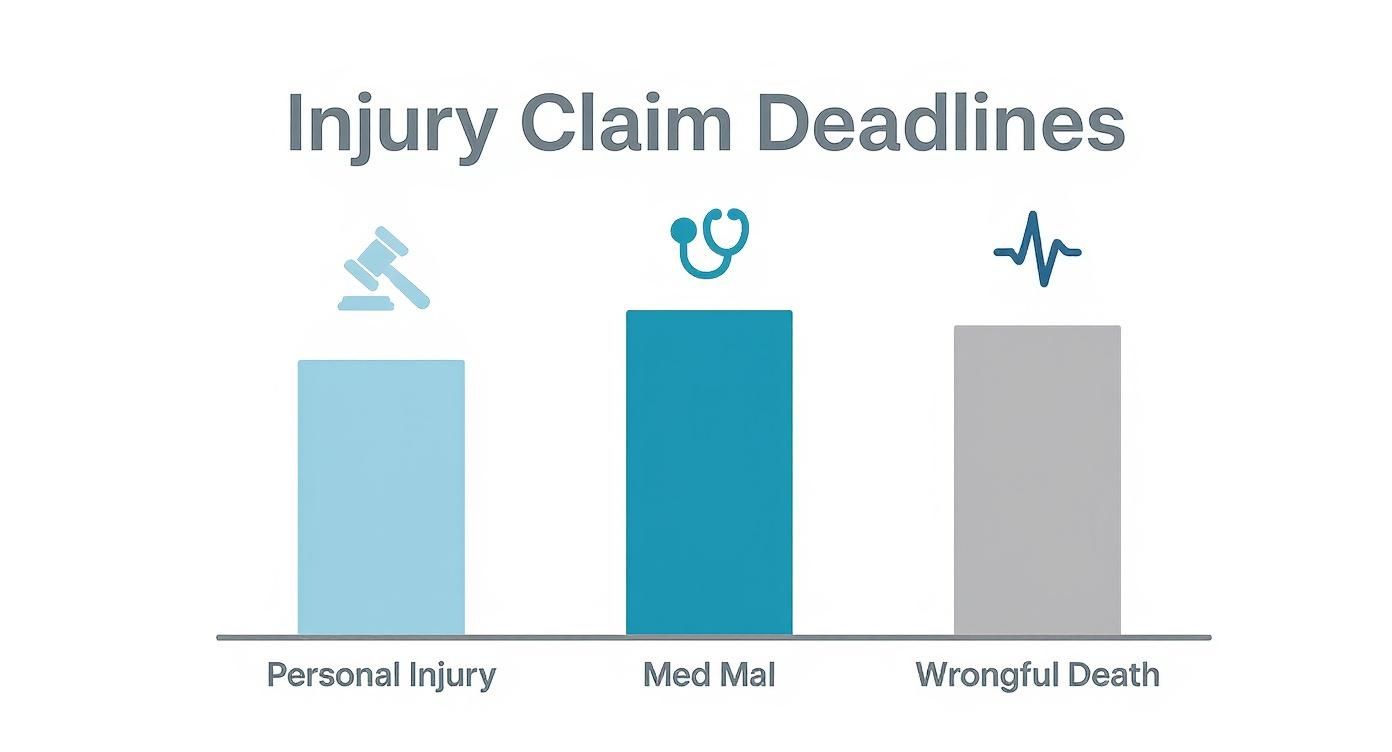
It’s pretty clear that states often set unique—and frequently shorter—clocks for complex cases like medical malpractice compared to a standard bodily injury claim.
How Court Rulings Refine the Rules
It’s not just about what the legislature writes. State supreme courts play a massive role in interpreting how these deadlines actually work in the real world. Judges are the ones who decide how a law applies to a messy, nuanced case—like figuring out when an injury was technically "discovered" or whether a defendant's conduct was bad enough to justify an extension.
A single landmark court decision can redefine when the legal clock starts ticking for thousands of future plaintiffs, making case law just as important as the written statute itself.
These judicial interpretations are what keep the law relevant as new types of injuries and modern problems arise. For any practicing attorney, staying on top of both new statutes and recent court precedents is non-negotiable. These shifting legal sands also change how law firms can even talk about their services, which you can see in our guide to ethical attorney advertising in California.
Key Exceptions That Can Extend Your Filing Deadline

While a statute of limitations feels like a concrete deadline, it’s not always set in stone. The law recognizes that some situations make it fundamentally unfair—or outright impossible—for an injured person to file a lawsuit on time. That's where specific legal doctrines can step in to pause the clock.
These exceptions, known as tolling provisions, effectively freeze the countdown on the statute of limitations until a certain condition is met. Knowing these rules is a critical part of case analysis, as they can sometimes revive a claim that would otherwise be lost forever. But be warned: relying on an exception requires solid evidence and a firm grasp of the specific personal injury statute of limitations by state.
The Discovery Rule Explained
Perhaps the most important exception is the Discovery Rule. This doctrine is a lifeline in cases where an injury isn't obvious right away. Instead of the clock starting on the date of the accident or negligent act, it begins when the injured person discovered—or reasonably should have discovered—both their injury and its connection to the defendant's actions.
This rule is absolutely essential in cases involving latent harm that takes years to surface. Without it, a victim’s right to sue could expire before they even knew they were hurt.
- Medical Malpractice Example: Imagine a surgeon accidentally leaves a surgical sponge inside a patient. The patient suffers from mysterious abdominal pain for years, but no one makes the connection. Three years post-op, a CT scan finally reveals the foreign object. Thanks to the discovery rule, the statute of limitations clock would likely start ticking from the date of that CT scan, not the date of the surgery.
- Toxic Exposure Example: A factory worker is exposed to asbestos for decades but is diagnosed with mesothelioma 20 years after retiring. The discovery rule allows the filing deadline to begin upon diagnosis, acknowledging the harm was hidden and impossible to identify any earlier.
Ultimately, the Discovery Rule is a matter of fairness. It exists to ensure that a right to justice isn't lost simply because an injury was hidden or slow to develop. Its application, however, varies dramatically from state to state and by the type of injury involved.
Tolling for Minors and Mental Incapacity
The law provides special safeguards for individuals who can't legally file a lawsuit on their own. The two most common situations involve minors and those who are mentally incapacitated. In these scenarios, the law "tolls," or pauses, the statute of limitations.
Rules for Injured Minors
When a child gets hurt, most states will pause the statute of limitations until they reach the age of majority, which is typically 18. Once they become a legal adult, the clock starts running, and they are given a specific period—often one to three years, depending on the state—to file their own personal injury lawsuit.
For example, say a 10-year-old is injured in a state with a two-year statute of limitations. The deadline doesn't expire on their 12th birthday. Instead, the clock is frozen until they turn 18. From that point, the two-year period begins, giving them until their 20th birthday to file a claim.
Rules for Mental Incapacity
In a similar vein, if a person is legally deemed mentally incompetent at the time of their injury—perhaps due to a coma, a severe traumatic brain injury, or another condition—the statute of limitations is usually tolled.
The clock generally stays paused until the person regains their mental capacity. If they never recover, the deadline might be tolled indefinitely or until a legal guardian is appointed to act for them. These rules are in place to make sure a person’s inability to understand their own legal rights doesn't prevent them from seeking justice.
Different Deadlines for Specific Types of Injury Claims
The general statute of limitations for personal injury is your baseline, but it's a mistake to think it's the only deadline that matters. In reality, it's just the beginning. States often create specific, and almost always shorter, timelines for different kinds of injury claims.
Why the variation? The law recognizes that some cases are just different. The evidence might fade faster, or the defendant might be a unique entity, like the government, that gets special protection. Assuming the standard deadline applies across the board is one of the easiest ways for a case to get thrown out on a technicality.
Claims Against Government Entities
Trying to sue a city, county, or state agency is a whole different ballgame. This isn't like suing a private citizen. Government bodies are shielded by what's called sovereign immunity, which basically means they can’t be sued unless they agree to it—and they set very strict rules for how that happens.
One of those rules is a much faster timeline. Before you can even think about filing a lawsuit, you almost always have to file a formal Notice of Claim.
- Notice of Claim Deadline: This is your official heads-up to the government agency that you intend to sue. The deadlines are notoriously short, sometimes giving you as little as 30 to 180 days from the injury date to get this filed.
- Waiting Period: After you file the notice, you can't just run to the courthouse. You have to wait for the government to review and either accept or deny your claim.
- Statute of Limitations: The clock for the actual lawsuit usually doesn't even start until after that administrative process is over. And even then, the statute of limitations is often cut down to just one year.
Think about it this way: if a city bus hits you, you don't have two years to figure things out. You have a few short months to file that initial notice, or you lose your right to sue entirely.
Product Liability Claims
When a dangerous or defective product hurts someone, the case falls under product liability. For these claims, many states stick with their general personal injury statute of limitations, and the clock typically starts ticking on the date the injury occurred.
But the "discovery rule" is a huge factor here. What if a faulty medical implant causes internal damage that you don't discover for years? In those situations, the clock might not start until you knew, or reasonably should have known, about the injury and its cause. You can see how these nuanced timelines play out in a variety of product liability case examples.
Other Specialized Claim Deadlines
Beyond government and product claims, you'll find a host of other injury types with their own unique statutes of limitations.
Key Insight: The logic behind these different deadlines often comes down to the evidence and the defendant. Lawmakers give the government short notice periods to allow for quick investigations, while other rules are tailored to the specific challenges of proving a particular type of harm.
Here are a few common ones to watch out for:
- Libel and Slander (Defamation): Cases involving harm to your reputation almost always have a very short fuse, often just one year.
- Workers' Compensation: This isn't a lawsuit but an administrative claim. It runs on a completely separate track with its own strict deadlines for reporting the injury to your employer and filing the official claim.
- Intentional Torts: Claims for deliberate acts like assault, battery, or false imprisonment often have shorter time limits than negligence cases, usually around one or two years.
A Practical Checklist for Managing Filing Deadlines

Knowing the personal injury statute of limitations by state is one thing; actively managing it is what truly protects your client. Let's be blunt: missing a deadline is a catastrophic, non-recoverable error. A case with perfect merit becomes worthless in an instant.
To prevent this nightmare scenario, every firm needs a systematic, no-excuses approach from the moment a potential client calls. This isn't just about abstract legal knowledge—it's about a concrete action plan that ensures no critical date ever gets missed.
Initial Case Assessment Steps
The moment a potential case lands on your desk, the clock is ticking. Your first moves must be laser-focused on identifying and locking down that filing deadline.
-
Pinpoint the Injury Date: First thing's first. Establish the exact date the injury occurred. This is your "accrual date" and the starting point for every calculation that follows.
-
Verify the Correct State Law: Where did the injury happen? That jurisdiction’s law will almost always govern the timeline, not where your client lives. This is a rookie mistake you can't afford to make.
-
Identify the Claim Type: Is this a straightforward car wreck, a complex med-mal case, or a claim against a government entity? Each category can have a wildly different deadline and notice requirements.
A classic trap is assuming a general two-year deadline covers everything. A slip-and-fall on city property, for instance, might demand a formal notice of claim within just 90 days—a tiny window that slams shut before most people even think of calling a lawyer.
Docketing and Diligence
Once you have the deadline, the next phase is all about building redundant safeguards. Never, ever rely on one person's memory or a single calendar entry.
-
Calculate the Final Deadline: Use a reliable legal date calculator to land on the exact last day to file. Pay close attention to how weekends and court holidays are treated, as local rules vary.
-
Docket in Multiple Systems: Redundancy is your best friend. The date needs to be logged in at least two separate systems—your firm’s case management software and a personal calendar, for example. Set multiple, escalating reminders well in advance.
-
Begin Investigation Immediately: Procrastination is the enemy. Waiting until the deadline looms creates unnecessary risk and sloppy work. Kicking off the investigation early preserves evidence, locates witnesses, and gives you ample time to draft a strong complaint. Getting the documentation right from the start is crucial, which is where a solid personal injury demand letter template can provide an excellent foundation.
Common Questions About Injury Claim Deadlines
Working through the personal injury statute of limitations by state always brings up a few key questions. Let's tackle some of the most common ones that attorneys and their clients face.
What Happens If I Miss the Filing Deadline?
It’s game over. Plain and simple.
If you file a lawsuit even one day after the statute of limitations has run out, the defendant’s attorney will immediately file a motion to dismiss. The judge will grant it. This isn’t just a procedural speed bump; it’s an absolute bar to recovery. Your client’s legal right to compensation is permanently gone, no matter how strong the case or how severe the injury.
Does the Discovery Rule Apply in Every Case?
Not at all. The discovery rule is a powerful tool, but its application is far from universal.
While many states recognize it for latent injuries—think medical malpractice where a surgical tool is left behind or a toxic tort where the illness manifests years later—its use varies wildly. Some jurisdictions have very narrow interpretations, while others don't apply it to certain personal injury claims at all. You absolutely have to check the specific case law and statutes in the state where the injury took place.
Can I Get an Extension from the Other Side?
Yes, but you have to do it the right way. Parties can agree to a "tolling agreement," which is a formal contract that hits pause on the statute of limitations clock for a set amount of time.
This is a common tactic used to give both sides more breathing room for settlement negotiations without the constant pressure of a looming filing deadline. Critically, this agreement must be in writing and signed by all parties to be enforceable. A verbal promise means nothing. For specific guidance, understanding the role of a specialized personal injury law firm is often the next step.
At Case Quota, we connect attorneys with the clients who need them most. Our focused marketing strategies help your firm grow by reaching the right audience. Find out how we can help at https://casequota.com.