

Personal injury marketing isn't just about running a few ads. It's the entire strategic process of connecting with people who've been wrongfully injured and desperately need legal help. This means a smart, multi-channel approach that blends search engine optimization (SEO), sharp paid advertising, and a rock-solid client intake process to land high-value cases in one of the most competitive legal fields out there.
Winning in the High-Stakes World of PI Marketing
Gone are the days when a few billboards and TV spots were enough to keep the phones ringing. In the dog-eat-dog world of personal injury law, a generic marketing plan is a one-way ticket to getting lost in the noise.
To actually thrive, you need a focused, data-driven strategy that puts your firm in front of clients at the exact moment they need you. It's not about just being online; it's about being strategically visible right where potential clients are searching for a lifeline.
This isn't an abstract concept. Whether you're fighting for cases in a packed market like Southern California or a rapidly growing city, the game is the same. You're up against hundreds of other firms, all chasing the same valuable cases. Old-school tactics just don't have the precision or measurable results to compete with modern digital methods.
The Modern Competitive Landscape
The personal injury law market has exploded into a $61.7 billion industry in the U.S. alone, with more than 50,000 firms all scrambling for a piece of the action. This fierce competition has sent advertising costs through the roof and made it incredibly difficult to stand out.
Before we dive into the playbook, let's get a clear picture of the market you're operating in.
The Personal Injury Market at a Glance
This table breaks down the key numbers that define the modern PI legal space. Understanding these figures is the first step toward building a strategy that can actually compete and win.
| Metric | Statistic | Implication for Your Firm |
|---|---|---|
| Market Size | $61.7 Billion in the U.S. | The market is massive, but so is the competition. A niche focus can help you stand out. |
| Number of Firms | 50,000+ | Your firm needs a strong, unique value proposition to cut through the noise. |
| Tech-Forward Firm Lead Gen | 51% More Leads | Firms using online ads and modern intake systems are dominating lead flow. |
| Tech-Forward Firm Revenue | 52% Higher Revenue | Adopting digital tools isn't a choice; it's directly tied to financial success. |
These numbers tell a simple story: firms that have embraced a modern, digital-first approach aren't just getting by—they're leaving everyone else behind. If you want to dig deeper into the data, you can check out the full personal injury statistics report.
A successful personal injury practice is built on a marketing engine, not a series of one-off campaigns. The goal is to create a predictable, scalable system that delivers a consistent stream of qualified clients who need your expertise.
Why a Multi-Channel Strategy Is No Longer Optional
A strong marketing plan for a PI firm never puts all its eggs in one basket. The only way to win consistently is to integrate several key channels into a complete client acquisition machine. Think of it like building a net with multiple layers, designed to catch potential clients at every stage of their search.
-
SEO and Content: This is your long-term foundation. By creating genuinely helpful content that answers the urgent questions injured people are typing into Google, you build trust and earn organic visibility. It’s a slow burn, but it delivers some of the highest-quality leads at the lowest long-term cost.
-
Paid Advertising (PPC): When you need leads now, nothing beats the immediacy of targeted Google Ads. This lets you jump to the top of the search results for money-making keywords like "car accident lawyer near me," capturing people who are actively looking to hire an attorney.
-
Local SEO: Personal injury is an inherently local game. Optimizing your Google Business Profile and cleaning up your local citations is non-negotiable. This is what gets you seen in the local map pack and "near me" searches, bringing in clients from your own backyard.
-
Video and Social Media: These channels are where you build a human connection. Sharing client success stories (ethically, of course) or educational videos about the claims process establishes your firm as a compassionate, trustworthy guide. It makes people feel comfortable enough to pick up the phone.
Weaving these strategies together creates a powerful marketing engine that does more than just bring in new cases. It builds a resilient brand that can weather market shifts and beat back the ever-growing competition. In the sections that follow, we'll break down the exact playbook for putting each of these pieces into action.
Building Your Digital Foundation with an SEO-First Website

Let's get one thing straight: your law firm's website is not an online brochure. It's your digital storefront, your first impression, and it should be your single most powerful client-generating machine, running 24/7.
But a beautiful website that Google can't find is like having a state-of-the-art office with no front door. It doesn't matter how great it looks if no one can get inside. This is why effective personal injury marketing for lawyers must start with an SEO-first foundation. Every single element, from your site's architecture to how quickly a page loads, has to be engineered to rank high and connect with clients actively searching for help.
And accessibility isn't optional. An ADA-compliant website is a non-negotiable. Not only does a non-compliant site open you up to legal risk, but it also shuts out a huge segment of potential clients. Over 16% of people worldwide live with a significant disability, and an inaccessible site makes it impossible for them to get the help they need from you.
Architecting Your Site for Maximum Visibility
Here's where so many firms go wrong. They design a website for aesthetics and then try to sprinkle in some "SEO" after the fact. That approach is doomed to fail.
Real, effective SEO is baked into your site’s DNA from the very first wireframe. It starts with a logical structure that makes sense to both a potential client and Google’s web crawlers. Think of it like a perfectly organized filing cabinet—you can find exactly what you need in seconds.
For a personal injury firm, this means building out a clear, intuitive hierarchy. Your homepage is the main hub, branching out to your most important practice area pages.
- Top-Level Practice Pages: These are your big-picture categories, like "Car Accidents," "Truck Accidents," and "Slip & Fall."
- Specific Niche Pages: This is where the magic happens. Under each top-level page, you build out content for lucrative sub-niches. For example, your "Truck Accidents" page would link to pages for "Jackknife Accidents," "Tire Blowout Cases," and "Truck Driver Fatigue Lawsuits."
This tiered structure does two crucial things: it allows you to target the hyper-specific, high-intent phrases that serious clients are actually typing into Google, and it signals to the search engine that your firm has deep expertise in these areas.
Essential Elements of an SEO-First Design
Beyond the site map, there are a handful of technical and content elements that are absolutely critical for a high-performing law firm website. These aren't just best practices; they are the table stakes for competing online today.
A fast, mobile-friendly, and secure website is no longer a nice-to-have—it’s the price of entry. Google prioritizes sites that give users a great experience, and if you fail on the basics, you're handing clients to your competitors.
Make sure your website nails these critical components:
- Mobile-First Design: Over 60% of Google searches now happen on a phone. Your site absolutely must look and work flawlessly on mobile. Google now indexes the mobile version of your site first, so a clunky mobile experience directly tanks your rankings.
- Blazing-Fast Page Speed: You have less than three seconds. If your site takes longer than that to load, potential clients are gone. Use tools like Google's PageSpeed Insights to find and fix whatever is slowing you down.
- Core Web Vitals: These are the specific metrics Google uses to measure a site's overall health in terms of speed, interactivity, and visual stability. Passing the Core Web Vitals assessment is a direct ranking signal that tells Google your site is high-quality.
- Trust-Building Content: Every single page needs clear, empathetic language that speaks directly to an injured person's fears and needs. Weave in client testimonials, case results (where ethically allowed), and powerful calls-to-action. To learn more about building a site that converts, check out our in-depth guide on web design for attorneys.
By putting these pieces together, your website stops being a static liability and becomes a dynamic, lead-generating asset. This is the unshakable foundation your entire marketing strategy will be built upon.
Dominating Local Search to Attract Nearby Clients

Let's be blunt: personal injury law is a local game. When someone gets rear-ended in Santa Monica, they aren't looking for a lawyer in Sacramento. They're grabbing their phone and searching for an expert right in their community, right now.
This makes local search the most important battlefield in your entire marketing strategy.
Winning here isn't just about showing up on a map. It's about owning the "map pack," dominating the top organic listings, and making your firm the only logical choice for someone in distress nearby. It’s how you build a powerful, localized presence that signals immediate trust.
Your Google Business Profile Is Your Digital Front Door
Your Google Business Profile (GBP) is the cornerstone of your local SEO. For most potential clients, it’s the very first interaction they'll have with your firm. A neglected or incomplete profile sends a terrible message—it suggests a lack of attention to detail, which is the last thing someone wants in their legal counsel.
On the flip side, a fully optimized GBP is a client-generating machine. It acts like a mini-website right inside the search results, giving people the answers and social proof they need to pick up the phone and call you.
Going Beyond the Basics
Just claiming your profile isn't enough. Not even close. To truly dominate, you have to treat your GBP as a dynamic, living marketing channel. This means consistent effort to keep it fresh, engaging, and full of the signals Google's algorithm loves to see.
Here's where to focus your energy:
- Get Granular with Services & Categories: Don't just list "Personal Injury Attorney." That’s lazy. Use every relevant category you can, like "Truck Accident Attorney" or "Motorcycle Accident Attorney," to capture those high-intent, specific searches.
- Use Real Photos, Consistently: Upload high-quality, authentic photos on a regular basis. Get pictures of your office (inside and out), your team in action, and even shots from community events you're involved in. This humanizes your firm and builds a connection.
- Treat Google Posts Like a Blog: Use the "Posts" feature to share firm updates, recent case results (while minding ethical rules, of course), or helpful content. These posts show up directly in your profile and prove to both Google and potential clients that your firm is active.
- Control the Narrative with Q&A: Don't wait for people to ask questions. Proactively load up the Q&A section with the most common questions you get from new clients and provide clear, authoritative answers. You get to frame the conversation from the very beginning.
Mastering these details is critical. If you want a deeper dive, check out these proven Google Business Profile tweaks for attorneys to really elevate your local game.
Your Google Business Profile is your digital front door. Answering questions, responding to reviews, and posting updates isn't just a marketing task—it's client service, and it starts before they ever call you.
Building Unshakable Trust with Reviews and Citations
Social proof is everything. For someone who's injured, vulnerable, and facing a legal battle, seeing a stream of positive reviews from your past clients can be the single most powerful deciding factor. You need a system for actively and ethically requesting reviews from satisfied clients.
It's also non-negotiable to respond to all reviews—good and bad. A thoughtful, professional response to a negative review often builds more trust than a dozen 5-star ratings because it shows you're listening and you care.
Beyond reviews, you need laser-focused consistency with your local citations. A citation is simply any online mention of your firm's Name, Address, and Phone number (NAP). Google crawls the web looking for these mentions on sites like Avvo, Justia, and local business directories to verify that you are who and where you say you are.
Any inconsistency in your NAP confuses search engines and will tank your rankings. It has to be perfect everywhere.
Using Google Ads to Land High-Intent Cases

While a solid SEO strategy is your long game for building authority, it won't bring in clients by tomorrow afternoon. When you need to generate high-value cases right now, Google Ads is the most direct tool in your arsenal. It puts your firm directly in front of people who are actively, and often desperately, searching for legal help.
This isn’t about just casting a wide net and hoping for the best. Modern personal injury marketing for lawyers is all about surgical precision. With Google Ads, you aren't interrupting someone's social media scrolling; you're answering a direct plea for help. That’s what makes these leads so incredibly valuable.
But be warned, the stakes are sky-high. Some law firms are looking at an $810,000 monthly PPC budget just to land 300 new cases. With top-tier keywords like 'bus accident attorney Los Angeles' costing anywhere from $490 to $1,000 per click, every single dollar has to pull its weight.
Sample PI Keyword CPC vs Potential Case Value
The eye-watering cost of PI keywords on Google Ads only makes sense when you consider the potential return. Below is a snapshot of what you might pay per click versus the potential value of the case you could land.
| Keyword Phrase (Example) | Average Cost Per Click (CPC) | Potential Case Value Range | Strategic Focus |
|---|---|---|---|
| "car accident lawyer near me" | $150 – $350 | $50k – $250k+ | High volume, broad reach. Requires strong local targeting and filtering. |
| "truck accident attorney" | $400 – $700 | $150k – $1M+ | Higher cost, higher value. Targets catastrophic injury cases. |
| "motorcycle accident lawyer" | $300 – $600 | $100k – $750k+ | Niche, but highly specific user intent. Ad copy must be tailored. |
| "slip and fall injury lawyer" | $100 – $250 | $75k – $500k+ | Lower CPC, but case value varies widely. Requires careful lead vetting. |
As you can see, the investment is substantial, but the payoff from a single case can fund your marketing for months. The key is turning those expensive clicks into actual clients.
Build Your Campaigns for Profit, Not Clicks
Throwing your entire budget into a single, generic "personal injury" campaign is the fastest way to burn through cash with nothing to show for it. Success lives in the details. You need a granular, segmented approach that mirrors the structure of your website and your firm's most profitable case types.
Break things down into distinct campaigns and ad groups. For example:
- Campaign: Trucking Accidents
- Ad Group 1: 18-Wheeler Wreck Attorney
- Ad Group 2: Commercial Truck Accident Lawyer
- Campaign: Premises Liability
- Ad Group 1: Negligent Security Attorney
- Ad Group 2: Slip and Fall Injury Lawyer
This structure is a game-changer. It lets you write incredibly specific ad copy and send searchers to landing pages built just for them. This improves your Google Quality Score, which in turn lowers your cost-per-click and sends your conversion rates through the roof.
Writing Ad Copy That Connects Instantly
When someone is in crisis, your ad needs to do more than announce you're a lawyer. It has to connect with their immediate pain, offer a clear path forward, and build a sliver of trust in a split second.
Your headline is your one shot to get their attention. Make it count.
- Weak Headline: "Experienced Personal Injury Firm"
- Strong Headline: "Hurt in a Car Wreck? Free Consult"
The description that follows should immediately address their biggest worries. Phrases like "No Fee Unless We Win" or "24/7 Availability" aren't just marketing fluff; they are powerful reassurances that reduce the hesitation to make that first call. Always be testing different versions of your copy to see what truly resonates.
Expert Insight: Your ad copy must mirror the user's problem. If they searched for 'motorcycle accident lawyer,' your ad headline better say 'Motorcycle Accident Lawyer,' not some generic 'auto accident' term. This tiny detail shows you're listening and dramatically boosts click-through rates.
Stop Wasting Money: The Power of Negative Keywords
One of the most critical parts of a profitable Google Ads account is also one of the most overlooked: an aggressive negative keyword list. These are the search terms you explicitly tell Google not to show your ads for, saving you from paying for completely irrelevant clicks.
For any PI firm, this is non-negotiable. Your list should include terms like:
freepro bonojobssalarytraining
Without these, a search for "personal injury attorney jobs" could easily trigger your ad, wasting hundreds of dollars on a job seeker instead of a potential client. A robust negative keyword list is your first line of defense against a drained budget. It's a key piece of the puzzle, and you can learn more in this modern guide to PPC campaign optimization.
Landing Pages: Where Clicks Become Clients
Sending paid traffic to your homepage is a rookie mistake that costs firms a fortune. Every single ad campaign needs to point to a dedicated landing page designed for one thing and one thing only: getting that person to contact you.
This page needs to be a seamless continuation of your ad. It must include:
- A Clear, Compelling Headline: Reassure them they're in the right place by repeating the promise from your ad.
- Trust Signals: Client testimonials, big case results, and legal association badges need to be front and center.
- A Dead-Simple Contact Form: Make it incredibly easy to reach out. Only ask for the absolute essentials: name, phone, email.
- A Bold Call-to-Action (CTA): Use strong, action-oriented language like "Get Your Free Case Review Now."
When you master these elements, your Google Ads account transforms from a money pit into a predictable, scalable machine for acquiring your most valuable cases. For a deeper dive into this, check out our comprehensive guide on https://casequota.com/google-ads-for-lawyers/.
Connecting with Clients Through Video and Social Media
Trust is the real currency in personal injury law. While a killer SEO strategy and smart Google Ads are fantastic for grabbing people already looking for a lawyer, that's only half the battle. Social media and video are where you build the human connection that makes them choose you.
Think about it. Someone in crisis isn't just looking for a legal technician; they need an advocate they can actually believe in. These platforms let you step out from behind the dense legal jargon and show the compassionate, human side of your practice. This is how you stop being just another business and become a trusted pillar of your community.
Building Real Trust with Authentic Video
Video isn't a "nice-to-have" anymore. It's an absolutely essential tool for building rapport with potential clients before they even think about calling you.
When someone can see and hear you explain a complex legal issue, it creates a powerful sense of familiarity. They feel like they know you. And you don't need a Hollywood production budget, either. Authenticity crushes high-gloss polish every single time. Simple, short videos shot on a good smartphone can be incredibly powerful if the information is genuinely helpful.
Here are a few high-impact video ideas you can start with:
- Quick FAQ Videos: Shoot a series of 60-90 second videos answering the questions you get all the time in initial consults. Think "What's the First Thing I Should Do After a Car Wreck?" or "Should I Ever Talk to the Insurance Adjuster on My Own?"
- "Meet Our Attorneys" Shorts: Film brief, personable intros for each lawyer at your firm. Let them share why they got into personal injury law in the first place. It makes your team approachable and real.
- Ethical Client Testimonials: This is the gold standard. With your client's full and explicit permission, a video testimonial is the most powerful social proof you can possibly have. Hearing a former client describe their experience in their own words is infinitely more compelling than a written review.
The most effective legal marketing videos don’t sell legal services. They offer clarity and reassurance to people who are scared, confused, and hurting. When you focus on educating them first, you earn the right to be their first call.
To get a complete picture of how to weave this into your strategy, exploring different types of attorney marketing videos can give you a ton of actionable ideas and real-world examples.
Using Social Media for True Community Connection
For a PI lawyer, social media isn't about chasing viral trends. It's about building a consistent, trustworthy presence right in your own backyard. Platforms like Facebook and Instagram are perfect for this, allowing you to reach very specific local groups with targeted messages.
Forget just posting links to your latest blog. Your goal is to create content that provides actual value and starts conversations.
Your Social Media Content Game Plan
- Community Spotlights: Feature a local business, a charity you support, or a community event your firm is involved in. This shows you're invested in the community, not just advertising to it.
- Practical Safety Tips: Share timely safety information. In the spring, post about motorcycle awareness. In the winter, share tips for driving in icy conditions. This is simple, helpful content that people appreciate.
- A Look Behind the Scenes: Photos of your team at a charity 5k or celebrating a firm milestone make your practice human. It shows the people behind the law firm, making you far more relatable.
Once you have this great content, you can put a little money behind it with the platform's ad tools. Imagine running a video ad with that powerful client testimonial, but targeting it specifically to people within a 15-mile radius of your office. This blend of valuable organic content and laser-focused paid promotion lets you connect with potential clients in a way that feels genuinely helpful, not intrusive. You're not just buying ads; you're building a pipeline of future cases founded on real trust.
Turning Leads into Cases with a Streamlined Intake Process
All your hard work in SEO, Google Ads, and social media funnels down to one make-or-break moment: the first contact. This is where your marketing spend either materializes into a profitable case or simply vanishes.
Let's be clear: generating leads is only half the battle in personal injury marketing for lawyers. Winning the war means converting those leads with a flawless intake process.
A person reaching out to you is likely in a state of distress, pain, and confusion. Your intake process absolutely must be a model of empathy, speed, and efficiency. Any friction, delay, or hint of disorganization will send a high-value lead straight to your competitor down the street.
Personal injury firms actually have the fastest lead conversion time in the legal industry, averaging just three days. But the numbers behind that are staggering. To sign 300 cases, a firm might need to generate 3,000 leads from 30,000 clicks. This volume makes an airtight intake system non-negotiable if you want to avoid hemorrhaging cash on wasted ad spend.
Mapping The Client Journey From First Contact
The journey from a curious lead to a signed case is a delicate one. It starts the second they dial your number, submit a form, or open a web chat. Every single step has to be optimized to build trust and keep them moving forward. A huge piece of this is having a structured client intake process, which often starts with an effective ultimate guide to your legal client intake form.
Your team needs to handle these initial interactions with precision and compassion. They aren't just receptionists; they're the frontline of your firm's reputation and your very first chance to show a potential client you care.
This whole flow is about educating, connecting, and then converting.
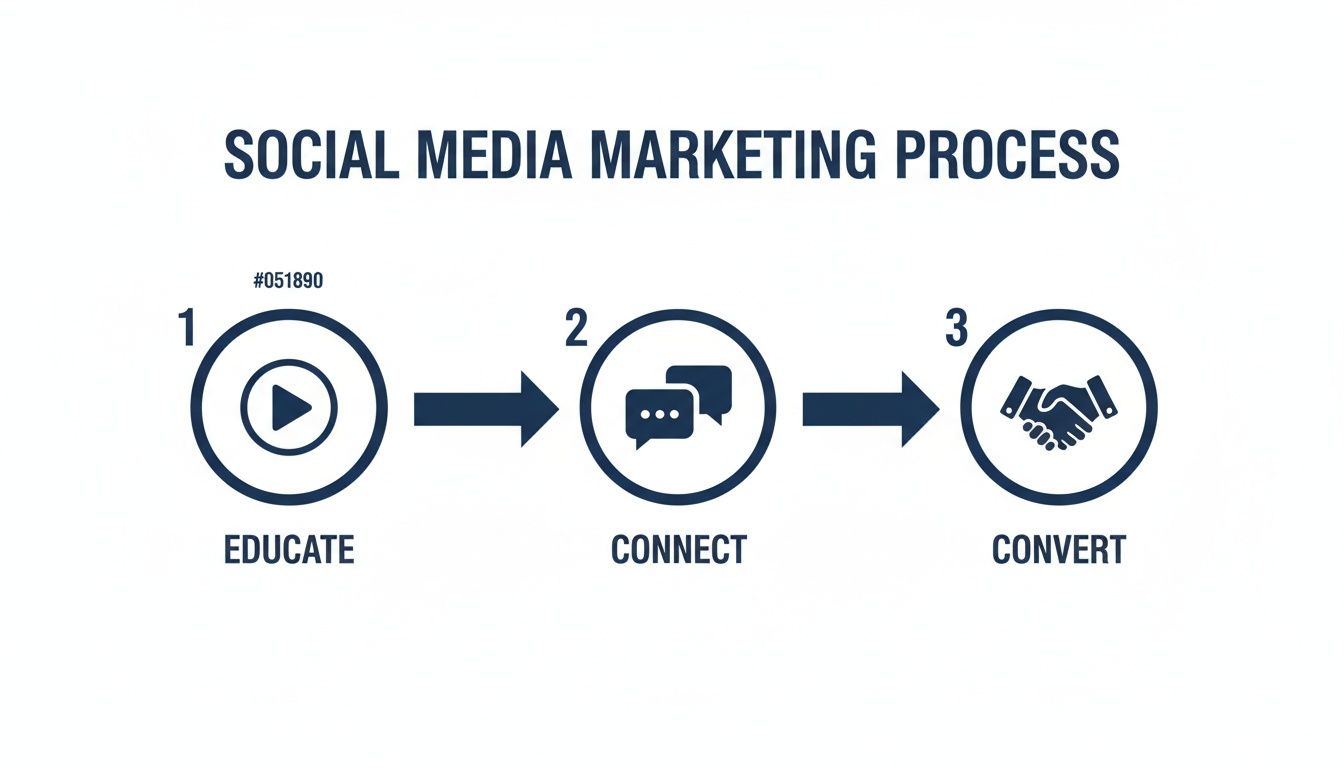
Your intake process is the critical bridge that turns a connection into a conversion, finalizing the relationship.
Equipping Your Team For Success
Your intake specialists need more than a script. To do their jobs right, they need the right tools and training to qualify leads effectively and make every single caller feel heard.
- Intake Software: Modern CRM and case management software isn't a "nice-to-have." It's essential. This tech lets your team capture key details instantly, track where leads came from, and automate follow-ups so nobody ever slips through the cracks.
- Empathy Training: Train your team to listen more than they talk. They need to be experts in active listening, showing genuine empathy, and gently steering the conversation to get the facts without sounding like a robot.
- Rapid Response Protocols: Speed is everything. Create a firm-wide rule: all web forms and missed calls must be answered within 5-10 minutes. The first firm that makes a real connection often lands the case. Period.
A slow, disorganized intake process is the silent killer of law firm growth. You could have the best marketing in the world, but if a potential client's first call is met with an answering machine or an unprepared staff member, you've already lost.
Tracking The Metrics That Actually Matter
If you really want to know if your marketing is working, you have to look past clicks and impressions. You need to zero in on the numbers that directly affect your bottom line. You can't improve what you don't measure.
Here are the key performance indicators (KPIs) every PI firm should be obsessed with:
- Cost Per Lead (CPL): How much you spend on marketing for every single inquiry that comes in, good or bad.
- Cost Per Qualified Lead (CPQL): A much smarter metric. This tracks what it costs to get a lead that actually meets your firm's criteria for a real case.
- Cost Per Signed Case (CPSC): This is the holy grail. It tells you exactly how much marketing cash it takes to get a signed retainer agreement.
By tracing these metrics back to their source—a specific Google Ad, an organic search keyword, or a Facebook post—you can finally make decisions based on data, not gut feelings. It allows you to double down on what’s working and cut the channels that are just draining your budget. For a deeper dive into this pipeline, our guide on lead generation for lawyers breaks down the entire ecosystem.
Common Questions from PI Attorneys, Answered
When you're trying to grow your personal injury firm, you're bound to run into some tough questions about marketing. Let's cut through the noise and get straight to the answers you actually need to make smart decisions and sign more cases.
How Much Should My Firm Actually Spend on Marketing?
There's no single magic number here, but a reliable starting point is anywhere from 5% to 15% of your firm's gross revenue.
If you're a newer firm or you're making a serious push for growth in a tough market (think major metro areas), you'll want to lean toward that higher end. But honestly, the total budget isn't the most important metric. What really matters is your Cost Per Signed Case (CPSC). That's the number that tells you if your marketing is truly profitable.
Should I Bet on SEO or Google Ads?
Why choose? The smartest, most effective strategy uses both.
Think of it this way: SEO is your long-term wealth-building asset. It builds organic credibility and authority that pays dividends for years, delivering an incredible ROI over time. But it takes time to get there.
Google Ads are your immediate source of leads. They get the phone ringing right now, which is essential for keeping a steady flow of cases coming in the door. A truly complete personal injury marketing plan for lawyers uses paid ads for today and SEO for forever.
Don't just take my word for it. The data shows that firms running both AI-powered ads and a strong SEO campaign are generating 51% more client leads and seeing 52% higher revenue. In a market where millions of injuries happen every year but only a fraction become claims, you can't afford to leave opportunity on the table, as detailed in recent legal trends reports.
At Case Quota, we don't just run ads—we build data-driven marketing engines that turn your budget into signed cases. Schedule your free consultation with us today and let's talk about what that looks like for your firm.