

Let’s be honest. When someone needs a personal injury lawyer, they aren't leisurely browsing. They're often scared, in pain, and frantically searching for help on their phone. They need an expert, and they need one now.
Personal injury law SEO is all about making sure your firm is the first one they find in that critical moment of need—whether it's after a car wreck, a slip and fall, or any other life-altering event. It's not just about having a website; it’s about strategically positioning your firm to connect with high-intent people who are actively looking for representation.
Why SEO Is Your Firm’s Best Case Generation Engine

In the dog-eat-dog world of personal injury law, visibility is everything. A polished website is table stakes, but it’s useless if no one ever sees it. That’s like showing up to court with a brilliant argument but no one in the jury box.
Potential clients aren't thumbing through the Yellow Pages anymore. They’re standing on the side of a highway, typing "truck accident lawyer near me" into their phone. A sharp personal injury law SEO strategy puts your name in front of them right when it matters most.
This isn’t about just getting clicks. It's about attracting the right kind of traffic—people with a pressing legal need. This is what transforms your website from a simple online brochure into a powerful engine for high-value cases. This principle is a cornerstone of any effective digital marketing plan for a law firm. You can learn more here: https://casequota.com/complete-guide-to-digital-marketing-for-legal-firms-strategies-that-drive-results/
The Sustainable Advantage of Organic Search
Pay-per-click (PPC) ads get you seen fast, but it’s a rental game. The second you stop feeding the machine, you disappear. That constant cash outflow can bleed a firm dry.
SEO is different. It’s an asset. Every blog post you publish, every backlink you earn, and every technical fix you implement builds a lasting digital foundation for your firm. This foundation grows stronger over time, delivering a steady stream of cases long after the initial work is done.
Think of it this way: PPC is like renting a billboard on the interstate. SEO is like buying the land it stands on. One offers temporary exposure; the other builds long-term equity for your practice. To really get a handle on how this works, it's worth digging into the tactics for driving high-quality SEO leads.
The Clear Business Case for SEO Investment
When you look at the numbers, the case for SEO becomes undeniable. It's simply more cost-effective.
One analysis of 49 personal injury firms—which collectively spent $21.4 million a year on digital marketing—found that Google Search Ads carried the highest cost per lead. SEO, on the other hand, consistently delivered the lowest average cost per lead while building that crucial, compounding value over time.
By investing in a smart SEO strategy, you aren't just buying leads for this month. You're building a reliable, cost-efficient case generation machine that will serve your firm for years, cementing your place in the market and ensuring a healthy pipeline of valuable clients.
Uncovering Keywords That Attract Actual Plaintiffs
Let's start with a crucial mindset shift. To win at SEO, you have to stop thinking like an attorney and start thinking like a potential client—someone who is scared, in pain, and desperately searching for answers. Their Google searches won't be packed with legal jargon. They'll be direct, emotional, and focused on solving their immediate, overwhelming problem.
This is the entire game when it comes to plaintiff-intent keyword research. It’s about getting past the obvious, hyper-competitive terms like "injury lawyer" and digging into the specific, urgent phrases people type when they need help right now. The goal is to show up at that exact moment of need.
Moving Beyond Generic Legal Terms
Your keyword strategy is the bedrock of your entire SEO campaign. If you build it on generic terms, you'll get low-quality traffic and even lower-quality leads. But if you build it on high-intent phrases, you're creating a direct pipeline of qualified cases to your firm.
Think about the real human intent behind these different searches:
-
Generic: "personal injury attorney"
-
Plaintiff-Intent: "compensation for slip and fall at Walmart"
-
Generic: "lawyer near me"
-
Plaintiff-Intent: "what to do after a fender bender hit and run"
The second query in each of those pairs isn't just someone browsing. That’s a person with a real, specific, and urgent problem who is actively looking for a solution. These are the keywords that turn clicks into clients. Tools like Ahrefs or SEMrush are indispensable here, letting you find these long-tail keywords, check their search volume, and see how hard they'll be to rank for.
Mapping Keywords to the Client Journey
From the moment of injury to the day they sign a retainer, a potential client is on a journey. Your content needs to meet them at every single step. This means mapping different keywords to the different stages of their decision-making process. This is a core concept, and understanding the fundamentals of SEO for law firms is what makes it work. For a much deeper look, you can check out our guide on SEO fundamentals for law firms.
We can break this journey down into three distinct phases:
-
Awareness (Top of the Funnel): The person just got hurt. They're looking for information, not necessarily a lawyer just yet. They're just trying to figure out what's going on.
- Keywords: "what to do after a car accident," "symptoms of whiplash," "how to report a slip and fall"
- Content: This is where you publish helpful blog posts, checklists, and FAQs that provide immediate value and quietly establish your firm as a trusted authority.
-
Consideration (Middle of the Funnel): Okay, now they realize they might have a case. They're starting to look into their legal options, and their searches get more specific.
- Keywords: "average settlement for back injury," "do I need a lawyer for a dog bite," "motorcycle accident lawyer reviews"
- Content: This is the time for detailed practice area pages, compelling case studies, and articles that help them evaluate their choices.
-
Decision (Bottom of the Funnel): They're ready to hire someone. Their searches are now transactional and almost always include a location. This is where you land the case.
- Keywords: "best car accident attorney in Miami," "top-rated workers comp lawyer near me," "free consultation injury lawyer Los Angeles"
- Content: Your homepage, attorney bios, contact forms, and client testimonials all work together here to build that final bit of trust and drive them to call you.
By aligning your content with these distinct phases, you create a comprehensive net that captures potential clients no matter where they are in their journey. You become the helpful guide at the beginning and the obvious choice at the end.
Prioritizing keywords is a balancing act between search volume and difficulty. Big, high-volume terms are tempting, but the competition is absolutely brutal. The real gold is often found in the lower-volume, long-tail keywords that signal immediate plaintiff intent.
A smart personal injury law SEO strategy targets keywords across this entire spectrum. It ensures a steady flow of traffic that you can nurture from that first frantic search to a signed client. This targeted approach is what separates the law firms that just have a website from the ones that truly dominate their local market.
Winning the Local Search and Google Maps Battleground
For personal injury attorneys, every single case starts locally. A client across the state line is no good, which is why dominating your local search results isn't just a tactic—it's the entire game. This is where you win or lose the battle for high-value cases.
The most valuable digital real estate for any local firm is the Google Maps "Local Pack." That’s the box of three listings screaming for attention at the top of the search results. Landing there means you are the first, most visible option for someone in a panic, desperately searching for help after an accident.
Your primary weapon in this fight is your Google Business Profile (GBP), formerly known as Google My Business. A neglected profile is a black hole for potential cases. A fully optimized one is a client-attraction machine.
Your Google Business Profile Is Your Digital Front Door
Think of your GBP as the digital equivalent of your firm's front door. It’s often the very first interaction a potential client has with your practice. It needs to look professional, be genuinely helpful, and build immediate trust.
Getting it right starts with the basics, but the details are what separate the winners from the losers. Choosing the right primary category—"Personal Injury Attorney"—is non-negotiable. But don't stop there. Add secondary categories like "Trial Attorney" or more specific practice areas if they fit your firm.
This process lays the groundwork, connecting your firm with the right kind of local searches. The whole game starts with understanding what your potential clients are looking for.
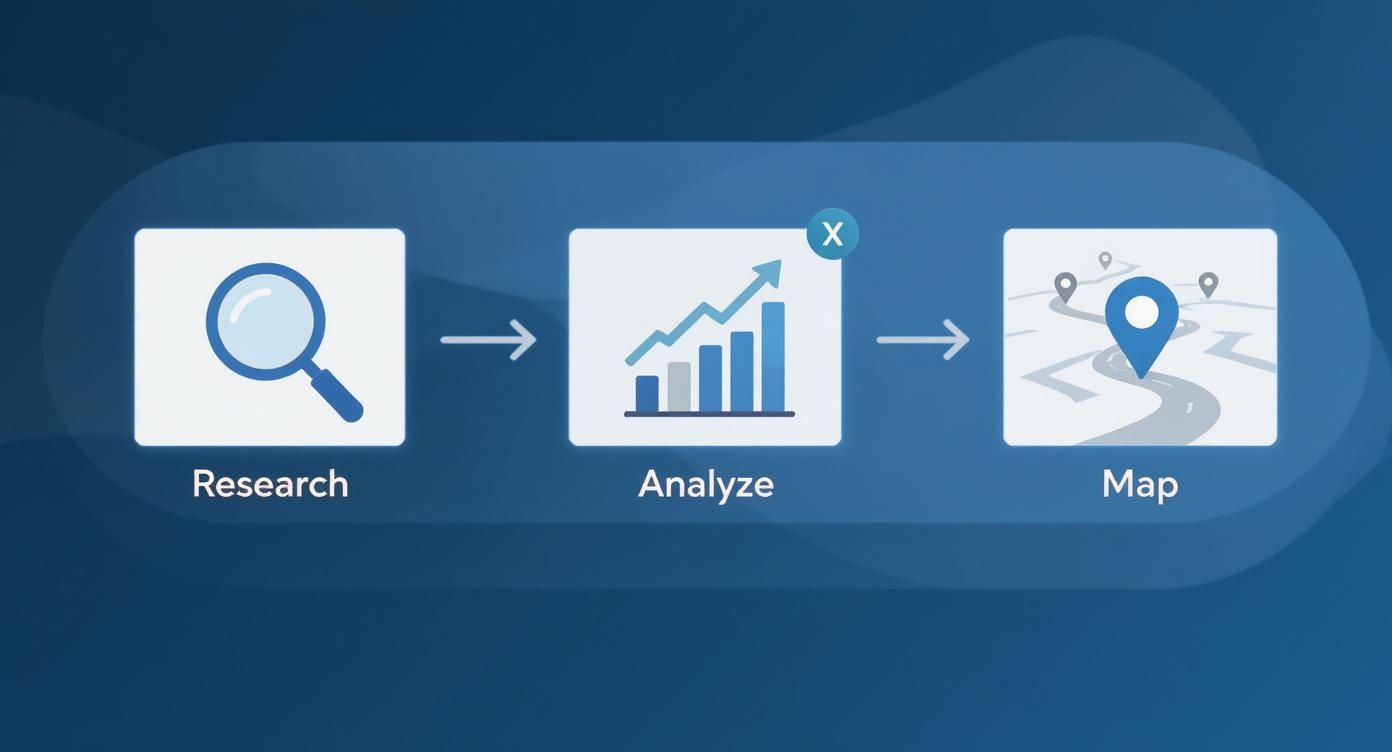
As this shows, it all flows from one thing: figuring out what your clients are typing into Google, analyzing that data, and mapping it directly to your services and content.
Building Trust Through Visuals and Updates
Photos are powerful trust signals. A profile filled with cheesy stock photos or, even worse, an empty gallery feels impersonal and sketchy. You need high-quality, professional photos of your actual team, your office (inside and out), and even shots of your attorneys at community events.
This simple step humanizes your firm. It shows potential clients the real people who will be fighting for them.
Google Posts are another tool most firms completely ignore. Think of them as mini-blog posts or social media updates that live directly on your GBP. You can use them to:
- Showcase Recent Wins: Announce a significant (but confidential) settlement or verdict.
- Share Helpful Content: Link to a new blog post about what to do after a car wreck.
- Promote an Event: Announce a free webinar on navigating insurance claims.
- Introduce Team Members: Highlight an attorney's recent award or certification.
Consistent posts signal to Google that your profile is active and relevant, which can directly impact how you rank in the local pack. For a much deeper dive, check out these proven Google Business Profile tweaks for attorneys to really start pulling ahead of the competition.
The Critical Role of NAP Consistency and Citations
One of the most foundational, make-or-break elements of local personal injury law SEO is NAP consistency. That stands for Name, Address, and Phone number.
This information must be identical—down to the last comma and whether you use "St." or "Street"—across your website and every single online directory where your firm is listed. Any inconsistencies create confusion for search engines and can absolutely torpedo your local rankings.
These listings on other websites are called citations. Every consistent citation acts like a vote of confidence for Google, verifying that your business is legitimate and located exactly where you claim it is.
Key local citation sources include legal directories like Avvo and Justia, major data aggregators, and local chamber of commerce websites. A systematic approach to building and cleaning up these citations isn't optional; it's a must-do task for local dominance.
Making Reviews Your Top Priority
If there's one thing that powerfully influences both potential clients and Google's algorithm, it's reviews. A steady stream of positive, five-star reviews is the ultimate social proof. Plain and simple. In today's market, search engine visibility is paramount, and reviews have become a massive ranking signal.
Recent data shows that 64% of people turn to Google to find a lawyer, with nearly all of them focusing on the top results. This behavior has made SEO the second-most effective lead generation channel for law firms. You can explore more of these legal marketing trends and statistics to see just how critical this has become.
You need a proactive system for getting reviews. This means asking for them when your client is happiest—usually, the moment you hand them that settlement check. Make it ridiculously easy for them by sending a direct link to your GBP review page. And be sure to respond to every review, good or bad. It shows you're engaged and that you actually care.
Turning Clicks into Signed Retainers

Getting to the top of Google is a major win, but let's be honest—traffic doesn't pay the bills. The real goal of personal injury law SEO is turning those hard-earned clicks into actual, signed client cases. This is where your website, specifically your practice area pages, has to step up and do the heavy lifting.
A page that ranks #1 but doesn't make a potential client pick up the phone is a sunk cost. You need a reliable blueprint for building pages that don't just impress search engines, but also connect with the real fears, questions, and immediate needs of someone who's just been injured. It’s time to move past simply dropping in keywords and start building genuine authority and trust.
Anatomy of a Page That Converts
Every single practice area page on your site—whether it's for "Car Accidents," "Medical Malpractice," or "Slip and Fall"—is a high-stakes landing page. Its one job is to guide a visitor from a state of stress and uncertainty to decisive action, and it has to do it in seconds.
Put yourself in their shoes. They’re hurting, they’re confused, and they’re looking for a genuine expert who can fix their problem. Your page must instantly scream, "You're in the right place." This starts with a headline that’s all about them, not you. Something like, “Fighting for Maximum Compensation for Truck Accident Victims in Los Angeles.”
From that crucial first impression, the rest of the page needs to flow logically:
- Connect with Their Pain: Open with empathy. Show them you get what they're going through.
- Prove Your Expertise: Break down the legal process for their specific case type. Use simple language, not dense legalese.
- Show, Don't Just Tell: This is where anonymized case results and powerful client testimonials provide the social proof they're looking for.
- Make it Human: Use real photos and short bios of the attorneys who actually handle these cases. People hire people, not logos.
- Give a Clear Next Step: Don't make them hunt for how to contact you. Use bold, obvious contact forms and click-to-call phone numbers.
Weaving in Trust Signals That Drive Action
When someone lands on your site, their guard is up. They are subconsciously scanning the page for reasons to trust you—or reasons to click the back button. Embedding trust signals throughout your content is one of the fastest ways to increase your conversion rate.
Your website must answer one unspoken question in the visitor's mind: "Why should I trust this firm with my case?" Every element on the page should work together to provide a resounding, confident answer.
These signals aren't just about claiming you're the best; they are visual and psychological shortcuts that build immediate credibility. Here’s a quick checklist of must-have trust-building elements:
- Professional Headshots: Ditch the generic stock photos. Use high-quality, professional images of your actual legal team.
- Bar Association Badges: Display logos from the state and local bar associations you’re a member of.
- Awards and Recognitions: Feature badges from credible sources like Super Lawyers, Martindale-Hubbell, or Avvo.
- "As Seen On" Logos: If your firm has ever been mentioned in the local news, add those station logos to your site.
- Client Testimonials (with Photos!): Written reviews are good. Video testimonials are even better and feel much more authentic.
- A Real Address: A clearly visible physical address and a local phone number signal that you're a legitimate, established practice, not a fly-by-night operation.
Individually, these might seem minor. Together, they create a powerful narrative of competence and reliability that makes a potential client feel safe reaching out.
To make this even more concrete, we've put together a quick-reference table outlining the critical elements every PI practice area page should have. Think of this as your pre-launch checklist for turning a good page into a great one.
Essential Elements of a High-Converting PI Landing Page
| Element | Purpose | Best Practice Example |
|---|---|---|
| Benefit-Driven Headline | Immediately answers "What's in it for me?" for the visitor. | "No Win, No Fee. We Fight Insurance Companies So You Can Heal." |
| Empathy-Led Introduction | Shows you understand the visitor's physical and emotional pain. | "A serious injury doesn't just disrupt your life—it turns it upside down. We understand." |
| Clear Call-to-Action (CTA) | Makes the next step obvious and easy to take, placed above the fold. | A large, clickable button: "Get Your Free Case Evaluation Now" |
| Social Proof (Reviews/Results) | Builds trust by showing past success with clients like them. | "Recovered $1.2M for a client injured in a multi-car pileup on I-5." |
| "Meet the Team" Section | Humanizes the firm and builds a personal connection. | Professional headshots and short bios of the handling attorneys. |
| FAQ Section | Proactively answers common questions, reducing friction and doubt. | "How much does it cost to hire you?" or "How long will my case take?" |
| Local Trust Signals | Cements your firm as a legitimate, local authority. | Displaying a map to your office, local phone number, and local awards. |
| Mobile-First Contact Options | Caters to the majority of users who are on their phones. | Click-to-call phone numbers and a simple, mobile-friendly contact form. |
By systematically including each of these elements, you're not just optimizing for Google; you're optimizing for the human on the other side of the screen, which is what truly drives conversions.
Create Content That Solves Their Problems Now
The most powerful content anticipates and answers the questions a potential client is frantically typing into Google. For a "car accident" page, this goes way beyond just saying, "We handle car accident cases." It means building out sections that address their most urgent concerns.
Your practice area pages and supporting blog posts should tackle topics like:
- What are the 3 things I need to do immediately after a crash?
- Should I talk to the other driver's insurance adjuster? (Hint: No.)
- What is the average settlement for a herniated disc injury in California?
- How long do I have to file a claim in this state? (Statute of Limitations)
When you provide this kind of genuine, helpful information, you transform your firm from a sales pitch into an indispensable resource. This strategy is the heart of effective content marketing for law firms because it establishes a relationship and builds trust before they've even decided to call you.
This educational content pulls double duty: it helps you rank for a much wider net of long-tail keywords and builds the credibility needed to turn a curious searcher into your next client.
Building Authority with Technical SEO and Backlinks
While powerful content and local visibility are the parts of your SEO strategy that everyone sees, what’s happening under the hood is just as important. Technical SEO and high-quality backlinks are the foundational pillars that tell Google your firm is a legitimate, authoritative, and trustworthy resource.
Without a solid technical foundation, even the most compelling blog post or practice area page can completely fail to rank.
Think of it this way: your content is a high-performance engine, but technical SEO is the expertly engineered chassis and aerodynamics. It’s what ensures all that power actually gets to the road, giving your potential clients a smooth, fast, and reliable experience. Google rewards that efficiency with much higher rankings.
The Nuts and Bolts of Technical SEO
Technical optimization isn't about flashy design. It's about raw performance and speaking Google's language clearly. There are three areas that absolutely demand your attention.
- Blazing-Fast Site Speed: In an emergency, a potential client isn't going to wait around for a slow-loading website. If your page takes more than three seconds to load, you've almost certainly lost them to a competitor. Optimizing your images, using clean code, and investing in quality hosting are all non-negotiable.
- A Flawless Mobile Experience: The overwhelming majority of urgent legal searches happen on a smartphone, often from the side of a road or a hospital waiting room. Your website must be perfectly responsive, with large, easy-to-tap buttons and simple navigation on any screen size.
- Schema Markup Implementation: This is specialized code that acts as a translator, telling search engines exactly what your content is about. For a law firm, adding ‘Attorney’ and ‘LegalService’ schema is vital. It’s a direct signal to Google that you're a legal professional, which can unlock enhanced search results and boost your visibility.
Getting these technical elements right is foundational. A comprehensive approach to website optimization for law firms is the only way to ensure your site is built to compete.
Simply put, a technically sound website makes it easy for Google to find, crawl, and understand your content. This builds the kind of trust that is a prerequisite for earning top rankings in the hyper-competitive legal field.
Earning Trust with High-Quality Backlinks
Once your technical house is in order, the next challenge is building external authority. Backlinks—which are just links from other websites back to yours—are one of the most powerful ranking signals in all of SEO. They essentially act as digital votes of confidence.
But here’s the critical part: not all links are created equal.
A single link from a respected local news outlet or a state bar association is worth more than hundreds of low-quality links from spammy, irrelevant directories. The goal is always quality over quantity. Understanding what a backlink profile is is the first step toward building a strong one.
This focus on authority is magnified tenfold in the legal space. In fact, research analyzing 112,000 personal injury firms found that older, more established domains tend to perform better, gaining an average of one search result position for every six years of domain age. This just goes to show the long-term value of building your digital presence early and consistently.
Ethical Link Building That Actually Works
Forget about the spammy, outdated tactics of the past. The best backlinks are earned, not bought. A sustainable strategy means creating assets and building relationships that naturally attract links from other reputable sites.
Here are a few proven approaches:
- Become a Local Resource: Create a definitive guide to local car accident reporting procedures, or offer a scholarship to students at a local high school. These community-focused assets are prime targets for links from local government sites, schools, and news outlets.
- Sponsor Community Events: Putting your firm’s name on a local charity 5K or a community festival often comes with a link from the event's website. That's a high-quality, locally relevant backlink that also builds real-world goodwill.
- Get Listed in Reputable Directories: Securing listings in respected legal directories like Avvo, Justia, and your local bar association provides foundational, industry-specific links that Google expects to see.
By combining a pristine technical setup with a strong, ethically built backlink profile, you send undeniable signals of authority to Google. This is the powerful combination that separates the firms that temporarily rank from those that dominate the search results for years to come.
Your Personal Injury SEO Questions Answered
Let's cut through the noise. When it comes to personal injury law SEO, you're probably buried in conflicting advice and technical jargon. It’s a tough field, and most lawyers just want straight answers to a few key questions.
So, let's get right to it. Think of this as a no-nonsense guide to making smart decisions for your firm's growth. We'll cover what truly moves the needle, how long it actually takes, and what a realistic investment looks like.
How Long Does SEO Really Take for a PI Law Firm?
This is the big one, and I'll be direct: SEO is a long game. It's not a magic button that delivers signed cases by next week. You're building a valuable, long-term asset for your firm, not just renting a billboard for a month.
In a competitive market, you can expect to see real, meaningful movement in your rankings and a noticeable lift in organic traffic within four to six months. But the actual goal—a steady, predictable flow of high-quality leads that become signed retainers—that usually takes a solid nine to twelve months of focused, consistent work.
Of course, that timeline depends on a few things:
- Market Competitiveness: Trying to rank in a major metro like Los Angeles is a completely different beast than a smaller city.
- Your Website's History: A brand-new website is starting from scratch, while a site with some age and history has a head start.
- Resource Investment: The budget and intensity you bring to the table directly shape how quickly you see results.
Think of it like a complex, multi-defendant case. You don't get a major win overnight. It takes discovery, meticulous prep, and relentless effort over months. SEO works the exact same way.
Should Our Firm DIY SEO or Hire an Agency?
It’s tempting to try and save money by keeping marketing in-house. I get it. But personal injury is arguably one of the most aggressive and cutthroat arenas online. You aren't just up against the firm down the street; you're competing with national firms backed by massive marketing budgets.
When you try to DIY your SEO, you're diverting your most valuable asset—your time—away from practicing law and into a completely different, constantly changing profession. It’s a brutal learning curve, and mistakes can set you back months, if not years.
A specialized legal SEO agency already knows the landscape. They understand plaintiff-intent keywords, the technical quirks of law firm websites, and the ethical link-building strategies that Google actually rewards in this high-stakes industry. For any firm serious about growth, partnering with a proven agency is almost always the faster, more profitable path.
What Is the Most Important Part of SEO for a Lawyer?
If I had to bet all my chips on one thing, it would be local SEO. Hands down.
Your potential clients aren't just searching for a "car accident lawyer." They're searching for a "car accident lawyer near me." That one phrase changes everything. It makes your Google Business Profile the single most valuable piece of digital real estate you own.
A perfectly optimized profile, packed with great reviews, and updated frequently with Google Posts showcasing your wins and expertise, is your ticket to the Google Maps "Local Pack." Landing in those top three map spots drives more direct calls and qualified leads than almost any other tactic. Everything else matters, but local is where the cases are found.
What Is a Realistic SEO Budget for a Personal Injury Firm?
Budgets can swing wildly, and it all comes down to the size and competition in your city. It’s critical to stop thinking of this as a marketing "expense" and start seeing it as an investment in client acquisition. The whole point is to generate cases where the fee from a single new client pays for your SEO investment for several months.
Here’s a realistic ballpark:
- Smaller City / Less Competitive Market: A monthly investment in the $2,500 – $4,000 range is a solid starting point.
- Major Metropolitan Area / High Competition: To make a real dent, firms are often investing $6,000 to $20,000+ per month.
The right budget is tied directly to your growth ambitions. A more aggressive investment doesn't just get you results; it gets you results faster, allowing you to start taking market share from the established players and see a clear return that much sooner.
At Case Quota, we build SEO strategies that don't just get you clicks—they get you cases. If you're ready to turn your website into your firm's most powerful client acquisition engine, let's talk. Learn more about how we help personal injury firms dominate their local markets at https://casequota.com.