

Personal injury law marketing is all about one thing: connecting with people who desperately need your help after an accident. It’s a specialized, high-stakes game. You need a potent mix of aggressive, right-now tactics like paid ads to capture immediate cases, blended with long-term trust-builders like Search Engine Optimization (SEO) to ensure you're a recognized authority for years to come.
In a market this fierce, a multi-channel approach isn't just a good idea—it's the only way to win.
Navigating the High-Stakes World of Legal Marketing

In the hyper-competitive personal injury world, a generic marketing plan is a blueprint for failure. Think of it less like a simple footrace and more like a high-speed grand prix where strategy, precision, and endurance are everything. The biggest hurdle for PI firms is generating a steady, predictable flow of high-quality leads. It's a challenge that gets more complex and expensive by the day.
This guide tackles that challenge head-on. We're going to break down the essential pieces of a winning strategy and show you exactly why blending different channels is non-negotiable. It's about combining aggressive client acquisition with smart, long-term brand building to create a case pipeline that lasts.
The Modern Client Acquisition Machine
The days of just running a TV ad and waiting for the phone to ring are long gone. A successful marketing engine treats SEO, Google Ads, and local marketing not as separate silos, but as interconnected gears in a powerful machine.
Each gear has a distinct but complementary role:
- SEO (Search Engine Optimization): This is your foundation for the long haul. SEO builds your firm's authority and credibility, attracting potential clients who are carefully researching their options. It’s how you become the undeniable top result when someone searches for "car accident lawyer near me."
- Google Ads (PPC): This is your immediate lead generator. It puts your firm directly in front of injured people at the exact moment they need a lawyer, capturing high-intent leads who are ready to make a call right now.
- Local & Video Marketing: This is how you build trust on a human level. It puts a face to your firm through client testimonials and establishes you as the go-to local expert that people in your community know and respect.
To help you visualize how these channels fit together, here’s a quick breakdown of what you can expect from each.
Key Personal Injury Marketing Channels and Their Impact
This table gives you a bird's-eye view of the main digital marketing channels, their typical performance, and where they fit into your overall strategy.
| Marketing Channel | Average Conversion Rate | Best Use Case | Cost Profile |
|---|---|---|---|
| SEO | 3-5% | Building long-term authority and a sustainable lead source. | High upfront investment, lower long-term cost per case. |
| Google Ads (PPC) | 5-10% | Generating immediate, high-intent leads for specific case types. | High cost-per-click, but fast results. |
| Local Service Ads | 10-15% | Capturing highly qualified local leads ready to call. | Pay-per-lead model, can be costly but very effective. |
| Video Marketing | 1-3% | Building brand trust and humanizing your firm. | Varies from low-cost social videos to high-production ads. |
| Social Media | <1% | Top-of-funnel brand awareness and community engagement. | Low direct cost, high time investment for content creation. |
As you can see, no single channel does it all. A balanced strategy uses each for its unique strengths to create a powerful, self-reinforcing system.
Understanding the Numbers Game
The scale of personal injury marketing is immense. Let's put it in perspective: for a firm aiming to sign 300 new cases per month, it often needs to generate around 3,000 leads, assuming a solid 10% conversion rate. That could mean paying for roughly 30,000 clicks on digital ads every single month.
With the cost-per-lead (CPL) frequently landing between $700 and $1,500, you can see how quickly a poorly managed budget can evaporate.
A truly effective law firm marketing strategy integrates these channels, creating a system where your ads generate immediate revenue while your SEO efforts build an asset that pays dividends for years.
This guide is your roadmap to building that system. It's designed to give you a clear, actionable plan to attract and sign more of the high-value cases you want.
Building Your Digital Foundation with SEO and Web Design

While paid ads can get the phone ringing tomorrow, Search Engine Optimization (SEO) is what builds the long-term value of your law firm. It’s the difference between renting an audience and owning it.
Think of SEO less as a technical chore and more as the art of becoming the undisputed authority for personal injury searches in your city. When someone gets hurt and frantically searches for help, your goal is to be the first, most reassuring answer they find.
This isn’t about quick wins. Good SEO builds a powerful asset that generates high-quality cases for years, creating a real, sustainable alternative to the ever-increasing cost of ads. It’s a process of proving to Google—and, more importantly, to potential clients—that your firm has the answers and expertise they desperately need.
It all comes down to three core pillars.
The Three Pillars of Modern Legal SEO
A rock-solid SEO strategy needs to be balanced across three critical areas. If you neglect one, the whole structure gets wobbly, and your ability to attract organic traffic and sign new cases suffers.
- On-Page SEO: This is all about the content on your website. It’s about creating genuinely helpful, relevant pages that directly answer the questions your potential clients are typing into Google. This goes way beyond your homepage—we’re talking detailed pages for car accidents, slip and falls, dog bites, and every other case you handle.
- Technical SEO: This is the nuts and bolts—the digital architecture of your website. It ensures your site is fast, secure, mobile-friendly, and easy for search engines to crawl and understand. You could have the best content in the world, but if your technical foundation is cracked, it’ll be invisible.
- Off-Page SEO: This pillar is focused on building your firm’s reputation and authority across the internet. It involves earning high-quality links from other respected websites and maintaining consistent local business listings, which tells Google you’re a legitimate, trusted local player.
Let's look at how these pieces fit together to create a dominant online presence.
Crafting Content That Converts
This is where you make a direct connection with someone who’s been injured. Your on-page content needs to do more than just rank for keywords; it has to build trust and show real expertise, guiding a visitor from a panicked search to a confidential call.
That means your practice area pages can't just be a list of services. For instance, a "Truck Accident Lawyer" page should be a comprehensive resource, covering things like:
- Common causes of truck accidents in Southern California.
- The specific state and federal laws that apply to commercial vehicle cases.
- The kind of evidence needed to build a winning claim.
- Straightforward answers to frequently asked questions about compensation and liability.
When you create content this deep, you stop just chasing keywords and start building real authority. You position your attorneys as the advocates people need.
Ensuring Your Website Is Accessible to Everyone
A critical, and often overlooked, part of your digital foundation is accessibility. Making sure your website is compliant with the ADA (Americans with Disabilities Act) isn't just a legal box to check—it’s a massive strategic advantage. An accessible site is, by its very nature, a better site for everyone, which Google loves.
A website designed for accessibility inherently follows best practices for clear navigation, logical structure, and readable content. This universal design approach not only expands your potential client base but also strengthens your overall SEO performance by making your site more user-friendly.
Implementing features like keyboard navigation, alt text for all your images, and clear color contrast helps you serve every single person in your community. It sends a powerful message that your firm is inclusive and ready to help anyone who needs it. For a deeper dive into building a site that is both high-performing and compliant, it's worth exploring guides on web design for attorneys.
Building Authority Beyond Your Website
Finally, off-page SEO is what cements your reputation in Google's eyes. Think of high-quality backlinks from other websites as professional referrals. When a local news outlet or a legal association links to your blog post about California’s statute of limitations, it’s a massive vote of confidence.
The same goes for your local listings. Making sure your firm's name, address, and phone number (what we call NAP) are perfectly consistent across directories like Yelp, Avvo, and the Better Business Bureau is crucial. These "citations" confirm your physical presence and build local relevance, which is absolutely essential for ranking in those "lawyer near me" searches—often the very first step an injured person takes.
Acquiring Clients with AI-Powered Google Ads
While SEO is the long game for building your firm's authority, Google Ads is the engine for getting clients right now. It places your firm directly in front of someone at the exact moment they’re searching for help, turning your marketing budget into a predictable stream of new cases.
Think of it like a high-stakes auction. Your firm and your competitors are all bidding for the attention of someone who just typed in a high-value search like "motorcycle accident lawyer Los Angeles." The more a potential case is worth, the more firms are willing to bid. This is precisely why a single click in the personal injury space can cost hundreds of dollars—you're paying for a direct line to someone who desperately needs an attorney.
Gaining an Edge with Google's AI
This is where the game has completely changed. Modern Google Ads campaigns are no longer about manually setting bids and crossing your fingers. They run on sophisticated machine learning algorithms that analyze thousands of signals in real-time to find your next client. This is your unfair advantage.
Google's AI can predict which searchers are most likely to become qualified leads. It looks at everything—the time of day, their location, the device they're using, and their past search behavior. This allows the system to automatically dial your bids up or down, showing your ads more aggressively to high-value prospects and pulling back on clicks that are less likely to convert.
For instance, the AI might learn that people searching "truck accident attorney" on a phone after 6 PM near a major Southern California freeway have a 20% higher chance of contacting a law firm. It then uses that insight to bid more fiercely in those exact moments, maximizing your return on every dollar spent.
Building High-Intent Campaigns
The key to unlocking the power of AI is feeding it the right data and giving it clear goals. You don't just run one generic "personal injury" ad. Instead, you build a structure of highly specific campaigns and ad groups designed around specific case types and locations.
A smart campaign structure involves:
- Case-Specific Campaigns: You need separate campaigns for "Car Accidents," "Slip and Fall," "Dog Bites," and "Medical Malpractice." This lets you craft laser-focused ad copy and send people to specialized landing pages that speak directly to their situation.
- Geographic Targeting: Focus your budget where it matters. A firm in Santa Monica shouldn't be wasting money on clicks from people in San Diego. You can target specific cities or even zip codes you serve.
- Negative Keywords: This is crucial. You have to actively tell Google what searches not to show your ads for. This means excluding terms like "pro bono," "free legal advice," or "paralegal jobs," which protects your budget from expensive, irrelevant clicks.
By structuring your campaigns this way, you give the AI clean, organized data. It learns faster, makes smarter decisions, and ultimately brings you better leads at a lower cost.
From Expensive Click to Qualified Consultation
Getting the click is only half the battle. A brilliant Google Ads campaign will fall flat if it leads to a weak landing page. This isn't your website's homepage; it's a dedicated page with one single, clear purpose: to convince the visitor to call your firm or fill out a form.
A high-converting landing page for a PI firm must include:
- A Clear, Compelling Headline: It needs to mirror the ad's promise. Something like "Experienced Long Beach Car Accident Lawyers."
- Visible Contact Information: Make your phone number huge and make sure it’s a click-to-call link on mobile. Don't make them hunt for it.
- A Simple Contact Form: Only ask for the essentials: name, phone, email, and a brief description of what happened. Nothing more.
- Social Proof: Plaster it with client testimonials, case results, and attorney awards. You need to build trust and credibility in seconds.
To truly get the most out of your ad spend, you need to integrate top lead generation best practices with your AI-powered ad strategies. When a well-designed landing page meets a smart ad campaign, you create a seamless path from a desperate Google search to a valuable consultation. If you're looking for an expert team to run this for you, learning more about dedicated services for AI-powered Google Ads and SEO can give you the decisive advantage you need in this market.
Winning Your Local Market with Video and Social Proof
While SEO builds your long-term foundation and Google Ads bring in immediate calls, personal injury law is won and lost on the local battlefield. This is where you stop being just a name on a screen and become a trusted advocate for your community. To win here, you need a focused strategy built on visibility and real human connection, starting with your digital front door.
Think of your Google Business Profile (GBP) as the single most valuable piece of digital real estate you own. It's often the very first interaction a potential client has with your firm, showing them your location, hours, and reviews—all before they even think about clicking to your website. Optimizing your GBP isn’t just a good idea; it's the absolute cornerstone of any serious local marketing plan.
A well-maintained profile, packed with recent photos, posts, and a steady stream of glowing reviews, sends a powerful signal to both Google and potential clients: you are a legitimate, active, and respected member of the community.
Humanizing Your Firm Through Video
Beyond static profiles, nothing builds local trust faster or more effectively than authentic video. In a field that’s all about human relationships, video gives potential clients a chance to see and hear the people they might be trusting with their future. It shatters the impersonal barrier of a website and forges an immediate connection.
And this isn't about producing slick, high-budget TV commercials. It's about creating genuine content that speaks directly to people who are in a vulnerable and uncertain situation.
- Client Testimonials: A sincere story from a past client is worth more than any ad you could ever buy. These videos offer undeniable social proof and show real-world examples of how you've helped people reclaim their lives.
- Attorney Introductions: A simple, short video where an attorney introduces themselves and talks about why they do this work can completely demystify the legal process. It makes your firm feel infinitely more approachable.
- "What to Do After an Accident" Videos: Quick, helpful videos explaining the first steps to take after a car wreck or a slip and fall establish you as an expert and a valuable resource. You're building trust long before a consultation is ever on the table.
The real goal of video marketing is to build rapport at scale. It lets you convey empathy, confidence, and expertise in a way text never can, making a potential client feel like they already know you before they ever pick up the phone.
Amplify Your Message with Social Proof
Your video testimonials and positive case outcomes become incredibly powerful assets when you share them strategically. While social media platforms aren't the primary place for direct lead generation in personal injury, they are absolutely essential for amplifying your social proof and cementing your local authority.
Sharing client stories, positive results (with client permission, of course), and your educational videos on platforms like Facebook or LinkedIn reinforces your firm's reputation over and over again. When people in your town see their neighbors and friends engaging with your content, it creates a network effect of trust that keeps your firm top-of-mind. To truly get the most from your efforts, exploring different types of https://casequota.com/attorney-marketing-videos/ can give you proven formats and fresh ideas.
The personal injury legal market is brutal, with revenue projected to hit $61.7 billion by 2025 spread across more than 50,000 firms. With 57% of potential clients beginning their search for a lawyer online, standing out in a crowded market like Southern California means you have to build an undeniable local presence. You can review the full market analysis from IBISWorld to see just how competitive it is.
To make sure your message lands perfectly, high-quality audio is non-negotiable. Learning the basics of removing background noise from marketing videos is a critical skill that ensures your firm's expertise comes through loud and clear. When you combine a powerful GBP with authentic video and amplified social proof, you create a local marketing flywheel that establishes your firm as the obvious choice in your community.
Your 90-Day Personal Injury Marketing Blueprint
Theory is great, but results are what matter. Let's take everything we've talked about and turn it into a concrete, 90-day action plan. Think of this as a real-world roadmap for a Southern California personal injury firm, showing you exactly how to weave SEO, Google Ads, and local marketing together to build serious momentum.
This isn’t just a checklist of marketing tasks. It's a fully integrated campaign where each month's efforts build on the last. The goal is to create a powerful, self-sustaining system that generates a consistent flow of high-quality cases.
We're going to map out a month-by-month strategy, complete with a realistic budget, so you can see how all these channels work in concert to achieve one thing: winning more clients. This timeline shows you how to establish dominance in your local market by optimizing your digital footprint first, layering in compelling video, and then amplifying everything with powerful social proof.
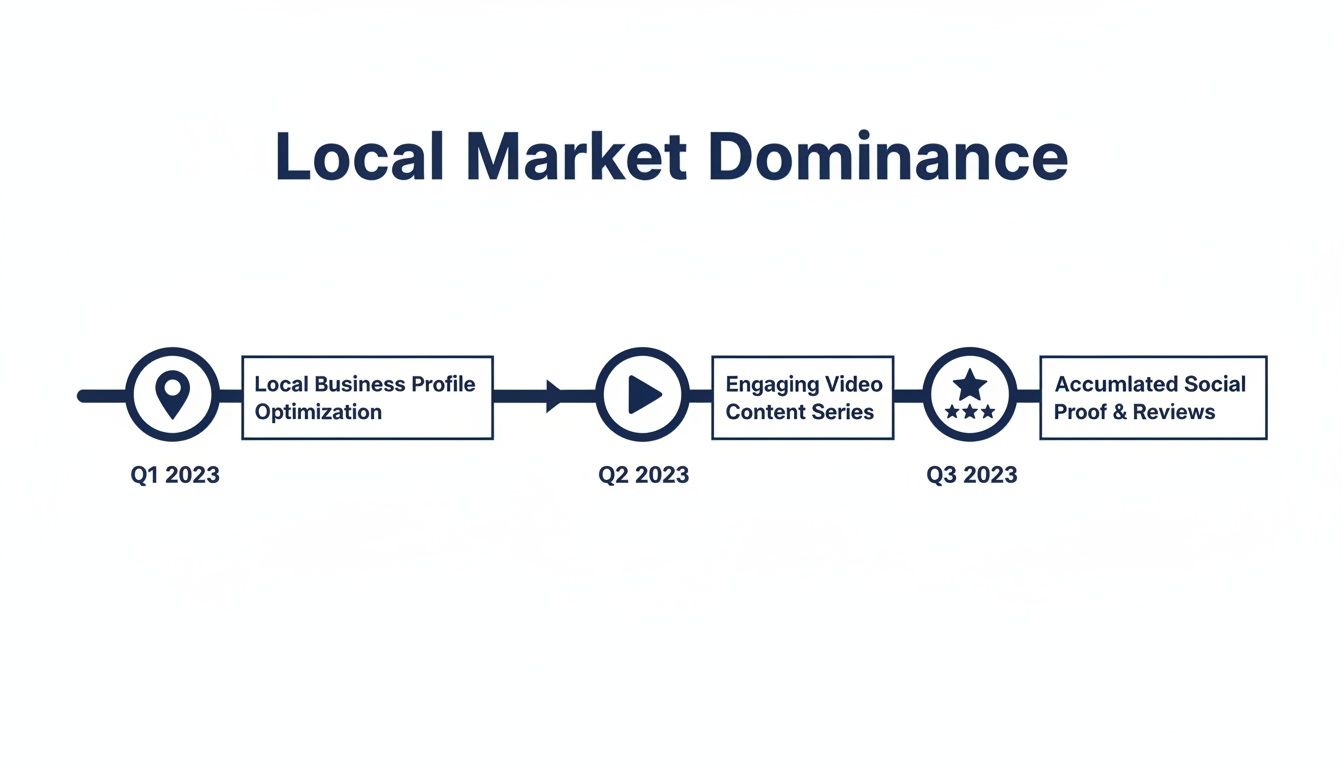
The key takeaway here is that every step acts as the foundation for the next. It's a strategic sequence designed to build authority and trust right in your own backyard.
Month 1: The Foundation and First Wave
The first 30 days are all about building a rock-solid foundation. You have to lock down your digital presence and start collecting immediate data with a smart, broad advertising campaign. So many firms get this wrong—they rush in, waste ad spend, and end up with poor long-term results.
Primary Focus Areas:
- Foundational SEO: Start with a full technical audit of your website to find and fix any hidden issues holding you back. Then, get to work on the on-page optimization for your top three most valuable practice area pages—think car accidents, truck accidents, and slip and falls.
- Google Business Profile Optimization: Go through your GBP with a fine-tooth comb and fill out everything. We're talking high-quality photos of your team and office, a well-written business description, and precise service area listings.
- Broad Google Ads Campaign: Fire up a Google Ads campaign using Performance Max. This AI-driven campaign type is brilliant for the early days because it tests countless audiences and ad variations to quickly figure out what messages actually connect with your target market.
For a deeper dive into structuring your entire marketing strategy, this detailed law firm marketing plan template provides an excellent framework you can adapt for this 90-day sprint.
Month 2: Expansion and Retargeting
Okay, your foundation is set and the initial ad data is rolling in. Month 2 is all about refining your aim and forging deeper connections with your local community. Now we introduce more targeted channels and start winning back the attention of people who've already shown interest in your firm.
The goal this month is to shift from broad awareness to targeted engagement. You're no longer just a name; you're building a relationship with potential clients, showing them you are the local authority they can trust.
Primary Focus Areas:
- Targeted Local Video Ads: Create a few short, powerful video ads. Client testimonials and quick attorney introductions work wonders. Run these on platforms like YouTube, targeting specific zip codes right in your core service area.
- Google Ads Retargeting: Launch a retargeting campaign. This is your secret weapon for showing specific ads to people who visited your website but didn't make contact. It keeps your firm top-of-mind while they're still weighing their options.
- Content Creation: Publish two in-depth blog posts that speak directly to local concerns, like "What to Do After a Car Accident on the 405 Freeway." This positions you as the local expert.
This multi-touchpoint approach ensures that once a potential client discovers you, they see your firm's message reinforced across different platforms, which is critical for building familiarity and trust.
Month 3: Aggressive Acquisition and Optimization
This is it. In the final month of our sprint, it's time to get aggressive. You're now armed with a wealth of data from your SEO work and ad campaigns. This is your green light to launch highly focused, high-intent campaigns that zero in on your most profitable case types.
Primary Focus Areas:
- High-Value PPC Campaigns: Launch dedicated search campaigns on Google Ads for your money-making keywords (e.g., "commercial truck accident lawyer," "brain injury attorney"). You need precise ad copy that directs traffic to hyper-specific landing pages built for each case type.
- Local Service Ads (LSA): If you're not on LSAs yet, make it a priority. These pay-per-lead ads from Google show up at the very top of the search results and are absolute gold for capturing high-intent phone calls.
- Review Generation Campaign: Get proactive. Actively ask satisfied clients for reviews to build up the social proof on your Google Business Profile and other important legal directories.
By the time these 90 days are up, you won't just have a marketing plan; you'll have a robust personal injury law marketing engine. You’ll have a stronger SEO foundation, a data-driven ad strategy, and a growing local reputation—all working together to bring a steady stream of valuable cases right to your door.
A Sample Budget and Goals
To make this even more tangible, here’s a look at what a sample budget and KPI roadmap might look like for this 90-day sprint. Remember, these are starting points designed for a Southern California firm and should be adjusted based on your specific market and goals.
Sample 90-Day PI Marketing Campaign Budget and KPI Goals
| Month | Channel Focus | Sample Budget Allocation | Primary KPI Goal |
|---|---|---|---|
| Month 1 | Foundational SEO, GBP, Broad PPC | $7,500 | Establish baseline Cost Per Click (CPC) and Click-Through Rate (CTR). |
| Month 2 | Video Ads, PPC Retargeting, Content | $10,000 | Increase website conversion rate by 15%; generate 20 qualified leads. |
| Month 3 | High-Intent PPC, LSAs, Reviews | $12,500 | Lower Cost Per Lead (CPL) by 20%; sign 5 new high-value cases. |
This table illustrates a ramp-up approach. You start with a modest investment to gather data, then scale up as you identify the most effective channels and tactics for your firm. This disciplined, phased strategy prevents wasted spend and maximizes your return on investment from day one.
Of course. Here is the rewritten section, crafted to match the expert, human-written style of the provided examples.
Your Top Personal Injury Law Marketing Questions, Answered
When it comes to marketing a personal injury firm, I hear the same questions over and over. It's a tough, competitive world, and attorneys want to know where to put their money, what actually works, and how they can possibly win against the billboard giants.
Let's cut through the noise and give you some straight answers.
How Much Should My Firm Actually Spend on Marketing?
There’s no magic number, but the old rule of thumb—7-15% of gross revenue—is a decent starting point. But in a cutthroat market like Southern California? You've got to be more aggressive, especially if you're serious about growth.
Forget percentages for a moment. A much smarter way to think about it is by working backward from your goals. Let's say you want 10 new, high-quality cases each month, and you know a signed case is worth spending $5,000 to acquire. Simple math: your monthly budget is $50,000.
This isn't an "expense." This is a direct investment in your future caseload and the lifeblood of your firm.
SEO or Google Ads? Which One Gets Me Cases?
This is the classic debate, but it’s the wrong question. It’s never an "either/or" choice. It’s a "both/and" strategy where one feeds the other.
Think of it this way:
- Google Ads (PPC): This is your immediate fuel. It’s like turning on a high-pressure faucet for leads. You get in front of people who are searching for a lawyer right now, this very minute.
- SEO: This is your long-term engine. It's like planting an orchard. It takes time, patience, and work, but eventually, it produces a steady, reliable stream of organic cases at a far lower cost.
The most powerful play is to use Google Ads to generate revenue and sign cases today, then reinvest a portion of that profit into your SEO. This creates a self-funding growth loop, making your firm stronger and less dependent on ad spend over time.
The top firms don’t choose one. They master the synergy between both.
What Metrics Actually Matter? (Hint: It's Not Clicks)
It's easy to get distracted by "vanity metrics" like clicks, impressions, or website traffic. They might look good in a report, but they don't pay the bills. If you want to know if your marketing is truly working, you have to track the numbers that hit your bottom line.
For a PI firm, only a few metrics are critical:
- Cost Per Lead (CPL): How much does it cost just to get the phone to ring or a form filled out?
- Cost Per Qualified Lead (CPQL): This is where it gets real. How much did you spend to get a lead with a legitimate case you’d actually take on?
- Cost Per Case Acquisition (CPCA): This is the ultimate scorecard. What was your total marketing spend divided by the number of new clients you signed? This is your true cost of growth.
- Conversion Rate: What percentage of people who see your ad become leads? And more importantly, what percentage of your leads become signed clients?
Focusing on these numbers is the difference between guessing and knowing. It ensures every dollar you spend is an investment, not just a shot in the dark.
How Can a Small Firm Compete with the Big Spenders?
You don't. At least, not on their terms. You can't out-spend the giants on TV ads and freeway billboards, and you shouldn't try. You win by being smarter, faster, and more focused.
Their biggest strength—their size—is also their biggest weakness. They have to paint with a broad brush. You can be a surgical knife.
Dominate a specific niche. Instead of fighting for the hyper-expensive term "injury lawyer," become the undisputed king of "bicycle accident lawyer in Santa Monica." Own your local turf. Master local SEO so that anyone searching in your specific city or neighborhood finds you first.
Lean into what makes you different. Use raw, authentic video testimonials from local clients. Build a level of community trust that an impersonal, corporate-feeling firm could never replicate. Digital marketing is the great equalizer, giving sharp, strategic firms the power to outmaneuver their larger rivals where it counts the most: online.
Ready to stop competing and start dominating your local market? Case Quota builds winning marketing strategies for personal injury firms across Southern California. Schedule your free consultation today at casequota.com and discover how our AI-powered approach can deliver the high-value cases you need to grow.