
SEO for personal injury law firms is all about a single, critical moment: making sure your firm shows up when a potential client desperately needs help after an accident.
It’s the strategy that gets your website to the top of Google, so you’re the first name they see—not your competitor down the street. It’s about being right there, right when it matters most.
Why SEO Is Your Firm’s Most Valuable Asset
Picture this: someone’s just been in an accident. They’re shaken, confused, and they pull out their phone to search for a lawyer. Who are they going to find? Your firm, or the one that’s mastered the modern battleground for personal injury cases?
This is where you win. Think of SEO not as some technical chore, but as building the most visible and trusted digital office in your city. It’s how you guarantee that when someone is in urgent need, your firm is the first one they see.
This guide cuts through the generic advice. We’re laying out a clear roadmap to attract high-value cases, establish your authority online, and build a client pipeline that doesn’t dry up. We’ll tackle the unique challenges of legal SEO head-on—the brutal competition, the high stakes, and the specific needs of clients in crisis—and show you how to turn them into your biggest strengths.
Connecting with Clients in Crisis
The real power of SEO is its ability to meet clients at their point of highest intent. This isn’t like traditional advertising that interrupts someone’s day. A sharp SEO strategy is a direct answer to a call for help.
When someone types “car accident lawyer near me” into Google, they aren’t just browsing. They are actively looking for representation, right now.
Here’s a perfect example of what that user sees:

See that? The results are dominated by the Google “Map Pack,” which proves just how critical local optimization is. The firms that show up here grab the immediate attention of highly motivated potential clients. It’s a massive advantage.
The Modern Client Journey Starts Online
The days of leaning on referrals and billboards are long gone. Today, the client journey starts with a simple search query.
In fact, over 95% of people looking for a lawyer now turn to search engines first. A huge chunk of those are “near me” searches happening on smartphones, a trend that has exploded in the last couple of years. This shift makes one thing crystal clear: optimizing for local search is non-negotiable. Personal injury law is inherently local.
Your digital presence is now your primary storefront. Effective personal injury law firm SEO ensures your doors are open, visible, and inviting to every potential client searching for help in your area.
This reality makes a comprehensive digital strategy essential. SEO is the foundation that drives qualified traffic to your door. For a wider view on building a successful practice, check out our guide on how to market a law firm effectively.
Ultimately, it’s not just about getting found; it’s about creating a system that consistently turns searchers into signed cases.
Uncovering Keywords That Attract High-Value Cases
Great SEO for a personal injury firm starts with a simple, fundamental truth: you have to know the exact words and phrases your potential clients are typing into Google. This isn’t a guessing game. It’s about finding the precise language that connects a person in need with your firm’s expertise.
We need to get way beyond generic terms like “injury lawyer.” While that might seem like the obvious keyword, it’s incredibly competitive and casts a net so wide you end up with a mix of everyone—from law students doing research to people who aren’t seriously looking for representation.
The real gold is in high-intent keywords. These are the specific, detailed phrases that signal someone isn’t just browsing; they’re ready to pick up the phone.
Think Like a Potential Client
To find these game-changing keywords, you have to put yourself in the shoes of someone who’s just had their life turned upside down. What does a person search for right after a slip and fall? Or while sitting in their living room, stressed about the fallout from a commercial truck accident?
Their searches will be incredibly specific and focused on their problem. They aren’t using broad terms; they’re using long-tail keywords that paint a picture of their situation.
- Long-tail Keyword Example 1: “commercial truck accident lawyer for back injury in Houston”
- Long-tail Keyword Example 2: “next steps after a construction site fall NYC”
- Long-tail Keyword Example 3: “motorcycle accident attorney for wrongful death claim”
These longer, more detailed phrases might not get a ton of searches each month, but the people using them are the exact leads you want. Their intent is crystal clear, making them far more likely to become a high-value case. Getting this right is a cornerstone of your digital strategy, and using a structured guide like a law firm marketing plan template helps ensure these insights are put into action effectively.
This infographic breaks down the relationship between different keyword types.
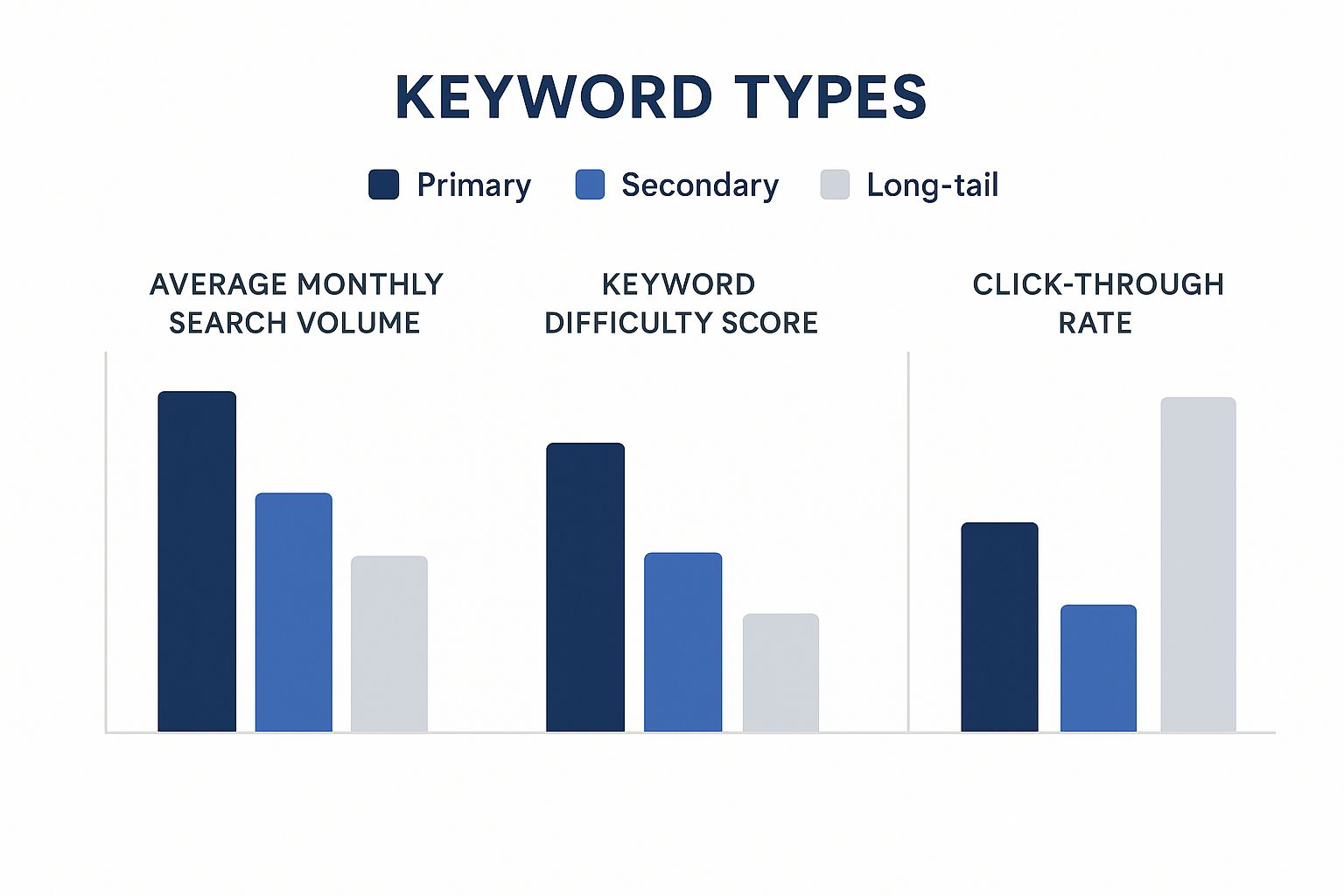
As you can see, while the search volume for long-tail keywords is lower, their click-through rates are often much higher, delivering a better return on your efforts.
Differentiating Search Intent
Knowing the difference between a search for information and a search for a lawyer is absolutely critical. If you don’t, you’ll waste a ton of time and money. Not every Google search comes from someone ready to hire an attorney right now.
High-Intent vs. Low-Intent Keyword Comparison
This table shows how small changes in wording reveal a huge difference in what the searcher is actually looking for.
| Keyword Type | Example Keyword | Searcher Intent | Likelihood to Convert |
|---|---|---|---|
| Low-Intent | “what to do after a car accident” | Informational | Low (needs answers) |
| High-Intent | “best car accident lawyer near me” | Transactional | High (ready to hire) |
| Low-Intent | “how long does a personal injury claim take” | Informational | Low (researching) |
| High-Intent | “schedule consultation with brain injury attorney” | Transactional | High (taking action) |
Targeting high-intent, transactional keywords on your main service and location pages is how you get the phone to ring.
Tools for Strategic Keyword Research
You don’t have to fly blind. Professional SEO tools give you the hard data you need to make smart decisions. Platforms like Ahrefs and SEMrush are the industry standard for good reason—they take the guesswork out of the equation.
Here’s a straightforward way to use them:
- Start with Seed Keywords: Begin with the obvious, broad terms for your practice areas, like “car accident lawyer” or “medical malpractice attorney.”
- Spy on Your Competitors: This is my favorite part. Drop your top competitors’ websites into the tool and see every single keyword they’re ranking for. It’s a goldmine of proven terms you might have overlooked.
- Find the Variations: Use the keyword research features to expand your initial list into hundreds of long-tail variations and questions people are asking. You can then filter everything by search volume, ranking difficulty, and even potential traffic value.
- Map Keywords to Pages: Once you have your golden list, assign each keyword to a specific page. High-intent keywords go on your main practice area pages. Informational, question-based keywords are perfect fuel for blog posts and FAQ sections.
How to Dominate Google’s Local Map Pack
For a personal injury firm, the most important SEO battle is fought and won locally. When someone gets hurt, they aren’t looking for a lawyer across the country—they’re desperately searching for an expert in their own community.
This is why showing up in Google’s Local Map Pack is not just a nice goal. It’s a necessity. The Map Pack is that block of three business listings that pops up right at the top of local search results, and it’s where the real action is.
Think of it as the digital town square. Getting a spot there is like having your office on the busiest street corner, impossible to miss. It’s the ultimate signal to Google and potential clients that you are relevant, nearby, and ready to help. It’s where the most motivated clients look first.

This digital real estate is incredibly valuable. Local optimization is a cornerstone of personal injury law firm SEO, and the data backs it up. Firms that successfully rank in the local pack can see a 113% increase in clicks. Considering most personal injury clients are searching on their phones for immediate help, being in the Map Pack is how you capture those urgent calls.
Your Google Business Profile Is Your Foundation
Your Google Business Profile (GBP) is the engine that powers your entire Map Pack strategy. It’s not just a simple listing; it’s a living, breathing profile that tells Google and potential clients everything they need to know about your firm. Neglecting it is like locking the front door to your digital office.
To make it work, you have to be meticulous. Every single field needs to be filled out with accuracy and a little strategic thinking.
- Select the Right Categories: Your primary category must be “Personal Injury Attorney.” No exceptions. From there, get specific. Add secondary categories for every practice area you handle, like “Car Accident Lawyer” or “Medical Malpractice Attorney.”
- Write a Compelling Description: You get 750 characters—use every single one. Don’t just list services. Speak directly to your clients’ anxieties and explain what makes your firm the right choice for them.
- Upload High-Quality Photos: Show off your team, your office (inside and out), and professional headshots. Photos build immediate trust and put a human face on your firm, making you far more approachable than a competitor with no images.
Think of your Google Business Profile as your firm’s digital business card, handshake, and first impression all rolled into one. Meticulous optimization is the key to making that impression count.
This profile is your single most important local SEO asset. You can’t set it and forget it. Treat it with the attention it deserves by regularly updating it with new photos, posts, and Q&A responses to keep it fresh and active in Google’s eyes.
The Power of Client Reviews and Local Citations
Beyond setting up a stellar profile, two other factors carry immense weight in your Map Pack ranking: client reviews and local citations.
Reviews are the lifeblood of local trust. A steady stream of positive, detailed reviews sends an undeniable signal to both Google and potential clients that your firm gets results. You absolutely need a system for asking satisfied clients for a review when their case wraps up. Don’t just hope they’ll do it. The quantity, quality, and frequency of your reviews all play a huge role. For a deeper dive, our guide on online reputation management for lawyers lays out more advanced strategies.
Local citations are simply mentions of your firm’s name, address, and phone number (NAP) across the web. Think of them as votes of confidence from other websites, verifying your location and legitimacy for search engines.
Here, consistency is non-negotiable.
Your NAP information must be identical everywhere it appears, from major legal directories like Avvo and FindLaw to the local chamber of commerce website. Even a tiny mistake, like using “St.” on one site and “Street” on another, can confuse Google and weaken your local authority.
By ensuring your digital footprint is consistent and backed by powerful social proof, you build an airtight case for why your firm deserves to own a spot in the local Map Pack.
Creating Content That Builds Trust and Authority
In the high-stakes world of personal injury law, your website has to do two things at once. It absolutely must be optimized to show up in search results. But more importantly, it has to earn the trust of a potential client who is likely having one of the worst days of their life.
Simply listing your services and practice areas just won’t cut it. Your content needs to show real empathy and undeniable expertise. It has to transform your website from a simple digital brochure into a go-to resource for someone in desperate need of help. This is the heart and soul of a powerful personal injury law firm SEO strategy.
Applying E-E-A-T to Legal Content
Google has a framework it calls E-E-A-T to judge content quality, and it pays special attention to topics that can seriously impact someone’s life or finances—like legal advice. It stands for Experience, Expertise, Authoritativeness, and Trustworthiness. For a law firm, this isn’t just some technical guideline; it’s a direct command to build and prove your credibility.
Here’s how you can translate E-E-A-T into content that actually connects with people:
- Experience: Show you’ve been in the trenches. Share anonymous, story-driven case studies that walk a reader through the real challenges and successful outcomes you’ve achieved for past clients.
- Expertise: Don’t just regurgitate generic legal definitions. Break down complex legal jargon and processes into simple, clear language that a potential client can actually understand and use.
- Authoritativeness: Make your attorney bios shine. Highlight credentials, speaking events, and any legal publications. Displaying badges from respected legal associations like Avvo or Super Lawyers also goes a long way in reinforcing your firm’s standing.
- Trustworthiness: Put your client testimonials front and center. Authentic reviews, especially video testimonials, are incredibly powerful social proof that builds immediate confidence in your firm.
This approach is the foundation for a website that doesn’t just rank, but also converts visitors into clients. For a deeper dive into building out your content plan, check out our complete guide on law firm content marketing.
Mastering On-Page SEO Fundamentals
Once you have content that’s grounded in E-E-A-T, you need to structure it so search engines can actually understand it. This is where on-page SEO comes into play. Think of it as organizing your brilliant legal arguments into a clean, simple format that the judge—in this case, Google—can easily follow and rule in your favor.
Getting these technical elements right is completely non-negotiable for ranking success.
1. Compelling Title Tags and Meta Descriptions
Your title tag is the main blue link people see in the search results, and the meta description is that little snippet of text right below it. This is your one and only shot to earn a click. They have to be short, to the point, include your main keyword (like “NYC Car Accident Lawyer”), and give the searcher a clear reason to choose your site over all the others.
2. Logical Header Tag Structure
Headers (H1, H2, H3) are like an outline for your page. The title of your page should be your one and only H1 tag. Then, use H2s for the major sections and H3s for the sub-points within them. This breaks up the text, making it much easier for both real people and search engine crawlers to read and understand.
3. Optimized Images and Alt Text
Every single image on your website needs descriptive alt text. This text tells visually impaired users what the image is about, and it also gives search engines critical context. So instead of a filename like “image123.jpg,” your alt text should be something useful, like “attorney Jane Doe meeting with a client after a slip and fall case.”
A study of over 112,000 personal injury law firms found a direct line between optimized on-page elements and higher rankings. Things like meta data and content length had a huge impact on search performance, proving the undeniable link between these small technical details and attracting more cases. You can read more about these findings over at Rankings.io.
4. Strategic Internal Linking
Internal links are just hyperlinks that point from one page on your website to another. They are absolutely critical for guiding users to other relevant information and, just as importantly, for helping search engines understand how all your content is related. For example, a blog post about “What to Do After a Truck Accident” should always link back to your main “Truck Accident Lawyer” practice area page.
Advanced Strategies for Competitive Markets

Once you’ve nailed the basics, it’s time to start playing chess while your competitors are still playing checkers. In hyper-competitive legal markets, just having good on-page SEO is the price of admission. It doesn’t win you the game.
The firms that absolutely own their local search results are the ones that build a deep competitive moat around their practice. This means going way beyond keywords and local listings. We’re talking about building undeniable digital authority and making sure your website is a finely-tuned machine.
Let’s dive into the two areas that truly separate the top-ranked firms from the rest of the pack: building a digital referral network and dialing in your website’s technical performance.
Build a Digital Referral Network with Link Building
Let’s get one thing straight: forget the old-school, spammy idea of “buying backlinks.” That’s a quick way to get penalized.
Modern, effective link building is all about earning digital referrals. Think of it this way: every link from another reputable website to yours is a vote of confidence. When a trusted local news outlet, a state bar association, or a well-known community organization links to your site, they’re vouching for you. They’re telling Google, “Hey, this law firm is a legitimate, trustworthy authority on this subject.”
This process is absolutely central to any serious personal injury law firm SEO strategy because it directly builds your website’s authority, which is what you need to leapfrog competitors in the rankings. The real secret is to create assets and participate in activities that make people want to link to you.
Here are a few powerful ways to earn those high-quality links:
- Launch a Local Scholarship: Offering a small scholarship to a student at a local college or high school is a classic for a reason. It’s a fantastic, legitimate way to earn links from highly trusted .edu websites.
- Sponsor Community Events: Putting your firm’s name on a local 5k charity run, a little league team, or a city festival almost always gets you a link from the event’s website and sometimes even local press coverage.
- Publish Ultimate Legal Guides: Don’t just write another blog post. Create a massive, data-backed resource like “The Definitive Guide to California Motorcycle Accident Claims.” This type of in-depth content becomes a magnet for links from other bloggers, journalists, and legal professionals.
Link building isn’t about tricking Google. It’s about becoming such a valuable resource for your community that other authoritative sites can’t help but reference you. This is how you build real, lasting digital authority.
For firms in incredibly dense legal battlegrounds, mastering these strategies is make-or-break. We get into more region-specific tactics in our guide on SEO for PI firms in crowded markets like Los Angeles.
Fine-Tune Your Website’s Technical Engine
Technical SEO is the high-performance engine under the hood of your website. You could have the most persuasive content and the best links in the world, but if your site is slow, clunky, or impossible for Google to crawl, you’ll never hit your true ranking potential.
Put yourself in the shoes of a potential client. They’re stressed, likely in pain, and have zero patience. If your website takes more than a couple of seconds to load, they’re gone. They’ll just hit the back button and give their case to your competitor.
Here are the technical vitals that make the biggest difference:
- Obsess Over Site Speed: Your site must be lightning-fast, especially on a phone. That means compressing your images, using clean code, and investing in quality web hosting to get those load times as close to instant as possible.
- Demand a Flawless Mobile Experience: The overwhelming majority of people searching for a PI attorney are doing it on their smartphone. Your website has to look and work perfectly on a small screen, with big, easy-to-tap phone numbers and simple contact forms.
- Secure Your Site with HTTPS: That little padlock in the browser bar isn’t optional anymore. Having an SSL certificate (which turns your URL from “http” to “https”) is a baseline security requirement that encrypts user data. Google also uses it as a direct, albeit small, ranking signal.
- Maintain a Clean XML Sitemap: Think of your sitemap as a clear, organized map of your website that you hand-deliver to Google. Keeping it clean and up-to-date helps search engine crawlers find and index all of your important pages without any trouble.
By mastering both a sophisticated link-building game and a technically perfect website, your firm will be positioned not just to compete, but to truly dominate your market.
Measuring Your SEO Success and Finding the Right Partner
Throwing money at an SEO strategy without a way to measure it is just gambling. You’re pouring resources into your firm’s website, but without tracking the results, you’re flying blind. Are you actually getting closer to signing more cases, or just spinning your wheels? To see a real return on your investment, you have to focus on the data that actually moves the needle.
This means looking past the ego-boosting “vanity metrics” like total website traffic. Sure, it feels great to see more visitors, but that number doesn’t tell you if they’re the right visitors—the ones who need a lawyer now. The real measures of success for a personal injury law firm SEO campaign are the numbers that directly pad your bottom line.
Key Performance Indicators That Matter
Don’t get lost in a sea of data. You only need to obsess over a handful of key performance indicators (KPIs) that show genuine progress. These are the numbers that prove your SEO is actually growing your practice.
- Keyword Ranking Improvements: Are you climbing the search results for those money-making, high-intent keywords like “motorcycle accident lawyer in [Your City]”? Seeing consistent upward movement for these specific terms is one of the clearest signs that things are working.
- Increase in Organic Leads: This is the big one. This is what it’s all about. You need to track the number of phone calls and contact form submissions that come directly from people who found you on Google. A steady climb here is undeniable proof of your ROI.
- Local Map Pack Visibility: How often are you showing up in that coveted 3-pack of local results when someone searches for a lawyer “near me”? Getting seen here puts you directly in front of local clients and drives calls.
Success in SEO isn’t about the glory of a #1 ranking. It’s about a measurable, undeniable increase in qualified leads and signed cases that you can trace straight back to your presence in organic search.
Choosing the Right SEO Partner
Let’s be honest, executing a sophisticated SEO strategy takes a ton of specialized expertise. It’s why so many firms decide to hire an agency that lives and breathes this stuff. But not all agencies are created equal. You absolutely have to find a partner who gets the unique ethical rules and the cutthroat competition of legal marketing.
When you’re interviewing potential agencies, you need to ask sharp, direct questions to see if they really know their stuff.
- Can you show me case studies from other personal injury law firms? They need to have a track record of success with firms just like yours, not just a portfolio of random local businesses.
- How do you measure and report on ROI? Their answer should be all about leads and signed cases. If they start rambling about traffic and rankings, they don’t get it.
- What is your approach to link building? You’re looking for strategies built around earning high-quality, relevant links from authoritative sources, not buying garbage links from spammy networks.
Most importantly, keep an eye out for major red flags. Any agency that guarantees #1 rankings is lying to you—plain and simple. No one can control Google’s algorithm. A real partner will set realistic expectations, communicate with you transparently, and act like a true extension of your team, completely focused on sustainable, long-term growth.
Answering Your Law Firm’s Biggest SEO Questions
When it comes to SEO for personal injury law firms, we hear the same questions time and time again from managing partners and marketing directors. You need straight answers, not jargon. Let’s tackle the big ones.
How Long Until My Phone Starts Ringing From SEO?
This is always the first question, and the honest answer is: SEO is a long game, not an overnight lottery ticket. While you might see some small wins in the first few months, you should expect it to take a solid 6 to 12 months to see a significant, measurable impact on your caseload.
Think of it like building a reputation in your community. It doesn’t happen in a week. It takes time, consistent effort, and a smart strategy. You’re building a powerful, long-term asset for your firm that generates cases for years to come—not just a temporary spike in traffic that disappears when you stop paying.
Should I Do SEO or Just Run PPC Ads?
It’s not an “either/or” situation. The smartest firms use both. They’re two different tools for two different jobs, and they work incredibly well together.
SEO is about building organic authority and trust. It’s the foundation of your online presence, generating high-quality leads without you having to pay for every single click. On the other hand, pay-per-click (PPC) ads get you immediate, top-of-the-page visibility for your most important keywords.
The most powerful approach is to run PPC campaigns to get the phone ringing right now while your SEO strategy builds that crucial, long-term organic momentum. One delivers instant results, the other builds a sustainable future.
For a PI Firm, What’s the Single Most Important Part of SEO?
If you only focus on one thing, make it local SEO. Hands down.
Your clients aren’t looking for a lawyer across the country; they’re looking for the best attorney in their city, right now. Showing up in the Google Map Pack isn’t just a nice-to-have, it’s non-negotiable for attracting high-value cases.
Getting there means obsessing over these key pieces:
- Google Business Profile: This is your digital storefront. Every single section needs to be filled out meticulously and optimized.
- Consistent NAP: Your firm’s Name, Address, and Phone number must be identical everywhere online. No exceptions.
- Client Reviews: You need a steady stream of positive reviews from happy clients. This is the social proof that tells both Google and potential clients you’re the right choice.
Dominating your local market is the most direct path to turning search engine queries into signed clients.
Ready to turn your website into your firm’s most powerful client-generation tool? Case Quota specializes in creating SEO strategies that deliver measurable results for personal injury law firms. Learn more and schedule your consultation at https://casequota.com.