

A well-written personal injury demand letter template is hands-down the most powerful tool you have for getting a fair settlement without ever stepping foot in a courtroom. This isn't just a letter asking for money. It’s a formal, evidence-backed argument that sets the tone for the entire negotiation and forces the insurance company to take your claim seriously from day one.
Why Your Demand Letter Is The Key to Settlement
Think of the demand letter as the opening statement in your case. It’s the very first comprehensive look the insurance adjuster will get into the facts, the extent of your injuries, and the real-world financial devastation the incident has caused.
If you send a vague or poorly put-together letter, you're inviting a lowball offer or endless delays. But a strong, clear demand letter immediately establishes your credibility and puts you in control of the negotiation. This single document is often the difference between a fast, fair resolution and a drawn-out legal nightmare.
The Foundation of a Strong Negotiation
Your demand letter is the cornerstone of the entire settlement process. It does a few critical things to pave the way for a successful outcome:
- It tells a complete story. It pulls all the facts, evidence, and damages together into one cohesive, compelling narrative.
- It shows you mean business. A professional, detailed letter signals to the insurer that you know your rights and you’re fully prepared to fight for them.
- It puts a number on the table. It clearly breaks down all your damages—from medical bills and physical therapy to lost wages—and presents a specific monetary figure you’re demanding.
The reality is, very few personal injury claims ever make it to a trial. While an estimated 300,000 to 500,000 personal injury cases happen in the U.S. each year, only a tiny fraction—about 5%—actually go to court. The vast majority end in a settlement, and that process almost always kicks off with a demand letter.
A well-documented demand letter forces the insurance adjuster to evaluate your claim based on cold, hard facts, not their own assumptions. It's your chance to frame the narrative and anchor the negotiation in your favor before they get a chance to.
Staying Out of the Courtroom
Ultimately, a strong demand letter saves everyone time, money, and a whole lot of stress. It gives the insurance company everything it needs to evaluate their liability and your damages, making it much easier for the adjuster to justify a fair settlement to their higher-ups.
This proactive approach is essential. By presenting a rock-solid case from the very beginning, you dramatically increase your chances of resolving the claim efficiently and getting the compensation you deserve. For a behind-the-scenes look at how firms find and manage these cases, check out our guide on how to get personal injury clients.
Anatomy of an Effective Demand Letter
A powerful demand letter is much more than just a request for money. Think of it as a structured legal story, carefully crafted to persuade an insurance adjuster that settling with your client is their best and only logical option. Each piece builds on the last, creating a compelling argument that can’t be ignored. Getting this structure right is everything.
The entire journey, from gathering the initial facts to negotiating a final settlement, really pivots on the strength and clarity of this single document. It’s the crucial bridge between your client’s claim and the final handshake.
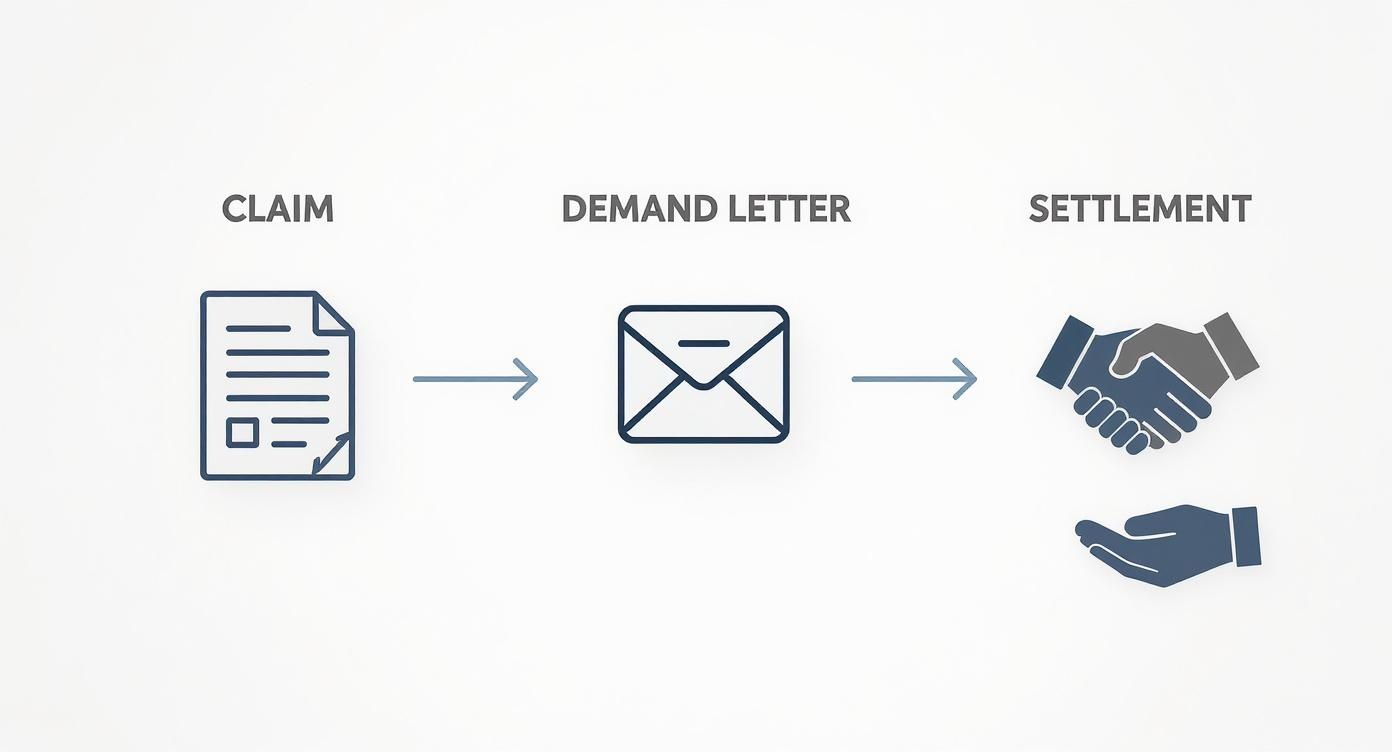
As you can see, the demand letter is the central piece of the puzzle. It’s what transforms a collection of facts and bills into a formal negotiation, setting the stage for a successful outcome.
To help you visualize the flow, here’s a breakdown of the essential elements your letter must contain.
Essential Elements of a Demand Letter
This table outlines the key sections of a personal injury demand letter and what each one needs to accomplish.
| Section | Purpose | Key Information to Include |
|---|---|---|
| Professional Header | To immediately identify the claim and provide essential context for the adjuster. | Your contact info, adjuster's details, claim number, date of loss, and their insured's name. |
| Clear Introduction | To state the letter's purpose without ambiguity. | A direct statement demanding a settlement for injuries caused by their insured's negligence. |
| Statement of Facts | To establish an undisputed, chronological narrative of the incident. | A step-by-step account of what happened, where, and when, leading to the conclusion of fault. |
| Liability Argument | To legally connect the insured's actions to your client's injuries. | Explicitly state why their insured is at fault (e.g., ran a red light, failed to yield). |
| Injuries and Treatment | To detail the full extent of the physical and emotional harm suffered. | A complete list of all injuries, medical procedures, therapies, and ongoing medical needs. |
| Damages Calculation | To present a clear, itemized list of all financial losses. | A breakdown of economic damages (medical bills, lost wages) and non-economic damages (pain and suffering). |
| Settlement Demand | To state your total demand and set the terms for negotiation. | The total settlement figure, a deadline for response (usually 30 days), and the consequences of inaction. |
Each part plays a critical role in building a rock-solid case before you even step into a courtroom.
The Professional Header and Introduction
Let’s start at the top. Your letter absolutely must begin with a professional header containing all the key details. This isn't just about looking official; it’s about making the adjuster's job easy. A clear header allows them to instantly pull up the right claim file and get to work.
Make sure you include:
- Your Information: Full name and contact details.
- Recipient’s Information: The claims adjuster’s name and the insurance company’s address.
- Claim Details: The claim number, the date of the accident, and the full name of their insured.
The opening paragraph should be short and to the point. State clearly that this letter is a formal demand for a settlement for the injuries your client sustained because of their insured's negligence on a specific date. No fluff needed.
Building Your Case with Facts and Liability
This is where you lay the foundation of your argument. You need to present the undisputed facts of what happened in a simple, chronological order. Describe the incident exactly as it occurred—what happened, where it happened, and when. Your goal is to create a narrative that logically leads to one, and only one, conclusion: their insured was at fault.
Right after the facts, you have to spell out why the other party is legally responsible (liable) for your client’s injuries. Don't assume the adjuster will connect the dots. You have to do it for them. Directly link their insured's specific actions—running that red light, failing to clean up a spill, rear-ending your client—to the incident and the harm that followed. A strong demand is built on solid information, so be sure to nail down your legal client intake documents to have every detail at your fingertips.
Detailing Injuries and Calculating Damages
Now you pivot from the incident itself to the painful consequences. This is where you detail every single injury your client sustained. Go beyond the obvious. List everything from major fractures and surgeries to the nagging soft tissue injuries and emotional trauma that followed. Describe all the medical treatment they've received: hospital stays, specialist visits, physical therapy, and medications.
This section is where you show your work. Your narrative of pain and recovery must be backed up by a comprehensive list of every associated cost. These are your economic damages.
Pro Tip: Your opening demand should always be significantly higher than the minimum amount your client would accept. Experienced attorneys often demand 75% to 100% more than their walk-away number. This gives you crucial room to negotiate without leaving money on the table.
Finally, you state your total settlement demand. This number is the sum of your hard costs (economic damages like medical bills and lost income) and the value you've placed on the non-economic damages (pain and suffering). While basic templates can give you a structure, every case is unique. For complex claims, you need to ditch the templates and embrace tailored growth with expert guidance.
End your letter with a firm deadline for a response—30 days is standard—and a clear statement that you are prepared to pursue litigation if a fair settlement cannot be reached.
Telling Your Story with Credibility and Impact
This is where your demand letter stops being a dry collection of facts and starts breathing. You need to paint a vivid, human picture for the insurance adjuster, showing them not just what happened, but how the incident has fundamentally altered your life. Your story is what gives weight to the compensation you’re asking for.
The best way to do this is to walk them through a clear, chronological account of the incident and everything that followed. Start moments before the accident and guide the reader through the event, step by step. Stick to the facts here—being specific is powerful, but using overly emotional language can make you seem less credible.

From Incident to Injury
Once you’ve laid out the facts of the accident, you need to connect the dots. The goal is to draw a straight line from the at-fault party's negligence to your physical and emotional pain. List every single injury, from the most severe fractures down to the nagging soft tissue damage that still hasn't gone away.
Then, you'll want to detail the medical journey you've been on. This creates a clear timeline that backs up your claim. For example, you might break it down like this:
- The immediate diagnosis you received in the emergency room.
- Any specific surgical procedures you had to endure.
- The ongoing physical therapy sessions needed to get your mobility back.
- A list of the medications prescribed to manage your pain.
This isn't just about listing medical bills; it's about showing the adjuster the painful and often grueling road to recovery you were forced down.
Quantifying the Human Cost
Beyond the hospital visits and therapy sessions, you have to articulate how all this has impacted your day-to-day existence. This is where your demand letter becomes a powerful storytelling tool. Explain how your injuries have affected your ability to work, take care of your home, or even enjoy the hobbies you once loved.
A powerful narrative helps the adjuster grasp the full extent of your loss. Don't just write "I have back pain." Describe how that pain means you can't pick up your child or even sit through a movie without shifting in agony. This personal context makes your claim real and justifies your demand for non-economic damages.
This strategy is absolutely essential in the U.S., where a thoughtfully written demand letter can resolve over 99% of personal injury cases before they ever see a courtroom. The U.S. legal system allows for compensation that goes beyond just financial losses to cover pain and suffering, which makes telling your story one of the most critical parts of your claim. You can read more about how personal injury claims differ around the globe on egenerationmarketing.com.
Maintaining a Professional Tone
As you tell your story, it’s absolutely critical to maintain a firm, professional tone. Resist the urge to use angry or accusatory language. Your credibility is your biggest weapon, and a calm, fact-based narrative will always be more persuasive to an adjuster than an emotional rant.
Think of this letter as a business communication. Presenting it that way shows you're organized and serious. That professional approach also shapes how the insurance company views you or your attorney, which can be a huge factor when negotiations start. Our guide on online reputation management for lawyers dives deeper into why perception matters so much. Your letter should be confident and assertive, leaving no doubt that you know your rights and are ready to see this through to the end.
How to Calculate Your Settlement Demand
Figuring out the right number for your settlement demand is, without a doubt, the most critical part of your letter. This isn't a number you just pull out of thin air. It’s a carefully calculated sum of every single loss you've had to endure because of your injury.
Your total demand is built from two very different kinds of damages: economic and non-economic. Think of them as the hard numbers and the human cost.
Tallying Your Economic Damages
Economic damages, which lawyers sometimes call "special damages," are the straightforward, tangible costs. These are all the out-of-pocket expenses you can prove with a receipt, an invoice, or a pay stub. This part of your calculation is the bedrock—the solid numbers that are tough for an insurance adjuster to argue with.
Start by gathering every single piece of paper related to your financial losses. You have to be meticulous here. Every dollar you overlook is a dollar you can’t get back.
Your list of economic damages should cover things like:
- Medical Bills: Every single cost, from the ambulance ride and ER visit to surgery, physical therapy sessions, and prescriptions.
- Lost Income: Add up all the wages you lost because you couldn't work. Don't forget to include not just your base pay, but any overtime or bonuses you would have normally earned.
- Future Lost Earnings: This is a big one. If your injuries will keep you from returning to your old job or limit your earning power down the road, you have to estimate that future loss.
- Property Damage: This is usually the cost to fix your car or replace any other personal belongings that were destroyed in the accident.
Add every last one of these figures together. The total is your economic damages, and it serves as your baseline. In certain situations, like when a faulty product is involved, these costs can get very high. You can see what I mean in these product liability case examples.
Valuing Your Pain and Suffering
This is where things get a bit more subjective. Non-economic damages, or "general damages," are meant to compensate you for the intangible harm—the real human suffering. This covers your physical pain, emotional distress, anxiety, and the simple loss of being able to enjoy your life like you used to.
Obviously, there's no receipt for suffering, so how do you put a price tag on it?
The most common way is the multiplier approach. You take your total economic damages and multiply that number by something between 1.5 and 5.
The multiplier you pick is a direct reflection of how severe your injuries were and how much they've upended your life. A minor sprain that healed quickly might get a 1.5x or 2x multiplier. A permanent, life-changing injury could easily justify a 4x or 5x multiplier.
Let's walk through an example. Say your total medical bills and lost wages came out to $10,000. You suffered some pretty moderate injuries that took a few months to heal and really disrupted your daily routine. In that case, you might use a multiplier of 3.
That would make your non-economic damages $30,000.
Your final demand is simply the two categories added together. In our example, that's $10,000 (economic) + $30,000 (non-economic) = $40,000 total demand. This is the number you lead with; it's your opening bid in the negotiation process.
Your Go-To Demand Letter Template
Alright, let's put everything we've talked about into action. I've drafted a comprehensive, fill-in-the-blank template that you can adapt for your own claim. Think of it as a solid foundation—your job is to build upon it with the specific, compelling facts of your case.
The key here is detail and organization. An insurance adjuster sees hundreds of these letters. The ones that are clear, professional, and well-supported are the ones that get taken seriously right from the start.

The Fill-In-The-Blank Template
[Your Full Name]
[Your Address]
[Your City, State, Zip Code]
[Your Phone Number]
[Your Email Address]
[Date]
[Claims Adjuster’s Name]
[Adjuster’s Title]
[Insurance Company Name]
[Insurance Company Address]
RE: Claim Regarding [Your Full Name]
Claim Number: [Your Claim Number]
Date of Injury: [Date of Incident]
Insured Party: [Name of the At-Fault Person]
FOR SETTLEMENT PURPOSES ONLY
Dear Mr./Ms. [Adjuster’s Last Name]:
This letter is my formal demand for settlement for the injuries I sustained on [Date of Incident]. These injuries were a direct result of the negligence of your insured, [Insured’s Name].
The incident happened at approximately [Time of Incident] at [Location of Incident]. At the time, I was [Briefly describe what you were doing, e.g., "driving northbound on Main Street"]. Your insured, [Insured’s Name], acted negligently when they [Clearly state the negligent act, e.g., "ran a red light and struck my vehicle"]. There is no question that their actions were the direct cause of the collision and my subsequent injuries.
As a direct result of this incident, I suffered significant harm, including:
- [List Injury #1, e.g., "A fractured right tibia"]
- [List Injury #2, e.g., "Cervical strain (whiplash)"]
- [List Injury #3, e.g., "A severe concussion"]
These injuries required immediate medical attention at [Name of Hospital or Clinic] and have forced me into ongoing treatment, which includes [Describe ongoing care, e.g., "physical therapy three times per week"]. The physical pain, emotional distress, and sheer disruption to my daily life have been substantial.
I have enclosed all necessary supporting documents, including the police report, all medical records, and receipts for every related expense to date.
My economic damages are calculated as follows:
- Medical Expenses: $[Total Medical Bills]
- Lost Wages: $[Total Lost Wages]
- Other Out-of-Pocket Costs: $[Total Other Costs]
- Total Economic Damages: $[Total]
Considering the severity of my injuries, the pain I've endured, and the significant impact this has had on my quality of life, I am demanding $[Total Settlement Amount] to resolve this claim. This figure reflects my documented economic damages as well as fair compensation for my pain and suffering.
I expect a written response to this demand within 30 days.
Sincerely,
[Your Signature]
[Your Typed Name]
Important Note: Where you file matters. The legal landscape for personal injury claims varies wildly from state to state. For example, Florida sees about 127 personal injury cases filed for every 100,000 residents—that's roughly 12 times the national average. This just goes to show how critical it is to tailor any template to local legal standards and expectations.
To get a better feel for how to tell your own story effectively, it helps to see how others have done it. Reviewing a few effective sample personal injury demand letters can give you great ideas on how to frame your narrative and present your evidence.
And for law firms trying to bring these cases in the door, mastering this kind of storytelling is a core part of any modern marketing effort. We dive deeper into this in our guide to law firm content marketing.
Common Questions About Demand Letters
Navigating the aftermath of an injury is confusing, and when it comes to your claim, you're bound to have questions. Getting a handle on how the demand letter works is your first step toward taking control of the situation. Let's tackle the most common questions people have when they’re ready to write one.
When Is the Right Time to Send the Letter?
Timing is everything. You absolutely should not send your demand letter until you’ve either finished all your medical treatment or reached what’s called Maximum Medical Improvement (MMI).
MMI is the point where your doctors have officially said you're as recovered as you're going to get.
Sending that letter before you hit MMI is a huge gamble. You could seriously underestimate what your future medical care will cost or the true long-term impact of your injuries. Settle too early, and you could be left with a check that doesn't even come close to covering what you'll actually need down the road.
Should I Handle This Myself or Hire a Lawyer?
This is the big one. Deciding whether to write the letter yourself or bring in a legal pro is a major fork in the road.
For minor injuries where the other party’s fault is a slam dunk—think a simple fender-bender where no one is arguing about who caused it—drafting the letter yourself with a solid template can work great. It keeps legal fees out of your pocket and can wrap things up quickly.
But you need to seriously think about hiring a personal injury lawyer if your case involves:
- Serious or permanent injuries. Anything with long-term consequences needs an expert to figure out its true value.
- Complex liability. If there’s even a hint of a debate about who was at fault, you need an attorney in your corner.
- A ghosting insurer. When the insurance company is ignoring you or refusing to negotiate fairly, a lawyer gets their attention.
- A high-value claim. Big numbers get big scrutiny. Professional representation shows the insurance company you mean business.
Bringing in a lawyer often forces the insurance adjuster to take your claim more seriously. It can lead to a much higher settlement offer, even after you account for the attorney’s fees.
Here's a pro tip: An insurance company's first move—or lack of one—is almost always a tactic. A ridiculously low offer or complete radio silence is meant to see if you'll just give up. Don't let it get to you. It’s almost never their final answer.
Your well-documented demand letter is the starting point for whatever comes next, whether that’s a firm follow-up call, a written counter-offer, or handing the whole file over to an attorney to turn up the heat.
What Are the Biggest Mistakes to Avoid?
Even with a perfect template, a few simple mistakes can sink your entire claim. One of the most common pitfalls is writing with an aggressive or overly emotional tone. It just makes you look less credible to the adjuster.
Another classic error is forgetting to attach all your proof. Every single medical bill, doctor's note, and pay stub that backs up your lost wages has to be in that package.
And finally, make sure the amount you're demanding is realistic and supported by your math. Always, always be aware of your state's statute of limitations for filing a lawsuit—miss that deadline, and your claim is worthless.
At Case Quota, we specialize in connecting law firms with the clients who need them most. If your firm is ready to grow its personal injury caseload with targeted, effective marketing, visit us at https://casequota.com to see how we can help.