

Most American law firms miss out on local clients because their websites are buried beneath larger competitors in search results. In Southern California, where competition is fierce, even small technical flaws or thin content can lose business to big national legal brands. This practical guide reveals how small and mid-size law firm partners can apply straightforward on-page SEO strategies—optimized for local search and compliance—to help your practice stand out and attract more potential clients in the American legal marketplace.
Table of Contents
- What On-Page SEO Means for Lawyers
- Essential On-Page Elements for Law Firms
- Content Strategy for Legal Services Pages
- Unique Legal Compliance in SEO Practices
- Avoiding Common On-Page SEO Mistakes
Key Takeaways
| Point | Details |
|---|---|
| On-Page SEO Importance | For law firms, effective on-page SEO improves online visibility by optimizing website elements like content and technical aspects. |
| Content Strategy | Develop practice-specific pages that address client needs using accessible language and real-world examples. |
| Compliance Awareness | Ensure SEO practices align with legal advertising regulations to maintain professional standards and client trust. |
| Avoid Common Mistakes | Regularly audit for issues like keyword stuffing and inconsistent business information to enhance visibility and client engagement. |
What On-Page SEO Means for Lawyers
On-Page SEO for law firms represents a strategic approach to digital visibility that goes far beyond simple keyword placement. At its core, attorney SEO involves optimizing a legal website to improve organic search visibility by creating authoritative, user-focused content that directly addresses potential clients’ legal needs.
For lawyers, on-page SEO means meticulously crafting website elements to signal expertise, trustworthiness, and relevance to search engines and potential clients. This includes optimizing page titles, headers, meta descriptions, and content to precisely match the search intent of individuals seeking legal representation. Your website’s structure, load speed, mobile responsiveness, and content quality all play critical roles in determining how effectively you connect with local clients searching for legal services.
Successful on-page SEO for law firms requires a nuanced understanding of both technical optimization and content strategy. Key elements include creating practice area-specific pages with detailed, valuable information, incorporating location-based keywords for local search dominance, and developing content that demonstrates legal expertise while remaining accessible to potential clients. The goal is not just ranking higher in search results, but establishing your law firm as a credible, approachable resource for individuals navigating complex legal challenges.
Pro Tip: Regularly audit your website’s content and technical SEO elements, focusing on updating practice area pages with current, specific information that directly addresses potential client questions and concerns.
Essential On-Page Elements for Law Firms
Building an effective law firm website requires strategic attention to on-page elements that simultaneously communicate professional credibility and optimize search visibility. Key website homepage components are critical for establishing your firm’s digital presence, each serving a specific purpose in attracting and converting potential clients.
The most essential on-page elements for law firms include a compelling homepage design, clear navigation structure, and practice area-specific content. Your website must quickly communicate your firm’s unique value proposition through strategic visual and textual elements. This means developing professional attorney profiles that highlight expertise, creating location-specific practice area pages that address local legal needs, and incorporating client testimonials that build trust and demonstrate successful outcomes.

Technical optimization plays an equally crucial role in on-page SEO for law firms. This involves ensuring mobile responsiveness, implementing fast page load speeds, using structured data markup for enhanced search results, and creating a logical internal linking structure that helps both users and search engines understand your website’s content hierarchy. Each page should be carefully optimized with relevant keywords, informative meta descriptions, and headers that precisely match potential clients’ search intentions.
Here’s a summary of critical on-page elements and their business impact for law firm websites:
| Website Element | Business Impact | Optimization Focus |
|---|---|---|
| Practice Area Pages | Attracts relevant client leads | Local keywords, depth |
| Attorney Profiles | Builds trust and credibility | Detailed bios, expertise |
| Client Testimonials | Demonstrates successful outcomes | Compliance, authenticity |
| Homepage Design | Engages visitors and reduces bounce | Visual appeal, clear value |
| Structured Data Markup | Enhances search result appearance | Schema integration |
Pro Tip: Conduct a quarterly audit of your website’s on-page elements, focusing on updating content, checking technical performance, and ensuring all practice area pages reflect your most current legal expertise and client service offerings.
Content Strategy for Legal Services Pages
Developing an effective content strategy for legal websites requires a nuanced approach that balances professional expertise with client accessibility. Successful legal content prioritizes plain language and clear organization of complex legal information, ensuring potential clients can easily understand and navigate sophisticated legal concepts.
The core of a compelling legal services content strategy involves creating practice area pages that speak directly to potential clients’ specific needs and concerns. This means developing in-depth, practice-specific content that demonstrates deep legal expertise while remaining approachable and solution-oriented. Each content piece should address common client questions, explain legal processes in straightforward language, and showcase the firm’s unique approach to solving complex legal challenges. Incorporate real-world case studies, client testimonials, and practical insights that help potential clients understand how your legal expertise can resolve their specific situations.
Technical content optimization is equally critical for legal service pages. This includes strategic keyword integration that reflects actual client search patterns, creating clear hierarchical content structures, and ensuring each page is mobile-responsive and easily digestible. Your content should not just inform but also guide potential clients toward taking action, with clear calls-to-action, contact information, and easy-to-find consultation request mechanisms. Regularly update your content to reflect current legal trends, recent case successes, and evolving practice area specializations to maintain relevance and demonstrate ongoing expertise.
Pro Tip: Develop a content calendar that maps out practice area page updates, ensuring you refresh key pages quarterly with current legal insights, recent case studies, and emerging legal trends specific to your firm’s expertise.
Unique Legal Compliance in SEO Practices
Navigating the complex intersection of digital marketing and legal ethics requires law firms to implement SEO strategies that not only improve online visibility but also maintain strict professional standards. Unlike other industries, attorneys must balance aggressive digital marketing tactics with the rigorous ethical guidelines established by state bar associations and professional conduct rules.
Unique legal compliance in SEO practices demands careful attention to several critical areas. This includes avoiding misleading claims, protecting client confidentiality, maintaining professional representation standards, and ensuring all online content adheres to advertising regulations specific to legal professionals. Law firms must craft website content that provides genuine value and accurate information without making exaggerated promises or guaranteeing specific legal outcomes. Each practice area page should present factual, verifiable information that demonstrates expertise while remaining within the boundaries of professional ethics.
Technical SEO considerations for law firms extend beyond typical website optimization. Attorneys must carefully navigate restrictions around client testimonials, professional achievements, and case representations. This means implementing robust disclaimers, ensuring all client references are appropriately anonymized, and avoiding any language that could be construed as creating an attorney-client relationship through website content. Compliance also involves regular review of website content to ensure ongoing alignment with current legal advertising regulations, which can vary significantly between different state bar associations.
Pro Tip: Develop a comprehensive legal marketing compliance checklist that includes quarterly reviews of website content, ensuring all SEO strategies remain fully compliant with current state bar advertising guidelines.
Avoiding Common On-Page SEO Mistakes
Law firms frequently sabotage their online visibility by making critical on-page SEO errors that dramatically reduce their ability to attract potential clients. Numerous common mistakes can significantly cost law firms potential client opportunities, ranging from technical oversights to content strategy missteps that push potential clients toward competing practices.
The most prevalent on-page SEO mistakes for law firms include keyword mismanagement, content quality issues, and local search optimization failures. Keyword stuffing remains a critical error, where attorneys attempt to manipulate search rankings by overloading content with repetitive legal terminology. This approach not only reduces readability but also triggers search engine penalties that can dramatically lower website rankings. Similarly, creating thin, superficial content that lacks substantive information about practice areas, legal processes, or client solutions represents another significant mistake that undermines a law firm’s online credibility.
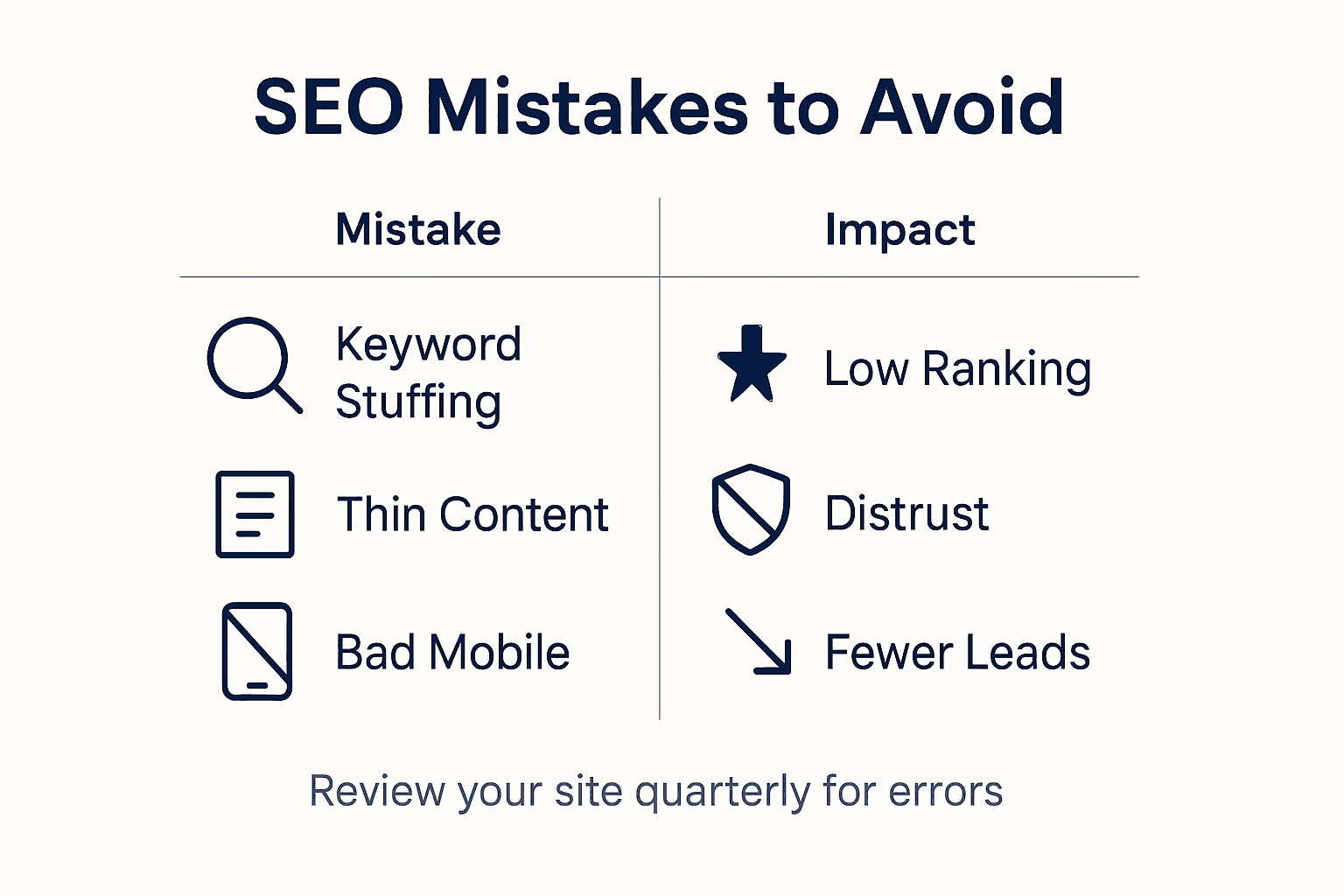
Technical SEO challenges pose equally significant risks for law firm websites. Mobile responsiveness, page loading speed, and consistent business information across digital platforms are fundamental elements that many attorneys overlook. Inconsistent Name, Address, and Phone (NAP) information across different online directories can confuse search algorithms and potential clients, effectively fragmenting your digital presence. Implementing proper schema markup, ensuring comprehensive local SEO optimization, and maintaining a technically sound website structure are essential steps in avoiding these common pitfalls that can undermine a law firm’s digital marketing efforts.
Here is a comparison of common on-page SEO mistakes and their consequences for law firms:
| Mistake | Description | Potential Consequence |
|---|---|---|
| Keyword Stuffing | Excess use of legal keywords | Search penalties, poor UX |
| Thin Content | Lack of substantive information | Low rankings, lost clients |
| Inconsistent Business Info | Mismatched NAP across platforms | Fragmented digital presence |
| Slow Mobile Load Speeds | Poor phone browsing experience | High bounce rates, lost leads |
Pro Tip: Conduct a comprehensive quarterly SEO audit of your law firm’s website, systematically reviewing technical performance, content quality, and local search signals to identify and proactively address potential optimization gaps.
Elevate Your Law Firm’s On-Page SEO and Win More Local Clients
On-page SEO is critical for lawyers who want to attract and convert local clients by showcasing their expertise, credibility, and relevance. Many law firms struggle with keyword mismanagement, thin content, and technical SEO challenges that lower their search rankings and lose potential clients. If you want to avoid these costly mistakes and develop a powerful, compliant content strategy tailored to legal services, you need specialized support.
Case Quota is a digital marketing agency dedicated to helping Southern California law firms grow their client base through customized SEO-optimized web design and cutting-edge marketing solutions. We understand the importance of practice area-specific content, local keyword integration, and legal marketing compliance so your firm can stand out even against bigger competitors. Our expert team provides proven strategies that improve your website’s search visibility, enhance user experience, and convert visitors into paying clients.
Take control of your online presence and turn your on-page SEO efforts into tangible client growth. Learn more about how our tailored digital marketing services empower law firms, see real client success stories and case studies, and discover why specialized legal SEO is not a luxury but a necessity.
Harness the full potential of your law firm’s website today and start winning the local clients you deserve.
Looking for expert help to transform your law firm’s digital presence?

Partner with Case Quota now and get the competitive edge you need with our customized SEO strategies for lawyers. Visit Case Quota to schedule your consultation and begin growing your client base efficiently.
Frequently Asked Questions
What is on-page SEO for law firms?
On-page SEO for law firms involves optimizing various elements on a legal website, including page titles, headers, meta descriptions, and content, to enhance visibility in search engines and attract potential clients seeking legal representation.
How can law firms improve their local SEO?
Law firms can improve local SEO by incorporating location-based keywords in their content, creating specific pages for each practice area, and ensuring consistent business information across all online directories.
Why is content quality important for a law firm’s website?
Content quality is crucial because well-crafted, informative content helps establish the law firm as an authority in its practice areas, engages potential clients, and answers their specific legal questions, ultimately driving more traffic to the site.
What common mistakes do law firms make in on-page SEO?
Common mistakes include keyword stuffing, having thin or superficial content, inconsistent business information, and neglecting mobile optimization, all of which can negatively impact search rankings and client engagement.