

When it comes to marketing, most law firms overlook one of the most powerful tools sitting right in front of them: the humble newsletter. It's often dismissed as a time-consuming chore with a foggy ROI. But that’s a massive missed opportunity.
A well-crafted newsletter isn’t just another email blast; it’s a direct line to your past clients, professional contacts, and warmest leads. It’s a marketing channel you actually own, free from the whims of Google's algorithms or the latest social media shake-up.
The goal isn't a hard sell. It's about consistently delivering value. That's what builds the trust and authority that makes your firm the first one someone thinks of when they—or a friend—need legal help. This is the long game of relationship marketing, a cornerstone of any sustainable law firm marketing strategy.
Your Newsletter is a Competitive Advantage in Disguise
Here’s the surprising truth: the legal space is not flooded with great newsletters. This creates a wide-open lane for firms ready to take this channel seriously.
Recent data shows that only about 40% of law firms bother to send email newsletters regularly. Of that small group, just 28% manage a monthly cadence, and a tiny 12% send them more often. The biggest roadblocks? Time constraints (46%) and a simple lack of belief in their value (26%).
This gap is your opening. With an efficient system for creating and sending valuable content, your firm can easily stand out in a relatively quiet room.
Think of your newsletter as more than an ad. It's a regular, welcome conversation that reinforces your firm's expertise and commitment to its clients. You're shifting your marketing from a periodic expense to an ongoing relationship.
The Pillars of a High-Impact Newsletter
A newsletter that actually gets results doesn't happen by accident. It’s built on a few key pillars, all working together to keep your audience engaged and moving you toward your goals. To really level up, it's worth exploring advanced strategies for personalized newsletters that make every email feel like it was written just for the recipient.
To help you build a newsletter that drives real business, we’ve created this guide around four essential pillars.
Before we dive deep into each component, here's a high-level look at what makes a law firm newsletter truly effective.
Key Components of a High-Impact Law Firm Newsletter
| Component | Primary Goal | Key Takeaway |
|---|---|---|
| Strategic Foundation | Set clear objectives and understand the rules. | Define your "why," segment your audience, and get compliance right from day one. |
| Valuable Content | Become a trusted resource, not a sales brochure. | Create content that solves problems and answers questions your audience actually has. |
| Professional Delivery | Ensure your message gets seen and opened. | Master subject lines, design, and a sending schedule that respects your audience's inbox. |
| Performance Measurement | Know what’s working and prove its value. | Track the right metrics to continuously improve and demonstrate a clear return on effort. |
Each of these elements plays a critical role. Getting them right is the difference between an email that gets deleted and one that gets read, shared, and generates a call. Let's break down how to nail each one.
Building a Strategic and Compliant Foundation
Before you ever write a single word, you need a plan. An email without a clear purpose is just more noise in an already crowded inbox, and for law firms, that’s a quick way to get ignored. So let's start by defining what success actually looks like for your firm. Is the main goal to keep past clients in your orbit, generate more referrals, or something else entirely?
Your answer dictates everything—your content, your audience, your cadence. Don't fall into the common trap of blasting the same generic email to every contact in your database. A one-size-fits-all approach almost always guarantees a one-size-fits-none result.
This is all about building a cohesive strategy where your different goals work together, not against each other.
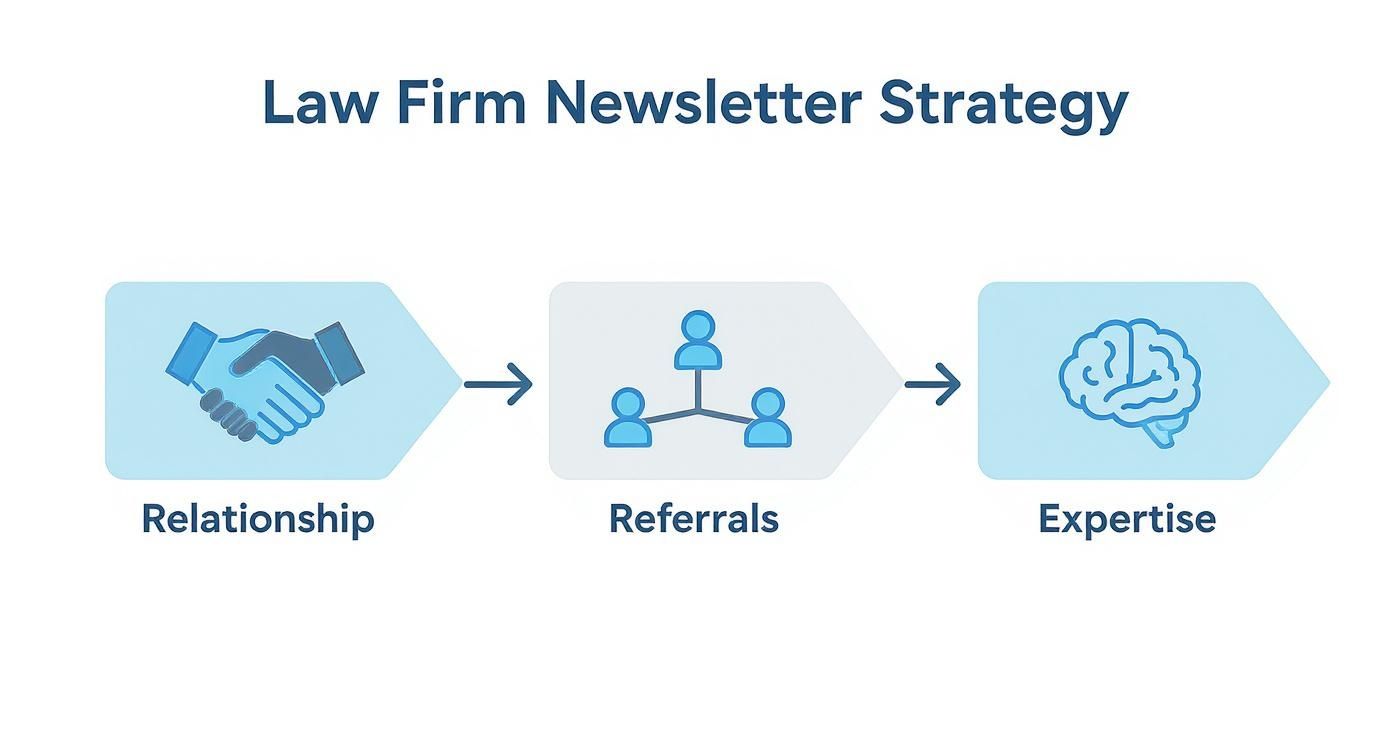
As you can see, these objectives are all interconnected. When you build strong relationships, referrals happen naturally. When you demonstrate expertise, you strengthen both.
Defining Your Primary Objective
What is the single most important thing you want your newsletter to accomplish? You can absolutely have secondary goals, but picking a primary one brings much-needed focus to your efforts.
Most law firms land on one of these:
- Client Retention: The goal here is to stay engaged with past clients. You want to be the first firm they think of for their next legal need or when a friend asks for a recommendation.
- Referral Generation: This is about staying top-of-mind with your professional network—think accountants, financial advisors, or other attorneys who can send business your way.
- Thought Leadership: This is how you establish your attorneys as the go-to experts in their practice areas. It builds serious credibility and tends to attract higher-value cases.
- Cross-Selling Services: A simple but effective goal. You're educating existing clients about other ways your firm can help them, services they might not even know you offer.
A personal injury firm, for example, would probably lean heavily on client retention. An M&A firm, on the other hand, would likely prioritize thought leadership to attract sophisticated corporate clients.
Smart Audience Segmentation
Once you know your "why," it’s time to figure out your "who." Segmentation is just a fancy word for dividing your email list into smaller, more relevant groups. This is what lets you send content that truly speaks to each audience's specific needs.
Seriously, ditch the single master list. A potential business litigation client doesn't care about your new article on estate planning basics.
Sending targeted content isn't just a best practice; it's a fundamental sign of respect for your reader's time. It shows you understand who they are and what they care about, which is the fastest way to build trust.
Here are a few practical ways to slice up your list:
- By Practice Area: Create separate lists for contacts interested in family law, criminal defense, business law, and so on.
- By Client Status: Group your contacts into buckets like “Current Clients,” “Past Clients,” and “Prospective Clients.”
- By Referral Source: Keep a dedicated list for your professional network to share different kinds of updates, like co-marketing opportunities or invitations to networking events.
Navigating Legal and Ethical Guardrails
For lawyers, compliance isn't a suggestion—it's mandatory. Building your newsletter on a solid ethical and legal foundation from day one will save you from major headaches and potential disciplinary action down the road.
CAN-SPAM Act: This is the federal law for commercial email. The rules are straightforward: you must provide a clear unsubscribe link, include your physical mailing address, and not use shady or deceptive subject lines.
State Bar Advertising Rules: Don’t forget, every newsletter you send is a form of attorney advertising. That means it has to comply with your state bar's rules. These regulations often dictate what you can claim, whether you need to include a disclaimer like "Attorney Advertising," and how you present past case results. If you want to go deeper, check out our guide on navigating Rule 7.2 for ethical attorney advertising in California, which has insights that apply in many other jurisdictions.
GDPR and Privacy: If you have contacts in the European Union, the General Data Protection Regulation (GDPR) applies to you. This is a big one. It requires explicit, unambiguous consent before you can send them marketing emails. No assumptions allowed.
Getting these details right isn’t just about avoiding fines. It’s about upholding the professional standards of your firm and building a channel of communication your audience can actually trust.
Developing Content That Your Clients Will Actually Value
The single biggest roadblock for any law firm newsletter isn't the software or the send schedule. It's the blank page. That blinking cursor can feel paralyzing when you're trying to figure out what your clients actually want to read.
The secret is a simple but powerful shift in perspective: stop asking, "What do we want to say?" and start asking, "What would our clients find genuinely useful?"
This client-first mindset is the engine of a great newsletter. It transforms your email from a digital brochure into a can't-miss resource. Instead of bragging about a recent firm award, you’re breaking down a new law that impacts their business or family. That’s how you earn attention and build real trust.
Valuable content is the foundation of any effective law firm content marketing strategy, and your newsletter is the perfect way to deliver it directly to the people who matter most.

Finding the Right Content Mix
A newsletter that works isn't just one thing. It's a calculated blend of content types, each serving a distinct purpose. The goal is to establish a rhythm where subscribers know they're getting a mix of educational, practical, and personable content in every issue.
Try to balance these three core pillars:
- Educational Content: This is the heart and soul of your newsletter. It tackles your clients' most common problems and answers their burning questions head-on.
- Informative Updates: This keeps your audience in the loop on legal or industry changes that directly affect them. Think new regulations, landmark court rulings, or updated compliance requirements.
- Firm News (Used Sparingly): This is your chance to humanize the firm. A short note about a new associate, a community event you sponsored, or a personal story shows the real people behind the logo.
When you blend these elements, you create something that feels both authoritative and approachable—the perfect tone for building lasting client relationships.
Translate Legalese into Plain English
Your expertise is your most valuable asset, but it can also be your biggest communication hurdle. Clients don't think in case citations or statutory language. Your job is to be the expert translator, breaking down intimidating legal topics into simple, actionable advice.
Think about it this way: a small business owner doesn't need to read the entire text of a new corporate transparency act. What they need is a three-bullet summary explaining how it impacts them and what they need to do next.
Your value isn’t just in knowing the law; it’s in explaining the law in a way that empowers your clients to make smarter decisions. Simplicity is a service.
Before hitting "send," always ask yourself: "Would my ideal client understand this without a law degree?" If the answer is no, it's time for another edit.
Content Ideas Tailored by Practice Area
Generic content gets deleted. The law firm newsletters that truly succeed are the ones that deliver highly relevant information to a specific audience. What a personal injury client needs to know is worlds away from the concerns of corporate counsel.
To get your brainstorming started, here are some practical, client-focused content ideas broken down by legal specialty.
Practical Content Ideas by Law Firm Practice Area
| Practice Area | Newsletter Content Idea | Value to the Client |
|---|---|---|
| Personal Injury | "5 Steps to Documenting Your Car Accident Scene (Before You Forget)" | Provides immediate, actionable advice during a stressful time, building trust. |
| Estate Planning | "Common Mistakes Parents Make When Choosing a Guardian for Their Kids" | Addresses a deeply personal and critical concern, prompting proactive planning. |
| Family Law | "A Guide to Co-Parenting Apps The Pros and Cons of OurFamilyWizard vs. AppClose" | Offers practical solutions to common post-divorce challenges. |
| Business Law | "Breaking Down the New Reporting Requirements for Small Businesses" | Translates complex regulations into clear compliance steps, saving clients time and risk. |
| Criminal Defense | "What 'Right to Remain Silent' Actually Means (and When to Use It)" | Demystifies a core legal right and reinforces the importance of legal counsel. |
| Real Estate Law | "Is Title Insurance Really Necessary? A Plain-English Explanation" | Answers a common and confusing question for homebuyers, demonstrating expertise. |
Use this table as a jumping-off point. Think about the top 5 questions you get from new clients—those are almost always your best newsletter topics.
Creating a Sustainable Content Calendar
Consistency is everything, but it's tough to maintain. The only way to avoid that last-minute scramble for content is to plan ahead with a simple content calendar. You don't need fancy software; a Google Sheet or a whiteboard will work just fine.
Try mapping out your newsletter themes a quarter at a time. This lets you batch your research and writing, which makes the entire process more efficient and less stressful.
Here’s what a simple quarterly plan could look like for a family law firm:
- January: Theme: "New Year, New Beginnings." Content could focus on collaborative divorce options or setting healthy co-parenting goals.
- February: A short month is perfect for a Q&A. Maybe you interview a paralegal about the client intake process to demystify the first steps.
- March: Focus on spring break travel. Write a piece on creating clear custody agreements for holidays and travel permissions.
This kind of forward-thinking transforms your newsletter from a recurring chore into a manageable and strategic part of your marketing. You'll deliver consistent value without the constant stress.
Designing and Delivering a Professional Newsletter
You've got great content. But if the package looks sloppy, it's dead on arrival. The design and delivery of your law firm's newsletter are just as critical as the words inside; they're the first impression that decides whether your email gets opened, read, or junked. A clunky design or a poorly timed send can completely sabotage even the sharpest legal insights.
This is where you translate your firm’s brand and professionalism into a digital format. The goal is a clean, readable, and consistent experience that builds credibility every single time you hit "send."
Crafting a Clean and Accessible Design
In email design, less is more. Your subscribers are busy people, and a huge chunk of them are reading on a phone. That's why you need to prioritize a single-column layout that’s a breeze to scroll through, with plenty of white space to let the content breathe.
Think of the design as an extension of your brand. Use your official logo, brand colors, and professional fonts every time. Don't worry, you don't need to be a coder; most email marketing platforms have simple drag-and-drop templates that make a polished look achievable for anyone.
But it's not just about looking good. Your newsletter has to be accessible to everyone, including those with disabilities. Frankly, this isn't just a best practice—it's an ethical obligation.
- Use Alt Text for Images: Always provide descriptive alternative text for images. This allows screen readers to describe them to visually impaired users.
- Ensure High Color Contrast: Text has to be crystal clear against its background. Use an online tool to check your color combinations for compliance.
- Write Descriptive Links: Ditch "click here." Instead, use link text that explains exactly where the user is going, like "Read our guide to estate planning."
Making your digital communications accessible is a fundamental part of modern client service. For a deeper dive, check out this ADA compliance checklist for websites; the core principles apply directly to email design, too.
Writing Subject Lines That Earn the Open
Your subject line is the single most important sentence in your entire newsletter. It’s the gatekeeper. No matter how brilliant your content is, a boring or spammy subject line guarantees it will die unread in an inbox. You have to be clear and compelling without veering into cheesy clickbait.
Think of it as the headline for your email—it needs to accurately reflect the content and offer an obvious benefit to the reader.
Your subject line is a promise. Make it enticing enough to earn a click, but make sure the content inside delivers on that promise to maintain long-term trust.
Here are a few examples that work for different practice areas:
- Estate Planning: "3 Questions to Ask Before Choosing a Guardian"
- Business Law: "New Reporting Rule Affects CA Businesses Jan 1"
- Personal Injury: "Does Your Auto Insurance Cover a Rideshare Accident?"
Always front-load the most important info. Mobile devices often chop off subject lines after just 30-40 characters. And don't guess what works—use A/B testing. Sending two different subject lines to small segments of your list is a powerful way to see what actually grabs your audience's attention.
Finding the Right Sending Cadence and Time
Consistency is everything. It builds anticipation and trust. Whether you send weekly, bi-weekly, or monthly, just pick a schedule and stick to it. For most law firms, a monthly newsletter is a realistic and sustainable place to start.
While there's no magic "best" time to send an email, industry data gives us a solid starting point. Studies consistently show high engagement on Tuesdays and Wednesdays. The sweet spots are often around 10 AM (as people settle into their workday) and 2 PM (during that post-lunch slump).
But here's the thing: the best time for your firm depends entirely on your audience. Test different days and times, watch your open rates like a hawk, and let the data tell you what to do.
To really elevate your firm's communications, fold these actionable email newsletter best practices into your entire process. Creating a simple, repeatable workflow is what turns your newsletter from a marketing task into a sustainable marketing asset.
How to Measure Your Newsletter's True Impact
Sending a newsletter without tracking its performance is like driving with your eyes closed. You're putting in the work, but you have no idea if you're even on the right road. To turn your newsletter from a hopeful guess into a measurable asset for your firm, you have to get comfortable with the data.
This isn't about becoming a data scientist. It's about knowing which numbers tell you the real story, proving the value of your efforts, and getting the insights you need to make smart adjustments. Instead of wondering if your content is working, you'll know what resonates and what needs to change.
Defining Your Core Key Performance Indicators
Key Performance Indicators (KPIs) are the vital signs of your newsletter's health. Your email provider’s dashboard is full of numbers, but for most law firms, only a few really matter. Focusing on these core metrics keeps you from getting distracted by "vanity metrics" and helps you zero in on what actually drives results.
These are the essentials you need to watch:
- Open Rate: The percentage of subscribers who actually opened your email. This is a direct gut-check on your subject line's power and your firm's sender reputation.
- Click-Through Rate (CTR): This shows the percentage of people who clicked on at least one link inside your email. Your CTR is the ultimate test of your content's value and relevance.
- Unsubscribe Rate: The percentage of people who opted out after this email. A spike here is a clear signal that your content missed the mark or you're sending too often.
Here's a dose of reality: email newsletters in the legal sector have a lot of room for improvement. The average open rate for legal services emails hovers around 22%, with a click-through rate of just 2.81%. These benchmarks show just how critical it is to send high-quality, relevant content to keep your audience from tuning out. You can discover more insights about these legal marketing benchmarks to see how you stack up.
Connecting Metrics to Real-World Business Goals
Standard KPIs are important, but they don't pay the bills. The true impact of newsletters for law firms is measured by how they contribute to client growth. You have to move beyond opens and clicks to track the actions that directly connect your newsletter to your bottom line.
A high open rate is nice, but a single click that leads to a scheduled consultation is what truly proves the newsletter's worth. The goal is to see how email engagement translates into tangible client interactions.
Here’s how to track what really matters:
- Consultation Clicks: Create a dedicated link for your "Schedule a Consultation" call-to-action. Tracking clicks on this specific link is the most direct way to measure how many leads your newsletter is generating.
- Resource Downloads: If you offer a lead magnet—like a free guide or an estate planning checklist—track how many subscribers download it. This signals deep engagement and helps you identify your most interested prospects.
- Website Goal Completions: Using a tool like Google Analytics, you can set up "Goals" to track how many newsletter readers go on to visit a key service page or fill out your main contact form. This is a crucial part of measuring advertising effectiveness across all your marketing channels.
This screenshot shows email marketing benchmarks across different industries, which gives you a useful comparison point for your firm's performance.
Notice how the legal sector's numbers compare. This context is invaluable for setting realistic goals and spotting where you can gain an edge.
Troubleshooting Common Performance Issues
Think of your data as a diagnostic tool. When a metric is underperforming, it’s pointing you to a specific problem—one that usually has a straightforward fix. Don't just stare at the numbers; use them to ask the right questions and make strategic moves.
Here are a few common scenarios and what to do about them:
- Low Open Rate? The problem is almost always your subject line. Is it too long, too generic, or just plain boring? Start A/B testing different subject lines to see what your audience actually responds to. Also, double-check that your "from" name is instantly recognizable as your firm.
- High Open Rate but Low CTR? This means your subject line made a promise that the email's content didn't deliver on. People were intrigued enough to open it, but nothing inside compelled them to act. Re-evaluate your content's relevance and make sure your calls-to-action are clear, visible, and persuasive.
- High Unsubscribe Rate? This is a five-alarm fire. It could mean your content is totally off-base from what subscribers expected, or you're emailing them into submission. Go back and look at your sign-up process—are you setting clear expectations from the very beginning?
Got Questions About Law Firm Newsletters? Let's Clear Them Up.
Even with a solid plan, actually starting a newsletter can feel like stepping into a minefield of questions. It's easy to get bogged down in the details, and overlooking them can mean wasted time or, worse, an ethical misstep. Let's tackle the most common hurdles and practical concerns we hear from attorneys every day.
Think of this as your no-nonsense troubleshooting guide. We'll cover everything from building your list the right way to managing your time effectively.
How Do We Build an Email List Without Breaking the Rules?
Growing your subscriber list is step one, but doing it ethically is the only way to do it. The golden rule is simple: focus on consent and value.
Let’s be crystal clear: never, ever buy an email list. Not only is it a complete waste of money on people who don't care about your firm, but it's a fast track to violating anti-spam laws and torching your reputation.
Instead, earn your subscribers. Grow your list organically with people who actually want to hear from you.
- Website Sign-Up Forms: Place a simple sign-up form where people will see it—your homepage, blog sidebar, and contact page are prime real estate.
- Valuable Lead Magnets: Give people a compelling reason to hand over their email. Offer a genuinely useful resource, like a free guide ("5 Things to Know Before Signing a Commercial Lease") or a practical checklist.
- Client Intake Process: Add an optional checkbox for newsletter sign-ups on your new client forms. Critically, this box must be unchecked by default. You need their explicit permission.
- Double Opt-In: This is non-negotiable. After someone signs up, they get an automated email asking them to confirm their subscription. This one extra click ensures a high-quality, engaged list and protects you from spam complaints.
An ethical, consent-based list is your single most valuable marketing asset. It’s a direct line to people who have already raised their hand.
What are the Most Critical Ethical Rules to Follow?
For a law firm, a newsletter isn't just marketing—it's a form of professional communication that falls under your bar's strict guidelines. Getting this wrong has real consequences.
The core issues revolve around attorney advertising and client confidentiality. Your newsletter is considered advertising, so it must comply with your state bar’s rules. That means no misleading claims, no puffery, and absolutely no guarantees of a specific outcome.
Don't forget this one: Your newsletter must be clearly labeled "Attorney Advertising" if your jurisdiction requires it. This tiny detail is a critical compliance step that many firms miss.
Client confidentiality is, of course, paramount. You can't share any confidential information, even if you frame it as an anonymous case study, without getting that client's explicit, written consent first. And finally, every single email must have a clear, functional unsubscribe link. That’s a federal requirement under the CAN-SPAM Act.
Can We Just Use AI to Write the Whole Thing?
AI tools offer a tempting shortcut, but it’s a shortcut you need to take with extreme caution. Think of AI as a powerful paralegal, not a partner.
AI is fantastic for:
- Brainstorming a list of potential topics
- Outlining the structure of an article
- Generating a rough first draft to break through writer's block
But here's the reality: all legal content demands 100% accuracy, nuance, and strict adherence to ethical rules. An AI simply can't guarantee that. An attorney must review, edit, and personally approve every word before it goes out. This human oversight is your only safeguard to protect your firm, uphold your professional standards, and ensure the information you share is actually correct.
How Much Time Does a Monthly Newsletter Really Take?
This is the big one, and the answer is probably less than you think. Once you have a system down, a small to mid-sized firm can knock out a quality monthly newsletter in about 4 to 6 hours total.
Here’s how that time breaks down:
- Planning (1-2 hours): This is where you map out topics for the next few months and outline the current issue. A little forethought goes a long way.
- Writing (2-3 hours): Drafting the actual content. This gets much faster if you’re smart about it and repurpose material from existing blog posts or recent client alerts.
- Production (1 hour): Loading the content into your email template, dropping in images, and scheduling the send.
The key to making this work is creating templates—both for the email design and the content structure (e.g., short intro, one main article, a quick tip, firm news). The initial setup takes a bit of time, but your monthly investment drops significantly after that.
Ready to turn your law firm's newsletter into a consistent source of client engagement and referrals? At Case Quota, we specialize in creating strategic marketing systems for law firms that deliver measurable results.
Learn how our targeted marketing services can help you connect with more clients.