

For a long time, social media felt like an optional add-on for law firms—a nice-to-have, but not essential. Those days are long gone. Today, it’s a core part of building a reputation, managing your brand, and, most importantly, getting new clients.
Think of it as the new town square. It’s where potential clients go to check you out, get a feel for your firm's personality, and decide if they can trust you. A solid, strategic social media presence is no longer a luxury but a necessity for any firm that wants to grow.
Why Your Firm Can No Longer Ignore Social Media
Let’s put this in perspective. Your traditional marketing—the print ads, the formal website bio—is like a pristine, leather-bound book in a quiet library. It’s respectable and authoritative, sure, but it’s just sitting there, waiting for someone to find it.
Social media, on the other hand, is an active, ongoing conversation. It’s a dynamic forum where you can jump in, demonstrate what you know, answer questions, and build real relationships. That’s a game-changer, because modern clients aren't just looking for legal services; they're looking for a legal partner they can trust.
A strong social media presence lets you:
- Humanize Your Attorneys: Show the people behind the law degrees. Post about their community work, their expertise, and their personalities. It makes your firm far more approachable.
- Demonstrate Authority: When you consistently share sharp insights on legal topics, you become the go-to resource. You're building credibility long before someone even realizes they need a lawyer.
- Connect on a Personal Level: You can directly engage with your community, answer general questions, and show that your firm is accessible and focused on helping people.
The Modern Client Journey Starts Online
The numbers don't lie. A recent survey found that 85% of lawyers now use social media as part of their marketing strategy, with LinkedIn being the top choice for 77% of firm owners.
Even more telling? Over 30% of firms have landed new clients or gotten referrals directly from their social media efforts. It's proof that what you do online translates directly into new business.
A firm's reputation isn't just built in the courtroom anymore—it's forged with every post, comment, and connection you make online. This is why many firms now invest in specialized reputation management for law firms to protect and enhance their digital brand.
Ultimately, getting good at social media is just one piece of a much larger growth puzzle. Our guide on how to get more clients as a lawyer shows how it all fits together to create a powerful client acquisition engine.
Choosing the Right Platforms for Your Practice
Jumping into social media without a strategy is like walking into a courtroom without preparing your case. You might make some noise, but you won't get the outcome you’re looking for. The trick is to sidestep a scattered, "be everywhere at once" approach and instead focus your energy where your ideal clients already are.
Not all social platforms are created equal, especially for legal professionals. Each one has its own unique audience, content style, and professional etiquette. Think of it like choosing a venue for a networking event—you wouldn’t host a seminar for corporate CEOs at a local community fair. You have to match your practice area to the platform's user base.
This infographic frames the first decision every firm has to make when building its digital presence.
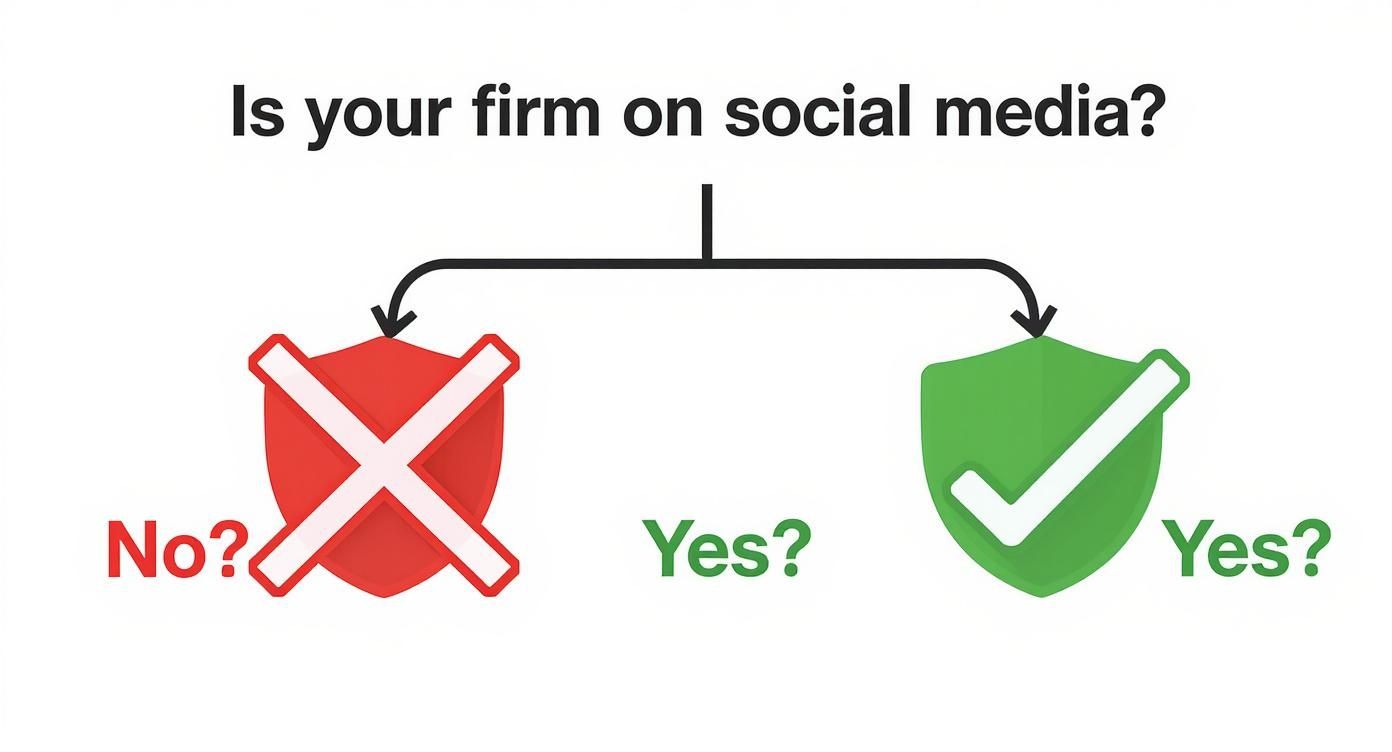
The choice is pretty clear: engage, or get left behind. It’s the firms with a proactive social media plan that are positioned for real growth.
To make the right choice, you first need to understand the playing field. Each platform offers a distinct advantage, and knowing which one aligns with your firm's goals is the first step toward a winning strategy.
Strategic Platform Selection for Law Firms
| Platform | Primary Audience | Best For Content Type | Ideal Practice Areas |
|---|---|---|---|
| Professionals, B2B clients, corporate decision-makers, referral sources | In-depth articles, case studies, company news, professional commentary | Corporate Law, IP, Commercial Litigation, B2B Services | |
| General public, local community members, individual consumers | Community updates, client testimonials, helpful guides, firm culture posts | Family Law, Estate Planning, Personal Injury, Criminal Defense | |
| X (Twitter) | Journalists, legal peers, public figures, tech-savvy individuals | Quick legal updates, breaking news commentary, live event engagement | Media Law, Government Relations, Tech Law |
| Younger demographics (under 45), general public | Team photos, infographics, behind-the-scenes content, community involvement | Personal Injury, Family Law (humanizing the firm), Recruiting |
This table serves as a starting point. The best strategies often involve a primary platform where you build authority, supplemented by a secondary one to broaden your reach or humanize your brand.
H3: LinkedIn: The Professional Powerhouse
For attorneys, LinkedIn is the undisputed king. With nearly 70% of law firms already on the platform, it’s the digital version of a bar association mixer crossed with a business journal. This is where you go to showcase expertise, connect with colleagues for referrals, and get in front of corporate clients.
If your firm serves other businesses (B2B)—think corporate law, intellectual property, or commercial litigation—LinkedIn is non-negotiable. It’s where you publish thoughtful articles, weigh in on industry news, and build a solid reputation as a leader in your field.
Think of LinkedIn as your digital business card and professional portfolio, all in one. It’s where your credibility is built through substantive content, not just clever updates.
This isn’t the place for casual chatter. LinkedIn is all about demonstrating professional authority. Your activity here directly fuels referral generation and reinforces your firm's standing in both the legal and business communities.
H3: Facebook: Connecting with Your Community
While LinkedIn is all business, Facebook is where you connect with people on a more personal level. Its massive user base of 2.96 billion monthly active users gives it an unmatched reach for firms targeting individual clients (B2C).
This makes it the perfect ground for practices like:
- Family Law: Reaching individuals navigating major life changes.
- Estate Planning: Connecting with families thinking about the future.
- Personal Injury: Sharing valuable information with a broad local audience.
- Criminal Defense: Building a foundation of trust within your community.
The content game is different on Facebook. Here, you can share client testimonials (with explicit permission, of course), post helpful guides on common legal questions, and show off your firm's community involvement. It’s all about being approachable and building trust with the people you serve.
H3: X (Formerly Twitter) and Instagram: Niche Opportunities
Platforms like X and Instagram offer more specialized opportunities. With its tight character limit, X is perfect for sharing quick legal updates, commenting on breaking news relevant to your practice, and engaging with journalists or other legal professionals. It's a fast-paced world that rewards timely and concise insights.
Instagram, on the other hand, is a visual-first platform. That might seem like an odd fit for a law firm, but it’s fantastic for humanizing your practice. You can use it to:
- Showcase Firm Culture: Introduce your team with professional photos and short bios.
- Share Community Involvement: Post pictures from charity events or local sponsorships.
- Create Simple Infographics: Break down complex legal concepts into easy-to-digest visuals.
For practices like personal injury or family law, Instagram can make your firm feel more relatable and less intimidating. Larger firms can even use it for recruitment, attracting top talent by highlighting a great work environment. The key is simply to maintain a professional, high-quality look that reflects your brand.
Navigating Social Media Ethics and Compliance
For a lot of attorneys, the biggest thing holding them back from social media isn't a lack of time or ideas—it's the fear of making an ethical mistake. And honestly, that's a healthy fear. The rules governing our profession were written long before "going viral" was even a concept, but that doesn't change the fact that they apply to everything we do online.
The digital world moves at lightning speed, but the core principles of professional responsibility don't budge. You have to treat your social media profiles as a direct extension of your professional life. One casual comment, a seemingly harmless post, or a claim you can't back up can land you in serious hot water.

Learning the boundaries isn't about holding your firm back. It's about protecting it. Once you get a handle on a few key principles, you can navigate the online world with confidence and keep your integrity intact.
Avoiding Accidental Attorney-Client Relationships
One of the sneakiest risks out there is accidentally creating an attorney-client relationship. It happens so easily. Someone posts a question in your comments or slides into your DMs with the details of their legal mess. If you give a well-meaning but specific answer, it could be seen as formal legal advice. Just like that, you've created a duty of care you never meant to take on.
Here’s a classic example:
An attorney who practices family law sees a public Facebook post where someone asks, "My ex won't let me see my kids. Can I just go pick them up from school?" The attorney replies, "In this state, if you have a custody order, you absolutely can." While that might be generally true, it could easily be taken as specific legal advice, creating a professional relationship—and potential liability if the real situation is more complicated.
The fix is simple: put a clear disclaimer in your profile bios and use one whenever you answer general questions. Something like, "Content is for informational purposes only and does not constitute legal advice or create an attorney-client relationship," is an absolute must-have.
Upholding Attorney Advertising Rules
Make no mistake: every single post you make to promote your firm's services is attorney advertising. That means it falls under your state bar's specific rules, and this is where a lot of firms get tripped up.
While the rules vary by state, some guidelines are nearly universal:
- No False or Misleading Claims: You can't promise results ("We'll win your case!") or make comparisons you can't prove ("We're the best PI firm in the city.").
- Watch Your Wording: Many states prohibit lawyers from calling themselves "experts" or "specialists" unless they hold a specific board certification.
- Include Required Disclaimers: Some jurisdictions require specific language, like "This is an advertisement," on any promotional content.
These rules exist to protect the public from being misled. To get a better sense of how these rules work in practice, you can check out our deep dive on navigating Rule 7.2 for ethical attorney advertising in California. Knowing these rules inside and out is the bedrock of any compliant social media strategy.
Protecting Client Confidentiality
The duty to protect client confidentiality is absolute, and it follows you online. You have to be constantly vigilant. Sharing details about a case—even if you scrub the names—can still be a violation if there's enough information for someone to figure out who you're talking about.
Never post about a client's matter without their explicit, informed, and written consent. Frankly, the safest policy is to just not do it at all.
Focus your energy on sharing valuable educational content, updates on the law, and news about your firm. That way, you're providing value without ever getting near the ethical line of client confidentiality. A firm-wide social media policy that spells this out is your best defense against an accidental breach. It's not just a good idea; it's fundamental to maintaining your professional integrity and the trust your clients place in you.
Developing a Content Strategy That Builds Authority
Let’s get one thing straight: social media for law firms isn't about sales pitches. No one is scrolling through LinkedIn hoping to be sold legal services. They’re looking for answers, for clarity, and for a trusted expert who understands their problem. Your content strategy is how you become that expert.
Forget about just posting your phone number. Think of every post as an act of generosity. Your goal is to educate, inform, or demystify a complex legal issue. This simple shift in mindset changes you from just another service provider into an indispensable resource for your community.

When you do this right, your firm becomes the first one people think of when they face a legal challenge in your practice area. That’s the real goal.
From One Big Idea to Many Small Pieces
The idea of creating fresh content every single day is enough to make any busy lawyer’s head spin. But you don't have to. The secret is to work smarter, not harder, using a content pillar model.
It starts with one big, substantial piece of content—your "pillar." This could be an in-depth blog post, a webinar, or a detailed guide. From there, you break that single pillar down into a dozen smaller pieces perfect for social media.
Let's say your firm writes a comprehensive blog post analyzing new state legislation affecting small businesses. That one article is a goldmine.
Here’s how you can slice it up:
- LinkedIn Article: A condensed version focusing on the top three takeaways for business owners.
- Facebook Post: A sharp, clean infographic summarizing the key changes from the new law.
- Instagram Reel: A 60-second video where an attorney explains the single most important impact of the legislation.
- X (formerly Twitter) Thread: A series of five or six short posts, each breaking down a different clause from the main article.
This approach keeps your messaging consistent across all channels and saves an unbelievable amount of time. You aren't constantly reinventing the wheel. You're just giving people different ways to access your core expertise. For a deeper dive, check out this guide to mastering your social media content strategy.
Content Ideas That Build Trust and Credibility
Your content should always, always serve your audience. When you focus on their questions and pain points, you naturally showcase your firm's expertise and approachability. This is a foundational concept in content marketing for law firms.
Need some ideas? Build your content calendar around these proven themes:
-
Demystify Complex Legal Topics: Break down the jargon. A simple post titled "What's the Real Difference Between a Trust and a Will?" is infinitely more valuable to a potential client than a generic firm announcement.
-
Ethical Case Study Insights: Obviously, you can't violate confidentiality. But you can share high-level insights from the types of cases you handle. A personal injury firm could post about the critical importance of documenting evidence after an accident, using a generalized scenario to make the point.
-
Humanize Your Team: People hire people, not logos. Post professional spotlights on your attorneys and staff. What drives them? What community organizations are they passionate about? This builds a genuine human connection.
-
Answer Frequently Asked Questions: You hear the same questions in consultations every day. Turn them into a social media series! This provides incredible value and helps pre-qualify potential clients by educating them before they even pick up the phone.
Embrace the Power of Video
Written content is crucial, but video is the undisputed king of engagement. Short-form video is dominating social media for a reason. In fact, video posts typically generate 2.5 times more engagement than other content formats, a trend that legal marketers simply can't ignore.
Platforms like Instagram Reels, TikTok, and YouTube Shorts reward authentic, concise clips that grab attention fast.
Don't overthink production. A clear video shot on a smartphone in a well-lit office, where an attorney answers one common question, is often more authentic and effective than a high-budget commercial.
By consistently creating content that educates and empowers your audience, you transform your social media from a marketing chore into a powerful engine for building authority and attracting your ideal clients.
Using Tech to Streamline Your Social Media Game
Keeping up a consistent, high-value social media presence sounds like a full-time job—and most busy attorneys I know don't have that kind of time. The good news? It doesn't have to eat up all your billable hours.
The secret is to work smarter, not harder. You can use technology to manage your firm’s social media efficiently without ever sacrificing quality.
Think of these tools as a hyper-efficient paralegal for your marketing. They take care of the routine, time-consuming tasks, freeing you up to focus on the high-level strategy and client conversations that actually matter. This lets your firm build authority and attract clients online, even when you're tied up in court.
Nail Your Consistency with Scheduling Tools
The single biggest key to success on any social platform is consistency. An active, regularly updated profile builds trust and keeps your firm top-of-mind. But logging in every single day to post is a massive time-suck. This is where scheduling tools like Buffer, Hootsuite, or Sprout Social become absolute game-changers.
These platforms let you batch-create your content. Just block off a couple of hours one afternoon to write and schedule all of your posts for the next week, or even the whole month.
This approach gives you a few major advantages:
- Always-On Presence: Your profiles stay active even on your busiest days, keeping your audience engaged.
- Consistent Brand Voice: Scheduling everything in one go helps maintain a steady, professional tone across all your posts.
- Perfect Timing: These tools can analyze when your followers are most active and suggest the best times to post for maximum reach.
By automating the "when," you can pour all your energy into the "what"—crafting valuable content that speaks directly to your ideal clients.
Use AI as Your Creative Assistant
Artificial intelligence isn't some far-off concept anymore; it's a practical tool that can seriously lighten your content creation load.
When you use it right, AI acts as a creative partner, not a replacement for your legal expertise. It's fantastic for breaking through writer's block and getting a first draft on the page, but the final, authoritative touch must always come from an attorney.
Here’s how AI can help with a few key tasks:
- Brainstorming Ideas: Give an AI tool a legal topic like "estate planning basics," and it can spit out dozens of potential blog titles, social post angles, and common questions your clients might have.
- Drafting Initial Copy: AI can create a solid first draft of a post explaining a complex legal concept. This gives you a great starting point to review, edit, and add your own unique insights and necessary disclaimers.
- Repurposing Content: Already have a great blog post on your site? Feed the link to an AI, and it can summarize it into a punchy LinkedIn article or a multi-part X (formerly Twitter) thread in seconds.
Used strategically, AI can dramatically cut down the time it takes to create content. It's also a serious competitive advantage. Firms with a defined AI strategy are nearly four times more likely to see benefits and almost twice as likely to experience revenue growth from it. With about a third of law firms having no AI plan at all, jumping on this now puts you way ahead of the curve.
AI should never be the final word. Always have an attorney review and approve any AI-generated content to ensure accuracy, compliance with advertising rules, and alignment with your firm's brand voice.
It's also worth noting that AI is becoming a huge player in video creation. If you're looking to explore that, check out our guide on AI tools for social media video editing. By integrating these technologies, your firm's social media strategy can become more efficient and a whole lot more impactful.
Measuring Social Media Success and Proving ROI
So you’re posting content and chatting with your community. That's a great start, but how do you prove it’s actually working? Likes and follower counts feel good, but they don't pay the bills. The real measure of success for your firm's social media is whether it contributes to the bottom line.
To get there, you have to shift your focus from vanity metrics to actionable metrics. A "like" is just passive approval. A click to your website or a filled-out contact form? That's an active step toward becoming a client. The entire goal is to connect your online activity to tangible business outcomes.
Identifying Your Key Performance Indicators
Key Performance Indicators (KPIs) are just the specific, measurable data points that tell you if your strategy is actually working. Instead of getting lost in a sea of platform analytics, just focus on a few that directly reflect client acquisition and brand authority.
Here are the most important KPIs for a law firm:
- Website Clicks from Social Media: This is a huge one. It measures how many people saw your post and were interested enough to visit your website—your digital office.
- Conversion Rate: Of those visitors, how many actually did something? This could be signing up for a newsletter, downloading a guide, or, most importantly, filling out a consultation request form.
- Cost Per Lead: If you're running paid ads, this metric is non-negotiable. It tells you exactly how much you're spending to get one potential client to reach out.
- Direct Inquiries: Don't forget to ask new clients how they heard about you. Tracking how many mention seeing your firm on LinkedIn or Facebook is direct, undeniable proof of ROI.
These metrics move way beyond surface-level engagement. They start to paint a clear picture of how your social media efforts are generating real business opportunities. They're also fundamental to any effective strategy for online reputation management for lawyers, as they show which platforms are best for building a positive and profitable brand presence.
Using the Right Tools to Track Success
You don't need a complex suite of expensive software to measure what matters. The tools are already at your disposal, and most of them are free.
Your primary toolkit should have two key components. First, use the native analytics on each platform, like Facebook Insights or LinkedIn Analytics. These dashboards provide a ton of information about your audience demographics, post reach, and engagement rates. Use this data to figure out what kind of content resonates with your followers so you can create more of it.
Second, connect your website to Google Analytics. This is the most powerful tool for tracking the entire client journey. You can create reports that show you exactly how many visitors came from each social platform and what they did once they landed on your site.
By setting up "Goal Conversions" in Google Analytics for actions like contact form submissions, you can directly attribute new leads to specific social media channels and campaigns.
Creating a Simple ROI Report
At the end of each month, pull your findings into a simple one-page report. This isn't just for your records; it's a powerful tool to justify the time and money you're spending on social media.
Your report should clearly show:
- Top-Performing Content: Which posts drove the most clicks and engagement?
- Website Traffic: How many visitors did social media send to the site this month?
- Leads Generated: How many contact form submissions or direct calls came from social channels?
- Key Takeaways: What did you learn, and what will you do differently next month?
This simple framework transforms social media from a marketing expense into a measurable investment, proving its value to your firm's growth.
Frequently Asked Questions
Jumping into social media for a law firm can feel like navigating a minefield. You've got questions, and we've got answers based on years of helping legal professionals get this right. Here are some of the most common things we're asked.
How Much Time Should Our Firm Actually Spend on Social Media Each Week?
There's no magic number, but a solid starting point for a small or mid-sized firm is 3-5 hours per week.
The key isn't to block out an entire afternoon. It’s about consistency. That time should be split between creating and scheduling content, and more importantly, engaging with your network. That means responding to comments, answering direct messages, and joining relevant conversations.
Think of it like watering a plant. A little bit of attention every day is far more effective than drowning it once a week. Scheduling tools can be a lifesaver here, cutting down the daily hands-on time while keeping your presence active and consistent.
Can We Really Use Paid Ads on Social Media?
Absolutely. But you have to tread very, very carefully. The moment you put money behind a post, it becomes attorney advertising, and that triggers a whole set of state bar association rules. You'll need to be vigilant about avoiding misleading claims and often include specific disclaimers in your ad copy.
The payoff, however, can be huge. Platforms like LinkedIn and Facebook offer incredibly powerful targeting. Imagine reaching people by specific job title, industry, or geographic area—it's a perfect way to promote a niche practice area or a high-value webinar.
What's the Single Biggest Mistake Law Firms Make on Social Media?
Hands down, the biggest mistake is treating it like a digital billboard.
Firms that just blast out posts screaming, "Contact us for a free consultation!" are missing the entire point. That approach doesn't build trust; it just creates noise and drives potential clients away.
Your goal isn't to sell, it's to serve. You build authority by educating, informing, and showing the human side of your practice. Answer the questions your ideal clients are already asking. Be a resource, not an advertisement. Engagement is a two-way conversation—provide real value first, and the clients will naturally follow.
At Case Quota, we build compliant, high-impact social media strategies designed to establish your firm as an authority and bring in the right kind of clients. Find out how our targeted approach can elevate your online presence at https://casequota.com.