

Most American law firms underestimate the power of dynamic marketing leadership amid rising competition. For small to mid-sized practices in Southern California, standing out from larger rivals is no easy task. The difference often comes down to strategic vision and cross-practice collaboration. When over eighty percent of American clients select firms based on clear value communication, effective marketing leadership becomes a decisive advantage for growth and sustained client relationships.
Table of Contents
- Defining Marketing Leadership In Law Firms
- Core Roles And Responsibilities Explained
- How Marketing Leadership Drives Client Growth
- Essential Skills And Qualifications Needed
- Common Pitfalls And Misconceptions In Legal Marketing
Key Takeaways
| Point | Details |
|---|---|
| Strategic Role of Marketing Leadership | Modern legal marketing leadership goes beyond traditional promotion to focus on strategic positioning and growth initiatives. |
| Cross-Functional Collaboration | Effective marketing requires collaboration among different practice areas to create a unified client engagement approach. |
| Data-Driven Insights | Utilizing analytics and advanced technology is essential for informed decision-making and effective client communication strategies. |
| Importance of Professional Development | Continuous learning and adaptation in digital marketing and technology are critical for successful law firm marketing leaders. |
Defining Marketing Leadership in Law Firms
Marketing leadership in law firms represents a strategic role far beyond traditional promotional activities. Unlike conventional marketing approaches, modern legal marketing leadership focuses on comprehensive organizational positioning, client relationship management, and sophisticated growth strategies. Strategic collaboration across practice groups has become a critical function that transforms how legal organizations develop and communicate their value proposition.
At its core, marketing leadership for law firms involves creating a cohesive narrative that connects specialized legal expertise with targeted client needs. This requires deep understanding of both the firm’s internal capabilities and the external marketplace. Marketing leaders must craft compelling stories that showcase the firm’s unique strengths while precisely addressing specific client pain points. They serve as critical translators between legal technical expertise and strategic business communication, bridging complex legal services with clear, actionable messaging.
The most effective marketing leaders in law firms blend analytical insights with creative storytelling. They utilize data-driven approaches to segment markets, identify growth opportunities, and develop targeted outreach strategies. This might involve leveraging advanced digital marketing techniques, creating specialized content that demonstrates thought leadership, or developing nuanced communication strategies that resonate with specific client industries. The goal is not merely to attract clients but to position the firm as a strategic partner capable of solving sophisticated legal challenges.
Pro Legal Marketing Leadership Tip: Develop a cross-functional marketing team that includes members from different practice areas to ensure comprehensive, integrated messaging that reflects the firm’s full range of expertise.
Marketing Strategy Pro Tip: Create quarterly collaborative sessions where attorneys and marketing professionals jointly develop client communication and positioning strategies to ensure alignment and maximize strategic impact.
Here’s a comparison of traditional marketing roles versus modern legal marketing leadership roles in law firms:
| Aspect | Traditional Marketing Role | Modern Legal Marketing Leadership |
|---|---|---|
| Focus | Promotion and advertising | Strategic positioning and growth |
| Collaboration | Limited to support teams | Cross-practice, firm-wide collaboration |
| Data Usage | Basic analytics | Advanced, data-driven decision making |
| Technology Integration | Siloed or minimal | Central to strategy, continuous updates |
| Outcome Goal | Attract more clients | Build long-term, strategic partnerships |
Core Roles and Responsibilities Explained
Modern law firm marketing leadership encompasses a complex array of strategic responsibilities that extend far beyond traditional marketing functions. Core responsibilities defined by industry experts include strategic business development, comprehensive client service initiatives, sophisticated brand management, internal communications coordination, and thought leadership programming. These multifaceted roles require marketing leaders to act as critical organizational architects who translate legal expertise into compelling market positioning.
The primary responsibilities of law firm marketing leaders can be segmented into several key strategic domains. Business development represents a critical function where marketing professionals identify potential client opportunities, develop targeted outreach strategies, and create frameworks for relationship building. Client service initiatives involve designing robust communication protocols, understanding client expectations, and creating seamless engagement experiences that differentiate the firm from competitors. Brand management requires developing a cohesive narrative that communicates the firm’s unique value proposition across multiple channels and touchpoints.
Technology integration and market trend adaptation represent increasingly important dimensions of marketing leadership in legal environments. Strategic technology adoption and market responsiveness now demand that marketing leaders not only understand digital transformation but actively drive technological innovation within their organizations. This includes leveraging data analytics, implementing advanced customer relationship management systems, developing digital communication strategies, and creating sophisticated content marketing approaches that demonstrate thought leadership and technical expertise.

Marketing Technology Pro Tip: Conduct a quarterly technology audit to identify emerging digital tools that could enhance client communication and marketing efficiency, ensuring your firm stays ahead of technological trends.
Strategic Alignment Pro Tip: Develop cross-functional workshops that bring together attorneys, marketing professionals, and technology experts to create integrated strategies that leverage collective organizational knowledge.
How Marketing Leadership Drives Client Growth
Marketing leadership transforms client growth strategies by creating sophisticated, data-driven approaches that go beyond traditional business development techniques. Evidence-based methods for coaching attorneys in business development demonstrate how strategic marketing leadership can systematically overcome internal resistance and create sustainable client acquisition frameworks. By developing targeted communication strategies, marketing leaders help law firms articulate their unique value proposition more effectively and connect with potential clients through precise, compelling narratives.
The process of driving client growth involves breaking down organizational silos and fostering collaborative approaches across different practice areas. Strategic collaboration across firm expertise enables marketing leaders to create integrated service offerings that address complex client needs. This approach allows firms to develop innovative solutions that transcend traditional practice boundaries, positioning the organization as a comprehensive problem-solving partner rather than a narrow legal service provider.
Successful client growth strategies require marketing leaders to leverage advanced analytics, digital communication channels, and sophisticated storytelling techniques. This involves creating targeted content that demonstrates thought leadership, developing personalized client engagement strategies, and utilizing data-driven insights to identify and pursue high-potential market segments. Marketing leaders must continuously adapt their approaches, using technology and strategic communication to build trust, showcase expertise, and create meaningful connections with potential and existing clients.
Client Engagement Pro Tip: Develop a quarterly client feedback mechanism that captures detailed insights about service expectations, allowing your firm to proactively adapt and refine its client growth strategies.
Strategic Positioning Pro Tip: Create cross-practice narrative templates that help attorneys articulate the firm’s comprehensive value proposition consistently across different client interactions.
Essential Skills and Qualifications Needed
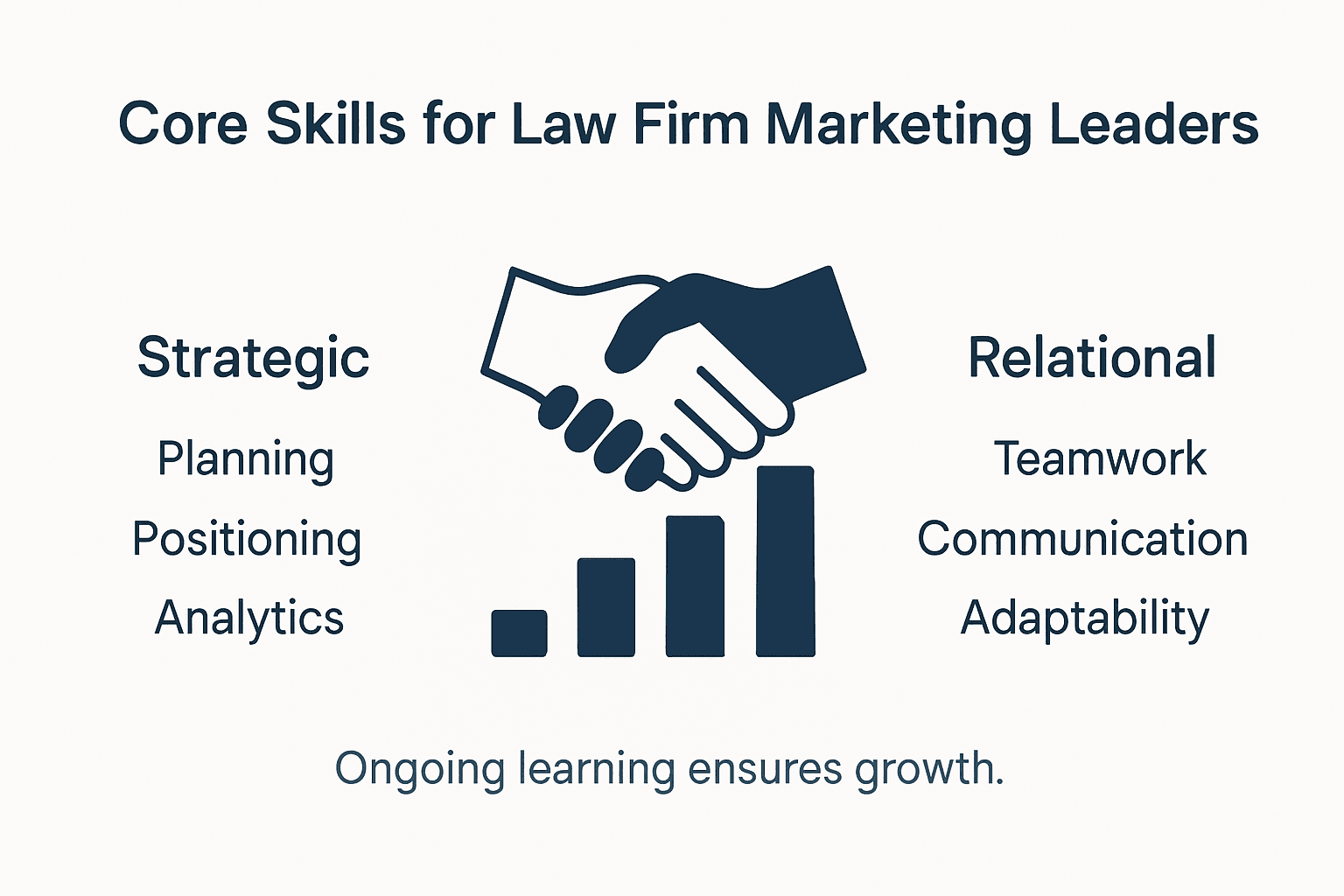
Marketing leadership in law firms requires a sophisticated blend of strategic, technological, and interpersonal competencies that extend far beyond traditional marketing backgrounds. Key leadership competencies crucial for modern professional environments highlight the importance of strategic vision, relationship management, and exceptional influencing skills. These capabilities enable marketing leaders to navigate complex organizational dynamics, build compelling narratives, and drive meaningful client engagement strategies.
Technical proficiency represents another critical dimension of marketing leadership qualifications. Advanced credentials and technological integration skills are increasingly important in driving successful outcomes. This encompasses advanced digital marketing capabilities, data analytics expertise, customer relationship management technology proficiency, and the ability to leverage artificial intelligence and machine learning tools. Marketing leaders must demonstrate comfort with emerging technologies while maintaining a strategic perspective that prioritizes human connection and relationship building.
Successful law firm marketing leaders typically possess a unique combination of educational background and professional experience. While traditional marketing degrees provide foundational knowledge, advanced credentials in business administration, digital marketing, legal business development, and technology management offer significant advantages. Practical experience across multiple domains becomes increasingly critical, with the most effective leaders showing adaptability across digital marketing, client relationship management, strategic communications, and technological innovation. The ability to translate complex legal expertise into compelling market positioning requires both analytical thinking and creative communication skills.
Professional Development Pro Tip: Develop a personal learning roadmap that includes quarterly technology workshops, legal marketing conferences, and strategic certification programs to continuously expand your professional skill set.
Skill Alignment Pro Tip: Create a comprehensive skills matrix that maps your current capabilities against emerging market demands, identifying specific areas for targeted professional growth.
The following table summarizes crucial skills for successful legal marketing leaders:
| Skill Category | Key Attribute | Impact on Firm Success |
|---|---|---|
| Strategic | Vision and big-picture thinking | Drives sustainable competitive edge |
| Analytical | Data and technology proficiency | Enables targeted growth initiatives |
| Interpersonal | Communication and relationship-building | Strengthens client and team trust |
| Creative | Storytelling and innovative messaging | Differentiates firm in marketplace |
Common Pitfalls and Misconceptions in Legal Marketing
Legal marketing is fraught with persistent misconceptions that can significantly undermine a firm’s growth potential. Prevalent misunderstandings about business development in legal practices reveal a critical disconnect between traditional legal service delivery and modern marketing strategies. Many attorneys still view marketing as a peripheral activity rather than an integral component of client acquisition and retention, creating systemic barriers to effective growth and client engagement.
One of the most damaging misconceptions is the belief that high-quality legal work alone guarantees client attraction and retention. In reality, modern clients expect sophisticated, proactive communication and strategic positioning that goes beyond technical legal expertise. This narrow perspective leads firms to underinvest in marketing infrastructure, miss critical opportunities for client communication, and fail to differentiate themselves in an increasingly competitive legal marketplace. Successful firms recognize that marketing is not about self-promotion, but about demonstrating value, building trust, and creating meaningful connections with potential and existing clients.
Technological resistance and outdated marketing approaches represent another significant pitfall for law firms. Many legal professionals maintain skeptical or dismissive attitudes toward digital marketing, social media engagement, and data-driven client acquisition strategies. This reluctance prevents firms from leveraging powerful tools that could dramatically enhance their market positioning. Advanced digital marketing techniques, content strategy, targeted advertising, and comprehensive online presence management are not optional luxuries but essential components of a modern legal marketing approach. Firms that cling to traditional referral-based models risk becoming increasingly irrelevant in a rapidly evolving professional services landscape.
Marketing Mindset Pro Tip: Conduct monthly cross-functional workshops that demystify digital marketing techniques and demonstrate their direct impact on client acquisition and firm revenue.
Perspective Shift Pro Tip: Develop a firm-wide narrative that positions marketing as a strategic partnership tool, not a peripheral sales function, to encourage broader organizational buy-in.
Elevate Your Law Firm’s Marketing Leadership to Drive Real Client Growth
Navigating the complex world of legal marketing leadership requires more than traditional promotion. If your law firm struggles with strategic positioning, data-driven decision making, or technology integration as outlined in the article “Marketing Leadership for Law Firms Driving Client Growth” then you are not alone. Many firms face challenges like ineffective collaboration across practice groups and limited use of advanced analytics — key hurdles to sustainable client acquisition and long-term growth.
At Case Quota you gain access to tailored digital marketing solutions designed specifically for law firms in Southern California. Our expertise spans SEO-optimized web design, AI-powered pay-per-click advertising, and high-level marketing leadership like fractional CMO services — all aimed at bridging the gap between your firm’s legal expertise and the precise needs of your clients. Experience the power of strategic collaboration and technology integration to transform how your firm builds trust and positions itself as a strategic partner.

Take the first step toward overcoming traditional marketing limitations and unlocking client growth today. Discover how Case Quota’s specialized legal marketing strategies can help you translate your firm’s strengths into compelling narratives that attract and retain high-value clients. Visit Case Quota now to learn more about our tailored digital marketing services and join the many law firms that have gained a competitive edge through sophisticated online campaigns.
Frequently Asked Questions
How does marketing leadership differ in law firms compared to traditional marketing?
Modern legal marketing leadership focuses on strategic positioning, cross-practice collaboration, and data-driven decision-making rather than just promotion and advertising. It emphasizes long-term relationship building and comprehensive client engagement strategies.
What are the core responsibilities of marketing leaders in law firms?
Marketing leaders in law firms are responsible for business development, client service initiatives, brand management, internal communications, and thought leadership. They play a key role in translating legal expertise into compelling market positioning.
What skills are essential for effective marketing leadership in legal practices?
Essential skills include strategic vision, data and technology proficiency, strong interpersonal communication, and creative storytelling abilities. These skills enable marketing leaders to build trust and drive meaningful client engagement.
What common misconceptions exist about legal marketing?
A prevalent misconception is that high-quality legal work alone attracts and retains clients. In reality, modern clients expect proactive communication and strategic positioning, underscoring the importance of effective marketing strategies.