

When it comes to local SEO, a few key signals carry most of the weight: your Google Business Profile, your website’s on-page optimization, your client reviews, local backlinks, and your online citations.
Think of these as the foundation, walls, and curb appeal of your digital office. Each one is absolutely critical for bringing local clients through your door.
Why Local SEO Is Your Firm’s Most Valuable Real Estate
Imagine your law firm snagged the best office space in downtown Los Angeles or San Diego—the one on that busy corner everyone sees. That kind of prime real estate guarantees visibility and foot traffic.
Local SEO gives your firm that exact same advantage, but in the digital world where your next client is starting their search. The numbers don't lie: a staggering 46% of all Google searches have local intent. People are actively looking for services "near me."
For a law firm in Southern California, this isn't just a technical box to check; it's a direct line to your most valuable cases. When someone searches for a "personal injury lawyer in Irvine" or "family law attorney Santa Monica," Google’s one and only job is to serve up the most relevant, trustworthy, and prominent local result. This is where a deep, practical understanding of local SEO ranking factors becomes your competitive weapon.
This flowchart breaks down the core pillars Google is looking at.
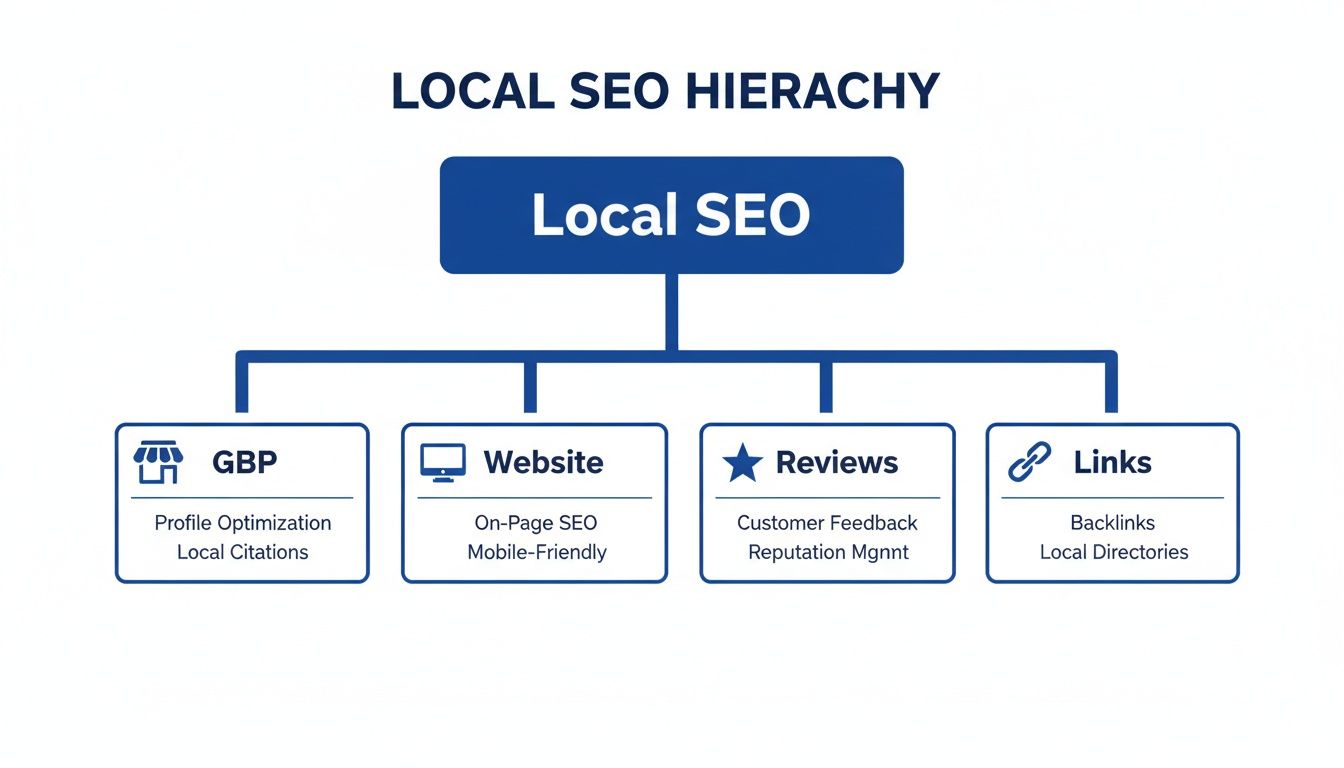
As you can see, a winning strategy hinges on four interconnected components all working in harmony to build your firm's authority.
The Core Components of Local Dominance
Think of your local SEO strategy like building a case for trial. You need to present strong, consistent evidence to convince the judge—in this case, Google—that your firm is the definitive answer for a searcher's problem. Every ranking factor is another piece of evidence.
Here are the key areas we're about to unpack:
- Google Business Profile (GBP): This is your digital storefront and, frankly, the single most important factor. It’s where you control your firm’s name, address, services, and the first impression you make on potential clients.
- Website & On-Page Signals: Your website is the central hub for your authority. Google scans it for clear signals that confirm your location, your practice areas, and your expertise.
- Reviews & Reputation: Client reviews are pure gold. Google sees the quantity, quality, and frequency of your reviews as powerful social proof that speaks directly to your firm's credibility.
- Citations & Links: Every time your firm is mentioned across the web—from legal directories like Avvo to the local chamber of commerce—it reinforces your legitimacy and local prominence in Google's eyes.
These pieces don't work in isolation. A perfectly optimized GBP profile that links to a relevant, location-specific page on your website—bolstered by dozens of glowing client reviews and credible local citations—creates an unstoppable synergy.
This holistic approach is the cornerstone of any successful law firm marketing strategy. It proves to Google that your firm isn't just in a community but an active and trusted part of it. Master these interconnected factors, and you will own the most valuable digital real estate in your market.
Optimizing Your Google Business Profile to Win Clients
Forget everything you think you know about online directories. Your Google Business Profile (GBP) isn't just another listing—it's your law firm's digital front door. For a potential client in Southern California searching for legal help, this profile is almost always their very first interaction with your practice. It is, without a doubt, the single most important local SEO ranking factor.
Imagine a car accident victim in Irvine frantically searching for an attorney on their phone. They aren’t seeing your impressive office lobby or your polished courtroom demeanor first. They're seeing your GBP listing in Google Maps and the Local Pack. This is your one shot to build instant trust, prove your expertise, and make it dead simple for them to call you. A neglected profile is like a locked door—it just sends that high-value case directly to your competitor down the street.
While Google's local algorithm is a complex beast with hundreds of moving parts, your GBP is the heavyweight champion. Industry data consistently shows that GBP signals are the most dominant force, accounting for roughly 25% of your local ranking power. Things like the completeness of your profile, your primary business category, and the quality of your client reviews carry immense weight. Think about it: recent studies assign the highest point value out of all local factors to just selecting the correct primary GBP category. That's how critical it is.
Nail Your Categories and Business Description
The absolute foundation of a top-performing GBP is choosing the right categories. This isn't some minor detail you can just set and forget; it's how you explicitly tell Google who you are and what you do. For a firm in San Diego, selecting "Personal Injury Attorney" as your primary category is infinitely more powerful than the generic "Law Firm."
Your primary category needs to be your bread and butter—the practice area that drives the most revenue. After that, you can add relevant secondary categories like "Car Accident Attorney" or "Wrongful Death Attorney" to capture more specific searches. Be precise. Be accurate.
Next up is your business description. This is your chance to speak directly to your ideal client. Don't just stuff it with keywords. Tell a story.
"For over 20 years, our Riverside-based team has been the trusted advocate for families navigating the aftermath of catastrophic injuries. We focus exclusively on personal injury law, ensuring every client receives the dedicated, compassionate, and aggressive representation they deserve to secure their future."
See the difference? This description is all about the client. It highlights experience, establishes a clear geographic focus, and starts building trust before they've even clicked on your website.
Use GBP Features to Showcase Activity and Expertise
A static profile is an invisible one. Google's algorithm loves to see activity, and GBP gives you a whole toolkit to show that your firm is active, engaged, and responsive.
- GBP Posts: Think of these as a micro-blog for your practice. Share anonymized case wins, post short videos answering common legal questions, or highlight your community involvement. A quick post about a recent settlement for a slip-and-fall case in Anaheim demonstrates real-world success and local authority.
- Photos and Videos: People hire people. Visuals are a massive trust-builder. Upload high-quality, geotagged photos of your office (inside and out), your legal team, and even short, authentic video testimonials. Geotagging the images is a simple but powerful way to reinforce your physical location to Google.
- Q&A Feature: This is an absolute goldmine that most firms ignore. Proactively populate this section by asking and answering the most common questions you get from new clients. This not only provides immediate value to searchers but also lets you control the narrative and showcase your expertise from the get-go.
To help you get started, we've put together a quick checklist of the most impactful optimizations.
GBP Optimization Checklist for Law Firms
This checklist breaks down the essential action items to turn your GBP into a client-generation machine. Follow these steps to ensure your profile is sending all the right signals to Google and potential clients.
| GBP Element | Action Item | Impact on Ranking |
|---|---|---|
| Business Name | Ensure it's your exact, real-world business name. No keyword stuffing. | High |
| Primary Category | Select the most specific and accurate category for your main practice area. | Very High |
| Secondary Categories | Add all other relevant practice area categories (e.g., "Truck Accident Attorney"). | Medium |
| Business Description | Write a client-focused, 750-character description highlighting expertise and location. | Medium |
| Service Area | Define the specific cities/counties you serve in Southern California. | High |
| Photos & Videos | Consistently upload high-quality, geotagged images of your team, office, and wins. | High |
| GBP Posts | Publish at least one post per week (offers, updates, events, case studies). | Medium |
| Q&A Section | Proactively add and answer at least 10-15 frequently asked questions. | Medium |
| Services List | Detail every legal service you offer with descriptions and pricing (if applicable). | Medium |
| Reviews | Actively request reviews from satisfied clients and respond to every single one. | Very High |
By consistently working through this list, you'll be building a powerful asset that directly contributes to your bottom line.
Your GBP is so much more than a simple listing; it’s a dynamic client-acquisition tool. By meticulously optimizing every single element, you build the trust and authority needed to dominate the local search results and attract the high-value cases you want. For a deeper tactical guide, check out our post on the most effective Google Business Profile for attorneys tweaks to start generating more leads today.
Turning Your Website into a Local Authority
If your Google Business Profile is your digital front door, your website is the very foundation that front door is built on. It's where you prove to both Google and potential clients that you are the authority in your practice area and your city. This is where some of the most powerful local SEO signals come into play.

Think of it like this: your GBP makes the introduction, but your website has to close the deal. It must send clear, consistent, and powerful signals that back up every claim your profile makes. When Google sees perfect alignment between these two assets, its trust in your firm skyrockets—and so do your rankings. Neglecting your site is like having a pristine storefront that opens into a messy, disorganized office. It just shatters your credibility.
The Bedrock of Trust: NAP Consistency
Let's start with the absolute basics. The most fundamental on-page signal is your NAP (Name, Address, Phone Number). This isn't just contact info; it's your firm's unique digital fingerprint. It must be absolutely, unequivocally identical everywhere it shows up online, from your website's header and footer to your GBP and every last legal directory.
Even a tiny variation, like using "St." on your website but "Street" on your GBP, creates confusion for search engines. This inconsistency plants a seed of doubt, forcing Google to question which information is correct and, in turn, weakening your local authority. Consistency here is completely non-negotiable.
Key Insight: Absolute NAP consistency acts as a digital handshake between your website, your Google Business Profile, and hundreds of other online directories. A firm, consistent handshake builds trust; a weak or varied one erodes it.
Dominate Your Market with Hyper-Specific Pages
Generic pages get generic results. A single "Car Accidents" page trying to cover all of Southern California is a recipe for getting lost in the noise. To truly establish your website as a local powerhouse, you need to build dedicated location landing pages for each city and service area you want to own. These pages are designed to rank for the high-intent, location-specific searches that your best clients are actually typing into Google.
For example, a page titled "Irvine Car Accident Lawyer" is infinitely more powerful than a general practice page. It allows you to tailor every single element—the title tag, the main heading, the content, the images—to that specific market.
Here’s how to structure these powerhouse pages:
- Location-Specific Keywords: Weave in terms like "car accident attorney in Irvine," "Orange County injury claims," and "Tustin auto accident lawyer" naturally.
- Localized Content: Show you're a true local. Mention landmarks, specific courthouses, major freeways like the 405 or the 5, and even individual neighborhoods.
- Embedded Maps: Include a Google Map of your actual Irvine office location.
- Local Testimonials: Feature reviews from clients who live in Irvine or the surrounding cities.
This hyper-focused approach sends an unmistakable signal to Google: you are the most relevant answer for a searcher in that exact area.
Translating Your Expertise with Schema Markup
Finally, let’s pull back the curtain on one of the most powerful technical tools in your arsenal: local schema markup. Put simply, schema is a bit of code you add to your website that works like a translator for search engines. It doesn't change how your site looks to a human visitor, but it explicitly tells Google what your content is about in a language it understands perfectly.
Using "LegalService" schema, you can define your firm’s name, address, phone number, hours, and practice areas. This removes all the guesswork for Google's crawlers, helping them instantly understand that you are a "Personal Injury Attorney" at "123 Main Street, Irvine, CA," specializing in "Wrongful Death" cases.
This structured data is the magic behind Google's "rich snippets"—like seeing star ratings appear right there in the search results under your link. Implementing it correctly gives you a serious leg up on the competition.
On-page SEO signals are a true heavyweight, wielding 20% to 36% influence over local rankings according to industry studies. This makes a well-optimized website the second-most critical factor right behind your GBP. For a complete walkthrough of essential on-site tactics, explore our definitive guide on website optimization for law firms.
Building a Reputation That Google Trusts
In the legal world, your reputation is everything. It’s the currency your practice runs on. Well, it turns out Google’s algorithm thinks the exact same way.
Beyond your website and your Google Business Profile, the search engine is constantly scanning the wider internet for signals that back up your firm's credibility. This is where your digital reputation is truly built—or broken.

Think of it like building a case for your own firm. The more credible witnesses you have, the stronger your argument. In local SEO, these "witnesses" are online citations and client reviews. Each one is a piece of evidence telling Google you’re a legitimate, active, and respected law firm in your community.
The Power of Consistent Citations
A citation is simply any online mention of your law firm's Name, Address, and Phone number (NAP). You'll find them everywhere from major legal directories like Avvo and FindLaw to local Southern California business listings and social media profiles.
Each citation is like a digital breadcrumb leading back to your firm, reinforcing who you are and where you're located. The key here is absolute consistency.
If your Irvine office is listed as "123 Main St." on your website, "123 Main Street" on Yelp, and "123 Main St Ste 200" on Avvo, you’re creating confusion. This forces Google to second-guess the accuracy of your information, and that uncertainty can absolutely tank your rankings.
Key Takeaway: Consistent NAP information across all online directories is a foundational trust signal. Inconsistencies erode that trust and can negatively impact your visibility in local search results.
Turning Client Reviews into a Ranking Superpower
While citations lay the foundation, online reviews are what bring your reputation to life. In fact, reviews now account for around 16% of what determines local pack rankings. It's not just about having a five-star rating anymore. Google’s algorithm is much smarter now, digging into the specifics of your review profile.
- Quantity: A firm with 100 reviews just looks more established and trustworthy than one with only five. There's real strength in numbers.
- Velocity: Are new reviews coming in regularly? A steady stream of fresh feedback shows Google your firm is active and keeping clients happy right now.
- Diversity: Getting reviews across multiple platforms—Google, Yelp, Avvo, etc.—paints a much richer, more believable picture of your reputation.
- Substance: Google's AI actually reads the reviews. When clients use keywords like "best car accident lawyer in San Diego" in their feedback, it’s a massive relevancy signal for that exact search term.
Strategies for Ethical Review Generation and Management
A powerful review profile doesn't just happen. It takes a proactive, ethical strategy focused on making it incredibly easy for satisfied clients to share their experience.
- Ask at the Right Time: The perfect moment to ask for a review is right after a positive case outcome or a moment of high client satisfaction. Strike while the iron is hot.
- Make it Simple: Give them a direct link to your Google Business Profile review page in an email. You can even use a QR code on a business card. The goal is to remove every possible point of friction.
- Respond to Every Review: This is non-negotiable. Responding quickly and professionally to all reviews—good and bad—shows you’re engaged and value what clients have to say. Google sees and rewards this engagement.
- Learn from Feedback: Your reviews are a goldmine of business intelligence. Use them to figure out what you’re doing right and where your practice can improve.
Effectively managing your online presence is a cornerstone of any modern legal practice. To go deeper, check out our complete guide on reputation management for attorneys, which is packed with actionable strategies to protect and grow your firm’s digital standing.
Gaining a Competitive Edge with Advanced SEO Factors
Once you’ve got the core local SEO ranking factors locked down, it’s time to push into the strategies that truly separate the top-ranking law firms from everyone else. The basics get you on the map. These next-level tactics are what secure your spot at the very top and keep it there.
We’re talking about building real authority in your community and understanding what potential clients actually do when they find you online. Think of it like this: the basics are like building a great office, but these advanced factors are about becoming a recognized pillar of the community—the firm everyone knows, trusts, and recommends.
Building Powerful Local Link Authority
In the world of SEO, links from other websites are basically votes of confidence. When a reputable site links to yours, it’s telling Google that your firm is a credible, trustworthy authority. Local link building refines this concept by zeroing in on "votes" from sources that are geographically relevant to your practice.
For an Irvine-based firm, a link from the Orange County Business Journal is worth its weight in gold. It’s a powerful local signal that screams relevance, far more valuable than a random link from a blog halfway across the country. These links don't just boost your authority in a generic sense; they tell Google you are a prominent and trusted part of a specific community.
Here’s how Southern California firms can build these high-impact local backlinks:
- Sponsor a Local Charity Event: Putting your firm’s name on a 5K race in Riverside or a local youth sports team often gets you a link from the organization’s website. That’s a highly trusted local signal.
- Host a Free Legal Workshop: Team up with the San Diego Chamber of Commerce to host a workshop on estate planning. This can earn you links from the Chamber itself and the local businesses that attend.
- Get Featured in Local Media: Offer your expert take on a recent legal development to a local news outlet. A quote in a publication like the Los Angeles Daily Journal provides an incredibly authoritative local link.
Of course, beyond these local tactics, a solid grasp of general search engine optimization tips is foundational for any firm serious about dominating the search results.
Decoding Powerful Behavioral Signals
Google is watching. It pays incredibly close attention to how users interact with your Google Business Profile. These behavioral signals are real-world data points that show whether searchers find your listing useful in the moment. A flood of positive interactions sends a crystal-clear message to Google: this firm is a popular and relevant choice.
Key Insight: Behavioral signals are the digital equivalent of foot traffic. If tons of people are clicking to call, get directions, or visit your website from your listing, it tells Google that your "digital storefront" is a hot destination that deserves to be seen by more people.
Google's algorithm is tracking several key user actions:
- Clicks to Call: A high number of people hitting the call button directly from your profile is one of the strongest indicators of immediate client intent.
- Requests for Directions: When a user asks for driving directions to your office, it signals a powerful intent to visit in person, reinforcing your physical relevance.
- Website Clicks: A healthy volume of clicks through to your website shows that your profile successfully grabbed their interest and pushed them to learn more.
- Message Clicks: Engagement with the GBP messaging feature shows that potential clients see your firm as responsive and easy to reach.
These actions prove that your listing isn't just taking up space—it's actively solving problems and creating connections. By mastering these advanced areas, you build an undeniable case to Google that your firm is the premier choice in your market.
Your Local SEO Audit and Action Plan
All this knowledge is great, but turning it into action is what separates the law firms that dominate the local map from those that don't show up at all. This is your roadmap—a clear, practical way to grade your firm's performance across every single ranking factor we've covered.
Think of it like preparing for trial. First, you conduct discovery and gather the evidence (the audit). Then, you build your legal strategy (the action plan). Finally, you track the verdict (measuring your results).
Conducting Your Initial Local SEO Audit
An audit is your starting line. It's a snapshot of where you stand right now—your strengths, your weaknesses, and your biggest blind spots. It's the only way to focus your time and money where they'll actually make a difference.
Don't get overwhelmed by this process. Just go through it step-by-step to see what you're missing. A brutally honest assessment is the foundation of any marketing effort that gets real results. And if you want a professional, in-depth look under the hood, we offer comprehensive marketing audits and analysis for law firms.
Use the checklist below to grade your firm. The more honest you are, the more powerful your action plan will be.
Local SEO Ranking Factor Audit Checklist
This simple table is designed to quickly highlight your most urgent priorities. Go through each point and be critical—this exercise is for your benefit.
| Ranking Factor Category | Audit Point | Status (Good/Needs Improvement) |
|---|---|---|
| Google Business Profile | Is your GBP profile 100% complete with all sections filled out? | |
| Google Business Profile | Are you using the most specific primary and secondary categories? | |
| On-Page SEO Signals | Is your NAP (Name, Address, Phone) identical across your website? | |
| On-Page SEO Signals | Do you have dedicated, optimized pages for each core service and location? | |
| Reputation & Reviews | Are you consistently getting new client reviews every month? | |
| Reputation & Reviews | Do you respond professionally to every single review, positive or negative? | |
| Citations & Links | Is your NAP consistent across major legal directories like Avvo and FindLaw? | |
| Citations & Links | Have you acquired any backlinks from local Southern California organizations? | |
| Behavioral Signals | Are you tracking calls, direction requests, and website clicks from your GBP? |
See? That wasn't so bad. This checklist should have immediately surfaced your biggest problems. If your NAP is a mess, that's where you start. If your GBP is a ghost town, that's your first priority.
Building Your Prioritized Action Plan
Now that you know what's broken, it's time to fix it. Don't try to tackle everything at once—that's a recipe for burnout and failure. Focus on the foundational pieces first, because they almost always deliver the biggest and fastest wins.
Here’s a simple, effective plan to get started:
- Month 1 (The Foundation): Hunt down and correct every single NAP inconsistency you can find. At the same time, fully optimize your Google Business Profile—photos, services, Q&A, everything.
- Month 2 (Content & Reviews): Build a simple, repeatable process for asking every satisfied client for a review. Then, write and publish your first hyper-local service page (e.g., "Riverside Truck Accident Lawyer").
- Month 3 (Building Authority): Launch your first local link-building effort. This could be as simple as sponsoring a local Little League team or a charity 5k in exchange for a link from their website.
Key Takeaway: The goal here is consistent, focused progress, not overnight perfection. Hitting one major area each month creates momentum and gets you tangible results without overwhelming your firm.
Measuring What Matters Most
Finally, you have to track your work. This isn't about vanity metrics; it's about proving that your time and investment are generating a real, measurable return for your practice.
These are the KPIs that truly matter:
- Local Pack Rankings: Where do you show up in the map pack for your top 5-10 keywords in your target cities?
- GBP Engagement: How many phone calls, website clicks, and requests for driving directions is your profile generating each month?
- Organic Traffic to Local Pages: Are people actually finding and visiting those city-specific service pages you're building?
- Lead Conversions: This is the big one. How many qualified leads and, ultimately, signed cases can you trace back to your local search efforts?
Questions We Hear All the Time
When you're knee-deep in local SEO, some common questions always seem to pop up. Let's tackle the ones we hear most often from law firms, so you can move forward with total clarity.
How Do I Handle SEO for Multiple Office Locations?
This is a big one. The key is to think "one firm, many locations." Each office needs to stand on its own two feet in Google's eyes. That means every single location must have its own, unique Google Business Profile and a dedicated, hyper-localized page on your website.
Treat your Irvine office and your Riverside office like separate businesses online. Each one needs its own reviews from local clients, its own set of photos, and its own consistent name, address, and phone number plastered across the web. Whatever you do, don't use a single GBP listing for multiple offices. It’s a surefire way to confuse Google and tank your rankings everywhere.
How Long Until I Actually See Results from This?
Local SEO is a marathon, not a sprint. Anyone who tells you otherwise is selling something. While some quick fixes, like a full-scale GBP optimization, can start moving the needle in a few weeks, building real, lasting authority takes patience.
Realistically, you should expect to see a meaningful uptick in rankings, calls, and qualified leads within 3 to 6 months of consistent work. That includes building out your citations, earning a steady stream of reviews, and publishing content that speaks directly to your local market. The name of the game is consistent, focused effort over time.
Key Insight: Your timeline is massively influenced by your market. Trying to rank in the cutthroat Los Angeles legal scene is a much longer, tougher battle than establishing dominance in a smaller city like Temecula. Patience isn't just a virtue here; it's a core strategy.
What’s the Right Way to Handle a Negative Review?
Getting a bad review feels like a punch to the gut, but how you react is what truly matters. Your response has to be professional, period. A prompt, cool-headed, and public reply is absolutely non-negotiable.
Here’s our go-to framework for responding:
- Acknowledge & Apologize: Start by thanking them for the feedback. Express genuine regret that their experience fell short of expectations.
- Take it Offline: Immediately offer to resolve the issue privately. Give them a direct contact name and an email or phone number to connect.
- Keep it Short & Sweet: Never, ever get into a public debate or air out confidential details of a case.
This strategy does more than just damage control. It shows prospective clients (and Google) that you're responsive, you care about client satisfaction, and you conduct yourself professionally—and that can actually build more trust than a perfect 5-star record.
At Case Quota, we live and breathe this stuff. We take these complex local SEO challenges and turn them into a predictable stream of high-value cases for Southern California law firms. See how we put these ranking factors to work at https://casequota.com.