

For a long time, social media felt like a fringe activity for law firms—something you did if you had extra time, but not a core part of business development. That's completely changed. It’s now one of the most direct ways to build your firm's brand and bring in new clients.
Think of it as the modern-day town square. This is where you can connect with potential clients, build trust, and demonstrate your expertise on the platforms they're scrolling through every single day. The trick is to move beyond just having a profile and start using it with a real strategy.
Why Social Media Is Non-Negotiable for Today's Law Firms
I get it. For many partners, the idea of using social media for a law practice still feels a bit foreign, maybe even unprofessional. Or, at the very least, a waste of perfectly good billable hours.
This view, though, misses a huge shift in how people find and vet lawyers. Your firm’s online presence is its digital front door, and social media is often the path people take to find it. The hesitation makes sense—the legal profession is built on precedent, confidentiality, and trust, which can feel out of sync with the open, fast-paced nature of platforms like Facebook or LinkedIn.
But the data is hard to ignore.
From Skepticism to Strategy
Ten years ago, a law firm with a Facebook page was an anomaly. Today, it’s table stakes. This isn't just about "keeping up with the times"; it's about meeting potential clients where they already are.
Whether you’re a family law attorney sharing helpful advice on Facebook or a corporate lawyer connecting with C-suite executives on LinkedIn, social media gives you a direct line to the exact people you want to reach.
Here’s how to think about the strategic advantages:
- Put a Face to the Firm: Social media is your chance to show the real people behind the firm's name. Posting photos from a team outing, celebrating an associate's win, or highlighting community service makes your firm relatable and helps build the kind of trust that leads to new business.
- Become the Go-To Expert: When you consistently share valuable insights, break down complex legal updates, or offer expert commentary, you position your attorneys as the authorities in their field. You're building credibility long before someone even realizes they need to hire a lawyer.
- Directly Reach New Clients: For practice areas like personal injury, family law, or real estate, platforms like Facebook offer incredibly powerful local targeting. You can literally put your message in front of people in your specific town or county who might be looking for your exact services. It’s a direct path from follower to lead.
The Numbers Don't Lie
The legal industry's move to social media is no longer a slow trickle; it's a flood. A recent survey found that a massive 79% of law firms worldwide are active on at least one social media platform. That’s a clear signal of where the industry is heading.
Diving deeper, Facebook is the top platform with 82% usage among firms, and LinkedIn is right behind it at 76%. You can discover more insights about these legal marketing statistics and see just how deeply integrated this has become.
The question isn't if your firm should be on social media anymore. The real question is how you can use it to drive real, measurable growth. Sticking your head in the sand just means handing clients over to your competitors.
Choosing the Right Social Media Platforms for Your Firm
When it comes to social media, the urge to be everywhere at once is a common trap for law firms. But spreading yourself thin across every platform is a surefire path to burnout and mediocre results. The real strategy isn't about being everywhere; it's about being in the right places—where your ideal clients are already scrolling.
This decision has to be deliberate. The best social media channel for a corporate M&A practice is going to look completely different from what works for a local personal injury firm. Your choice should be a direct reflection of your firm's practice areas, your goals, and, most importantly, the people you want to reach.
Most firms are already on social media, so having a smart, focused presence is no longer optional—it's essential to stay competitive. This data shows where most legal professionals are currently spending their time.
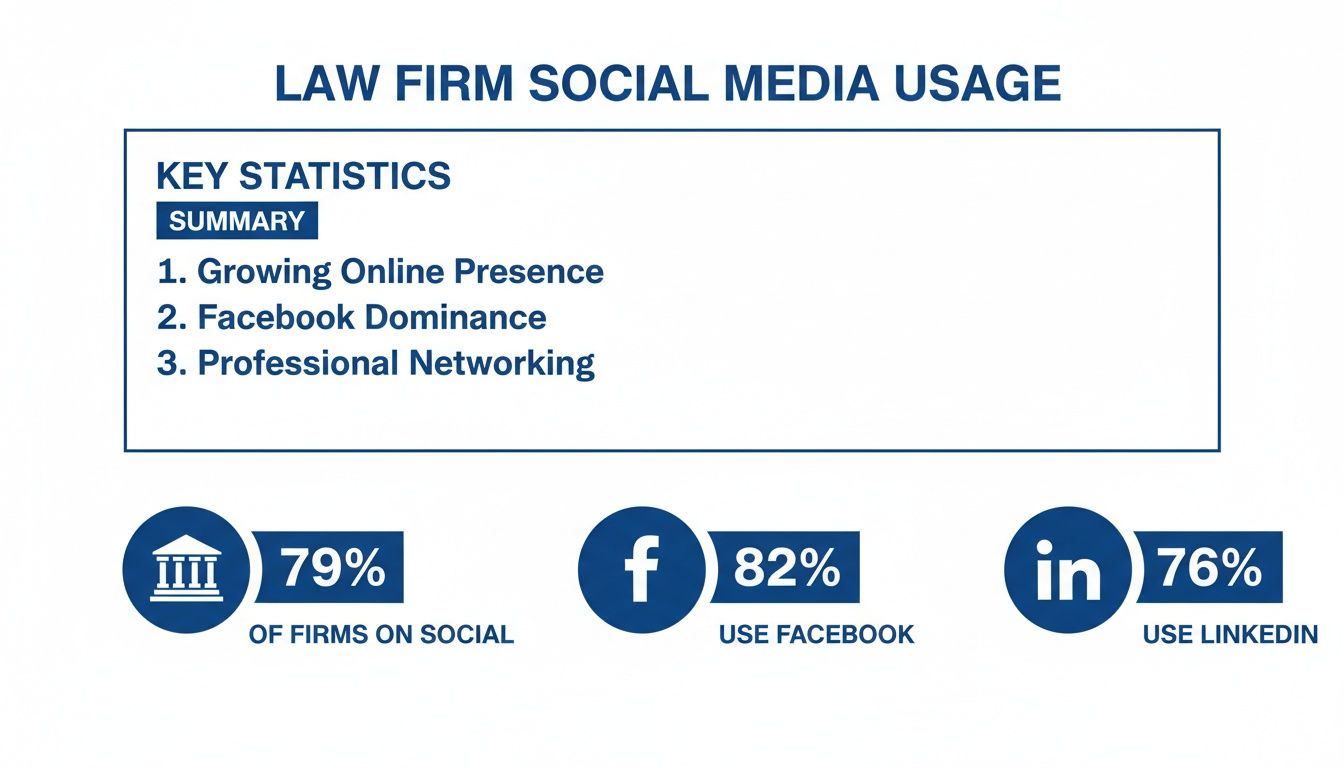
As you can see, Facebook and LinkedIn are the heavy hitters. But that doesn't mean they're automatically the right fit for you. Let's dig into where each platform truly shines for lawyers.
LinkedIn: The Professional Networking Powerhouse
If your firm serves other businesses (B2B), LinkedIn is non-negotiable. For practices in corporate law, intellectual property, or employment law, this is your digital headquarters. Think of it as a massive, ongoing industry conference where you can build high-value connections.
Here, you can connect directly with the decision-makers that matter—in-house counsel, C-suite executives, and valuable referral partners. It’s the perfect place to share substantive articles, weigh in on breaking industry news, and cement your firm's reputation as an authority on complex legal issues.
This is where you go to build professional credibility among your peers and attract sophisticated corporate clients.
Facebook: The Community Connection Builder
With over 3 billion active users, Facebook's superpower is its ability to build connections at the local level. This makes it an absolute workhorse for consumer-facing (B2C) practices like family law, estate planning, personal injury, and criminal defense.
This is where you engage with people in your own backyard. You can share practical, easy-to-digest legal tips, post about your firm’s community involvement, and run laser-focused ad campaigns that target potential clients down to the zip code. The goal on Facebook is to become a trusted, familiar face in your local community.
Don't underestimate the power of a well-managed Facebook page. For many potential clients, it’s the first place they’ll look for reviews, service information, and a general feel for your firm's personality.
For firms that rely on individual clients, getting a handle on paid advertising is a game-changer. You can find a solid playbook on how to use Facebook advertising for attorneys to generate qualified leads right in your service area.
Instagram: Humanizing Your Firm Through Visuals
Instagram is all about visuals and authentic storytelling. It might not seem like an obvious choice for a law firm, but it's incredibly powerful for putting a human face on your brand and connecting with younger audiences.
Think of it as the place to showcase your firm’s culture and people. It’s perfect for things like:
- Team Spotlights: Introduce your attorneys and staff with professional-yet-approachable photos and short bios.
- Behind-the-Scenes: Share moments from a firm charity drive, a team-building event, or a casual office lunch.
- Quick Tips: Use simple, branded graphics or short videos (Reels) to break down a single legal concept in a visually engaging way.
For example, a real estate law firm could post photos of beautiful homes from recent closings (with permission, of course!), while a family lawyer could share supportive, encouraging graphics for clients navigating a tough time. It's a way to build an emotional connection that other platforms can't quite match.
Emerging Platforms: TikTok and Beyond
Don't write off newer platforms like TikTok. Its short-form video format is surprisingly effective for making dense legal topics feel accessible and even entertaining. We're seeing lawyers find huge success by answering common legal questions in 60-second clips, debunking myths from popular TV shows, or quickly explaining new legislation.
While it’s not for every firm, being an early adopter on a platform like TikTok can help you reach a massive audience with far less competition from other lawyers. It’s a fantastic way to showcase both your expertise and your personality. The key is to find the platforms that align with your firm's brand and, just as importantly, your own comfort level with creating content.
Crafting a Content Strategy That Actually Gets Clients

Effective law firm marketing social media doesn't happen by accident. If you're just posting randomly whenever you have a spare moment, you're not building the momentum needed to attract and convert clients. The real secret is to stop thinking post-by-post and start thinking bigger. You need a deliberate plan built around foundational topics, or what we call "content pillars."
Content pillars are simply the core subjects your firm will consistently talk about. They're your guardrails, making sure everything you create is relevant to your audience and aligned with your firm’s goals. For a law firm, this is how you graduate from posting generic legal news to building a content engine that establishes genuine trust and authority.
Building Your Content Pillars
Instead of staring at a blank screen wondering what to post, a pillar-based system gives you a reliable well of ideas. This approach simplifies your creative process and, just as importantly, trains your audience on what to expect from you.
Here are four content pillars that I've seen work for virtually every law firm, regardless of practice area:
- Educational Insights: This is your chance to demystify the law. Your job isn't to sound like a legal textbook; it's to be a go-to resource that makes complex topics understandable.
- Firm Culture & Team Spotlights: People hire people, not just a firm name. This pillar is all about humanizing your practice and showing the real, relatable individuals behind the legal advice.
- Client Wins & Case Studies (Handled Ethically): Done right, this pillar is incredibly powerful for demonstrating your firm's effectiveness. The key is to focus on the client's problem and the solution you provided, all while protecting confidentiality and never guaranteeing results.
- Community Engagement: Show you're more than just a business; you're an active part of the community. This builds local goodwill and brand recognition faster than almost anything else.
When you organize your content around pillars, you create a consistent and valuable experience. Followers will learn that your page is the place for clear legal explanations, a look at your team's human side, and updates on how you're making a local impact.
Turning Pillars into Powerful Posts
Once your pillars are set, brainstorming post ideas becomes a breeze. You want a healthy mix of content that keeps your feed from feeling stale or overly self-promotional. Social media is a conversation, so ditch the dry, formal legalese.
Ideas for Educational Posts
Think about the questions your potential clients are constantly asking. That's your goldmine.
- "Did You Know?" Series: Create a simple graphic or a quick video busting a common myth in your practice area. A personal injury lawyer could do one on why you shouldn't talk to the other party's insurance adjuster on your own.
- FAQ Carousels: Use a multi-slide post on Instagram or LinkedIn to tackle a frequently asked question. Each slide can break down one part of the answer, making it easy to digest.
- Explainer Videos: Have an attorney record a 60-second video explaining a recent change in the law and what it actually means for regular people.
Ideas for Firm Culture Posts
This is where you build a real connection and let your firm's personality shine.
- Attorney Spotlights: Post a great photo of an attorney, but go beyond their professional bio. Share a personal detail, like their favorite local coffee shop, a hobby, or why they became a lawyer in the first place.
- "Day in the Life" Stories: Use Instagram or Facebook Stories for candid, behind-the-scenes glimpses of office life—a team lunch, setting up for a trial, or a firm volunteer day.
- Celebrate Milestones: Share your wins! Announce firm anniversaries, partner promotions, or an associate passing another state's bar exam.
This pillar-based approach is a cornerstone of a much larger strategy. To see how it fits into the bigger picture, check out this guide on content marketing for law firms. And if you're serious about getting results, digging into a proven social media content strategy framework will help guide every single piece of content you create.
Planning and Putting It All Into Action
Here’s the hard truth: consistency is everything on social media. A content calendar is what makes consistency possible, saving you from the daily panic of "what do I post today?"
It doesn't have to be complicated. Start with a simple spreadsheet or a dedicated scheduling tool. Map out your posts two to four weeks in advance, assigning a content pillar to different days of the week. This lets you "batch" your work—for example, spend one afternoon shooting all the short videos you need for the entire month.
Using a scheduling tool is a non-negotiable for any serious firm. Platforms like Hootsuite or Sprout Social let you write your posts, add your visuals, and schedule them to publish at the best times. This frees you up to practice law, confident that your firm is maintaining an active, professional presence even when you're in court.
Using Paid Social Ads and Local Targeting Effectively
While building an organic presence is fundamental, paid social advertising is the accelerator. It’s how you cut through the noise and guarantee your message reaches the exact people who need your services, right in your local area.
Think of it as the difference between putting a billboard on a quiet backroad and buying a primetime commercial slot—only with far more precision and a much smaller price tag.
For many law firms, the idea of "paying for ads" can feel overwhelming, conjuring images of complicated dashboards and wasted money. But platforms like Facebook and LinkedIn have made it remarkably straightforward to run highly effective, hyper-local campaigns that generate real leads, not just likes. The key is starting with a clear budget and an even clearer objective.
This isn't just theory. Social media delivers a serious ROI for law firms. Facebook and Instagram lead the pack at 29%, and there's a reason 86% of businesses, including savvy legal practices, actively use Facebook ads. It works. In fact, 71% of lawyers report generating leads from social media, with over 30% successfully signing new clients from those efforts.
Setting Your Budget and Allocating Spend
Your first question is probably, "How much should I spend?" There's no magic number, but a great starting point is to allocate a specific monthly budget you're comfortable with—even if it's just a few hundred dollars—and test what works.
Don't spread your budget too thin across multiple campaigns. Instead, focus your initial spend on a single, high-value goal. For a family law firm, that might be promoting a free divorce planning checklist. For an estate planning attorney, it could be an ad for an upcoming webinar on trusts.
This focused approach lets you actually measure what’s working and make informed decisions, rather than just guessing.
Let's look at how a firm might structure a starting budget.
Sample Social Media Ad Budget Allocation
| Objective | Platform | Monthly Spend | Key Performance Indicator (KPI) |
|---|---|---|---|
| Generate consultation requests | $750 | Cost Per Lead (CPL) | |
| Drive webinar registrations | $500 | Cost Per Registration | |
| Increase local brand awareness | $250 | Reach and Impressions | |
| Retarget website visitors | $500 | Cost Per Click (CPC) |
This table shows a more developed strategy, but you can see how each dollar is tied to a specific outcome. You start small, prove the concept, and then scale up.
Mastering Hyper-Local and Demographic Targeting
The real power of social ads is in the targeting. You can get incredibly specific, ensuring your ad dollars are only spent reaching truly relevant potential clients.
On Facebook, for instance, you can dial in your audience based on:
- Location: Target by city, zip code, or even a one-mile radius around your office. This is a game-changer for practices serving a specific geographic community.
- Demographics: Filter by age, gender, job title, and even income level to match your ideal client profile.
- Behaviors and Interests: Reach people who have recently visited real estate websites (for a real estate lawyer) or shown interest in small business resources (for a business attorney).
LinkedIn offers equally potent options for B2B-focused firms. You can target by industry, company size, specific job titles (like "General Counsel"), or seniority. A corporate law firm can place an ad directly in the feeds of C-suite executives in the local tech sector.
Your ad campaign is only as good as its targeting. Spend the time to build a detailed audience profile. It’s the single most important step in ensuring your budget delivers a positive return on investment.
Creating an Ad That Converts
A winning ad needs three things: a compelling visual, clear copy, and a strong call-to-action (CTA).
- The Visual: Use a high-quality, professional photo of your attorneys or a clean, branded graphic. Please, avoid generic stock photos. They scream "advertisement" and are easily ignored.
- The Copy: Your ad copy must speak directly to a client's pain point and offer a clear solution. Start with a hook, explain the benefit of clicking, and keep it concise.
- The Call-to-Action (CTA): Tell people exactly what to do next. Vague CTAs like "Learn More" are weak. Use action-oriented phrases like "Download Your Free Guide," "Book a Confidential Consultation," or "Get Your Case Evaluation."
Once you have a small, successful test campaign running, the next step is to scale. Learning advanced strategies for scaling Facebook ads is how you turn that initial test into a consistent, reliable lead generation machine. For a deeper dive into the nuances of paid campaigns for legal practices, our guide on social media advertising for lawyers provides a complete roadmap.
Navigating Ethics and Compliance in Social Media

Let's be clear: marketing a law practice isn't like selling shoes. The rules are different, and the stakes are much, much higher. In the fast-moving world of social media, it's dangerously easy to make a misstep that lands you in serious trouble with your state bar.
This is one area where your law firm marketing social media strategy has to be absolutely airtight. Every single post, comment, and ad is considered attorney advertising, which means it falls under your state's professional conduct guidelines. You have to be incredibly careful with your language to avoid creating false hopes or making promises you can't possibly keep.
Steering Clear of Common Ethical Pitfalls
Most of the landmines in legal social media marketing are buried in the claims you make. State bar associations are, rightfully, focused on protecting the public from advertising that could be misleading or downright false.
You need to avoid any posts that:
- Promise specific outcomes. Phrases like "We guarantee a win" or "We'll get you the maximum settlement" are huge red flags. Case outcomes are never certain, and you can't suggest otherwise.
- Create unjustified expectations. Calling yourself "the best personal injury lawyer" or using other superlatives can be seen as misleading if you don't have objective, verifiable data to back it up.
- Imply specialization without certification. In most jurisdictions, you can't call yourself an "expert" or a "specialist" unless you hold an official certification recognized by your state bar.
- Mishandle client testimonials. Client stories are compelling, but you absolutely must have their explicit, written consent. Even then, the testimonial can't be presented in a way that promises a similar result for everyone else.
The smart play is to focus your content on your experience, your process, and the educational value you can provide—not on guaranteed results. For a deep dive into the specifics, this guide to ethical attorney advertising in California offers some great insights that apply almost anywhere.
Compliant vs. Non-Compliant: A Real-World Example
Let's make this practical. Imagine a personal injury firm just secured a great settlement for a client.
- Non-Compliant Post: "Another huge win! We just got our client a $1.2 million settlement. We're the best in the business and will get you the money you deserve. Call us now!"
- Compliant Post: "We are pleased to have resolved a complex case for a client injured in a commercial vehicle accident. Our team's dedicated approach helped them secure the resources needed for their recovery."
See the difference? The second post highlights the firm's good work without guaranteeing results or using prohibited superlatives. It communicates competence without crossing any ethical lines.
Don't Forget: Accessibility Is Also Compliance
Beyond your state bar's rules, your social media presence has to be accessible to people with disabilities. This isn't just about doing the right thing; it’s a matter of compliance with the Americans with Disabilities Act (ADA).
ADA compliance on social media is often overlooked but is essential for both ethical marketing and risk management. Making your content accessible ensures you are reaching everyone in your community.
A few simple habits can make a huge difference:
- Add Alt Text to Images: Write a short, descriptive sentence explaining what's in the picture. This is crucial for users who rely on screen readers.
- Caption All Videos: Make sure every single video, from a quick Reel to a longer explainer, has accurate and easy-to-read captions.
By building these ethical and accessibility practices directly into your workflow, you can market your firm with confidence, build genuine trust, and stay clear of preventable disciplinary issues.
Measuring Performance and Knowing When to Bring in the Pros
A busy social media feed feels productive, but feelings don't impress the partners or justify your marketing budget. To prove your social media efforts are actually working, you have to look past the superficial metrics and focus on what truly drives the firm forward.
Success isn't about likes or follower counts. It's about signed retainers and new clients. When you can draw a straight line from your social media activity to tangible business growth, you've cracked the code.
What to Actually Track: Your Firm's KPIs
Key Performance Indicators (KPIs) are just the specific numbers that tell you if you're hitting your goals. Forget getting lost in a sea of analytics. You only need to obsess over a handful of metrics that directly point to client acquisition.
Here are the KPIs that matter:
- Website Clicks from Social: This tells you how many people are taking the next step, moving from a social post to your firm's digital front door.
- Consultation Form Submissions: This is a direct measure of lead generation. How many people who came from social media filled out your "Contact Us" or "Free Case Evaluation" form?
- Phone Calls from Social: A simple but powerful trick is to use a unique, trackable phone number on your social profiles. Now you know exactly how many calls your social media is generating.
- Cost Per Lead (CPL): If you're running paid ads, this is your holy grail. It tells you precisely how much you're spending to get each potential client in the door.
The best performance reports I've ever seen are simple and all about the business. A one-page monthly snapshot showing trends in website clicks, form fills, and phone calls is infinitely more valuable than a 20-page report bragging about follower growth.
Knowing When It's Time for Expert Help
There comes a point where managing social media in-house just doesn't make sense anymore. When a partner's billable hours are being spent trying to schedule posts, you've hit a wall of diminishing returns. That’s your cue to start thinking about outsourcing to specialists.
The data backs this up. Law firms are getting smarter about their marketing budgets, with social media often accounting for 10% of the total spend. The shift toward outsourcing is undeniable, as 39% of firms now hire outside help for social media just to get precious time back for their lawyers. While 80% of solo practitioners start out doing it all themselves, they quickly learn it's not a sustainable path to growth.
And it works. A whopping 71% of firms are successfully generating leads through social media. You can see more legal marketing findings that show how firms are strategically investing their resources.
In-House vs. Agency: Making the Right Call
Deciding between hiring an in-house marketer or partnering with an agency is a big decision. An in-house person knows your firm's culture inside and out, which is a huge plus. But an agency brings an entire team of specialists—ad buyers, copywriters, strategists, designers—to the table, often for a similar price.
For many firms, a hybrid approach is the sweet spot. It's worth exploring what is a fractional CMO to see how you can get high-level strategic direction without the hefty salary of a full-time executive. This model gives you expert oversight while an agency or a junior team member handles the daily grind.
When you start interviewing agencies, here's what you need to look for:
- Relevant Case Studies: Have they gotten real results for firms like yours? Make them prove it.
- Knowledge of Legal Ethics: Ask them point-blank how they ensure every post and ad complies with your state bar's advertising rules. If they hesitate, run.
- Transparent Reporting: A great partner will report on the business-focused KPIs we talked about, not distract you with fluff.
Be wary of any agency that makes concrete promises, like "we guarantee you'll get 10 new cases a month." That's a massive red flag. Real marketing is about smart strategy, consistent execution, and clear reporting—not pie-in-the-sky guarantees. The right partner will turn your social media from a time-suck into a predictable source of new clients.