

Marketing for an immigration attorney isn't just about placing an ad and hoping for the best. It's the art and science of connecting with people who desperately need your help, showing them you have the answers, and guiding them to your door.
It's about building a predictable system for growth that moves your firm beyond inconsistent referrals. The real goal? To create a reliable, steady stream of new cases you can count on, month after month.
Why Your Firm Needs a Modern Marketing Blueprint

Building a thriving immigration practice today takes more than just being a brilliant lawyer. It demands a strategic marketing blueprint. Think of it like an architect's plan for a skyscraper—without that solid plan, even the finest materials will lead to a shaky, unstable structure.
A well-defined marketing plan is that foundation. It guides every single decision you make to attract the clients you actually want to serve.
This guide is that essential blueprint. We're going to break down the core pieces of a winning strategy, showing you exactly how to build a powerful online presence that generates not just leads, but trust. We're focused on turning marketing from a confusing expense into the single most important investment you can make in your firm's future.
The Growing Market and Fierce Competition
The opportunity for immigration attorneys has never been bigger. The industry has swelled to a $9.9 billion market in the U.S., growing at a steady clip of 3.3% annually between 2020 and 2025. That growth is powered by a constant need for family-sponsored visas, employment-based immigration, and diversity programs.
But with big opportunity comes fierce competition.
The number of immigration law firms has exploded to nearly 20,000, which is an incredible 6.9% growth rate over that same period. In a field this crowded, just hanging a shingle—digital or otherwise—simply won't cut it. Standing out is impossible without a deliberate plan.
Your marketing blueprint is what separates your firm from the noise. It ensures your message reaches the right people, at the right time, with the right solution to their urgent legal needs.
To give you a high-level view of what this blueprint entails, here are the foundational pillars we'll be building on throughout this guide.
Key Pillars of a Modern Immigration Marketing Strategy
This table outlines the foundational components of a successful marketing plan, providing a quick reference for the key areas explored in this guide.
| Pillar | Objective | Key Tactics |
|---|---|---|
| Client Personas | Deeply understand who you're trying to reach. | Identify demographics, pain points, motivations, and common questions. |
| Local & Technical SEO | Be the first firm potential clients find online. | Google Business Profile optimization, keyword research, site speed, ADA compliance. |
| Content & Video | Build trust and authority by answering questions. | Blog posts, video explainers, FAQs, client success stories. |
| Paid Advertising | Generate immediate, targeted leads. | Google Ads, social media ads, retargeting campaigns. |
| Reputation Management | Solidify your firm's credibility and trustworthiness. | Online review generation, testimonial videos, case studies. |
| Intake & CRM | Convert leads into paying clients efficiently. | Streamlined intake process, lead nurturing, CRM integration. |
These pillars work together to create a comprehensive system that attracts, engages, and converts your ideal clients.
From Tactics to a Cohesive Strategy
So many firms fall into the trap of chasing isolated tactics. They might boost a social media post one day or run a random Google ad the next, all without an overarching vision. This approach is like trying to build a house one brick at a time with no blueprint—you'll get a pile of bricks, not a home.
A true marketing blueprint connects all these activities into a single, powerful engine for growth. It aligns every effort with your firm's specific goals, ensuring every dollar and hour you spend contributes to a measurable outcome. For a deeper dive, check out our guide on creating an effective law firm marketing strategy.
Before you can build your plan, you have to know who you're up against. A critical first step is effectively analyzing the competition.
From there, we'll dive into the most fundamental element of all: understanding exactly who you are trying to reach.
Know Who You’re Talking To
Here’s a hard truth about marketing your immigration firm: if you’re trying to talk to everyone, you’re not really talking to anyone. A generic message designed to catch all potential clients will almost always fail to connect with a single one.
The secret is to stop thinking about a vague, faceless "client." Instead, you need to get laser-focused on specific people who have unique, urgent, and often deeply personal problems that you can solve.
This is where creating client personas becomes one of the most powerful tools in your marketing arsenal. A client persona is essentially a detailed, semi-fictional profile of your ideal client. We're not just talking about their age or where they live; we’re talking about understanding their deepest fears, their most powerful motivations, and the exact life events that sent them searching for an attorney in the first place.
Think of it this way: a doctor doesn't just hand out the same pill for every sickness. They diagnose the specific problem first. Your marketing has to do the same thing by diagnosing the specific legal—and emotional—pain your ideal client is feeling.
Go Deeper Than Just Demographics
To forge a real connection, you have to know more than just the surface-level details. Every piece of your marketing—from your website's homepage to your ad campaigns—needs to speak directly to the precise emotional and logistical challenges of each type of client you serve. This means you have to dig into their world.
Just think about how vastly different two common immigration clients can be:
- The Family Petitioner: This person is driven by one of the most powerful human emotions: the desire to reunite with a spouse, child, or parent. Their search for help likely starts in community forums or by asking trusted friends for a recommendation. Their biggest fear is being permanently separated from their loved ones by a mountain of confusing paperwork.
- The Corporate HR Manager: This individual is laser-focused on a business objective—getting an H-1B visa for a brilliant new hire who is critical to a project. Their main concerns are efficiency, compliance, and avoiding any disruption to the business. They’re looking for answers on professional networks like LinkedIn and need an attorney with a rock-solid track record in corporate immigration.
These two people need to hear completely different things from your firm. The family petitioner is looking for empathy and reassurance. The HR manager needs to see competence and predictability, fast.
Building Your Firm’s Client Personas
Creating these personas means asking the right questions to build a complete picture of these individuals. Doing this helps you step into their shoes and see the legal process from their perspective—which is the absolute foundation of effective marketing.
This template from HubSpot is a great starting point for the kind of detail you should be aiming for.
As you can see, a good persona goes way beyond a job title. It captures goals, challenges, and even how they prefer to communicate. For your immigration firm, you'd customize this to include fields like "Legal Triggers," "Biggest Immigration Fears," and "Where They Go for Information."
Once you've defined these personas, you have a clear roadmap for your entire marketing strategy. Every blog post, every video, and every social media ad can now be crafted to speak directly to the needs of a specific person. This ensures your marketing budget is spent reaching the right people with a message that actually hits home.
Winning the Local Search Battle with SEO

When someone has an urgent immigration problem, their first move isn't to look through a national directory. It’s a quick, hopeful search on their phone for an expert right there in their own community. This is precisely why mastering local search engine optimization (SEO) is a non-negotiable part of your marketing plan.
Think of local SEO as having the most visible, trusted office on the busiest street in town, but online. When a potential client types "immigration lawyer in Miami" into Google, you need your firm to be one of the very first names they see. That doesn't happen by chance; it’s the direct result of a focused strategy.
The real prize in this local search battle is a coveted spot in Google's "Map Pack"—that prominent box at the top of the results showing the top three local businesses. Landing here can instantly and dramatically increase the number of calls coming into your firm.
Optimizing Your Google Business Profile
Your Google Business Profile (GBP) is the absolute cornerstone of your local SEO strategy. It’s a free, powerful tool that works like a digital storefront, and it's often the very first impression a searcher will have of your practice. A neglected profile is the same as putting a "closed" sign on your front door.
To turn your GBP into a magnet for new clients, you have to be meticulous. Start by ensuring your firm’s name, address, and phone number (what we call NAP) are 100% consistent across your profile, your website, and every other online directory. Even a tiny variation can throw off search engines and hurt your ranking.
Next, you have to fill out every single relevant section with rich, useful information. This means:
- Services: Don't just say "immigration law." Get specific. List everything you do, like "Family-Based Visas," "Employment Visas," and "Deportation Defense."
- Photos: Show people you're real. Upload high-quality photos of your office, your team, and yourself. This small step goes a long way in building trust.
- Posts: Use the Google Posts feature to share firm updates, quick insights on new immigration laws, or links to your latest blog articles. Keep it active.
Finally, client reviews are the lifeblood of your GBP. You need to actively and ethically encourage satisfied clients to leave you feedback. Positive reviews are incredibly powerful social proof and a major factor in getting you into that all-important Map Pack.
On-Page SEO for Geographic Targeting
While your GBP sends powerful off-site signals, your own website has to back it all up by establishing your local authority. We do this through targeted on-page SEO. The single most effective tactic here is creating specific pages for each service in each geographic area you want to own.
For example, instead of one generic "Visa Services" page, you should build out pages like:
- "H-1B Visa Attorney in San Diego"
- "Family Green Card Lawyer in Los Angeles"
These hyper-local pages send a crystal-clear signal to Google that you are the expert for that service in that city. This makes you far more likely to show up when people in those areas are searching for help. To see how all these pieces fit into a larger puzzle, it's worth exploring a complete guide to dominating legal search rankings.
Website Accessibility and Technical SEO
Just like your physical office needs a ramp for wheelchair access, your digital office—your website—must be accessible to everyone. Making your site usable for people with disabilities isn't just about compliance anymore; it’s a critical piece of modern SEO.
Think of it this way: a website that is easy for a screen reader to navigate is also incredibly easy for Google's own crawlers to understand.
Things like proper heading structures, descriptive alt text for images, and clear navigation are a win-win. They help both users and search engines. By making your site ADA-friendly, you aren't just opening your doors to more potential clients—you're sending strong, positive signals to Google that can give your overall rankings a serious boost.
Building Trust with Content and Video

Content is the engine that drives modern legal marketing. It’s how you build trust long before a potential client ever picks up the phone. This isn’t about selling; it's about solving. When you answer their most urgent questions with clarity and compassion, you start building a real relationship before the first consultation is even on the books.
This simple shift in thinking turns your website from a static digital brochure into a powerful, automated client-generation machine. By giving away genuine value upfront, you position yourself not just as another attorney, but as a knowledgeable and trustworthy guide through one of the most stressful times in a person's life.
Creating High-Value Content Pillars
Let’s get one thing straight: sporadic, generic blog posts don’t work anymore. The most effective immigration attorney marketing strategy today is built on what we call content pillars.
Think of a pillar as a massive, central hub of information on a broad topic—like a definitive guide to the naturalization process or everything someone needs to know about securing an H-1B visa. It’s the single best resource on that subject.
From that one massive pillar, you can then create dozens of smaller, related pieces of content. For example, a "Complete Guide to Family-Based Green Cards" pillar could easily branch out into:
- Blog Posts: "5 Common Mistakes We See on Form I-130" or "How to Confidently Prepare for Your Green Card Interview."
- FAQ Pages: Answering hyper-specific questions like "How long does the family-based green card process really take right now?"
- Checklists: "All the Documents You Need for Your Adjustment of Status Application."
- Infographics: A visual timeline of the entire process, from petition to approval.
This structure accomplishes two critical things. First, it instantly establishes your firm as a deep subject matter expert in the eyes of potential clients. Second, it creates a powerful web of interconnected content that search engines absolutely love, which significantly boosts your SEO authority.
The goal of your content is simple: be the most helpful, clear, and reassuring resource available online for your ideal client's specific problem. When you achieve that, you'll earn their trust and, eventually, their business.
To get an edge on content creation and streamline your client communication, it's worth exploring modern AI-powered marketing support tools that can help with the heavy lifting.
Harnessing the Power of Video
While well-written content is the foundation, video is where you connect on a truly human level. Immigration law is deeply personal. Seeing your face and hearing your voice can break down barriers and build rapport in a way that plain text simply can't.
Video lets you convey empathy, and that’s a massive differentiator in a crowded market. Remember, people don't just hire a lawyer; they hire a person they feel they can trust with their entire future.
Key Video Types for Your Firm
Your video strategy needs to be just as focused as your written content plan. Don't try to do everything at once. Concentrate on a few high-impact formats that deliver immediate value and build rock-solid credibility.
- Educational Explainers: These are short, punchy videos (2-5 minutes) that break down a single complex topic into simple, understandable terms. Think "What Is a Request for Evidence (RFE)?" or "Explaining the Diversity Visa Lottery." Post these on YouTube and then embed them directly into relevant blog posts. They are perfect for capturing people who are already searching for answers on Google.
- Empathetic Client Testimonials: Nothing is more powerful than a satisfied client sharing their story on camera. A professionally shot testimonial where a client describes their fears, the process, and their successful outcome is incredibly persuasive. This provides the exact social proof that anxious applicants need to see before they'll make a call.
- "Meet the Attorney" Videos: A short, authentic video introducing you and your team adds a personal touch that sets you apart. Share your "why"—what drives you to practice immigration law? This helps potential clients see the passionate human advocate behind the law degree.
These videos don't just have to live on your website; they're gold for sharing on social media platforms to reach a wider audience. To really nail this, it’s worth reviewing the finer points of creating compelling attorney marketing videos.
By consistently creating helpful content in both written and video formats, you build an invaluable library of assets that works for your firm 24/7, establishing trust and attracting qualified clients around the clock.
Using Paid Ads for Targeted Client Acquisition
While SEO and content are fantastic for building long-term trust, sometimes you need to get in front of a client the very second they realize they need help. This is where paid advertising excels. It’s like putting a billboard on the exact digital highway your ideal client is frantically driving down in a moment of crisis.
Paid ads let you jump the line. Instead of slowly climbing the organic search rankings, you can place your firm’s name directly in front of people actively searching for an immigration lawyer. It’s a direct, powerful way to generate calls and consultations right now.
But let’s be clear: the digital ad space for lawyers is a battlefield. Marketing costs have gone through the roof. Some legal keywords now command up to $1,000 per click on Google Ads, a number that would have been unthinkable just a few years ago. This bidding war means you can’t just throw money at the wall and hope it sticks. You need a razor-sharp strategy to survive. To get the full picture on rising costs, check out this piece on why law firm marketing is getting so expensive.
Mastering Google Ads for Immigration Law
Google Ads is still the king when it comes to capturing high-intent leads. These are people with an immediate, pressing problem, and they’re looking for a solution now. But modern campaigns are a world away from simply bidding on keywords. AI-powered features now let you target with incredible precision, ensuring your budget is spent reaching the most qualified searchers.
Success on Google Ads demands discipline. Forget bidding on broad, expensive terms like "immigration lawyer." The real wins come from focusing on long-tail keywords that signal specific, urgent needs—phrases like "attorney for marriage green card interview" or "best H-1B visa lawyer near me." These searches are far less competitive, which means the leads are often higher quality and come at a lower cost. For a deeper dive, check out our guide on how to effectively use Google Ads for lawyers.
Gaining Instant Credibility with Local Service Ads
One of the single most powerful tools in the immigration attorney marketing playbook is Google’s Local Service Ads (LSAs). You’ve seen them—they’re the profile boxes sitting right at the very top of the search results, even above the traditional paid ads.
LSAs are a game-changer for two simple reasons:
- The 'Google Screened' Badge: To even be eligible, your firm has to pass a background check by Google. This earns you a little green checkmark badge that acts as an instant stamp of approval, signaling trust and legitimacy to potential clients.
- Pay-Per-Lead Model: This is the best part. Unlike traditional ads where you pay for every single click (whether they’re a good fit or not), with LSAs, you only pay for a qualified lead—a direct phone call or message from someone seeking your services.
This model completely flips the script. It shifts the risk away from your firm and guarantees your budget is only spent on genuine opportunities, not just curious clickers. LSAs are a fantastic way to generate high-quality local leads with a crystal-clear return on investment.
Reaching Clients Through Social Media Advertising
While Google is great for capturing people who are actively searching, social media platforms like Facebook let you reach potential clients based on who they are. This is where your detailed client personas become your secret weapon. You can run hyper-targeted campaigns aimed at specific demographics, languages, interests, and even online behaviors.
For example, imagine running an ad campaign that only shows up for Spanish speakers in your city who have shown an interest in family-based immigration content. This allows you to craft ad copy and visuals that connect on a cultural and emotional level, building rapport before they even click. The key here is to relentlessly test different ad creatives, audiences, and messages to see what resonates. Over time, you’ll see what works, steadily lower your cost per lead, and turn your ad spend from a gamble into a predictable engine for new cases.
Your 90-Day Immigration Marketing Action Plan
All the strategy in the world means nothing until you put it into action. This is where the rubber meets the road. Real growth comes from momentum, so I’ve broken down everything we've covered into a clear, manageable 90-day roadmap.
This isn't about trying to boil the ocean. The goal is to focus your energy on high-impact activities in a logical order. You'll build a solid foundation first, then layer on more advanced tactics as you go. Think of it as a controlled launch sequence for your firm's growth.
This timeline gives you a bird's-eye view of the plan, splitting it into three distinct phases: laying the groundwork in Month 1, creating content in Month 2, and finally, analyzing your results in Month 3.
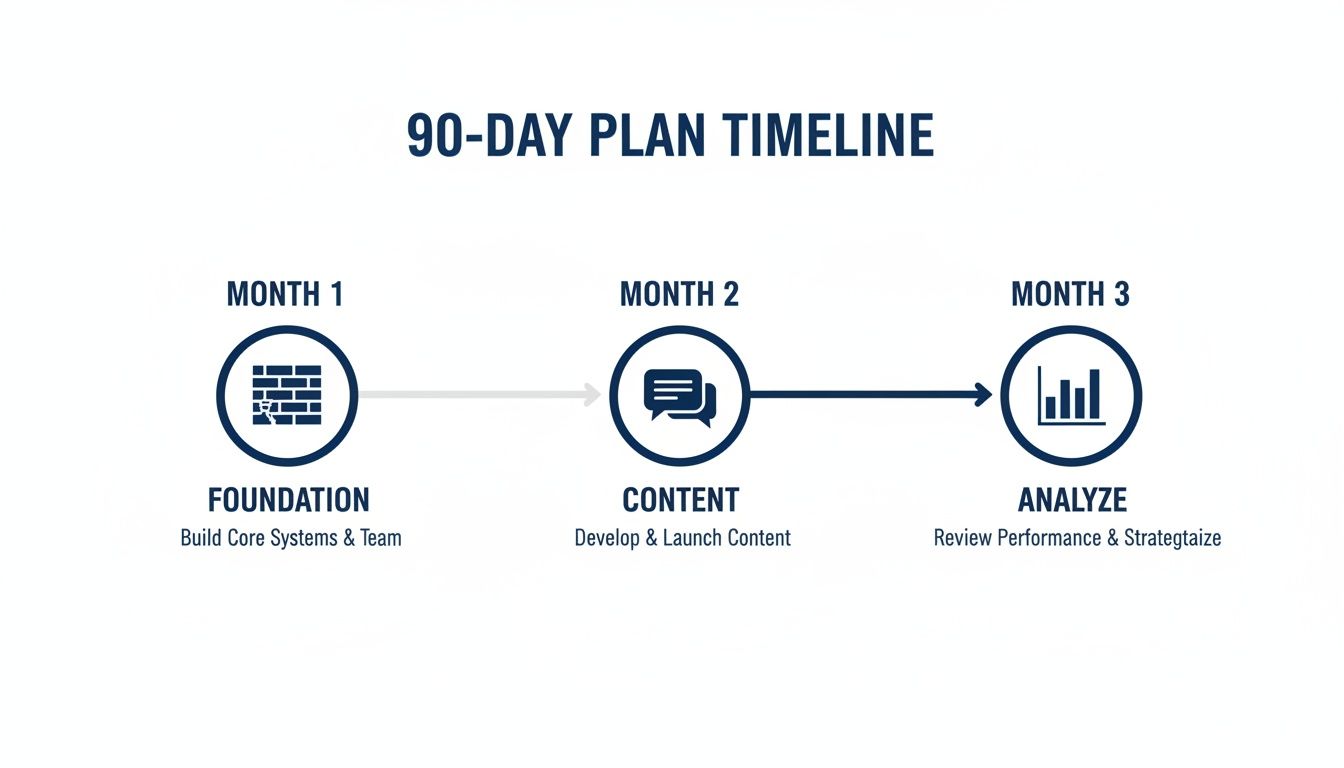
The key here is progression. Each month’s work builds directly on the last, creating a powerful, cumulative effect that pays off down the line.
Month 1: The Foundation Phase (Days 1-30)
Your first 30 days are all about building the essential infrastructure. If you get these pieces right, everything that follows becomes exponentially easier and more effective.
- Audit Your Digital Presence: Do a serious audit of your website and social media profiles. Does your messaging actually speak to your ideal clients? Is your firm's name, address, and phone number consistent everywhere? Fix it.
- Optimize Your Google Business Profile: This is completely non-negotiable for local search. Fill out every single section, upload high-quality photos of your team and office, and make sure your services list is crystal clear.
- Define Your Client Personas: It's time to get specific. Lock in your 2-3 core client personas. Write down their real-world pain points, their goals, and the exact questions they're typing into Google.
Month 2: Content Creation and Local SEO (Days 31-60)
With a solid foundation in place, you can now start creating valuable content that pulls in your ideal clients and cements your authority in your local market.
- Publish Two Pillar Articles: Pick two of your most important practice areas. Write comprehensive, genuinely helpful articles that answer the most common questions you get from clients about those topics.
- Launch a Client Review Campaign: You need social proof. Create a simple, ethical system for asking satisfied clients to leave a review on your Google Business Profile. This is the single biggest factor for ranking in the local Map Pack.
- Create Your First Explainer Video: Grab your smartphone and record a short (2-3 minute) video breaking down a complex immigration topic. Post it on your YouTube channel and embed it directly into one of your new pillar articles.
Month 3: Paid Ads and Analytics (Days 61-90)
Now it’s time to pour some fuel on the fire and start measuring what actually works. This month is about paid client acquisition and making decisions based on data, not guesswork.
Your only goal in this final phase is to gather data. You need to know your cost per lead and conversion rates to establish a baseline. This is how you prove your marketing is actually making you money.
Start a small, tightly targeted Google Ads or Local Service Ads campaign. Aim it directly at your primary client persona in your main service area. The market for immigration law is fast-moving; 59% of firms report call volume spikes tied directly to policy changes, which makes a responsive ad strategy essential.
Finally, set up basic analytics to track your key metrics: website traffic, leads generated, and cost per acquisition. For a structured approach to get this done, you might find our customizable law firm marketing plan template helpful.
A Few Common Questions We Hear
Getting into digital marketing for your firm can feel a bit overwhelming. There are a lot of moving parts. To help clear things up, here are answers to some of the most common questions we get from immigration attorneys just like you.
How Much Should We Really Be Budgeting for Marketing?
There’s no magic number, but a solid rule of thumb for law firms is to set aside anywhere from 2% to 10% of gross revenue for marketing.
A brand-new firm trying to make a name for itself will naturally lean toward the higher end of that spectrum. A well-established practice with a steady stream of referrals, on the other hand, might find that the lower end is plenty.
The real shift in thinking is to stop seeing marketing as a cost and start treating it as an investment. Instead of asking, "How much is this?" the better question is, "What's the likely return on this?" Start with a budget that feels comfortable, track your results like a hawk, and then double down on the channels that are actually bringing clients through the door.
What are the Most Important Metrics to Keep an Eye On?
It's incredibly easy to get buried in a mountain of data. To cut through the noise, focus on the handful of Key Performance Indicators (KPIs) that are directly tied to your firm’s bottom line.
- Cost Per Lead (CPL): This tells you, in plain dollars, how much you're spending to get one potential client to pick up the phone or fill out a form.
- Lead-to-Client Conversion Rate: Of all the leads you get, what percentage actually sign an engagement letter and become a client?
- Client Acquisition Cost (CAC): This is the total cost to land one new paying client. Think of it as your CPL divided by your conversion rate.
- Return on Investment (ROI): The big one. This measures how much revenue your marketing is bringing in compared to what you spent to get it. It’s the ultimate report card.
Watching these numbers shows you exactly what's working in your immigration attorney marketing plan and what needs a tune-up. No more guesswork.
How Do I Make Sure We Stay Compliant with Advertising Ethics?
This one is non-negotiable. Your license is on the line. The American Bar Association (ABA) and your state bar have very clear, strict rules designed to stop misleading advertising in its tracks.
Your marketing has to be truthful. It absolutely cannot create unjustified expectations. That means no promises about case outcomes and no language that even hints at a guaranteed result. When it comes to ethics, honesty and transparency are your only options.
Make sure you have a clear disclaimer on your website and in all your ads. If you’re ever unsure, pull up your state bar's specific advertising guidelines or even chat with legal ethics counsel. It’s a small step that protects your clients, your reputation, and your ability to practice.
Ready to stop guessing and start building a predictable pipeline of new clients? Case Quota creates client acquisition systems specifically for immigration law firms. Schedule your free strategy session today and let's talk about how we can help you attract the exact clients you want.