
Google Ads is, without a doubt, the most direct way to get in front of high-intent clients right when they need you. While SEO is a marathon, paid search is a sprint—it puts your law firm at the very top of Google search results today, intercepting potential clients who are actively looking to hire an attorney.
Why Google Ads Are a Client Magnet for Law Firms
Let's get straight to the point. You need clients. But more importantly, you need the right kind of clients—people who aren't just browsing but are facing an urgent problem and are ready to pick up the phone.
This is where you need to think like a potential client in crisis. Someone typing "car accident lawyer near me" into Google isn't doing academic research. They're sending up a flare, signaling a critical need for legal help, and they need it now.
That high level of intent is exactly what makes Google Ads for lawyers so incredibly effective. It's a direct line to these people, letting you skip the months (or even years) it takes for organic SEO to gain traction. While a solid SEO strategy is crucial for long-term, sustainable growth, paid ads deliver the immediate visibility you need to generate leads this week.
The Power of High-Intent Keywords
Let's look at the difference in mindset behind two simple searches:
- Informational Search: "what to do after a car accident"
- High-Intent Search: "personal injury attorney for rear-end collision"
The first person is gathering information. The second is actively looking for representation. A smart Google Ads campaign is laser-focused on those high-intent, transactional keywords, making sure every dollar you spend is aimed at attracting qualified leads, not just curious browsers. You can find more strategies for this in our complete guide on lead generation for lawyers.
To illustrate this, let's break down how search intent varies across different legal fields. The keywords people use reveal exactly where they are in their journey—from just starting to research to urgently needing to hire.
Client Search Intent Breakdown by Practice Area
| Practice Area | Low-Intent Informational Keywords | High-Intent Transactional Keywords |
|---|---|---|
| Personal Injury | "symptoms of whiplash" | "best car accident lawyer near me" |
| Family Law | "how is child support calculated" | "divorce attorney for men" |
| Criminal Defense | "what is a misdemeanor charge" | "hire a DUI lawyer immediately" |
| Bankruptcy | "types of bankruptcy" | "chapter 7 bankruptcy attorney consultation" |
See the pattern? The high-intent keywords are all action-oriented. They signal someone is ready to move forward, and that's who your ads should be targeting.
Meeting Clients Exactly Where They're Looking
The data doesn't lie. When people need legal help, their first move is almost always to open a search engine. In fact, one study found that a staggering 86.7% of people turn to Google first when looking for a lawyer. Even with new AI tools popping up, Google is still the place people go to find and validate a law firm.
A well-run Google Ads campaign isn't just advertising; it's a strategic interception. You are positioning your firm as the immediate solution to someone's urgent problem, right when they're asking for help.
This strategic advantage is what makes Google Ads an indispensable engine for law firm growth. By showing up at the top of the results, you instantly build credibility and capture the attention of clients who are ready to convert. You turn clicks into consultations and consultations into signed cases.
Building Your Campaign Foundation the Right Way
Jumping into Google Ads without a solid plan is a fast way to burn through your marketing budget. The platform makes it incredibly easy to start spending money, but turning that spend into profitable cases? That takes a thoughtful foundation. A well-structured campaign is what separates firms that get a steady stream of high-value clients from those that just get a bunch of irrelevant clicks.
The most effective way to start is by organizing your campaigns by practice area. Treat each one as its own dedicated marketing initiative. For instance, if your firm handles multiple areas, you absolutely need separate campaigns for "Family Law," "Criminal Defense," and "Estate Planning."
This structure is crucial because it gives you precise control over your budget, messaging, and targeting. You wouldn't talk to a client going through a divorce the same way you'd speak to someone facing a DUI charge, right? Your ads shouldn't either.
From Broad Practice to Specific Problems
Once you have your campaigns set, the real work begins inside of them with tightly themed ad groups. This is where you get granular. If your campaign is "Personal Injury," your ad groups need to mirror the specific problems potential clients are actually searching for.
For example, you'd break it down into distinct ad groups like:
- Car Accidents
- Slip and Fall Incidents
- Trucking Accidents
- Wrongful Death Claims
This segmentation is non-negotiable. It allows you to match your ad copy and landing pages directly to what the searcher needs in that moment. Someone looking for a "slip and fall lawyer" should see an ad that speaks to that exact issue and then click through to a page dedicated to premises liability cases. This alignment is what drives relevance, boosts your Quality Score, and ultimately, gets you more conversions.
Key Takeaway: Never, ever lump all your keywords into a single, massive ad group. A disorganized campaign forces you to write generic ads that speak to no one, leading to low click-through rates and a wasted budget.
The journey a client takes from realizing they have a problem to hiring an attorney is often quick and direct. The infographic below shows why being visible right when they're actively searching is so critical.
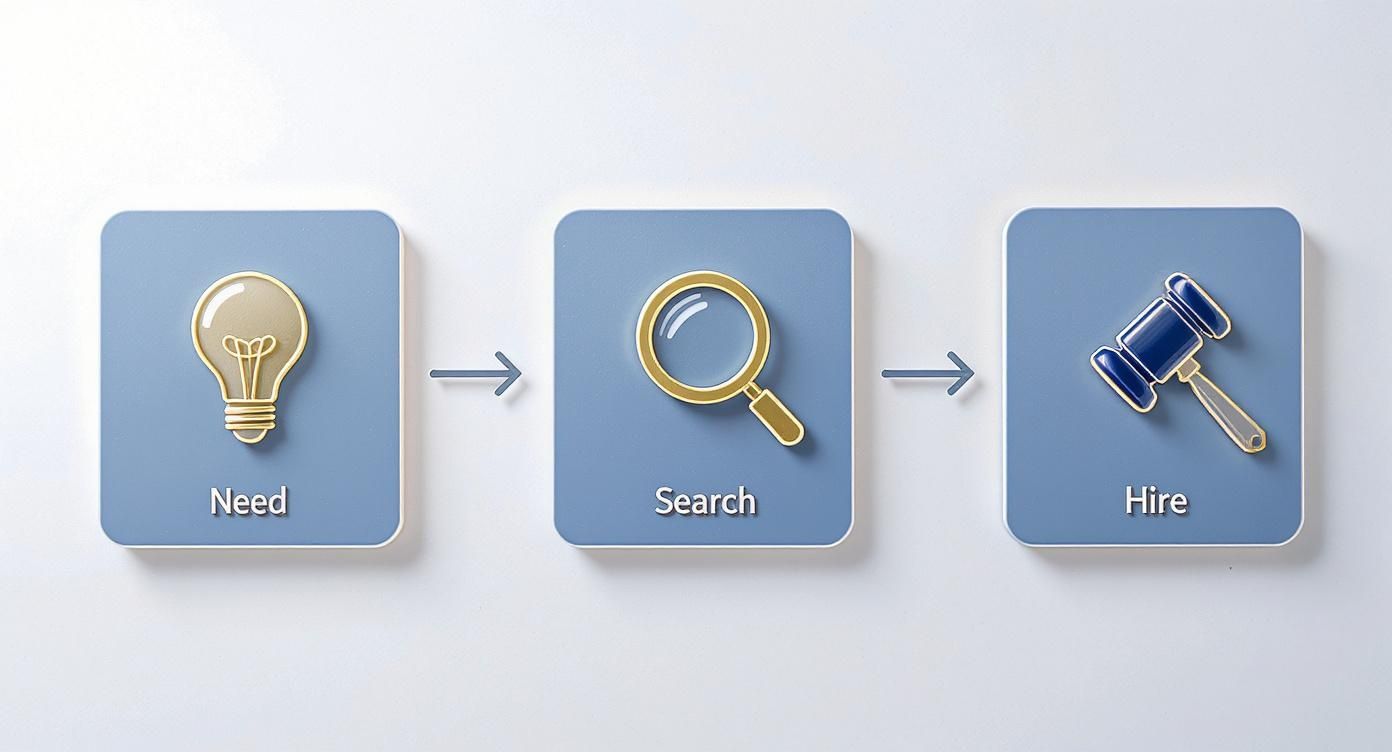
Your campaign’s success really hinges on intercepting clients at that exact moment they're looking for help.
Choosing the Right Campaign Type
Google throws a lot of options at you, but for most law firms, the choice boils down to two main players: Search and Performance Max (PMax).
A traditional Search campaign offers you maximum control. You pick the keywords, you write the ads, you set the bids. This is where every law firm should start. It lets you target people with high intent—the ones who are literally typing "lawyer near me" into the search bar.
On the other hand, Performance Max is a more automated, "black box" campaign that runs your ads across all of Google's properties, like YouTube, Display, and Gmail. While it can be powerful, it needs a lot of existing conversion data to learn and work effectively, and it gives you very little direct control. Think of it as a potential supplement to an already successful Search campaign, not a replacement for it.
Ultimately, a strong campaign structure is a core piece of your firm's entire growth strategy. To see how this fits into the bigger picture, you can check out our detailed law firm marketing plan template for more ideas.
Crafting Keywords and Ad Copy That Actually Converts
The entire success of your Google Ads campaign boils down to two things: the keywords you bid on and the ad copy that gets someone to click. Nail these, and you'll see a steady flow of qualified cases. Get them wrong, and you're just burning through your budget on clicks from people you can never actually help.
Your keyword strategy is the foundation. It’s how you tell Google precisely who should see your ads. The single biggest mistake I see law firms make is casting the net way too wide with broad match keywords like ‘lawyer’ or ‘attorney.’ This approach is a surefire way to pay for clicks from people looking for legal jobs, free advice, or even services you don't offer.
Instead, your entire focus needs to be on precision. By using more restrictive match types, you can make sure your ads only show up for searches that scream genuine client intent.
Mastering Keyword Match Types
Think of keyword match types as different levels of control over your ad visibility. Here’s a practical breakdown for a law firm:
- Broad Match:
divorce attorney(This is dangerous. It could trigger your ad for searches like “divorce attorney salary” or “how to become a divorce attorney”—clicks you definitely don’t want.) - Phrase Match:
"divorce attorney for men"(Now we're talking. Your ad shows for searches like “best divorce attorney for men in Dallas,” capturing relevant variations while filtering out the junk.) - Exact Match:
[family law consultation](This is your sniper rifle. It shows your ad only for identical searches, making it perfect for your highest-intent, bottom-of-the-funnel terms.)
I always recommend starting with a heavy focus on phrase and exact match keywords. It gives you immediate control over your ad spend and ensures you’re attracting people who are actively looking to hire a lawyer, not just browse.
Your goal isn't just to get clicks; it's to get the right clicks. Every keyword should be evaluated on its potential to deliver a client, not just traffic. This mindset shift is critical for running a profitable campaign.
Writing Ad Copy That Connects with Clients in Crisis
Once your keywords are dialed in, you face the next challenge: writing ad copy that resonates with someone in the middle of a stressful legal mess. They aren't just looking for a lawyer; they're looking for an expert who can offer a solution and some reassurance.
Generic, boring ad copy gets completely lost in the hyper-competitive legal market. To stand out, your ads must do three things in a split second:
- Mirror Their Problem: The headline must instantly confirm you solve their specific issue.
- Build Instant Trust: Show them why your firm is the right choice.
- Give a Clear Next Step: Tell them exactly what to do next.
Once you know your keywords, the next step is learning the art of writing ad copy that converts and pushes prospects to take action.
Examples of High-Performing Legal Ad Copy
Let's look at a weak ad versus a strong one for the keyword "car accident lawyer free consultation".
Weak Ad Example:
Headline: Dallas Law Firm – Attorneys at Law
Description: We handle all types of legal cases. Call our office today to learn more about our services. We have years of experience.
This ad is vague, lazy, and completely forgettable. It does nothing to connect with the searcher's urgent need.
Strong Ad Example:
Headline: Car Accident? No Fee Unless We Win | Dallas, TX
Description: Injured in a crash? Get a Free, No-Obligation Case Review. We've Recovered Millions for Clients. 24/7 Helpline Available. Call Us Now.
See the difference? This ad is powerful. It’s specific, empathetic, and action-oriented. It directly addresses the user's biggest pain point (the cost) and offers an immediate, risk-free solution.
Remember, your paid search efforts work hand-in-hand with your organic strategy. For more on that, check out these law firm SEO tips.
Fine-Tuning Your Targeting to Land High-Value Cases
Alright, once the clicks start rolling in, it's time to shift gears from casting a wide net to using a scalpel. This is the part where we get incredibly deliberate, refining your targeting to channel your budget toward the cases that truly matter. The goal isn't just more clicks; it's getting the right clicks.
This level of precision is non-negotiable in the legal field. Google Ads is still a heavyweight marketing channel for firms, but it’s also a battlefield. The average cost-per-click (CPC) in the legal space is a staggering $8.58, and pulling in a single lead costs an average of $131.63. When you’re paying that much, every dollar has to count. Smart targeting is what separates a profitable campaign from a money pit. You can learn more about these marketing costs and find other insights to keep your firm a step ahead.
Master Your Geographic Targeting
Simply targeting an entire city or metro area is a rookie move that burns cash. You need to think like your ideal client. Where do they live? Where do they work?
Google Ads lets you get much more granular than just blanketing a whole city.
Here are a few tactics I’ve seen work wonders:
- Zip Code Targeting: A family law practice could zero in on affluent suburban zip codes. Why? Because clients there often have more complex assets that need protecting during a divorce, leading to higher-value cases.
- Radius Targeting: Imagine you're a criminal defense lawyer. Targeting a tight radius around the county courthouse means your ad shows up for people who are literally right there, dealing with an urgent legal problem.
- Location Exclusions: This one is just as important. Tell Google where you don't want your ads to show. If you know certain areas consistently send low-quality or irrelevant leads, cut them out. It's a simple way to protect your budget for better opportunities.
This isn't just about drawing lines on a map; it's about making sure your message is seen by people who are not only in your service area but are also far more likely to become the clients you want.
Pro Tip: Try layering income demographics over your location targeting. For practice areas like estate planning or business law, targeting the top 10-20% of household incomes within specific zip codes can be an absolute game-changer.
Control Your Schedule to Maximize Intake
Running your ads 24/7 sounds like you're always open for business, but it's often a recipe for disaster. A call that comes in at 2 AM is usually a missed opportunity and a waste of your ad spend.
Your ads should only run when you have a team ready to answer the phone. This is where ad scheduling is your secret weapon.
Dig into your call tracking data. Find the patterns. When are the best calls coming in? For most firms I've worked with, the sweet spot is during normal business hours—think 9 AM to 5 PM, Monday through Friday. By running your ads only during these peak times, you ensure a real person is there to handle every single call, which dramatically increases your chances of converting that caller into a client.
Choosing the Right Bidding Strategy
Your bidding strategy is the engine of your campaign, dictating how Google spends your money. You're basically choosing between having your hands on the wheel or letting a very smart autopilot take over.
| Bidding Strategy | Best For | Key Advantage | Potential Downside |
|---|---|---|---|
| Manual CPC | New campaigns or those with very little conversion data. | Maximum Control: You dictate the absolute max you'll pay for any click. | It's a lot of work. You have to constantly monitor and adjust to stay competitive. |
| Maximize Conversions | Established campaigns with a steady stream of conversions. | Efficiency: You let Google's AI do the heavy lifting, adjusting bids to get you the most conversions possible. | You're giving up direct control and trusting the algorithm to get it right. |
My advice? If you're launching a new campaign, start with Manual CPC. It forces you to learn the ropes and get a real feel for your baseline costs. Once you have a solid history of at least 15-20 conversions a month, it's time to consider switching to an automated strategy like Maximize Conversions. It can seriously improve your campaign's efficiency and give you back valuable time.
Optimizing Landing Pages To Turn Clicks Into Clients

Getting a potential client to click your ad is a small victory, but it’s only half the battle. The real challenge—and where most law firms burn through their marketing budget—is what happens after the click.
Your landing page has one job: turn that expensive click into a tangible lead. A phone call, a form submission, a real person seeking your help.
A generic homepage just won’t cut it. Think about it: someone searches for a "DUI lawyer," clicks an ad promising immediate help, and lands on your homepage with a dozen different navigation options. They're confused, and they're gone.
A specialized landing page continues the conversation you started with your ad, building trust and guiding the visitor straight to the action you want them to take. Without an optimized page, you’re essentially paying to send high-intent prospects into a dead end.
The Anatomy Of A High-Converting Legal Landing Page
A truly effective landing page is focused, frictionless, and reassuring. It's not the place for distractions or links to your blog; it’s a purpose-built tool for conversion. Every single element has to work together to convince a person in a stressful situation that your firm is their best and only option.
Here are the non-negotiable components:
- A Compelling, Ad-Matching Headline: The first thing a visitor sees must mirror the promise of your ad. If your ad says, "Car Accident Lawyer – No Fee Unless We Win," your headline should say the exact same thing.
- A Prominent, Click-to-Call Phone Number: Your phone number needs to be impossible to miss, especially on a mobile device. Make it large, stick it to the top of the page, and ensure it’s clickable.
- A Simple, Frictionless Contact Form: Only ask for what you absolutely need. Name, phone, email, and a brief message box. Anything more is a barrier. A long, complicated form is a notorious conversion killer.
- Essential Trust Signals: Your landing page has to build credibility in seconds. This means showcasing bar association badges, five-star client reviews, notable case results, and professional attorney headshots.
These elements create a seamless journey from searcher to lead. You can find more detail on building these pages in our guide to website optimization for law firms.
To see how these elements make a real-world difference, let's look at the contrast between a poorly designed page and one built to convert.
Essential Elements of a High-Converting Legal Landing Page
| Feature | Poor Landing Page Example | Optimized Landing Page Example |
|---|---|---|
| Headline | "Welcome to Smith & Jones Law" | "Aggressive DUI Defense for [City] – Free Consultation" |
| Call-to-Action | "Contact Us" button buried at the bottom | Click-to-call phone number at the top; simple form "above the fold" |
| Contact Form | Asks for 10+ fields, including date of birth and address | Asks for only Name, Phone, Email, and a brief message |
| Trust Signals | Generic stock photos of a gavel or law books | Real attorney headshots, client testimonials, "As Seen On" logos |
| Content | Long paragraphs about the firm's history and philosophy | Bullet points highlighting benefits: "24/7 Availability," "No Fee Unless We Win" |
| Mobile Experience | Desktop site shrunk down, hard to read and navigate | Fully responsive design with large, tappable buttons and phone number |
The difference is stark. The optimized page speaks directly to the user's immediate need, removes all friction, and instantly builds confidence.
Building Unshakeable Trust in Seconds
When a potential client lands on your page, they're often anxious and deeply skeptical. You have just a few seconds to earn their trust before they hit the "back" button and click on your competitor's ad.
This is where social proof becomes your most powerful asset. Displaying testimonials from grateful clients or showcasing significant case results immediately validates your expertise. It reassures visitors that you can actually deliver on your promises.
Your landing page is your digital handshake. It needs to be firm, confident, and trustworthy. Every element, from your headline to your contact form, should make a potential client feel understood and certain in their decision to reach out.
Measuring What Truly Matters: ROI
It’s far too easy to get caught up in vanity metrics like clicks and impressions. While these numbers are part of the story, they don't pay the bills. The only metric that truly matters for a law firm is the return on investment (ROI) from signed cases.
This requires connecting your ad spend directly to your client intake process. By implementing robust call tracking and conversion tracking, you can see exactly which keywords, ads, and campaigns are generating not just leads, but profitable cases. That data is the key to making smart, informed decisions about where your budget goes.
True optimization comes from continuous experimentation. Dive into a practical guide to split testing landing pages to learn how to test different headlines, calls-to-action, and layouts. By relentlessly testing and measuring, you can turn your landing pages into highly efficient client-generating machines.
Answering Your Top Questions About Google Ads
Diving into the world of Google Ads can feel like a big leap, especially in the cutthroat legal market. It's totally normal to have questions about the budget, the time sink, and whether you'll actually see a return.
We hear the same questions from attorneys all the time. Let's clear things up so you can invest your firm's marketing dollars with confidence and avoid those costly rookie mistakes.
How Much Should We Really Budget for Google Ads?
There's no one-size-fits-all answer here. The right budget is a direct reflection of your practice area's competition and your city.
A personal injury firm trying to compete in a major metro like Los Angeles is playing in a different league. They might need $15,000 or more per month just to get noticed, with single clicks for prime keywords easily hitting $200 or more.
On the other hand, an estate planning lawyer in a smaller suburb could see fantastic results spending between $3,000 and $5,000 per month. The competition is just less intense, which brings the cost down.
A good way to find a starting point is to aim for at least 10 to 15 qualified clicks per day. Jump into Google's Keyword Planner and see what the average cost-per-click (CPC) is for your most important keywords in your target city. Multiply that CPC by 15, then multiply that daily number by 30. That gives you a realistic monthly budget for a test run. The name of the game is to start small, prove you're getting a positive ROI, and then hit the accelerator.
Should We Manage This In-House or Hire an Agency?
This really boils down to three things: expertise, time, and money. Running a Google Ads campaign that actually makes money is not a part-time job you can hand off to an office manager. It requires constant attention, deep data analysis, and non-stop tweaking.
If you happen to have a full-time marketing pro on your team who can dedicate at least 10 to 15 hours a week just to PPC, then sure, managing it in-house is a possibility.
But for the vast majority of law firms, partnering with a specialized legal marketing agency is the fastest path to a real return. These agencies live and breathe this stuff. They already know the competitive landscape, the bidding strategies that win high-value cases, and the tricky ethical advertising rules.
For more on those regulations, check out our guide on navigating ethical attorney advertising. Hiring pros lets you focus on what you do best: practicing law.
What Are the Biggest PPC Mistakes Lawyers Make?
The single biggest blunder is having a "set it and forget it" attitude. Google Ads isn't a crockpot—it's more like a stock market trading floor that demands daily attention. Beyond that, a few other common pitfalls consistently bleed law firm budgets dry.
Here are the worst offenders we see constantly:
- Sending Ad Traffic to the Homepage: This is a huge conversion killer. Someone who clicked your ad for a "DUI lawyer" needs to land on a page that talks only about DUI defense. Sending them to your general homepage that also mentions family law and estate planning is a recipe for a quick exit.
- Using Default Broad Match Keywords: This is like leaving the vault door open. Relying on broad match without careful management invites a ton of irrelevant searches—think "legal assistant jobs" or "free legal help"—that burn through your budget on clicks from people you can't actually help.
- Forgetting the Negative Keyword List: Your negative keyword list is your first line of defense against wasted ad spend. You have to actively tell Google not to show your ads for searches containing words like "pro bono," "free," "paralegal," and the names of your competitors.
- Not Tracking Conversions: This is the most expensive mistake of all. If you aren't tracking phone calls and form submissions, you're flying completely blind. You have no idea what's working and what's not, making it impossible to optimize your campaigns for profit.
A winning Google Ads campaign is the result of relentless, data-driven refinement. It’s about making hundreds of small, smart adjustments over time to systematically cut waste and maximize your flow of qualified cases.
How Long Does It Take to See Real Results?
Unlike the slow-burn of SEO, Google Ads can start sending traffic—and potential leads—almost immediately. It’s not unusual to see clicks and even phone calls within a few hours of launching a new campaign. That instant feedback is one of its biggest advantages.
But getting to a point where you have a consistent, predictable, and profitable stream of cases takes a bit more time.
Think of the first 90 days as a critical data-gathering phase. During this period, you’re collecting the performance data needed to make smart decisions. You’re refining keyword lists, testing different ad copy, adjusting bids, and figuring out the most profitable times of day to advertise.
While leads will certainly come in during this ramp-up period, you should expect a truly stable and profitable flow of cases to emerge within 3 to 6 months, assuming the campaign is being managed skillfully and actively.
At Case Quota, we specialize in building and managing high-performance Google Ads campaigns that deliver a predictable stream of high-value cases. If you're ready to stop guessing and start growing, learn more about our data-driven approach at https://casequota.com.