

Content marketing isn't just another line item in your budget anymore. For law firms, it's become the primary engine for finding and signing new clients. By creating genuinely helpful content, you can attract, educate, and earn the trust of potential clients long before they ever think about picking up the phone.
Why Your Firm Can No Longer Ignore Content Marketing

The old playbook of relying solely on referrals, billboards, and print ads is officially broken. The way people find and choose a lawyer has been completely upended by the internet.
Think about it. When someone is facing a messy divorce, needs to draft a will, or gets charged with a DUI, what’s the very first thing they do? They go to Google. They aren't just looking for a phone number—they're looking for answers, for reassurance, and for an expert who understands their situation.
This shift means your firm's website has to be more than a simple online business card. It needs to become your hardest-working rainmaker, constantly working to bring in and warm up potential clients.
The Modern Client Journey Starts Online
Let’s put ourselves in a potential client's shoes. A woman slips and falls in a local grocery store. She's in pain, confused, and worried about medical bills. Her first instinct is to type something like, "what should I do after a slip and fall in California" into her phone.
She's not ready to hire an attorney yet. She just wants information. If your firm’s blog post shows up with a clear, empathetic, and expert answer, you’ve just made the most important first impression possible.
That one piece of content can be the tipping point that turns a worried searcher into a qualified lead. It builds instant credibility and positions your firm as the obvious authority. The numbers back this up, with a staggering 75% of clients checking out two to five law firm websites before they decide who to call.
You can dive deeper into this in our guide to building a modern law firm marketing strategy.
Content Delivers Unmatched ROI
There’s a reason law firms are funneling serious money into their online presence. With 68% of firms dedicating over half their marketing budget to digital channels, getting a real return on that investment is non-negotiable.
Content marketing is what makes every other marketing dollar work harder. In fact, 65% of firms point to their website as their highest-ROI channel, delivering an incredible 526% return over three years.
The goal here is simple: transform your website from a static digital brochure into a dynamic, case-generating machine. It’s about being the helpful answer your future client is desperately searching for.
Of course, as your content starts bringing in more calls, you have to be ready to answer them. Missing that first call can mean losing the case, which is why many growing firms look into a professional answering service for law firms to make sure every lead is captured.
Before you write a single blog post or record a video, you have to lay the groundwork. Far too many firms jump straight to brainstorming topics without a real strategy, and that’s a surefire way to waste time and money.
Effective content marketing isn't about throwing things at the wall to see what sticks. It's about building a predictable, measurable system for attracting the exact clients you want. This foundational work is the difference between just making noise and building a machine that consistently generates new cases.
Define Your Ideal Client—Down to the Details
The single biggest mistake I see law firms make is casting too wide a net. A vague target like "we help personal injury clients" is practically useless in a crowded market. To create content that actually connects and converts, you have to get laser-focused.
Forget the broad strokes. Dig deep.
Instead of just "personal injury clients," what about something like this: "Construction workers injured on non-union job sites in Orange County."
See the difference? That level of detail changes everything. You suddenly know their specific fears (losing their job, paying medical bills), their burning questions ("can I sue my employer if I'm not in a union?"), and where they're looking for answers online.
When you're that specific, you can create content that speaks directly to their reality, making your firm the only logical choice. Our law firm marketing plan template is a great resource for helping you structure this process and build out your own client personas.
Set Goals That Actually Drive Business
"Get more website traffic" is not a business goal. It's a vanity metric. Your content goals have to be tied directly to real-world outcomes for your firm. The best way to do this is with SMART goals—Specific, Measurable, Achievable, Relevant, and Time-bound.
Here’s what that looks like in practice:
- Increase qualified probate consultations by 15% in the next six months.
- Generate 20 new leads per month for our family law practice from our downloadable divorce checklist.
- Rank on the first page of Google for "truck accident lawyer in San Diego" within nine months.
These are goals you can build a strategy around. They give your team a clear finish line and let you know, without a doubt, if what you're doing is working. Part of hitting these targets involves using the right tools, including specialized platforms for law firms that can help streamline how you manage new leads and client intake.
Identify Your Key Performance Indicators
With your goals set, you need to decide how you'll measure progress. These are your Key Performance Indicators, or KPIs. They are the hard numbers that connect your content efforts to the business goals you just defined.
Don't confuse activity with achievement. KPIs are about measuring outcomes, not just output. Tracking how many blog posts you publish is an activity metric; tracking how many qualified leads those posts generate is a performance indicator.
The online legal space is brutally competitive, but a smart, data-driven strategy always wins. Think about it: a staggering 96% of potential clients start their search for an attorney online. And according to recent studies, 91% of law firms that invest in content marketing report it consistently brings them qualified leads. The opportunity is massive if you approach it correctly.
Before diving in, it’s crucial to understand what success looks like and how you’ll track it.
Here’s a quick breakdown of how goals and KPIs connect:
Key Content Marketing Goals and KPIs for Law Firms
| Strategic Goal | Primary KPI | Example Measurement |
|---|---|---|
| Increase Brand Awareness | Organic Traffic & Keyword Rankings | "Track month-over-month growth in non-branded organic sessions and our ranking for 'estate planning attorney [city]'." |
| Generate Qualified Leads | Form Submissions & Consultation Calls | "Measure the number of completed 'Free Consultation' forms from blog posts related to our family law practice." |
| Establish Topical Authority | First-Page Rankings for Key Topics | "Count the number of articles ranking on page one for our primary practice area keywords." |
| Improve Client Conversion | Lead-to-Client Conversion Rate | "Calculate the percentage of web-generated leads that sign a retainer agreement." |
Ultimately, these numbers tell the story of whether your investment is paying off.
Analyze the Competitive Landscape
Finally, a solid foundation requires knowing who you're up against. You need a clear-eyed view of the competitive environment, which means looking at both your own assets and what your rivals are doing.
- Run a Content Audit: First, look inward. Go through every piece of content on your website—blogs, practice area pages, FAQs. Is it accurate? Is it optimized for search? Is it actually generating any traffic or leads? This audit shows you what to update, what to consolidate, and what to delete entirely.
- Do a Competitor Analysis: Next, identify the top 3-5 firms that consistently show up in search results for your most important keywords. Pick apart their content strategy. What topics are they covering that you aren't? Where are the gaps in their content? This analysis is a goldmine for finding opportunities to create something better and more helpful than what's already out there.
Finding the Topics and Keywords That Win Clients
Great content marketing for law firms all starts with one simple question: What are my potential clients actually searching for when they need help?
The secret is to get past the generic, high-volume keywords and zero in on the exact phrases people type into Google when they’re ready to hire an attorney. This is where the real cases are won.
Think about it. There's a massive difference between a vague search like "malpractice lawyer" and a high-intent, long-tail keyword like "statute of limitations for medical malpractice in California." The first is just browsing; the second is a cry for help. Your goal is to own the conversation around those urgent, specific problems.
This strategic approach is a cornerstone of effective SEO for law firms, because it connects your firm directly with people who are actively looking for legal services. Focusing on these detailed phrases attracts a much higher quality of traffic—people who are far closer to making a call.
Mapping Keywords to the Client Journey
People don't just wake up one morning and decide to hire a lawyer. It’s a process. They move through stages of awareness, consideration, and finally, a decision. Your keyword strategy needs to meet them at every single step.
-
Awareness Stage: The person knows they have a problem, but they might not have a name for it yet. Their searches are all about information. For a family law firm, this could look like "signs of an unhealthy marriage" or "how does child custody work in Texas?"
-
Consideration Stage: Now they understand the legal issue and are starting to weigh their options. Keywords get more specific. Think searches like "contested vs uncontested divorce cost" or "benefits of hiring a workers' compensation attorney."
-
Decision Stage: This is it—they're ready to hire someone. Their searches are transactional and often include a location, like "best criminal defense lawyer in San Diego for DUI" or "free consultation with an estate planning attorney near me."
By creating content for each stage, you build trust and guide a potential client from their initial panicked search right to your contact form.
The whole process hinges on a focused strategy—one built on truly understanding your audience, your firm's goals, and any gaps in your current content.
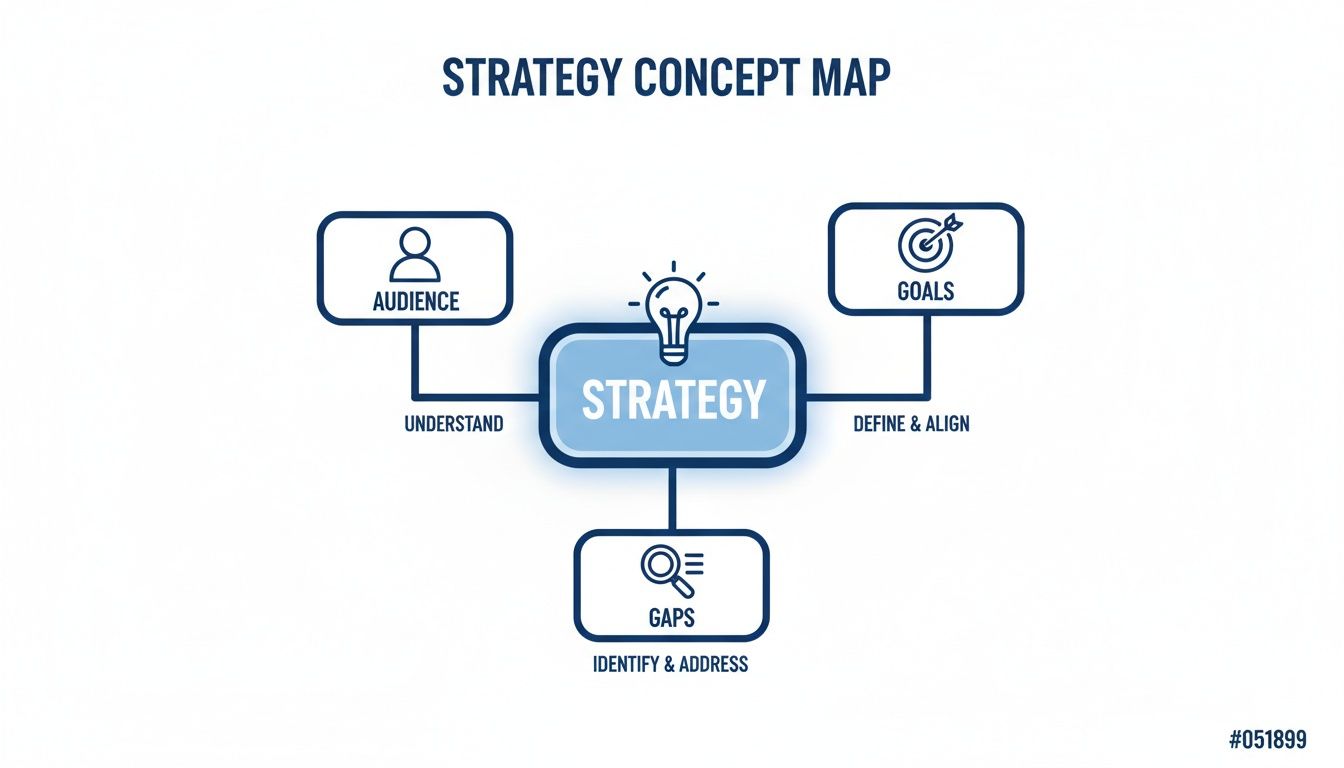
As you can see, finding the right topics isn't about guesswork. It’s a direct result of aligning what clients need with what your firm offers.
Uncovering High-Intent Legal Keywords
So, where do you find these golden long-tail keywords? It’s less about fancy software and more about putting yourself in your client's shoes.
Start by brainstorming every possible question a worried client might have. What are their biggest fears? What specific details would they type into Google at 2 a.m.?
Your firm’s receptionists and paralegals are an absolute goldmine for this. They hear the raw, unfiltered questions from potential clients every single day. Ask them to keep a running list of the exact phrases people use when they call.
You can also use a few free tools to get the ball rolling:
- Google Autocomplete: Just start typing a core phrase like "car accident lawyer" into the search bar and see what Google suggests. These are real searches from real people.
- "People Also Ask" Box: This little section in the search results is a cheat sheet of related questions. Answering them directly in your content is a huge SEO win.
- AnswerThePublic: This tool is fantastic for visualizing all the questions people have around a topic, breaking them down into who, what, where, when, and why.
Let’s say you’re a workers' compensation firm. The basic keyword is "workers comp lawyer." A much better, high-intent keyword you might find is "what to do if my workers comp claim is denied in Florida." A detailed article on that exact topic will attract leads who are ready to take action.
Building Topic Clusters to Dominate a Niche
Once you’ve got a solid list of keywords, the final piece of the puzzle is organizing them into topic clusters. This is how you show Google you’re an authority.
The idea is to create one major "pillar" page for a broad topic, then surround it with more detailed "cluster" articles that link back to it.
For example, a personal injury firm’s pillar page might be "The Ultimate Guide to Car Accident Claims in California."
That central hub would then link out to hyper-specific cluster posts like:
- How to Get a Police Report After a Crash in Los Angeles
- Dealing with Insurance Adjusters After an Accident
- Calculating Pain and Suffering Damages in a California Injury Claim
- What Is the Statute of Limitations for Car Accidents?
This structure signals to Google that you have deep expertise in that practice area. It establishes your firm as the undeniable go-to resource, helping you rank for dozens of related keywords and—most importantly—building incredible trust with potential clients.
Creating Content That Builds Trust and Authority

In the legal world, content has a much bigger job than just pulling in search traffic. It has to build rock-solid trust.
Think about it. A potential client is almost always in a vulnerable, stressful situation. The content they find on your website can be the one thing that convinces them your firm is the right one to help. This means every single piece you publish has to be engineered to prove your expertise, empathy, and authority from the very first sentence.
Effective content marketing for law firms is built on this foundation. You aren't just selling a service; you're offering a lifeline. Every blog post, practice area page, and video is a chance to show you are a credible, trustworthy advocate.
The Anatomy of High-Trust Legal Content
So, what does this content actually look like? It needs to be useful, crystal clear, and above all, reassuring. Let’s break down the essential types of content your firm should be producing right now.
-
The Problem-Solving Blog Post: This is your primary tool for building authority. The key is to focus on answering one specific, urgent question a potential client is wrestling with. A post titled “What Are the First Steps After a Commercial Truck Accident in Texas?” will always outperform a generic article. It should walk the reader through the immediate actions they need to take, calming their nerves while proving you know exactly what you're doing.
-
The High-Converting Local Landing Page: Your practice area pages have to do more than just list what you do. A powerful local page for a "Phoenix DUI Defense Attorney" needs localized content, testimonials from clients right there in Phoenix, and specific details about navigating the local court system. This shows you have real, on-the-ground experience—a massive trust signal for local clients.
-
The Empathetic Video: Nothing builds a personal connection faster than video. A simple, two-minute video of an attorney explaining a complex legal process in plain English can create a bond that text just can't match. You could even create a series of short videos answering common questions. For instance, exploring the different ways attorney marketing videos can connect with potential clients on a more human level is a great place to start.
Demonstrating E-A-T Is Non-Negotiable
Google's quality guidelines are laser-focused on Expertise, Authoritativeness, and Trustworthiness (E-A-T), especially for "Your Money or Your Life" topics like legal advice. This isn't optional. You have to bake E-A-T directly into your content.
Your content's primary job is to answer the client's unspoken question: "Can I trust you with my future?" Every element should work toward a resounding "yes."
Start with detailed, robust attorney bios. These shouldn't just be a dry list of credentials. Tell a story. Make sure to include bar admissions, notable (and ethically presented) case results, awards, and links to any published articles or speaking events. This is the hard evidence of your expertise.
Next, you need to strategically weave in client testimonials and case studies. As long as you follow your state bar's rules, showcasing positive outcomes and client satisfaction is the most powerful social proof you have. It turns your claims of success into tangible, relatable results.
Navigating Compliance and Accessibility
Building trust also means playing by the rules—both ethical and technical. Ignoring these can shatter the very trust you're trying to build and expose your firm to serious risk.
State Bar Advertising Rules
Make no mistake: every piece of content you publish is considered attorney advertising. It absolutely must comply with your state bar's regulations.
- Craft Airtight Disclaimers: Every page, especially blog posts, needs a clear disclaimer stating the content is for informational purposes only and doesn't create an attorney-client relationship.
- Avoid Guarantees at All Costs: Never, ever promise a specific outcome. Language like "we'll win your case" is an ethical landmine. Stick to phrases like "we'll fight for the best possible outcome."
- Handle Testimonials with Care: If you use testimonials, get written consent and ensure you aren't presenting them in a misleading way. Some states have very strict rules here, so know them inside and out.
Website Accessibility (ADA Compliance)
Trust also means making sure everyone can access your guidance. An ADA-compliant website isn't just a legal box to check; it's a powerful statement that your firm is here to serve every single member of the community.
This comes down to practical things like providing alt text for images, making sure your site can be navigated with a keyboard, and using proper color contrast. Making your content accessible to people with disabilities is an often-overlooked but incredibly potent trust signal. It shows your commitment to helping people is universal.
Distributing Your Content for Maximum Impact

Pouring your firm's expertise into an authoritative blog post or a helpful guide is a huge win. But here's the hard truth: if your ideal clients never see it, it doesn't exist.
Brilliant content gathering dust on your website won't generate a single case. You need a proactive, multi-channel distribution plan to turn that static asset into a dynamic tool that brings clients to your door. The goal is simple: put your best advice directly in the path of the people who are actively searching for it.
Your Foundation: Organic Channels for Long-Term Growth
Think of your own channels as your home turf. These are the platforms where you have total control, allowing you to build relationships and establish credibility over the long haul. Get these right first.
Search Engine Optimization (SEO) is the engine that drives everything. By now, every piece of content you've built should be tied to a specific, high-intent keyword. The organic traffic that flows from this is gold because it connects you with potential clients at the precise moment they need help.
An Email Newsletter is your direct line to people who have already raised their hand. Segment your lists so you're not sending personal injury articles to your estate planning contacts. If someone downloaded your will-drafting checklist, follow up with your latest blog on trusts—it's relevant, helpful, and keeps you top-of-mind.
Your content's journey doesn't end when it's published. Its true value is realized when it consistently reaches the right audience, answers their questions, and positions your firm as the indispensable expert. Distribution is how you make that happen.
Paid Channels: Accelerating Your Reach with Precision
While organic growth is the bedrock, paid distribution is the accelerator. It lets you jump the line and put your content in front of a hand-picked audience that might never have found you through a Google search.
The trick is matching the platform to the practice area.
A comparison of different content distribution channels can help illustrate where you should focus your budget and efforts.
Content Distribution Channels for Law Firms
| Channel | Best For Practice Areas | Key Benefit |
|---|---|---|
| LinkedIn Ads | Corporate Law, Employment Law, IP | Precision B2B targeting by job title, industry, and company size. |
| Facebook Ads | Family Law, Estate Planning, Personal Injury | Unmatched demographic and life-event targeting for B2C cases. |
| Google Ads | Most practice areas (especially PI, Criminal Defense) | Captures high-intent searchers at the exact moment of need. |
| YouTube Ads | Brand Awareness, Complex Topics | Visual storytelling to build trust and explain nuanced legal issues. |
| Local Services Ads | PI, Family Law, Immigration, Estate Planning | "Google Screened" trust signal; pay-per-lead model for local clients. |
Picking the right channel ensures your budget is spent reaching potential clients, not just random users.
- LinkedIn Ads for B2B Law: If you serve businesses, LinkedIn is a no-brainer. You can run a campaign promoting a whitepaper on "Navigating Non-Compete Agreements in California" and target it directly to C-suite executives and HR managers at tech companies in your state.
- Facebook Ads for B2C Law: For practices like family or personal injury law, Facebook’s targeting is incredibly powerful. A family lawyer can run ads for a guide on "Child Custody Basics" that only shows up for people in their county who recently changed their relationship status.
This isn't a niche strategy anymore. A staggering 71% of lawyers now report landing new clients directly through social media.
Don't Overlook Local Video
Video is the fastest way to humanize your firm and build genuine connection, especially on a local level. People hire lawyers they know, like, and trust.
Let's walk through a real-world example:
A criminal defense attorney in San Diego sees online chatter about upcoming DUI checkpoints. She pulls out her phone and records a quick, two-minute video: "3 Things to Know About San Diego DUI Checkpoints."
It’s not legal advice—just helpful, public-service information that shows she’s an authority on local issues. She can post that clip to Instagram Reels, YouTube Shorts, and her Google Business Profile. Just like that, she’s built trust and made her firm the first one people will think of when they, or someone they know, needs help.
Getting this right requires a plan. Our deep dive into social media for law firms provides a clear roadmap to make these efforts pay off.
Answering the Tough Questions About Legal Content Marketing
Even the most well-laid plans come with questions. When you're about to invest serious time and resources into content marketing, it’s only natural to wonder about the real-world practicalities. This isn't just another marketing expense; it's a long-term investment in your firm's growth.
So, let's cut right to it. Here are the most common concerns we hear from firms and the straightforward answers you need to move forward with your eyes wide open.
How Long Until We Actually See a Return on Investment?
This is the big one, and the answer isn't "overnight." Think of content marketing as building a library of digital assets, not running a quick ad campaign. While you might notice an initial bump in traffic within 3-6 months of consistent, high-quality publishing, the kind of meaningful lead generation you’re looking for typically starts to show up between the 6-12 month mark.
Of course, this timeline shifts based on a few key factors. Your practice area, the competitiveness of your market, and how aggressively you promote your content all play a role. A family law firm in a smaller city will likely see results faster than a personal injury firm fighting for space in downtown Los Angeles.
The real magic happens with consistency. Each well-crafted article becomes a resource that can generate leads for years, creating a powerful client acquisition channel that literally grows more valuable over time.
Sporadic posting just won’t build the authority or momentum you need to rank on search engines and earn a potential client's trust. A steady, strategic rhythm is what ultimately pays off.
What Are the Biggest Ethical Pitfalls to Avoid?
Legal marketing isn't the Wild West. It's strictly regulated by state bar associations, and claiming you didn't know the rules won't save you if you cross a line. The consequences are serious, so this is one area where you absolutely cannot afford to make a mistake.
Here are the most common traps we see firms fall into with their content:
- Guaranteeing Case Outcomes: Any language like "we will win your case" is a massive red flag and a clear ethical breach. Stick to phrases like "we will fight for the best possible outcome."
- Mishandling Client Testimonials: Different states have very different rules here. You have to get proper consent and be careful not to present testimonials in a way that could be seen as misleading.
- Forgetting Disclaimers: Every single piece of content needs a clear disclaimer. Whether it’s a blog post or a practice area page, you must state that the information is not legal advice and doesn't create an attorney-client relationship.
This is non-negotiable: an attorney at your firm must review every piece of content before it goes live to ensure it complies with your state bar’s specific advertising rules. It’s a critical step that protects your firm.
How Can Our Small Firm Compete with the Goliaths?
This is where being smaller is actually your biggest advantage. You can outmaneuver the big firms by being smarter, more focused, and more agile. The secret isn't a bigger budget; it's going deep instead of wide.
Forget about trying to rank for a broad, insanely competitive term like "personal injury lawyer." Instead, a smaller firm can absolutely dominate a long-tail, localized search term. For example, zero in on something like "business litigation attorney for partnership disputes in Irvine."
Then, you create the single best piece of content on the internet for that hyper-specific topic. Write the definitive guide to partnership disputes in Irvine that no large, generalist firm would ever invest the time to create. Go all-in on your Google Business Profile and local SEO to become the undisputed authority in your specific geographic area.
In legal content marketing, quality always, always beats quantity. One deeply insightful, client-focused article is worth more than five generic, cookie-cutter posts. By being smarter and more focused, you can become the go-to expert in your niche, attracting the exact clients you're best equipped to serve.
At Case Quota, we specialize in building these kinds of focused, results-driven content strategies for law firms. If you're ready to turn your firm's expertise into a consistent source of new cases, we can help. Learn more about our approach at https://casequota.com.