

B2B email marketing strategy for law firms: an integrated playbook to attract clients
Every law firm needs a practical roadmap to turn email into predictable new business. A strong B2B email marketing strategy will help your firm attract the right clients and move them through the funnel. In this guide you will learn how email works with social, influencers, and account based tactics to build a reliable revenue pipeline.
We focus on segmentation, automation, nurture tracks, and lifecycle staging. For example, welcome sequences onboard leads and nurture tracks guide prospects to evaluation. Moreover, mobile optimization and UTM tagging keep measurement tight and conversions high.
This article blends hands on templates with measurement best practices and vendor picks. Therefore, you will leave with a clear plan to set up welcome flows, lead scoring, re engagement campaigns, and pipeline acceleration. By the end you will feel confident launching a cross channel program that scales.
B2B email marketing strategy and segmentation
A B2B email marketing strategy centers on delivering relevant messages to the right decision makers. Therefore, it reduces friction and shortens sales cycles. For law firms, this means aligning content to client needs. Moreover, the goal is predictable pipeline and stronger client relationships.
Core segmentation types to use
- Demographic segmentation: firm size, role, and decision maker level. For example, target general counsel at mid market companies for corporate work. This helps tailor tone, pricing cues, and case studies.
- Behavioral segmentation: engagement, page visits, and content downloads. For example, if a prospect downloads a guide on employment law, send related emails. Consequently, you increase relevance and conversion.
- Firmographic segmentation: industry, revenue range, and geography. For law firms, focus on industries you serve. For example, prioritize tech startups or healthcare providers.
- Intent segmentation: search queries, content signals, and third party intent data. For example, a company researching M and A indicates late stage interest. Therefore, you can accelerate outreach.
Automation workflows that matter for law firms
Set up four automation workflows first. First, create a welcome and onboarding series to introduce partners and practice areas. Second, develop lead nurture tracks by persona and pain point. For example, one track for founders and another for compliance officers. Third, build product education and client expansion flows. Use them to upsell retained clients to additional services. Fourth, implement re engagement and win back sequences for inactive prospects.
How segmentation ties to workflows and channels
Map segments to workflows and to lifecycle stages. Early stage prospects get educational content and newsletters. Mid stage leads receive case studies and solution comparison materials. Late stage contacts receive vendor evaluation pieces and pricing conversations. As a result, you maintain relevance across the funnel. Also, integrate account based tactics and social touch points for higher conversion. For automation examples and templates see HubSpot.
Measurement and best practices
Use rigorous UTM tagging on every link for clean attribution. For example, utm_source=email&utm_medium=nurture&utm_campaign=q4_product_series&utm_content=email_3. Track email sourced and email influenced pipeline, MQL to SQL conversion rates, and revenue per campaign. Benchmarks and mobile guidance help set targets; see Mailchimp benchmarks at Salesforce guidance on best practices for mobile optimization and segmentation.
Finally, expect a mature program in six to twelve months. With ruthless segmentation, smart automation, and cross channel orchestration, law firms can scale predictable client acquisition. Related keywords include segmentation, automation, nurture tracks, lifecycle stages, and account based marketing.
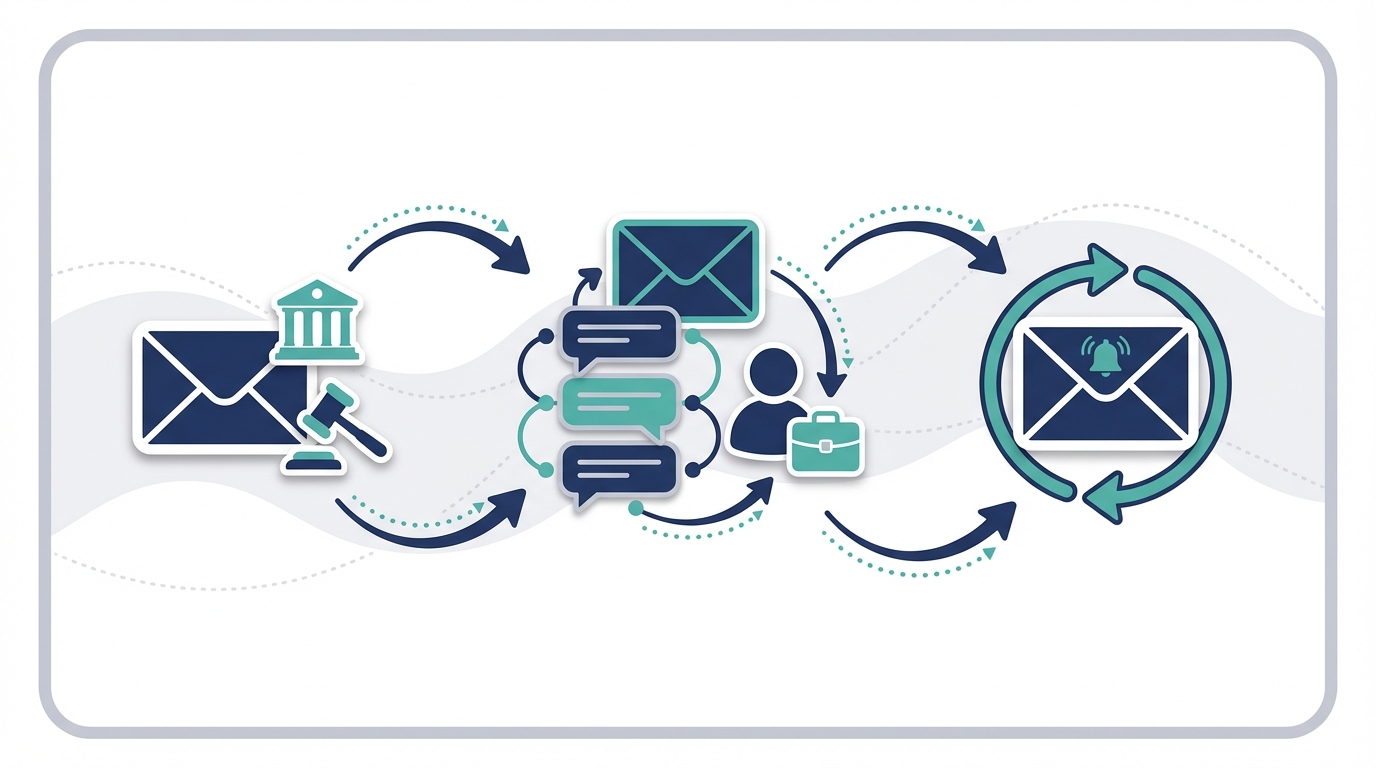
B2B email marketing strategy: best practices for law firms
Good email programs focus on relevance, timing, and measurement. Therefore, your law firm can win trust and generate predictable pipeline. Below are practical rules you can apply today.
Subject line strategies
- Keep subject lines under 50 characters. Short lines increase opens on mobile.
- Lead with value and specificity. For example, use “6 steps to faster M and A diligence” rather than vague promises.
- Use personalization beyond the first name. Mention industry or pain point when possible.
- Test wording and emoji use sparingly. However, only test if your sample size supports meaningful results.
Mobile optimization
- Design for single column layouts and large tap targets. Most B2B opens happen on mobile. As a result, small buttons reduce clicks.
- Use concise preheader text that complements the subject line. Preheaders boost the overall message clarity.
- Keep images small and use responsive HTML. Also, always include clear alt text for accessibility and deliverability.
Testing schedule and A/B testing
- Run daily or weekly A/B tests only when volume supports them. Otherwise, test monthly.
- Prioritize tests that impact conversion. Test subject lines, CTAs, and hero copy first.
- Rotate send time tests across Tue, Wednesday, and Thu between 10 a.m. and 2 p.m. These days usually perform best.
List hygiene and deliverability
- Remove hard bounces immediately and suppress repeat soft bounces. Clean lists improve sender reputation.
- Use double opt-in for critical flows to ensure quality contacts. Therefore, you reduce spam complaints.
- Segment by engagement and prune inactive contacts. For example, move inactive subscribers into a re-engagement stream.
Metrics to track: MQL, SQL, and ROI
- Track email sourced pipeline and email influenced pipeline separately. This gives cleaner attribution.
- Measure MQL to SQL conversion rates by campaign and by persona. Also, set benchmarks by practice area.
- Report revenue per campaign and calculate email ROI. Divide campaign revenue by total campaign cost for clarity.
- Use UTM parameters on every link for reliable analytics. For example, utm_source=email&utm_medium=nurture&utm_campaign=q4_product_series&utm_content=email_3.
Tools and reproducible templates
- Start with four automation workflows: welcome onboarding, persona nurture, product education, and re-engagement. These flows form your foundation.
- See practical automation examples and templates at HubSpot.
- Check benchmark performance and open rate norms at Mailchimp.
- For deliverability and design best practices, review Salesforce guidance.
Final checklist
- Ruthless segmentation and clear CTAs beat broad blasts.
- Test iteratively, measure revenue impact, and optimize for mobile.
- Expect a mature B2B email program in six to twelve months. With consistency, your firm will build a reliable stream of client leads.
B2B email marketing strategy: top tools comparison
Choose the right platform based on scale, budget, and integration needs. Below is a quick comparison of five leading tools.
| Tool | Pricing tiers | Standout features | Suitability for law firms |
|---|---|---|---|
| HubSpot Marketing Hub | Free, Starter, Professional, Enterprise | CRM native platform, deep automation, revenue attribution, ABM tools | Best for mid sized and large firms that need full CRM integration and reporting. It scales well, but costs more. |
| Mailchimp | Free, Essentials, Standard, Premium | Easy editor, templates, audience insights, simple automation | Good for small firms and newsletters. It is budget friendly, but has limited complex automation. |
| ActiveCampaign | Lite, Plus, Professional, Enterprise | Advanced automation, conditional workflows, CRM features, predictive sending | Strong choice for firms that want sophisticated nurture flows without HubSpot pricing. Also good for personalization. |
| Constant Contact | Email, Email Plus | Simple editor, event management, deliverability support | Useful for firms that run events and webinars. However, automation is basic compared with others. |
| Brevo (Sendinblue) | Free, Starter, Business, Enterprise | Affordable sending, transactional email, SMS, workflow editor | Best for budget conscious firms and transactional needs. Also good for multi channel messaging. |
Selection guidance
If you need pipeline attribution and close loop reporting choose HubSpot. However, if budget limits you choose Brevo or Mailchimp. For deep automation pick ActiveCampaign. Also consider integrations with your CRM and matter management software. Finally, run trials to test deliverability and ease of use.
Conclusion: why a B2B email marketing strategy wins for law firms
An integrated B2B email marketing strategy gives law firms predictable pipeline and higher conversion. It combines ruthless segmentation, targeted automation, and cross-channel orchestration to reach decision makers. Therefore, firms shorten sales cycles and improve client fit. As a result, marketing becomes measurable and revenue focused.
Law firms win when content aligns with client pain points and buying stage. Moreover, welcome series, persona nurture tracks, and re-engagement flows move prospects toward retained matters. Also, mobile optimization and tight UTM tagging keep measurement clean. Because of that, firms can prove email influenced pipeline and support firm growth targets.
Case Quota specializes in scaling law firm growth with Big Law-level marketing playbooks. They design ABM workflows, build nurture sequences, and integrate CRM reporting for clear attribution. Furthermore, they provide creative assets and influencer tactics tailored to legal audiences. As a result, smaller firms access enterprise caliber strategy and systems.
Expect a B2B email program to mature in six to twelve months. However, you will achieve early wins from welcome flows and targeted nurture tracks. Track MQL and SQL conversion rates, email sourced pipeline, and campaign ROI. Case Quota helps set benchmarks, build workflows, and report on revenue impact.
Ready to move from sporadic leads to predictable growth? Visit Case Quota to see examples and begin a tailored plan. Also contact their team to discuss a pilot program and timeline.
Frequently Asked Questions (FAQs)
How do law firms overcome low open and click rates?
Start with ruthless segmentation and relevant content. Segment by role, industry, and behavior. Use concise subject lines under 50 characters and strong preheaders. Personalize beyond the first name and mention the prospect’s industry or pain point. Test subject lines and send times, typically Tue, Wed, Thu between 10am and 2pm. Finally, optimize emails for mobile and keep CTAs clear and above the fold. Also run a re-engagement stream for inactive contacts.
What are the four segmentation types and which matters most for law firms?
The four core types are demographic, behavioral, firmographic, and intent. Demographic covers role and decision maker level. Behavioral uses engagement, downloads, and page views. Firmographic captures industry, firm size, and revenue band. Intent tracks content signals and buying intent. For law firms, firmographic and intent often deliver the fastest pipeline impact because they target the right accounts at the right time.
What quick wins and best practices should we prioritize?
Focus on welcome and onboarding flows first. Build persona-based nurture tracks next. Use UTM tagging on every link for clean attribution. Keep email cadence to two to four sends per month for prospects. Maintain list hygiene—remove hard bounces and prune inactive contacts. Measure MQL to SQL conversion and email-influenced pipeline. Iteratively A/B test subject lines, CTAs, and hero copy. Also include case study links and clear next steps in every email.
How do I choose between HubSpot, ActiveCampaign, Mailchimp, Constant Contact, and Brevo?
Choose HubSpot for CRM-native attribution and ABM needs. Pick ActiveCampaign for advanced automation without enterprise costs. Use Mailchimp for simple newsletters and small budgets. Consider Constant Contact if events and webinars drive leads. Opt for Brevo for affordable sending and transactional needs. Also test deliverability and CRM integration during trials before committing.
How can a small firm start building a B2B email marketing strategy?
Audit existing lists and remove duplicates and bounces. Define your ideal client profile and map buying stages. Create a 3 email welcome series and at least one persona nurture track. Implement basic lead scoring and UTM parameters. Track opens, CTR, MQLs, SQLs, and revenue influenced. Finally, iterate monthly and scale automation over six to twelve months. Outsource only if you need speed. A specialist partner reduces learning curves. Pilot projects often prove the model quickly.