

When you think of attorney marketing, what comes to mind? For many, it's the familiar face of a local lawyer on a TV commercial. This isn't just a cliché; it's a battle-tested strategy where law firms use television to connect with a huge audience, build a memorable brand, and, most importantly, sign new cases.
Especially for personal injury and criminal defense firms, TV advertising remains a dominant force. Why? Because it builds a powerful sense of authority and trust that a simple online ad often can't touch.
Why TV Is Still a Powerhouse for Law Firms
In a world obsessed with clicks, shares, and search rankings, it’s tempting to write off television as old news. But for law firms, TV isn't just surviving—it's thriving.
The unique power of television is its unmatched ability to build brand authority and widespread trust at scale. When a potential client sees you or your partners on their TV, it projects a level of success and credibility that a Google ad just can't replicate.
This psychological impact is a true game-changer. Seeing your firm's message during the local news or a primetime show creates a sense of familiarity. This isn't just another advertisement; it's you becoming a recognized, trusted expert in your community.
The Undeniable Reach and Influence
The sheer size of a television audience gives you a massive advantage. While digital marketing is great for targeting specific niches, TV advertising casts a wide, powerful net. This is absolutely critical in practice areas like personal injury, where your ideal client isn't actively searching for a lawyer until the moment disaster strikes.
A consistent TV presence makes sure your firm is the first one they think of when that unexpected need arises. It’s a proactive strategy that builds a solid foundation of awareness, a stark contrast to the reactive nature of paid search.
When a person is in a moment of crisis—a car accident, an arrest—they don't have time for extensive online research. They often turn to the name they already know and trust, and TV is incredibly effective at building that pre-existing trust.
Follow the Money: A Clear Trend in Legal Ad Spend
The numbers don't lie. The legal services advertising world has seen explosive growth, and TV is at the very center of it.
Just look at the recent data: legal service providers are pouring billions into TV spots, far outpacing many other major consumer industries. This isn't just a trend; it's a strategic shift indicating where the real ROI is.
Legal Ad Spend Growth vs Other Industries
| Industry Sector | Ad Spend (Recent Period) | Spend Growth (5-Year Trend) | Primary Medium |
|---|---|---|---|
| Legal Services | $2.5 Billion | +44% | Broadcast & Cable TV |
| Retail (General) | $18.2 Billion | +12% | Digital & TV |
| Automotive | $14.5 Billion | +8% | TV & Digital |
| Pharmaceuticals | $7.1 Billion | +15% | TV |
| QSR (Restaurants) | $5.8 Billion | +11% | TV & Digital |
This dramatic increase shows that competing firms are winning a ton of business through television. In 2023 alone, the number of legal TV ads hit a peak of more than 16.4 million spots.
Ignoring TV means you're basically letting your rivals own a powerful battleground for client acquisition.
While a smart marketing plan uses multiple channels—and you should definitely check out our guide on https://casequota.com/billboard-roi-what-every-socal-law-firm-must-know-before-signing-a-contract/ to see how offline methods compare—TV remains a foundational pillar for any firm aiming for market leadership. For a deeper look at specific strategies, this guide on TV advertising for attorneys offers some fantastic insights into winning clients with this powerful medium.
Developing Your TV Ad Strategy Before You Ever Hit Record
A powerful TV ad campaign doesn’t just happen. It’s not born in a studio with a camera and a clever script—it begins with a deliberate, rock-solid strategy. This is your blueprint for every single decision you’ll make, from the ad’s creative feel to where you spend your media dollars.
Rushing this stage is like building a house without a foundation. It’s a recipe for disaster.
The first move is to get specific. Forget vague ambitions like "getting more cases." A real strategy needs sharp, measurable objectives. What does a "win" actually look like for your firm?
Maybe the goal is to generate 50 qualified personal injury leads per month. Or perhaps it's to increase branded search traffic by 30% within the next two quarters. Getting this clarity from the jump guides your entire process and makes it possible to prove your ROI down the line.
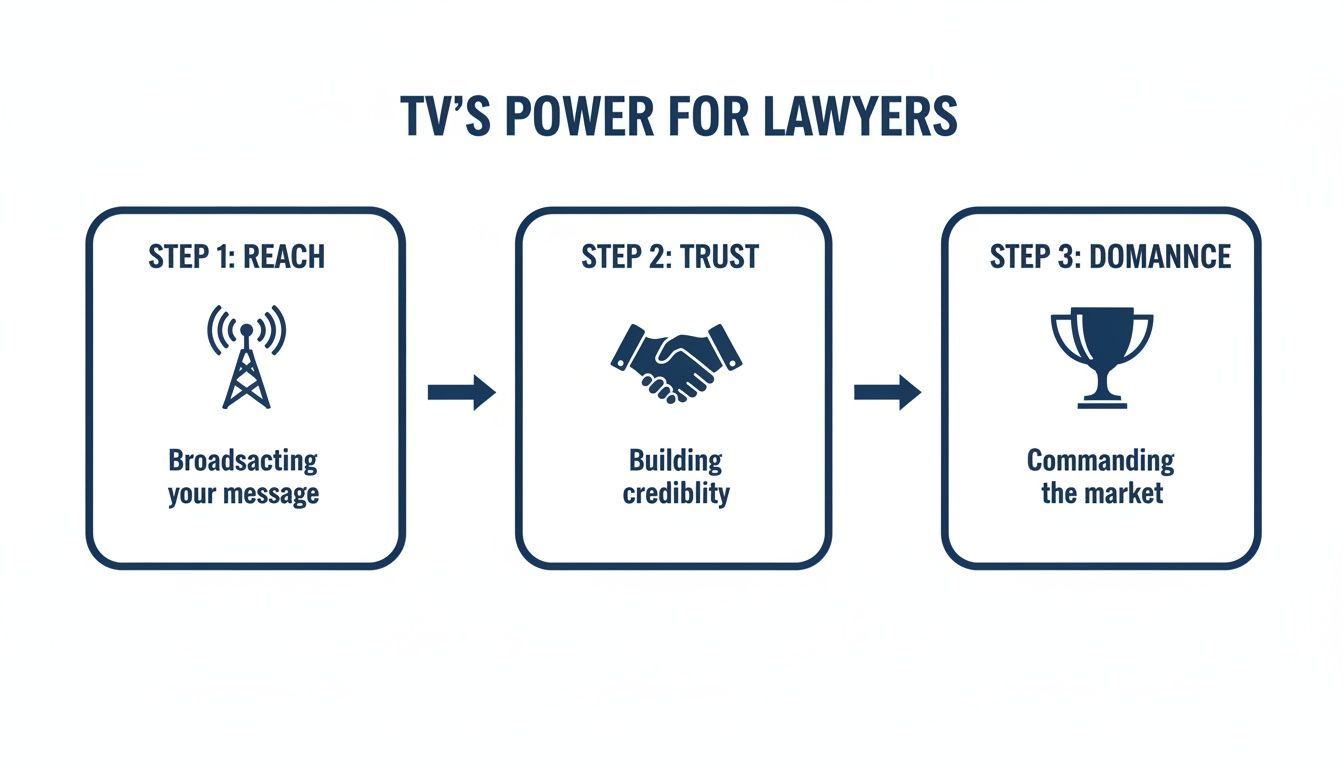
This process—moving from massive audience reach to building that crucial viewer trust—is precisely why TV is such a powerhouse for becoming the go-to firm in any market.
Who Are You Really Talking To?
The answer can't be "anyone who's been in an accident." That’s far too broad. To make an impact, you need to build out a detailed client persona, digging past simple demographics and into what makes them tick—their fears, their frustrations, and what truly motivates them.
Imagine you're a PI firm targeting car accident victims. Your ideal client isn't just "Jane Doe, age 45."
- Her Pain Points: She’s staring at a mountain of medical bills, stressed about missing work, and terrified about how she'll support her family. The insurance company is burying her in paperwork she doesn’t understand.
- Her Motivations: She wants justice, but more than that, she wants security. She’s looking for a compassionate expert who can take over the fight so she can focus on getting better.
- Her Media Habits: You can find her watching the local evening news to stay informed and tuning into morning talk shows as she gets her day started.
Knowing these details is a game-changer. It allows you to craft a message that speaks directly to her, making your commercial feel personal and relevant instead of just another ad screaming for attention. Building this persona is a vital part of any marketing effort; you can get more guidance in our law firm marketing plan template.
Before you can start laying out your strategy, you need to answer some fundamental questions. The table below breaks down the core components you need to define to ensure your campaign is built on solid ground.
Core Components of Your TV Ad Strategy
| Strategic Component | Key Questions to Answer | Example Goal/Metric |
|---|---|---|
| Primary Objective | What is the #1 thing we want this campaign to achieve? (e.g., leads, brand awareness) | Generate 200 qualified calls per quarter. |
| Target Audience | Who is our ideal client? What are their pain points, habits, and motivations? | Working mothers aged 35-55 injured in auto accidents. |
| Unique Selling Prop. | Why should a client choose us over the competition? What makes us different? | We are the only local firm with 2 board-certified trial attorneys. |
| Brand Tone & Voice | How do we want to sound? (e.g., empathetic, aggressive, authoritative) | Empathetic and reassuring, not aggressive. |
| Call to Action (CTA) | What specific action do we want viewers to take after seeing the ad? | Call our 24/7 hotline for a free, no-obligation consultation. |
| Key Performance Ind. | How will we measure success and calculate ROI? | Cost per signed case under $4,000. |
With these answers in hand, you'll have a clear roadmap that will inform everything from the script to the media buy, preventing costly mistakes and guesswork.
Scout the Competition
You can't stand out if you don't know what you're up against. Take the time to actually watch your competitors' commercials. What are they saying? Who are they targeting? What feeling do they leave you with?
Jot down notes on their tone. Are they coming across as aggressive bulldogs ("We'll fight for every penny!") or are they leaning into empathy ("We understand what you're going through.")? Pinpoint their core message. This analysis will quickly show you where the gaps are—and where your firm can slide in with something fresh and different.
Your goal isn't to copy the biggest spender in your market. It's to find a unique angle that makes your firm the obvious, better choice for the exact client you want to attract.
Make no mistake, the competition is fierce. Television is still the undisputed king of legal advertising. Between 2017 and 2024, an estimated 83% of all TV ad dollars in the legal space went to local spot television. In the top 75 markets alone, about 2,000 lawyers spend nearly $200 million on TV ads, with battleground cities like Tampa and Orlando seeing some of the most intense saturation.
Set a Budget That Matches Your Ambition
Your budget is what dictates the entire scope of your campaign. And it's not just about the one-time cost of shooting the commercial. The real investment—the much larger, ongoing expense—is the media buy.
A smart budget is tied directly back to your objectives. If you're aiming for aggressive market penetration, your spending needs to reflect that reality. Your budget should be broken down to cover a few key areas:
- Production Costs: This is everything from scriptwriting and filming to editing, music, and hiring any on-screen or voiceover talent.
- Media Buys: The actual cost of running your ads on specific channels at specific times of the day. This will be your biggest line item.
- Tracking & Attribution: Don't forget the tools needed to measure what's working, like call tracking numbers and web analytics software.
- Contingency Fund: Always build in a buffer. You might find an opportunity to increase your ad frequency during a key week, or you might run into an unexpected post-production cost.
This level of planning ensures your investment is positioned for maximum impact. For a deeper look into the nitty-gritty of budgeting and ROI for video, check out this guide on Mastering Corporate Video Production Strategies.
Creating a Legal Commercial That Actually Connects

This is where the rubber meets the road—turning your carefully planned strategy into a commercial that people actually remember.
A great legal commercial doesn't just list your services; it has to forge a real connection in 30 seconds or less. Forget the old-school approach of a stiff-looking lawyer sitting behind a massive desk. The ads that cut through the noise today tell a story.
Instead of leading with aggression, you need to zero in on the client's problem and frame your firm as the clear solution. This means shifting the spotlight from your accolades to their anxieties. An ad that builds an emotional connection will always outperform one that just shouts a phone number. This principle is true for all video marketing, not just TV. You can see how this applies across other platforms in our guide to producing effective attorney marketing videos.
Scripting for Connection, Not Just Conversion
The script is the soul of your commercial. Its job is to resonate with your ideal client on a personal level. From what I've seen, the most powerful scripts follow a simple but effective structure: problem, empathy, solution, and action.
First, you present a relatable problem—a car wreck, an injury at work, a family in crisis. Then, you show genuine empathy for their situation. This is where trust is built. Only then do you introduce your firm as the calm, competent answer to their chaos.
A huge mistake I see all the time in attorney TV ads is talking at the audience instead of to them. Your script should feel like a conversation that starts with, "We understand what you're going through," not "Here's why we're the best."
Finally, every script needs a crystal-clear call-to-action (CTA). This isn't just about flashing your number on the screen. It's about telling the viewer exactly what to do next and why they should do it now. A strong CTA removes hesitation and offers reassurance.
- Weak CTA: "Call us today."
- Strong CTA: "Call now for a free, confidential case review. Our team is standing by 24/7."
Deciding Who Goes on Screen
One of the biggest creative calls you'll make is whether to feature the firm’s actual attorneys or hire professional actors. There's no single right answer; it really depends on your firm's brand and the message you want to send.
Using your own attorneys can build incredible authenticity. When a potential client sees the actual lawyer they might work with, it creates an immediate sense of trust. But let's be honest—not every great lawyer is a great on-camera performer. A stiff or unconvincing delivery can kill your ad's credibility on the spot.
Professional actors, on the other hand, guarantee a polished performance. They're experts at conveying emotion and delivering lines in a way that feels natural, which can seriously elevate the ad's production value. The trick is to direct them in a way that doesn't feel generic or like a stock commercial.
| On-Screen Talent | Pros | Cons |
|---|---|---|
| Firm Attorneys | Builds authenticity and trust. Creates a direct, personal connection. | Can appear stiff or unnatural if not comfortable on camera. Requires time away from casework. |
| Professional Actors | Guarantees a polished, professional delivery. Skilled at conveying specific emotions. | Lacks the authenticity of using real attorneys. Can feel less personal if not directed well. |
Navigating Compliance and Disclaimers
This is the most critical, non-negotiable part of the process. Every state bar has strict, and often confusing, rules for lawyer advertising. Ignoring them can land you in serious hot water.
Before you even think about filming, you must get familiar with your jurisdiction's specific regulations.
Common things to watch for include:
- Guarantees and Promises: You can never, ever guarantee a specific outcome or settlement amount.
- Unverifiable Claims: Avoid superlatives like "the best lawyer" or "the most aggressive firm" unless you can objectively prove them.
- Client Testimonials: Many states have specific rules about using past clients, often requiring disclaimers that results aren't typical.
- Dramatizations: If you use actors to portray clients or re-enact events, you have to clearly state that it is a "dramatization."
Always include the necessary disclaimers, like "Results are not guaranteed" or "This is an advertisement." It's tempting to make them tiny and flash them quickly, but make sure they're legible and meet all legal requirements.
The best practice is simple: have your final script and a rough cut of the ad reviewed by legal counsel specializing in advertising ethics. This one step can save you from a world of hurt. The competition in this space is intense; one analysis showed that between 2008 and 2015, lawyer spending on TV ads grew six times faster than all other television advertising categories.
Mastering Your Media Buy Across All Platforms
Having a powerful commercial is one thing. Making sure the right people see it is another game entirely. If your ad runs at 2 AM on a channel your ideal clients never watch, you've just wasted your investment.
This is where the "media buy"—the strategic process of purchasing ad time—becomes the most critical part of your campaign. It can feel like a complex world, but understanding where to place your bets is the first step in making your budget work for you.
Your three main arenas for attorney TV advertising are local broadcast, cable, and the fast-growing world of streaming (often called OTT/CTV). Each one has its own strengths, and the smartest campaigns don't just pick one. The real power comes from creating an integrated mix that puts your firm in front of potential clients wherever they’re watching.
Local Broadcast: The Community Megaphone
Think of your local NBC, ABC, or CBS affiliates. These are the heavyweights. When you want to blanket your entire market (your DMA, or "designated market area") and build massive name recognition, nothing beats local broadcast.
Their primetime shows and, more importantly, the local news, attract a broad and often older demographic that still has a deep trust in traditional television. For a personal injury firm, running an ad during the 6 PM news is a classic, effective move. You're catching an audience that's already tuned in to local events, including the latest traffic and accident reports.
This is brand-building at scale. But that massive reach comes with a hefty price tag. Broadcast spots are typically the most expensive, and you’re paying to reach everyone in the market, not just the people who actually need your services.
Cable Channels: Precision Targeting
Cable TV gives you a much sharper tool. Channels like ESPN, HGTV, or CNN attract viewers with very specific interests, letting you align your message with the shows your ideal clients are already passionate about.
Does your firm handle business litigation? Advertising on a financial news network is a no-brainer. If you’re a family law attorney, running ads on channels with daytime programming geared toward parents could be a goldmine. This kind of precision cuts down on wasted ad spend and makes your message hit that much harder.
The trade-off? Individual cable channels have smaller audiences than the big broadcast networks. To get real reach, you'll need to buy spots across a portfolio of several different channels, which takes careful planning and negotiation.
The key is to think beyond just demographics and get into psychographics. What are your ideal clients' hobbies and interests? Their viewing habits will tell you exactly where your ad needs to be.
OTT and CTV: The Digital Frontier
"Over-the-Top" (OTT) and "Connected TV" (CTV) are just industry terms for streaming. Think Hulu, Roku, Peacock, and other services that deliver content over the internet. This is where TV advertising gets really interesting, blending the big-screen impact of a traditional commercial with the pinpoint targeting of digital marketing.
With streaming, you can target households based on an incredible amount of data:
- Geographic Location: Zero in on specific zip codes or even neighborhoods.
- Demographics: Filter by age, income level, and family size.
- Online Behaviors: Reach people who have recently searched for legal terms or visited a competitor's website.
This level of precision is something traditional TV could only dream of. You can ensure your ad for a high-net-worth estate planning practice is only shown in affluent suburbs, for example. While this digital-style targeting is incredibly powerful, it's a different world from traditional media buys. Our guide on Facebook advertising for attorneys offers some great insights into data-driven audience targeting that apply here, too.
Understanding the Language of Media Buying
To get the best deal, you have to speak the language. Media buyers use a few key terms to measure and plan every campaign.
- Dayparts: This is simply how the broadcast day is broken up. "Primetime" (roughly 8-11 PM) is the most expensive slot, while "Overnight" is the cheapest. Choosing the right daypart is essential for reaching your audience without blowing your budget.
- Gross Rating Points (GRPs): This is the currency of TV advertising. It’s a measure of an ad's total impact, calculated by multiplying the audience reach by the ad's frequency. Buyers use GRPs to figure out how much "weight" a campaign needs to achieve its goals.
- Cost Per Point (CPP): This is the price of buying one GRP. It's the standard metric for comparing the cost-efficiency of different channels or shows.
And don't be afraid to push back during negotiations. Always ask for "bonus spots" (free commercials) or "make-goods" if a program under-delivers on its promised ratings. A skilled media buyer can often squeeze 10-20% more value out of the initial offer. Your goal is to maximize your firm's presence and ensure every single dollar is working to bring in that next call.
Measuring the ROI of Your TV Commercials

Let's be blunt: running a TV ad without a bulletproof way to measure its impact is just burning cash. You're spending a significant chunk of your marketing budget, but can you actually prove it's bringing in valuable cases?
The old-school method of simply asking "How did you hear about us?" during intake just doesn't cut it anymore. It’s unreliable and won’t give you the hard data you need to justify the spend.
To get a real handle on your return on investment, you need a system. A system that connects the dots from the moment a viewer sees your commercial to the moment your firm signs a new client. This is about moving past guesswork and into direct, measurable attribution.
The goal is to build a model where TV creates the spark of awareness, and your digital channels are there to capture and convert that interest into real, signed cases.
Setting Up Your Tracking Infrastructure
Before a single commercial airs, your tracking tools have to be in place. Don't skip this step. The smartest approach is to create unique contact points that are used exclusively for your TV campaign. This isolates the traffic from the ad, giving you clean, undeniable data to work with.
Think of these tools as your first and best evidence in proving ROI.
- Dedicated Call-Tracking Numbers: Get a unique phone number that appears only on your TV spots. Services like CallRail or WhatConverts make this easy. The number forwards to your main office line, but now you can track every single call generated from your ad spend, log call durations, and even record calls for quality control.
- Memorable Vanity URLs: Don't send viewers to your complicated main homepage URL. Instead, create a simple, easy-to-remember domain like
[YourCity]CaseHelp.com. This vanity URL should redirect to a specific landing page on your site, giving you a crystal-clear signal that anyone who landed there came from your TV commercial. - Unique SMS Keywords: A great way to get potential clients to act is with a text message call-to-action. Prompting viewers to text a simple keyword (like "FIGHT" or "CASE") to a short code is a low-friction way for them to connect. It also gives you another perfectly trackable lead source tied directly to your TV campaign.
By setting up these separate channels, you create clear pathways. There's no more ambiguity—you can attribute new leads and signed cases directly back to your attorney TV advertising budget.
Analyzing Your Digital Footprint
TV advertising creates a powerful "halo effect" that lights up your digital channels. A viewer might not call the second your ad ends, but they will absolutely grab their phone and search for your firm. If you aren't monitoring these digital signals, you're missing a huge piece of the puzzle.
Your most valuable tool here is your website's analytics platform, most likely Google Analytics. You need to get very familiar with your direct traffic metrics. You should see obvious spikes in visitors who type your firm’s URL directly into their browser within minutes of your commercial airing. Cross-reference the timestamps of these traffic surges with your media buy schedule, and the connection becomes undeniable.
A sudden 200% increase in direct website traffic at 6:15 PM, right after your ad ran during the local news, is not a coincidence. It's direct proof that your commercial is driving action.
Another critical metric is your branded search volume. This is just a fancy term for how many people are searching Google for your firm’s name. A successful TV campaign will cause a significant lift here. Tools like Google Search Console will track this for you, showing a clear upward trend as more and more people recognize your brand from TV.
Ultimately, tracking ROI isn't about one single metric. It's a multi-faceted approach. To dig deeper into this, our guide on measuring advertising effectiveness offers more strategies to help your firm make truly data-driven decisions.
Your Attorney TV Advertising Questions Answered
Putting your firm on television can feel like a huge step, especially with a significant chunk of your marketing budget on the line. It's completely normal to have questions. We hear them all the time.
Here are some straight-up, no-fluff answers to the most common concerns we get from law firms, designed to give you the clarity you need to move forward.
How Much Does a TV Ad for a Law Firm Actually Cost?
There's no easy answer here, because the cost is really split into two different buckets: making the ad, and then paying to air it.
First, you have production. A professionally produced 30-second commercial can run anywhere from $5,000 to over $25,000. That price covers the whole nine yards—scripting, shooting, finding talent, editing, the works. If you're envisioning complex scenes or special effects, you'll naturally be on the higher end of that scale.
The second, and usually bigger, piece is the media buy. This is the ongoing cost to get your ad on the air, and it's where the budget can really expand. A targeted local cable campaign might start around $10,000 per month. But if you're aiming to dominate broadcast channels during primetime in a major city, you could easily be looking at $100,000 a month or more. Your final spend really boils down to your market, the channels you pick, and the time slots you need to own.
How Long Until I See Results from a TV Ad Campaign?
This isn't like flipping a switch on a Google Ad. TV advertising is a long game—it's about building momentum, not just getting a few clicks today. You’ll probably see a little bump in calls and website visits in the first couple of weeks, but the real magic of TV happens over time.
Think of your TV campaign as a long-term investment in your firm's brand. The goal is for your name to be the first one that pops into someone's head when they need legal help. That kind of top-of-mind awareness doesn't happen overnight.
For most firms we work with, it takes a solid three to six months of consistent airtime for that brand recognition to really sink in with the public. That's when you start seeing a more predictable, steady flow of high-quality cases. The biggest mistake you can make is getting impatient and pulling the plug too early. Consistency is everything here.
What Are the Biggest Compliance Mistakes to Avoid?
Ignoring your state bar's advertising rules is the fastest way to get into hot water. The consequences are no joke, so you have to get this right from the start.
We see a few common tripwires all the time:
- Making unprovable claims: You can't just call yourself "the best lawyer" or "the top firm" unless you have some objective, verifiable proof to back it up.
- Guaranteeing outcomes: Never, ever promise a specific result or settlement amount. That's a huge red flag in virtually every state.
- Using actors without a disclaimer: If you use an actor to play a client in a testimonial or scene, you must have a clear disclaimer on screen, like "Dramatization. Not an actual client."
- Forgetting required notices: Many states mandate that you include specific text, such as "This is an advertisement," and ensure it's easy to read.
Before that ad goes anywhere, have your legal counsel—someone who specializes in your state's advertising ethics—give the final cut a thorough review. It's a small upfront cost that can save you a world of trouble.
Can I Actually Target My Ideal Clients with TV Ads?
Absolutely. The old idea of TV being a "spray and pray" medium is long gone. Modern TV advertising gives you some surprisingly sharp tools to zero in on the exact people you want to reach.
Even with traditional broadcast and cable TV, you can be highly strategic. For instance, a personal injury firm knows that the local evening news audience skews older and is often more concerned with community safety—a perfect demographic fit. That's smart, effective targeting.
But streaming TV (often called OTT/CTV) takes it to a whole new level. It brings the precision of digital marketing to the big screen in the living room. You can target specific households based on a ton of data, including:
- Household income brackets
- Specific zip codes
- Recent online searches (like for legal keywords)
- Lifestyle habits and interests
This blend of TV's massive impact with laser-focused data makes attorney TV advertising an incredibly powerful way to get in front of the exact clients your firm needs.
Ready to build a marketing strategy that brings in high-value cases? Case Quota has over 15 years of experience helping law firms dominate their markets. We create marketing solutions that drive real growth, from SEO and web design to targeted video advertising.